
Why Clay Soil Makes Drainage a Serious Problem for Massachusetts Homeowners
The best drainage system for clay soil depends on your property’s slope, the severity of waterlogging, and how close the problem is to your problem to your foundation — but here’s a quick overview of the top solutions:
| Drainage Solution | Best For | Complexity |
|---|---|---|
| French drain (fabric-wrapped) | Soggy lawns, garden beds | Moderate |
| Surface regrading | Water pooling near foundation | Low–Moderate |
| Catch basins | Heavy runoff, downspout overflow | Moderate |
| Dry well | Isolated low spots | Moderate |
| Sump pump system | Severe, flat yards with no outlet | High |
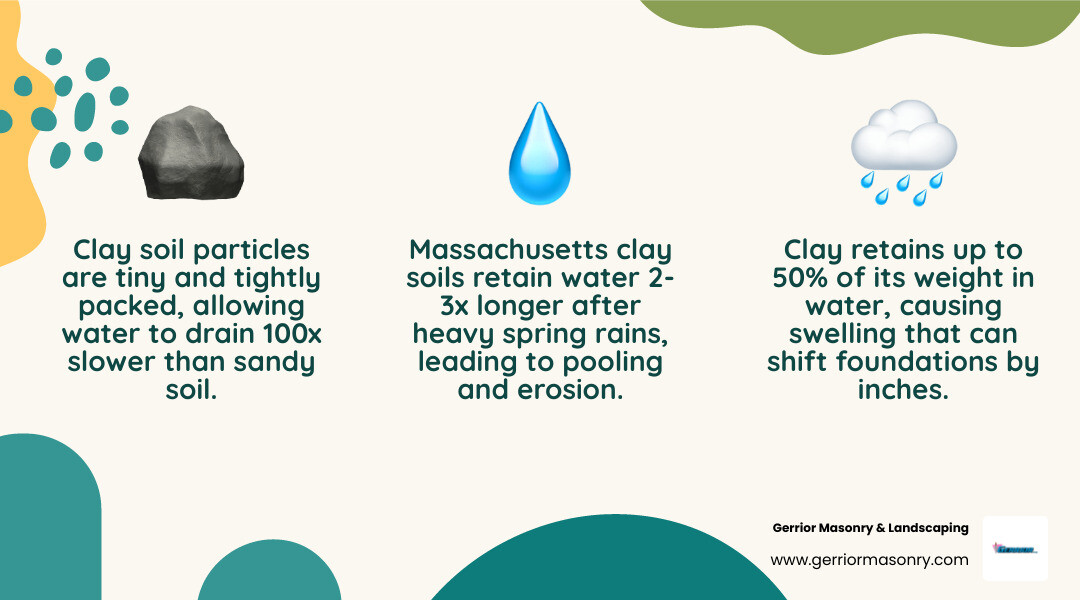
Clay soil is one of the most frustrating challenges a homeowner can face. Its tightly packed particles leave almost no room for water to pass through — so instead of soaking in, rainwater just sits there. That standing water isn’t just an eyesore. It stresses plants, attracts mosquitoes, and — most seriously — it can cause your foundation to shift as the soil swells and contracts with moisture changes.
In Massachusetts, where clay-heavy soils are common and spring rains are relentless, poor drainage can go from a minor annoyance to a major structural problem faster than you’d think.
I’m Joe Gerrior, owner of Gerrior Masonry & Landscape Construction, and over my 34+ years working on residential and commercial properties across Massachusetts, I’ve designed and installed drainage systems specifically engineered for the best drainage system for clay soil conditions our region demands. In the sections below, I’ll walk you through everything you need to know to solve your clay soil drainage problems — for good.
Basic best drainage system for clay soil glossary:
Implementing the Best Drainage System for Clay Soil
When we tackle a property in Woburn or Lexington that feels more like a swamp than a yard, we start by looking at how the water moves — or, more accurately, how it doesn’t move. Clay soil is uniquely difficult because it buffers water slowly and cannot pass it down into the deeper earth quickly. This leads to pooling water in your yard, which can eventually find its way into your basement or cause efflorescence (that white, powdery salt) on your foundation walls.
The first step in implementing the best drainage system for clay soil is choosing the right tool for the job. While a dry well might work for a small, isolated low spot, a heavy clay yard usually requires a more comprehensive approach.
Why Non-Woven Geotextile and Gravel Matter
In clay soil, the “enemy” isn’t just the water; it’s the clay particles themselves. These tiny particles are so fine that they can migrate into your drainage pipes and gravel, essentially “sealing” the system shut over time. This is why we always use non-woven geotextile filter fabric. Unlike woven fabric (which is like a tarp), non-woven fabric is made by bonding fibers with heat or chemicals, creating a material that lets water through but keeps those pesky clay particles out.
For the drainage medium, we recommend coarse gravel. In clay applications, a 5cm (2-inch) gravel bed under the pipe and a 10cm (4-inch) cover are standard. This ensures the pipe is protected and has plenty of “void space” to collect water.
Designing a French Drain: The Best Drainage System for Clay Soil
If you ask most experts, they’ll tell you that a properly installed French drain is the best drainage system for clay soil. However, “properly installed” is the keyword. In clay, a standard French drain can fail if it isn’t designed to handle the slow infiltration rates.
Here is how we design and install garden drainage for maximum efficiency:
- The 1% Rule: Water doesn’t like to move uphill, and in clay, it barely likes to move at all. We ensure a minimum slope of 1% (that’s a 1-inch drop for every 10 feet of pipe). For longer runs, such as a 60-foot line, you’re looking at a 10.5-inch total drop.
- Spacing is Key: In heavy clay, drain pipes should be installed about 10 feet apart. Closer spacing is even more effective because it reduces the distance water has to travel through the stubborn clay to reach the drain.
- PVC Over Corrugated: This is a big one. Many DIYers use thin, black corrugated pipe because it’s cheap and flexible. We call that the “Disney roller coaster” because it’s prone to sagging, which creates bellies where sediment settles and clogs the line. For a long-lasting system, we always use rigid SDR35 PVC pipe. It’s easier to clean and maintains a perfect slope. Furthermore, the smooth interior of PVC prevents the accumulation of fine clay silt that often clings to the ridges of corrugated piping. Rigid PVC allows for a higher flow velocity, which helps the system “self-clean” during heavy rain events.
- Holes Facing Down: It sounds counterintuitive, but the holes in your perforated pipe should face down. As the water table rises in the trench, it enters the pipe from below and is carried away.
If you have a retaining wall with a French drain, this setup is even more critical to prevent the wall from leaning or collapsing under the weight of water-heavy clay.
Why Geotextile Fabric is Essential for Clay Soil Drainage
We cannot overstate the importance of filter fabric. Without it, your expensive new drain will become a “French ditch” full of mud within a few seasons.
- Weight Matters: For clay applications, we recommend a non-woven geotextile in the 3.1oz to 4.5oz range. This weight provides the perfect balance of water permeability and soil stabilization.
- The “Burrito” Wrap: We don’t just wrap the pipe; we wrap the entire system. We line the trench with the fabric, add the gravel and pipe, and then fold the fabric over the top before backfilling with soil. This encapsulates the drainage stone, keeping it clean and clear for decades.
- Fabric-Wrapped Pipes vs. Liners: You might see “sock-wrapped” pipes at the hardware store. While these are okay for sandy soil, they often fail in clay because the clay seals the fabric directly against the pipe. A full geotextile trench liner is much more effective.
Using a proper drainage system around the house ensures that even the heaviest Massachusetts rainfalls don’t turn your basement into a swimming pool.
Surface Grading and Catch Basins for Heavy Runoff
Sometimes the best drainage system for clay soil isn’t underground at all — it’s on the surface. Because clay absorbs water so slowly, the most efficient way to manage it is to move it across the surface to a designated exit point.
Surface Grading We aim for a minimum 2% slope away from the house (about 1/4 inch per foot). For the first 10 feet away from your foundation, a 5% slope is even better. This ensures that water “sheets” away from your home’s structural elements.
Catch Basins and Channel Drains If you have a low spot where water naturally collects, or if your downspouts are dumping massive amounts of water onto a flat area, a catch basin is the answer. These are essentially underground “buckets” with a grate on top. They catch the water and direct it into a solid PVC pipe that carries it to the street or a lawn dry well.
For driveways or patios, channel drains for yards are excellent for catching runoff before it can reach your garage or foundation. We often tie these into downspout drainage systems to create a unified network that moves water safely off the property.
Long-Term Maintenance and Professional Installation
Installing a drainage system in clay is heavy, technical work. While there are DIY options, severe issues often require professional excavation equipment to reach the depths necessary for success. For example, a dry well for lawn drainage in clay might need to be dug deep enough to break through the clay layer and reach more permeable soil underneath.
Improving Soil Structure Over Time
While pipes move water out, you can also improve how water moves in by amending your soil. Adding organic matter, such as compost or livestock straw, can improve clay soil drainage over time. This helps create “macropores” in the soil structure, allowing microbes and earthworms to do the work of breaking up the dense clay for you.
Beyond organic matter, some homeowners find success with soil conditioners like gypsum. In certain types of clay, gypsum can help promote “flocculation,” where small clay particles clump together into larger ones. This creates more space between the particles for water to move. While not a substitute for a mechanical drainage system, it is an excellent supplemental strategy to improve the overall health of your lawn and the efficiency of your French drains.
Cost Considerations for the Best Drainage System for Clay Soil
When planning your project, it’s important to understand the investment involved. Based on average internet data, a professional drainage system can range significantly in price:
- Small DIY projects (grading, simple French drains): $1,500 – $3,000
- Professional French drain systems: $3,000 – $8,000
- Complex systems (multiple catch basins, sump pumps, extensive excavation): $8,000 – $15,000+
Please note that these are average costs based on internet data and not actual costs for Gerrior Masonry services. The high end of the range often reflects properties with severe topography issues, the need for dry well installation, or the requirement to cut through existing masonry and hardscaping.
When to Call a Professional for Severe Clay Issues
If you’re noticing cracks in your foundation, doors that won’t close, or a basement that smells like a wet basement even when it’s dry outside, you may have severe clay issues. Clay soil has the greatest swelling potential of any soil type, which can exert thousands of pounds of pressure against your foundation. In Massachusetts, the freeze-thaw cycle adds another layer of complexity. Clay holds onto moisture, and when that moisture freezes, the soil expands significantly—a process known as frost heave. This can shift poorly installed drainage pipes or even crack concrete footings.
In these cases, a simple trench won’t cut it. You may need:
- A Sump Pump System: If your yard is perfectly flat with no natural outlet, we can install a sump basin with a high-capacity pump (like a Zoeller M98) to force water out to the street or a dry well catch basin.
- Sewage Treatment Upgrades: According to Environment Agency septic advice, clay soils do not support traditional septic soakaways. If your septic system is failing due to clay, we can discuss alternatives like sewage treatment plants that produce cleaner effluent suitable for irrigation.
- Foundation Protection: We specialize in drainage around house foundation to ensure that water never has the chance to cause structural damage.
Conclusion and Next Steps
Living with clay soil doesn’t have to mean living with a bog. By combining the best drainage system for clay soil — whether that’s a fabric-wrapped French drain, strategic surface grading, or a robust dry well yard drainage system — you can protect your home and reclaim your yard.
At Gerrior Masonry & Landscaping, we bring over 30 years of experience to every project. We don’t believe in “cookie-cutter” fixes because we know that every property in towns like Winchester, Andover, and Bedford has its own unique challenges. From drainage systems and dry wells to expert masonry repairs, our team provides the oversight and skill needed for a permanent solution.
If you’re looking for a yard drainage company near me that understands the specific demands of Massachusetts clay, we’re here to help. Let’s get that water moving so you can get back to enjoying your outdoor space.
Gerrior Masonry & Landscape Construction is based in Woburn, MA, and services Middlesex and Essex County, Massachusetts.
