
Fireplace Mortar: Top 2025 Repair Guide
Why Fireplace Mortar is Essential for Safe Heating
Fireplace mortar is a specialized high-temperature cement essential for the safe operation of your fireplace. Its primary job is to bond firebricks and seal joints, preventing dangerous smoke and gas leaks. Unlike regular cement, it’s engineered to withstand temperatures from 2000°F to over 2550°F and resist thermal expansion without cracking.
You can find it in several forms:
- Pre-mixed cartridges: For small repairs.
- Dry-mix tubs: For larger projects like laying firebrick.
- Castable refractory cement: For custom-molded applications.
Popular brands include Rutland, Sakrete High-Heat, and MEECO’S RED DEVIL. Choosing the right product and ensuring it cures properly—either by air-drying or with controlled heat—is crucial for preventing structural damage.
With over 34 years of masonry experience in Massachusetts, I’m Joe Gerrior, owner of Gerrior Masonry & Landscape Construction Corp. I’ve learned that correct fireplace mortar selection and application are non-negotiable for safety and long-term durability.
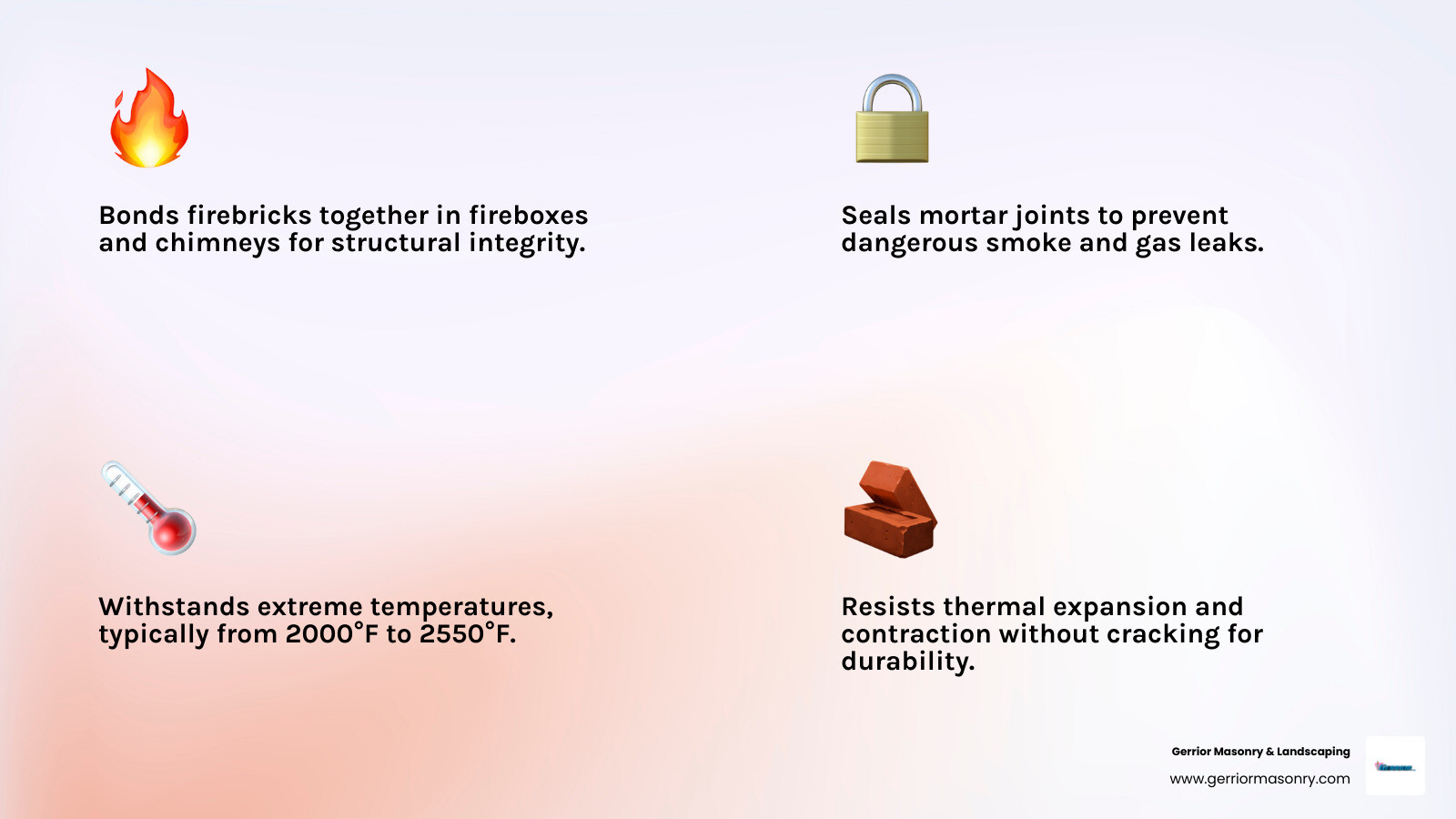
Quick look at fireplace mortar:
Your Complete Guide to Choosing and Using Fireplace Mortar
Understanding fireplace mortar is key to a safe, functional fireplace. It’s not everyday cement; it’s engineered for extreme heat that would destroy regular mortar. After 34 years in masonry, I’ve seen the dangerous results of using the wrong product. This guide will help you make the right choice.
Refractory Mortar vs. Regular Mortar: What’s the Difference?
Regular mortar and fireplace mortar may look similar, but they perform very differently under heat.
Why Regular Mortar Fails in Fireplaces
Regular mortar, made with Portland cement, starts to break down and crumble above 500°F. It also expands and contracts at a different rate than firebrick, causing stress cracks that can leak dangerous gases into your home.
What Makes Refractory Mortar Special
Fireplace mortar uses binders like calcium aluminate cement and fireclay that strengthen with heat. Products like Sakrete High-Heat Mortar can handle temperatures up to 2550°F. It’s formulated for thermal compatibility, meaning it expands and contracts with your firebricks, preventing cracks and ensuring a long-lasting, safe repair.
Here’s how they stack up:
| Feature | Refractory Mortar | Regular Mortar (Portland Cement) |
|---|---|---|
| Max Temperature | 2000°F – 2550°F+ (e.g., Sakrete High-Heat Mortar) | ~500°F (begins to degrade significantly) |
| Primary Use | Bonding firebricks, sealing fireplace/chimney joints | General masonry, structural walls, walkways |
| Composition | Specialized binders (fireclay, calcium aluminate cement, heat-resistant polymers) | Portland cement, sand, lime |
| Thermal Behavior | Expands/contracts with firebrick; resists cracking | Incompatible thermal expansion; prone to cracking |
| Water Solubility | Some air-setting types can be water-soluble; hydraulic-setting types are not | Generally water-resistant (after curing) |
Using anything other than refractory mortar in your firebox is a significant safety hazard.
Types of High-Heat Mortar and Their Applications
Fireplace mortar comes in several forms for different projects.
Pre-mixed Cartridges: The Quick Fix Solution
Convenient for small repairs like hairline cracks or minor gaps, these tubes (e.g., Rutland, MEECO’S RED DEVIL) fit a standard caulking gun. They are ready to use but are not cost-effective for large jobs.
Dry-Mix Powders: The Workhorse Option
For larger projects like laying new firebricks or extensive repointing, dry-mix powders (e.g., Rutland Dry Mix 211) offer the best value. You mix them with water to achieve the desired consistency for the job, from parge coating a smoke chamber to repairing flue tiles. For more extensive chimney work, see our guide on chimney repairs.
Castable Refractory Cement: For Custom Projects
Castable cement acts like a liquid firebrick, ideal for pouring custom shapes like firebox floors, pizza ovens, forges, and kilns. It provides a strong, seamless finish but requires more skill to use properly.
How to Select the Right Fireplace Mortar
Match the product to your needs by considering these factors:
- Temperature Rating: Ensure the mortar’s rating (at least 2000°F, preferably 2550°F) exceeds your fireplace’s heat output.
- Application Type: Use cartridges for small cracks, dry mix for laying bricks, and castable cement for custom forms.
- Curing Method: Check if the mortar is air-setting or requires a specific heat-curing process (building small, incremental fires) to achieve full strength.
- Other Factors: Consider the required consistency (fixed vs. adjustable) and how well it will bond to existing materials.
Application, Curing, and Durability
Proper application and curing are essential for a lasting repair.
Preparation
First, thoroughly clean the area. Use a wire brush and vacuum to remove all loose debris, soot, and old mortar. Lightly dampen the surface with water to prevent the dry bricks from absorbing moisture from the new mortar too quickly.
Application
For pre-mixed cartridges, apply a steady bead and smooth the joint with a trowel or gloved finger. For dry-mix powders, follow the manufacturer’s water ratio precisely to get a thick, peanut-butter-like consistency. Press the mortar firmly into joints with a trowel to eliminate air pockets.
The Critical Curing Process
The curing process is critical and cannot be rushed. All fireplace mortar needs an initial 24-48 hour air-drying period to allow moisture to evaporate slowly. This initial phase prevents the formation of steam pockets that can cause cracks or blowouts when heat is first applied. For heat-curing mortars, you must then build a series of small, progressively hotter fires over several days. This gradual heating completes the chemical reaction (vitrification) that gives the mortar its full strength and heat resistance. Rushing this process by building a large fire too soon will trap moisture, compromise the mortar’s structural integrity, and drastically shorten its lifespan. For technical details, this technical guide on cements and mortars is a useful resource.
Expected Lifespan and Maintenance
A properly applied and cured repair can last for many years. The lifespan depends on material quality, application, curing, and fireplace usage. Once fully cured, most fireplace mortar is paintable for a seamless finish.
Safety Precautions and Typical Costs

Essential Safety Equipment and Precautions
Always wear safety gear: heat-resistant gloves, goggles, and a respirator. The dust from fireplace mortar contains Crystalline Silica, a respiratory hazard, so work in a well-ventilated area. Some products carry warnings under California’s Proposition 65; check labels and Safety Data Sheets at www.P65Warnings.ca.gov. To minimize dust, add water slowly when mixing dry powders.
Cost Expectations for Materials
Fireplace mortar costs vary by type and brand. These are average costs based on internet data and not actual costs for Gerrior Masonry services; we provide detailed estimates for our projects.
- Pre-mixed cartridges (10.3 fl. oz.): $5 to $30 per cartridge.
- Dry-mix mortars: $15 to $45 for small tubs (2.5 lbs) and $30 to $100 for larger containers (10-25 lbs).
- Castable refractory cement: $65 to $200 for 25-27 lb. containers.
Expect to spend $15 to over $150 on materials, depending on your project’s scope.
Gerrior Masonry & Landscape Construction is based in Woburn, MA, and proudly services Middlesex and Essex County, Massachusetts.
When to Trust a Professional with Your Fireplace
While some minor fireplace mortar repairs are suitable for DIY, certain issues are red flags that require an expert. Your fireplace is a critical safety system, and significant failures can have serious consequences. After more than 30 years in the masonry business in Massachusetts, I know when a simple patch isn’t enough.
Signs You Need an Expert for Fireplace Mortar Repair
It’s time to call a professional if you see any of these warning signs:
- Crumbling Mortar: Mortar that turns to sand when touched or has deteriorated deep into the joints indicates a compromised structure that can’t be fixed with a simple patch.
- Loose or Fallen Firebricks: If firebricks are loose, wobbly, or have fallen out, the mortar has failed. This is a major hazard, as heat can transfer directly to your home’s wooden framing.
- Large or Deep Cracks: Cracks wider than an eighth of an inch, or those that run through multiple bricks, point to significant structural stress. They are potential pathways for smoke, carbon monoxide, and flames to escape.
- Smoke Leaking into the Room: Smoke should only exit through the chimney. If it’s seeping through cracks in the firebox or around the fireplace front, you have a serious and immediate safety problem.
- Water Damage: Stains, mold, or white powdery deposits (efflorescence) on the firebox walls mean water is getting in. Water is a primary cause of mortar deterioration and often points to larger issues with the chimney crown or flashing.
- Visible Gaps or Holes: Any opening in the firebox or smoke chamber is a direct path for heat, smoke, and embers to reach combustible materials in your walls or attic.
- Soot on Exterior Masonry: Soot stains on the face of your fireplace indicate that smoke is bypassing the flue, signaling a serious breach in the system.
For extensive damage or structural concerns, a professional assessment is crucial. At Gerrior Masonry & Landscaping, we can accurately diagnose the root cause of mortar problems, recommend the correct high-temperature solutions, and perform repairs that ensure your family’s safety. We understand the demands of New England’s climate and know how to spot issues an untrained eye might miss.
When your family’s safety is at stake, don’t risk it. Schedule your professional fireplace repair with our team.
Gerrior Masonry & Landscape Construction is based in Woburn, MA, and proudly services Middlesex and Essex County, Massachusetts.
