
Driveway widening with pavers: Ultimate 2025
Why Homeowners Are Choosing Pavers for Driveway Expansion
Driveway widening with pavers offers homeowners a durable, attractive solution for expanding their parking space and boosting curb appeal. Whether you need room for a growing family’s vehicles, storage for an RV or boat, or simply want to improve your home’s value, pavers provide the perfect combination of functionality and visual appeal.
Quick Answer: Driveway Widening with Pavers
- Materials: Concrete pavers ($3-$24/sq ft), brick pavers ($4-$30/sq ft), natural stone ($6-$60/sq ft)
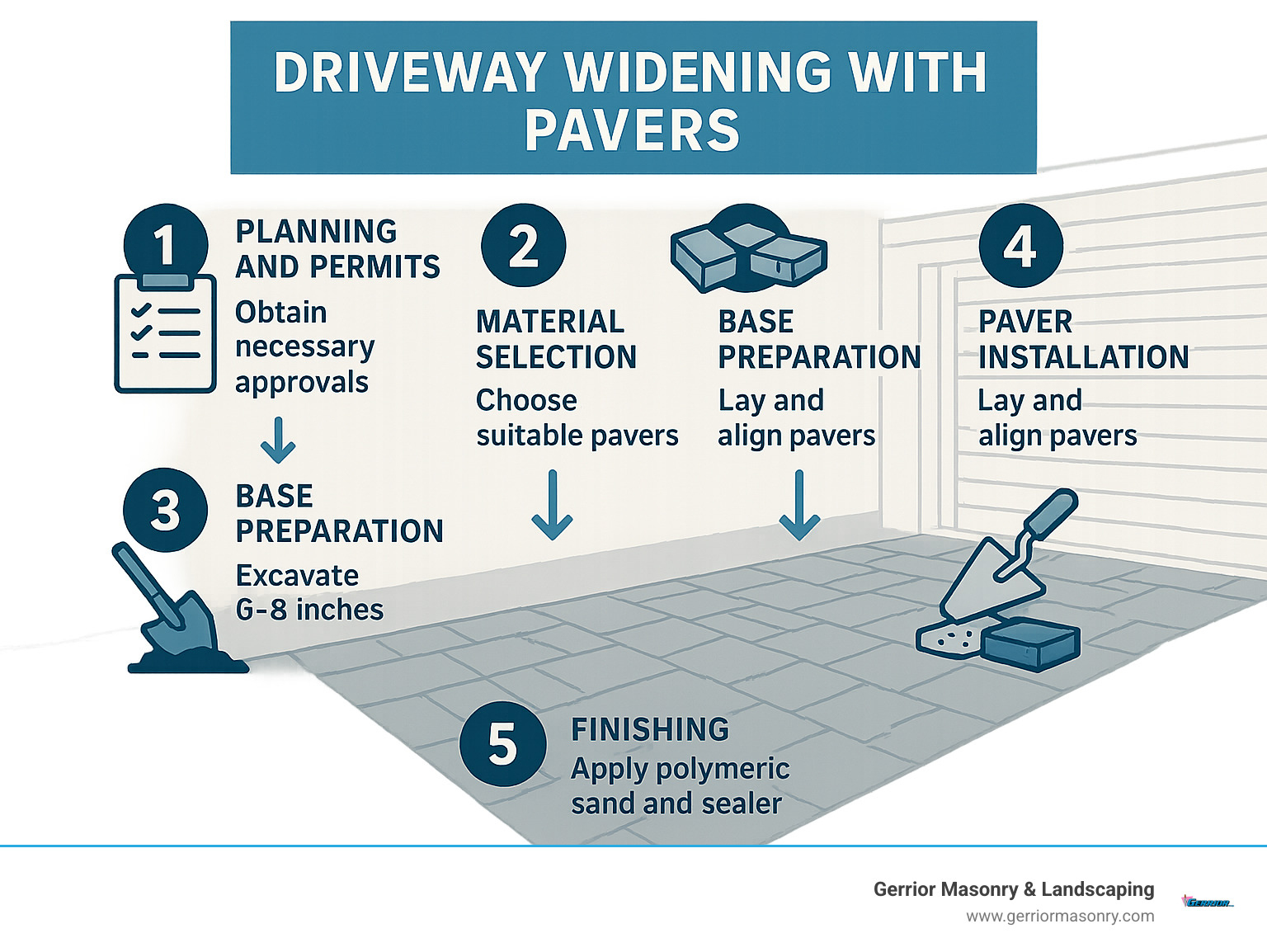
- Process: Excavate 6-8 inches, install compacted base, lay pavers, fill joints with polymeric sand
- Benefits: Durability, easy repairs, design flexibility, improved drainage
- Timeline: Most residential projects complete in 2-5 days depending on size
- Permits: Check local regulations – most areas require permits for driveway widening
Note: These are average costs based on internet data and are not actual costs for Gerrior Masonry & Landscape Construction services. For an accurate estimate, please contact us directly.
As one homeowner shared in their DIY journey, “My motivation for adding this paver driveway extension was a simple one… I realized that my grass was getting really thin at the edge of it because we were walking on it so much from getting in and out of our vehicles.” This common scenario drives many homeowners to explore driveway expansion options.
Unlike concrete or asphalt, pavers offer modular repairability – meaning you can replace individual pavers without redoing entire sections. They also provide superior drainage through permeable paver systems, which reduce water runoff and prevent puddling around your home.
The main reasons homeowners choose paver driveway widening include:
- Increased parking capacity for multiple vehicles
- Improved curb appeal that boosts property value
- Improved accessibility with wider entrance areas
- Durable solution that withstands freeze-thaw cycles
- Design flexibility to complement existing architecture
I’m Joe Gerrior, owner of Gerrior Masonry & Landscape Construction Corp., and over our 34 years serving Massachusetts homeowners, we’ve completed countless driveway widening with pavers projects that transform both functionality and aesthetics. Our expertise in hardscaping and masonry ensures your paver driveway extension will provide lasting value and beauty for decades to come.
The Complete Guide to Driveway Widening with Pavers
Expanding your driveway represents one of the most rewarding home improvements you can make, delivering both immediate practical benefits and long-term aesthetic appeal. When you’re considering driveway widening with pavers, you’re not just adding parking space – you’re investing in a solution that combines durability, beauty, and lasting value for your Massachusetts home.
Why Choose Pavers for Your Driveway Extension?
Driveway widening with pavers stands apart from other expansion methods because pavers offer unique advantages that traditional materials simply can’t match. While concrete or asphalt create solid surfaces that crack and require complete replacement when damaged, pavers provide modular flexibility that makes repairs simple and cost-effective.
The durability factor makes pavers particularly appealing for New England homeowners. Our freeze-thaw cycles can be brutal on driveways, but pavers handle these temperature swings better than poured surfaces. When individual pavers do shift or crack, you can replace just those pieces without disturbing the entire driveway.
Design versatility gives pavers another major advantage. You can create curved edges, decorative borders, and unique laying patterns that complement your home’s architecture perfectly. Whether your house features traditional colonial styling or modern design elements, pavers offer colors and textures to match your vision.
| Feature | Pavers | Concrete | Asphalt |
|---|---|---|---|
| Cost | Moderate to high initial investment | Lower upfront cost | Lowest initial cost |
| Durability | 25-50+ years with proper maintenance | 15-25 years before major repairs | 12-20 years typical lifespan |
| Maintenance | Individual paver replacement, re-sanding | Crack sealing, complete resurfacing | Regular sealing, frequent patching |
| Aesthetics | Unlimited design options and colors | Limited decorative possibilities | Basic appearance, few options |
Permeable paver options deserve special mention for homeowners dealing with drainage issues. These specialized pavers allow water to filter through the surface, reducing runoff and preventing puddles around your foundation. This feature becomes increasingly valuable as Massachusetts communities implement stricter stormwater management requirements.
Real homeowners consistently praise pavers for their weather resistance. As one Reddit user shared about their paver project, the ability to handle heavy snow loads and ice without cracking made pavers the clear choice for their New England driveway expansion.
The easy repair aspect cannot be overstated. When utility companies need to access underground lines, they can remove specific pavers and reinstall them afterward, leaving no visible trace of the work. Try achieving that seamless result with concrete or asphalt!
For homeowners exploring all their options, our comprehensive Paver Driveway Benefits guide covers additional advantages that make pavers the smart choice for Massachusetts driveways.
Planning Your Paver Driveway Widening Project
Successful driveway widening with pavers begins long before the first shovel hits the ground. Local regulations in Massachusetts communities often require permits for driveway expansions, especially when you’re adding significant square footage or changing drainage patterns. Contact your local building department early in the planning process to understand specific requirements for your area.
Property line verification prevents costly mistakes that could force you to redo completed work. Many homeowners assume they know their exact boundaries, but professional surveying often reveals surprises. That extra three feet you thought belonged to you might actually be your neighbor’s property or a utility easement.
Calling 811 for utility line marking isn’t just recommended – it’s legally required and absolutely free. Underground cables, gas lines, and water pipes often run closer to driveways than homeowners realize. A simple phone call prevents dangerous accidents and expensive repairs.
Choosing paver materials involves balancing aesthetics, budget, and performance needs. Concrete pavers offer excellent value and come in numerous colors and textures that mimic natural stone. Brick pavers provide timeless appeal that complements traditional New England architecture beautifully. Natural stone pavers deliver best beauty and uniqueness, though they command premium prices.
Matching existing driveway materials creates visual harmony, but don’t feel locked into identical choices. Sometimes complementary colors or contrasting borders create more interesting designs than perfect matches. Consider how the expanded area will look from your home’s main windows and from the street.
Design ideas for paver driveways extend far beyond simple rectangles. Curved edges soften harsh lines and create more natural transitions to landscaping. Decorative borders using contrasting paver colors define spaces beautifully. Popular laying patterns include herringbone for classic elegance, running bond for clean modern looks, and basket weave for traditional charm.
The site preparation phase determines your project’s long-term success. Proper drainage planning ensures water flows away from your foundation and doesn’t pool on the paver surface. Consider how the expanded driveway will affect existing drainage patterns and plan accordingly.
For inspiration and detailed planning guidance, explore our Driveway Design Ideas to see how other Massachusetts homeowners have successfully expanded their driveways with pavers.
The Step-by-Step Paver Installation Process
A professional installation is key to a durable paver driveway extension. The process follows these critical steps:
- Excavation and Grading: The expansion area is excavated 8 to 12 inches deep, essential for Massachusetts’ climate. All topsoil is removed to reach stable subsoil. The area is then graded with a slight slope (about ¼ inch per foot) to ensure proper water drainage away from your home.
- Base Preparation: This is the most critical stage. The subsoil is compacted, and geotextile fabric is laid to prevent the gravel base from mixing with the soil. Several inches of dense-grade aggregate are added in compacted layers to create an unyielding foundation that supports vehicle weight.
- Bedding Sand Layer: A 1-inch layer of coarse sand is spread over the compacted base to create a smooth bed for setting the pavers. This sand is carefully leveled, or “screeded,” to ensure a uniform surface.
- Paver Laying and Edge Restraints: Pavers are laid by hand in the desired pattern, starting from a fixed edge. Installers work on top of laid pavers to avoid disturbing the sand bed. Heavy-duty edge restraints are installed around the perimeter and secured with long spikes to prevent shifting.
- Jointing and Compaction: Once all pavers are in place, polymeric sand is swept into the joints. This special sand hardens when wet, locking pavers together and preventing weeds. A plate compactor settles the pavers and vibrates the sand into the joints. The process finishes by misting the surface with water to activate the sand’s polymers.
Maintaining Your New Paver Driveway
A key feature of a paver driveway is its low maintenance. These simple steps will keep it looking great.
- Regular Cleaning: Sweep away debris periodically. For a deeper clean, wash the surface with a hose or a pressure washer on a low-pressure setting, avoiding the joints.
- Weed Control: The polymeric sand in the joints is a powerful weed deterrent. Any occasional weeds can be pulled out easily by hand.
- Stain Removal: Address spills like oil quickly using a dedicated paver cleaner. Blot the spill first, then follow the product’s instructions.
- Easy Repairs: If a paver cracks or sinks, it can be repaired easily. A professional can lift the paver, adjust the sand base, and replace it. This modular benefit is a major advantage over concrete.
- Long-Term Care: Over many years, you may need to top off joints with fresh polymeric sand. Applying a quality sealer every 3-5 years is also recommended to protect against stains and improve color.
Gerrior Masonry & Landscape Construction is based in Woburn, MA, and services Middlesex and Essex County, Massachusetts.
