
Backyard Drainage Solutions Dry Well: 7 Powerful Tips for Success 2025
The Hidden Solution to a Soggy Backyard
Backyard drainage solutions dry well systems work like nature’s hidden water managers beneath your lawn. These underground structures collect excess water from your property and gradually release it into the surrounding soil, turning potential flooding disasters into a controlled, natural process.
For homeowners wondering if a dry well might be their answer to persistent puddles, here’s what you need to know at a glance:
| Dry Well Basics | Details |
|---|---|
| Purpose | Collects and disperses water underground to prevent pooling |
| Installation Depth | Typically 3-4 feet deep |
| Average Cost | $3,000 (ranges from $1,500-$9,000) |
| Lifespan | Up to 30 years with proper maintenance |
| Best Soil Types | Sandy or loamy soils (fast percolation) |
| Min. Distance from Home | At least 10 feet from foundation |
Have you ever stepped into your backyard after a rainstorm only to hear that disappointing squish beneath your feet? You’re not alone. Standing water isn’t just an inconvenience that ruins your Sunday barbecue plans—it can damage your lawn, create a mosquito breeding ground, and even threaten your home’s foundation over time.
A backyard drainage solutions dry well offers an neat solution to this common problem. Unlike visible drainage methods that can interrupt your carefully planned landscape, dry wells work invisibly beneath your lawn’s surface. They capture excess water and allow it to gradually seep into the ground, away from your property and foundation.
I’ve seen how transformative these systems can be. As Joe Gerrior, owner of Gerrior Masonry & Landscape Construction, I’ve installed hundreds of backyard drainage solutions dry well systems throughout Massachusetts. For over 34 years, we’ve helped homeowners reclaim their soggy yards, turning waterlogged nightmares into dry, usable outdoor spaces where families can gather without sinking ankle-deep in mud.
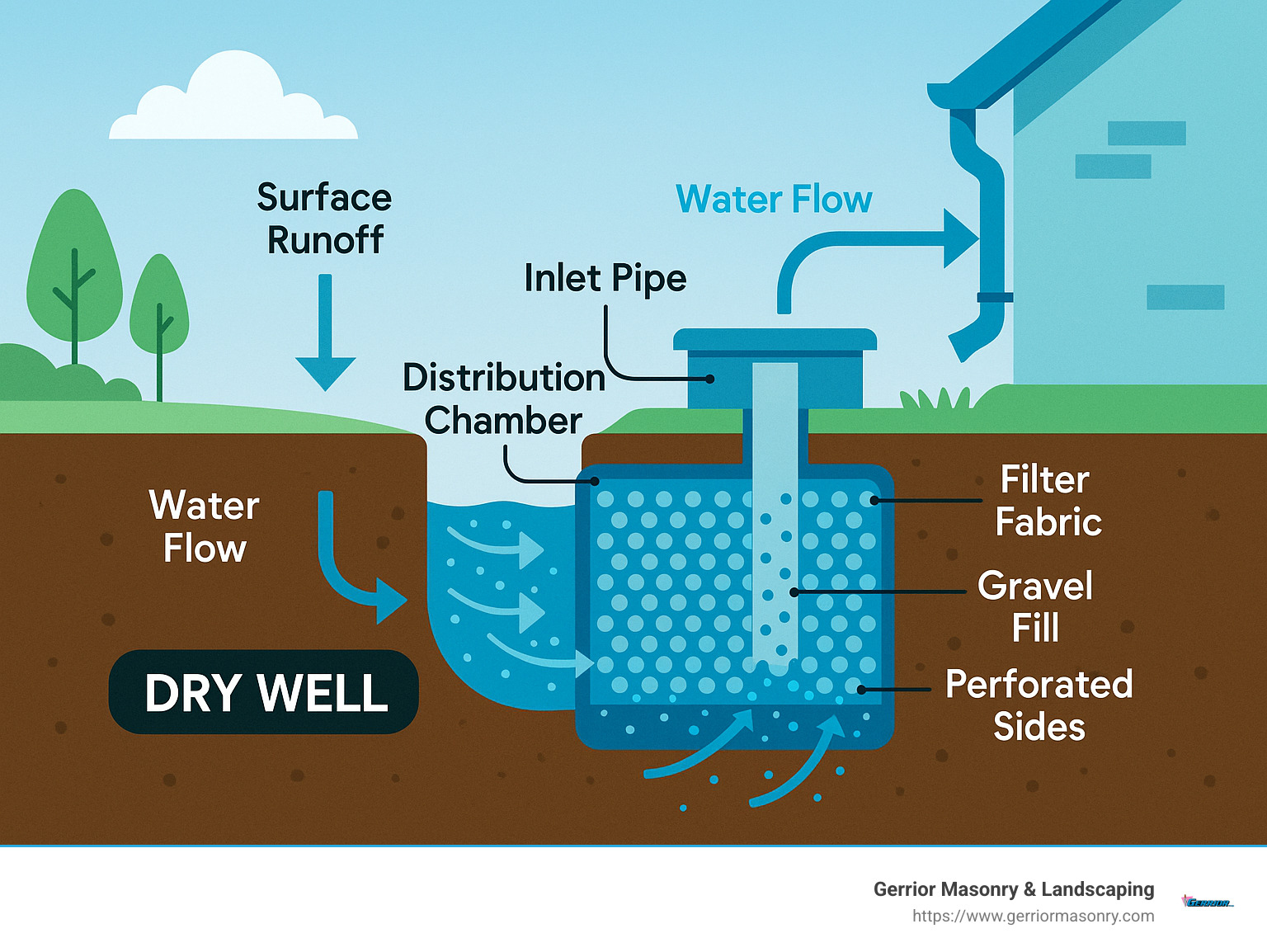
Understanding Dry Wells: The Science Behind Subsurface Drainage
Ever wondered what happens to all that rainwater that disappears into your backyard drainage system? Let me pull back the curtain on the humble dry well—a true unsung hero of landscape drainage.
A dry well is essentially an underground structure designed to collect excess water and allow it to gradually soak into the surrounding soil. As drainage expert Eric McClure puts it: “A dry well is a round concrete cylinder with stones in the bottom where drains lead into so water goes in and sheds out through the stones.”
But there’s more magic happening beneath your lawn than you might realize. Dry wells work on three fundamental principles of water movement:
Infiltration is when water first enters the soil surface—think of it as the initial handshake between rainwater and earth. Percolation happens next as water travels downward through different soil layers. Finally, this process contributes to groundwater recharge, helping replenish those underground water supplies that keep our ecosystems healthy.
What makes a backyard drainage solutions dry well truly special is its storage capacity. Unlike surface drainage that simply redirects water elsewhere (often to become someone else’s problem), a dry well temporarily holds water in void spaces—those empty areas between stones or within chambers—until it can safely dissipate into the ground.
A properly sized system can hold hundreds of gallons of water, with modular systems storing about 50 gallons per unit. This makes them particularly effective during those New England downpours when your yard might otherwise turn into a miniature lake!
How a Dry Well Works from Roof to Soil
Water’s journey through a dry well system is neatly simple:
First, water enters the system through inlet pipes connected to your downspouts, surface drains, or other collection points around your property. It then travels through solid PVC pipes, gently sloping at approximately 1/4 inch per foot toward the dry well.
As water enters the chamber, it displaces the air inside and fills those void spaces we mentioned. Then comes the patience part—water gradually exits through perforations in the sides and bottom of the well, filtering into the surrounding soil.
The beauty of this process? It happens entirely through gravity—no pumps or electricity required for basic systems. During heavy rainfall, the dry well fills quickly but releases water slowly, preventing the sudden flooding that can wreak havoc on your landscape.
“What makes dry wells so effective,” says Joe Gerrior, “is that they work with nature rather than against it. Instead of forcing water somewhere else, they help return it to the natural water cycle at a manageable rate.”
Types of Dry Wells You Can Install
When considering a backyard drainage solutions dry well for your property, you’ve got several options to choose from:
Gravel Pit Dry Wells are the most basic type—essentially a hole filled with clean gravel or stone. They’re simple and relatively inexpensive, but they have less storage capacity than other options and may require more space. Think of these as the starter model in the dry well world.
Prefabricated Chambers are manufactured plastic or concrete containers specifically designed for dry well applications. They feature perforated sides for water dispersion, structural stability to prevent collapse, easy connection points for inlet pipes, and greater storage capacity than simple gravel pits. These are the reliable sedans of drainage solutions.
Modular Stackable Systems like the NDS Flo-Well offer remarkable flexibility. Individual units can be stacked or connected horizontally, with each module holding approximately 50 gallons. These systems provide 250% more detention volume than comparable gravel-filled wells and can be customized based on your specific drainage needs. Consider these the adaptable crossovers of the drainage world.
Concrete Galleys are for larger properties or areas with significant drainage issues. These heavy-duty concrete structures can each hold around 300 gallons, and multiple units can be installed in a series. They’re ideal for commercial applications or severe residential drainage problems—the heavy-duty trucks of drainage solutions.
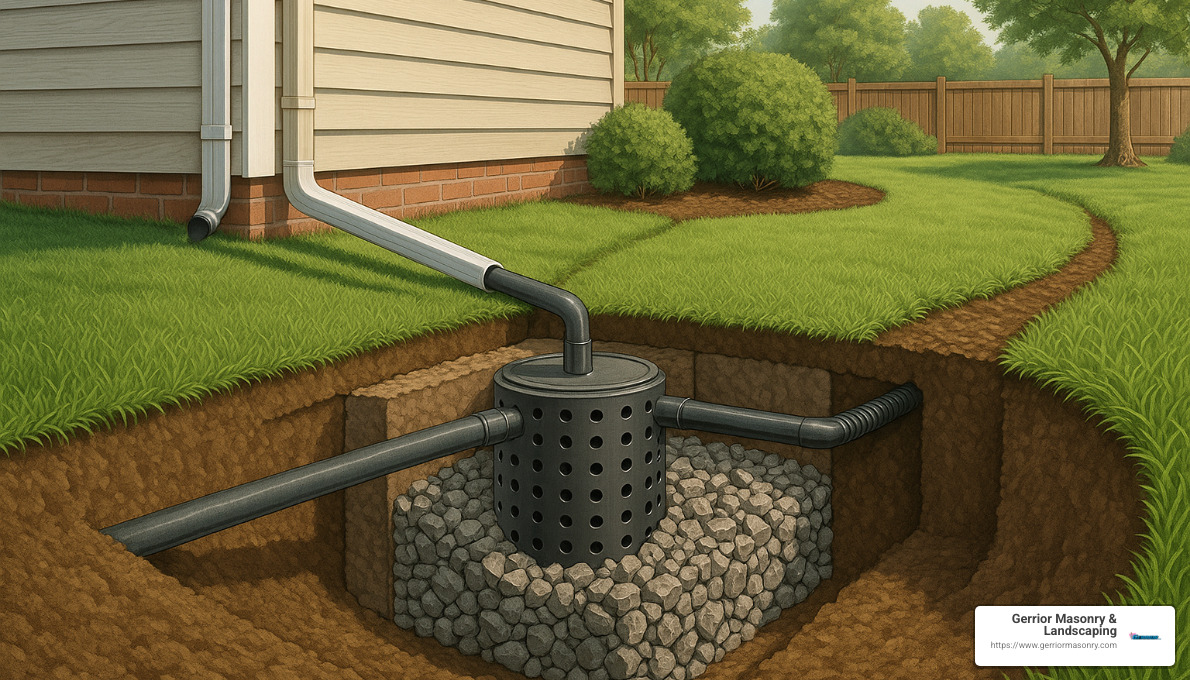
The right type for your property depends on your specific drainage needs, budget, and the characteristics of your landscape. In my 34+ years working throughout Middlesex and Essex Counties, I’ve installed all types and can help determine which might work best for your particular situation.
Is Your Yard Suitable for a Dry Well?
Walking around your yard after a heavy rain can tell you a lot about where water collects, but there’s more to consider before grabbing your shovel. The right location and soil conditions make all the difference between a dry well that works like magic and one that becomes an underground bathtub.
Soil Type and Percolation Rate
The soul of a successful dry well is good soil drainage. Sandy soils are the champions here, draining at rates of 1+ inch per hour. Loamy soils perform admirably too, moving water at 0.5-1 inch per hour. But if you’ve got heavy clay soil draining less than 0.5 inch per hour, you might be fighting an uphill battle.
“I’ve seen homeowners spend thousands on dry wells in clay-heavy yards,” says Joe Gerrior, “only to find they’ve essentially built an underground pool that never empties. Always test before you invest.”
Water Table Level
Your dry well needs breathing room above the water table. Aim to keep the bottom of your well at least 2 feet above the seasonal high water table. In areas where groundwater sits close to the surface, you might need to design a shallower, wider dry well system or consider alternative drainage solutions entirely.
Distance from Structures
Location matters tremendously. Keep your backyard drainage solutions dry well at least 10 feet from your home’s foundation to prevent any moisture issues. Stay clear of septic fields, utility lines, and property boundaries too. Whenever possible, position your dry well downhill from your home to work with gravity.
Local Regulations
Before breaking ground, check with your local building department. Many towns have specific requirements about permits, setbacks from property lines, discharge regulations, and stormwater management compliance. What’s perfectly acceptable in one municipality might be completely prohibited just one town over.
More info about drainage system around the house
Simple Percolation Test You Can Do in an Afternoon
Rather than guessing about your soil’s drainage capacity, spend an afternoon running this straightforward percolation test:
- Dig a hole approximately 12 inches in diameter and 12 inches deep where you’re considering installing your dry well.
- Fill the hole completely with water and let it drain fully.
- Refill the hole and measure how much the water level drops in one hour.
- Analyze your results: 1+ inch per hour is excellent, 0.5-1 inch is good, and less than 0.5 inch suggests you might need a different approach.
This simple test can save you significant frustration and expense. Sandy soil will show water disappearing quickly, while clay-heavy soil might hold water like a bowl.
Locating the Best Spot
Finding the perfect spot for your backyard drainage solutions dry well requires some detective work and strategic thinking.
Natural Low Spots make ideal locations because water already finds its way there. Look for depressions in your yard or areas where multiple surface flows converge after rainfall. These natural collection points are telling you exactly where water wants to go.
Downspout Outlets often create persistent wet spots that can benefit from a nearby dry well. The concentrated flow from your roof represents a significant volume of water during storms.
Strategic Placement considers both current drainage patterns and practical concerns. Stay at least 10 feet from your foundation, avoid large tree roots that could eventually infiltrate your system, and ensure the area remains accessible for future maintenance. Consider what might happen during an overflow situation – water should have a safe path away from structures and neighboring properties.
Before digging anywhere, make that crucial call to 811 (DigSafe). This free service marks underground utilities and can prevent costly and potentially dangerous accidents during installation. I’ve seen what happens when someone hits an unmarked electric line or gas pipe – it’s never pretty, and it’s always expensive.
Proper placement is just as important as proper construction. A perfectly built dry well in the wrong location simply won’t solve your drainage problems.
Backyard Drainage Solutions: Dry Well vs. Alternatives
When your yard turns into a mini-lake after every rainfall, it’s time to consider your drainage options. While backyard drainage solutions dry well systems are excellent choices, they’re not the only tools in our water management toolbox. Let’s explore how dry wells stack up against other popular solutions:
| Solution | Best For | Installation Complexity | Average Cost | Lifespan | Visibility |
|---|---|---|---|---|---|
| Dry Well | Localized water collection | Moderate | $3,000 ($1,500-$9,000) | Up to 30 years | Hidden |
| French Drain | Linear water redirection | Moderate | $6,000 ($2,000-$18,000) | 10-15 years | Hidden |
| Rain Garden | Surface water with aesthetic value | Low | $500-$5,000 | Ongoing | Visible feature |
| Catch Basin | Point collection near downspouts | Low | $500-$2,000 | 20+ years | Grate visible |
| Swale | Gentle surface redirection | Low | $800-$2,500 | 20+ years | Visible contour |
| Sump Pump | Areas below drainage outflow | High | $1,200-$5,000 | 7-10 years | Pump hidden, discharge visible |
Note: These are average costs based on internet data and not actual costs for Gerrior Masonry services.
Each solution has its sweet spot. After 34 years of solving drainage problems across Massachusetts, I’ve learned that water issues rarely have a one-size-fits-all fix.
“The right solution often depends on your specific situation,” I tell homeowners. “Sometimes, it’s not about choosing one method, but rather combining complementary approaches for comprehensive drainage management.”
More info about Dry Well vs French Drain
Why Choose a Backyard Drainage Solutions Dry Well Over a French Drain?
Picture this: You’ve just experienced a downpour that dropped two inches of rain in an hour. A French drain might struggle to keep up, but a dry well? It’s like having a hidden reservoir ready to capture that deluge.
Superior Storage Capacity
While French drains excel at moving water from point A to point B, dry wells are the champions of storage. A single concrete galley unit can hold up to 300 gallons of water—perfect for those Massachusetts spring storms that seem to dump half the Atlantic on your property. This storage ability gives the surrounding soil time to absorb water gradually, preventing flooding even during heavy rainfall.
Deep Storage Solution
One of my favorite aspects of dry wells is how they tap into nature’s own filtration system. By placing these structures 3-4 feet underground, we access deeper, often more permeable soil layers. Surface soils in many Massachusetts yards have become compacted over decades of use or contain clay that repels water. The deeper we go, the better the drainage gets.
Minimal Surface Footprint
Once we’ve installed your dry well, you’ll forget it’s even there. Unlike French drains, which sometimes create subtle linear depressions in your lawn, dry wells are completely invisible. Your kids can play ball, you can host barbecues, and nobody will know there’s a sophisticated drainage system beneath their feet.
Long-Term Value
With proper installation and occasional maintenance, your dry well can faithfully serve your property for up to 30 years. That’s significantly longer than the 10-15 year lifespan of the average French drain system. When we factor in the replacement costs over decades, dry wells often represent the more economical long-term investment.
“For homeowners with limited yard space who want a completely hidden solution,” I often tell clients, “dry wells provide the best balance of effectiveness and aesthetics.”
When a Combination System Makes Sense
In my three decades of drainage work, I’ve found that the most effective solutions often combine multiple approaches. Water is stubborn—it finds every weakness in your defenses—so sometimes we need to get creative.
Dry Well + French Drain
This dynamic duo is one of our most frequently installed systems. The French drain acts like a collector, gathering water along its path and funneling it to the dry well, which serves as the storage and dispersal center. This combination works wonders for:
Properties with both surface and subsurface water issues, where water comes from multiple sources. Many Massachusetts homes, especially those built before modern drainage codes, face this exact challenge.
Yards with heavy clay soils where water moves sideways better than downward. The French drain captures this horizontal movement and redirects it to the dry well in a more suitable location.
Situations where water needs to travel some distance before reaching its final destination. Think of the French drain as the highway and the dry well as the parking garage.
Dry Well + Rain Garden
This partnership isn’t just practical—it’s beautiful. The dry well handles the heavy lifting of water storage and infiltration, while the rain garden adds visual appeal and environmental benefits. Native plants in the rain garden create habitat for butterflies and birds, turning a drainage problem into a landscape feature.
Dry Well + Sump Pump
Some properties present unique challenges that gravity alone can’t solve. If your yard sits significantly lower than the street or has a high water table, a sump pump can actively move water to a dry well positioned at a more favorable elevation. It’s like having a little helper that keeps working even when the odds are stacked against natural drainage.
Step-by-step dry well installation
The best solution for your property depends on your specific conditions—soil type, slope, water volume, and budget all play important roles in designing the right system. After decades of solving drainage puzzles across Middlesex and Essex Counties, we’ve yet to meet a wet yard we couldn’t dry out with the right combination of techniques.
DIY Backyard Drainage Solutions Dry Well Installation Guide
Ready to roll up your sleeves and tackle that soggy yard yourself? While complex drainage issues often need professional help, a basic backyard drainage solutions dry well is within reach for the dedicated DIYer. I’ve helped hundreds of homeowners through this process, and with some careful planning, you can transform your waterlogged yard into dry, usable space.
Before we dive in, grab your coffee and let’s talk about what you’ll need for this weekend project:
Tools and Materials You’ll Need:
– Shovel and/or pick (your back will feel this tomorrow!)
– Wheelbarrow for hauling materials
– Tape measure and level (precision matters here)
– Reciprocating saw or PVC cutter
– 4-inch PVC pipe (the drainage superhighway)
– PVC fittings (elbows, couplings, adapters)
– PVC cement and primer
– Non-woven landscape fabric (the good stuff that won’t deteriorate)
– 3/4-inch washed crushed stone
– Dry well unit (prefabricated or DIY)
– Overflow emitter (optional but recommended)
– Safety gear (gloves, eye protection – your eyes will thank you)
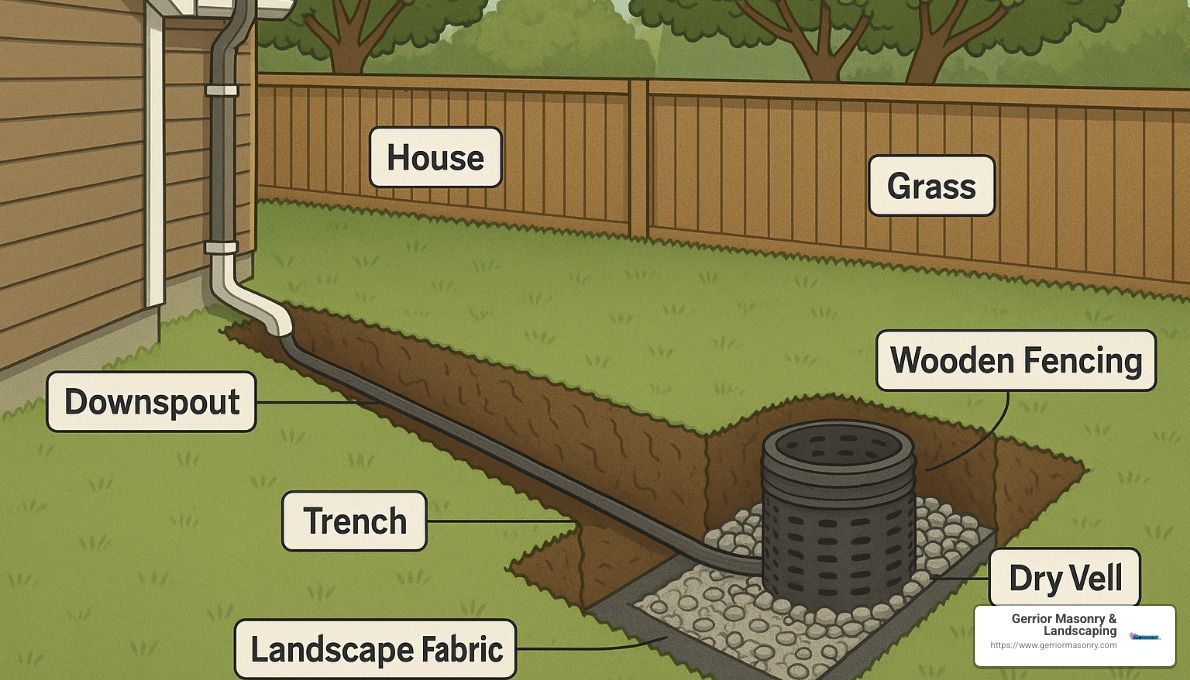
Step-by-Step Installation Process:
First, put on your planning hat. Mark your layout by identifying where water enters your yard (typically downspouts or surface drains) and trace the path to your chosen dry well location. Remember: water flows downhill, so ensure a minimum 1/4-inch per foot slope along the entire route. This gentle grade is the secret sauce to a successful installation.
Before the first shovel hits dirt, call DigSafe at 811. This free service marks underground utilities and can save you from a very bad day. Trust me, I’ve seen the alternative, and it’s not pretty!
Once you’re cleared to dig, excavate a trench about 12 inches deep and 6 inches wide from your water source to the dry well location. If you’re working through a lawn area, try removing turf in chunks for easier replacement later. Check your slope regularly with a level – even small errors here can lead to standing water in your pipes.
Now for the main event: dig the dry well hole approximately 4 feet in diameter and 3-4 feet deep. This should be at least three times the size of your dry well unit. I always tell homeowners that the extra digging effort pays off in performance – don’t skimp here!
“The most common mistake I see in DIY installations is undersizing the hole,” I often tell customers. “You need plenty of room for drainage material around the dry well itself.”
Next, prepare a proper foundation by lining the hole with landscape fabric (leave plenty hanging over the edges to fold over the top later). Add 4-6 inches of crushed stone to the bottom and tamp it down firmly. This creates a stable base and immediate drainage zone.
For the piping, cut your PVC to length for your trench, connecting to the downspout with an appropriate adapter. Maintain that critical 1/4-inch per foot slope toward the dry well. Use solid pipe until you reach the dry well area, then switch to perforated pipe within the dry well zone.
When positioning the dry well, carefully place the unit on your stone base and connect the inlet pipe. If you’re in an area with heavy rainfall, consider installing an overflow pipe as a safety valve for those monsoon-like downpours.
Backfill around the dry well with crushed stone to within 3-6 inches of the surface, then fold the excess landscape fabric over the top of the stone – this prevents soil from migrating into your drainage system. Finally, add soil over the fabric to reach grade level and replace any turf you removed.
“The key to a successful DIY installation,” I always tell homeowners, “is taking your time with the slope. Even a small error in pitch can lead to standing water in your pipes and reduced effectiveness.”
DIY Backyard Drainage Solutions Dry Well Installation Checklist
Before you consider this project complete, run through this essential checklist:
- [ ] Obtain necessary permits from local building department
- [ ] Call DigSafe (811) to mark underground utilities
- [ ] Perform percolation test to verify soil suitability
- [ ] Purchase all materials before starting excavation
- [ ] Excavate trench with proper slope (1/4″ per foot)
- [ ] Dig dry well hole 3x larger than the dry well unit
- [ ] Line hole and trench with non-woven landscape fabric
- [ ] Install 4-6″ stone base in dry well hole
- [ ] Connect downspout adapter to existing gutter
- [ ] Install and glue PVC pipe sections along trench
- [ ] Position dry well unit and connect inlet pipe
- [ ] Backfill around dry well with crushed stone
- [ ] Install overflow protection if needed
- [ ] Fold landscape fabric over stone
- [ ] Backfill with soil and restore surface
- [ ] Test system during next rainfall
- [ ] Document installation with photos for future reference
Safety & Permit Considerations
Let’s talk about keeping both you and your wallet safe during this project.
Permits and Regulations aren’t just bureaucratic red tape – they’re there to protect you and your neighbors. Check with your local building department about requirements before starting. Some towns in Massachusetts require professional engineering plans for drainage systems, while others have a simpler permit process. If you’re connecting to municipal storm sewers, special permits are almost always required. Expect permit fees ranging from $50-$250 depending on your location.
Safety should never be an afterthought. Never enter an excavation deeper than 4 feet without proper shoring – soil collapse happens faster than you might think. Wear appropriate safety gear throughout the project, and have a helper on site when working with heavy materials. Keep children and pets away from open excavations – what looks like a fun dirt playground to them can be genuinely dangerous.
Don’t forget the environmental impact of your project. Ensure your dry well won’t contaminate groundwater by never directing water containing chemicals, oils, or other pollutants into it. If your runoff might contain sediment or debris (common with driveway runoff), consider installing a filter or catch basin before the dry well.
While a backyard drainage solutions dry well can be a satisfying DIY project, there’s no shame in calling for professional help if you encounter unexpected challenges. At Gerrior Masonry & Landscape Construction, we’ve rescued many well-intentioned DIY projects – sometimes the most cost-effective approach is getting it done right the first time.
Gerrior Masonry & Landscape Construction is based in Woburn, MA, and services Middlesex and Essex County, Massachusetts.
Sizing, Costs, and Long-Term Care
Getting the size right for your backyard drainage solutions dry well is like choosing the right shoes—too small and you’ll feel the pain, too large and you’ve wasted money. Let’s make sure your system fits just right.
When sizing your dry well, follow the “one-inch rule”—design your system to handle one inch of rainfall from your drainage area. Here’s how to calculate what you need:
Take the square footage of the area draining to your dry well (like your roof section or patio), multiply by 0.623 gallons (that’s how much one inch of water equals per square foot), and voilà—you have your minimum gallon capacity.
For example, if you’re managing runoff from a 500 square foot section of roof:
500 sq ft × 0.623 gallons = 311.5 gallons capacity needed
This would translate to about 6-7 modular units (at 50 gallons each), one large concrete galley (300 gallons), or a custom gravel pit approximately 4’×4’×4′.
“For most residential applications in Massachusetts,” notes Joe Gerrior, “we recommend designing for a 100-year storm event—about 9 inches of rain in 24 hours. That might seem excessive, but with changing weather patterns, these extreme events are becoming more common.”
Average Cost of Backyard Drainage Solutions Dry Well Systems
Let’s talk dollars and cents. The investment in a dry well system varies widely based on several factors:
Typical Cost Ranges (based on internet data, not actual Gerrior Masonry pricing):
– Basic DIY gravel pit: $500-$1,500
– Prefabricated plastic chamber system: $1,500-$4,500
– Professional installation with multiple units: $3,000-$9,000
– Commercial-grade concrete galley system: $6,000-$25,000
What drives these costs? About 30-40% goes to materials, while labor makes up the remaining 60-70%. This is why DIY installations can save significantly—if you have the know-how and equipment.
Here in Massachusetts, we typically see costs running higher than the national average. Between our higher labor rates, stricter permitting requirements, challenging soil conditions, and shorter installation seasons, there’s a premium on quality drainage work in our region.
The good news? A well-installed system is a long-term investment that can protect your property for decades—often boosting your home’s value in the process.
More info about Dry Well Installation Cost
Pro Tips for Maintenance and Troubleshooting
With proper care, your backyard drainage solutions dry well can serve you faithfully for 30+ years. Think of maintenance like seasonal check-ups—each season has its own tasks:
In spring, inspect your gutters and downspouts for winter damage, clear any debris from inlet grates and pipes, and watch how quickly water drains after spring rains (it should disappear within 48 hours).
During summer, keep an eye on plants growing near your dry well—roots can be surprisingly invasive. Also ensure lawn clippings don’t pile up near drain inlets, and check for any standing water that might become a mosquito resort.
Come fall, cleaning gutters becomes critical before the leaves drop. Consider installing leaf guards if debris is a recurring headache, and make sure inlet grates stay clear as leaves fall.
In winter, keep snow from blocking downspout exits, watch for ice damming that might redirect water, and avoid using salt or de-icers near your dry well components—they can damage both the system and surrounding soil.
When things aren’t working right, here’s what to look for:
If water drains slowly, you might have clogging in the pipes or filter fabric, or sediment buildup in the chamber. A good flush with pressurized water often solves this, but sometimes professional cleaning is needed.
Surface water pooling above your dry well suggests the system is overwhelmed or the surrounding soil is clogged. Adding an overflow system or expanding capacity might be necessary.
Sinkholes or depressions are red flags that could indicate structural failure or soil erosion. These warrant immediate professional inspection.
“The number one maintenance tip,” says Joe Gerrior, “is prevention. Installing leaf guards on gutters and filters on inlets can dramatically extend the life of your dry well system by keeping debris out in the first place.”
Think of your dry well maintenance like dental care—regular check-ups and cleanings prevent major problems down the road. A little attention each season saves thousands in repairs later.
More info about Dry Well Installation Cost
When to Combine Solutions & Call a Professional
You’ve watched the DIY videos, read the articles, and maybe even tried your hand at some basic drainage solutions. But sometimes, water problems can be trickier than they first appear. Let’s talk about when it’s time to put down the shovel and pick up the phone.
Complex Site Conditions can turn a weekend project into a month-long headache. If your property has steep slopes that would make a mountain goat nervous, significant grade changes that resemble a roller coaster, or a maze of underground utilities, professional help isn’t just convenient—it’s essential.
I’ve seen homeowners find bedrock just a foot down after enthusiastically starting their dry well project. That’s when a pro with the right equipment becomes worth their weight in gold.
High Water Table Challenges are another red flag for professional intervention. If your area experiences seasonal flooding, sits near wetlands, or has documented high water tables, your dry well design needs careful consideration. As Joe Gerrior often tells clients, “You can’t expect a dry well to work if you’re essentially trying to drain into an already full bathtub.”
Properties with artesian wells or natural springs present unique challenges that require experienced eyes and specialized solutions.
Heavy Runoff Scenarios demand professional attention, especially when dealing with:
– Large roof areas channeling torrents of water to a single point
– Commercial properties with parking lots and extensive impervious surfaces
– Sites that unwillingly “collect” runoff from neighboring properties
– Areas with a history of flooding that’s well-documented (and probably well-photographed on your phone)
Sump Pump Integration adds another layer of complexity. When your basement needs mechanical drainage assistance or your discharge point sits uphill from your collection area (fighting gravity never ends well), a professional can design a system with the proper electrical components, weatherproofing, and backup systems.
“When we assess a property,” explains Joe Gerrior, “we’re not just looking at the immediate problem area. We’re considering the entire water flow across the site, from the highest point to the lowest. That comprehensive approach often reveals that a combination of solutions will provide the best long-term results.”
More info about Dry Well Installers
Signs You Need Expert Help
Your yard might be sending SOS signals that indicate it’s time for professional intervention. Here are the warning signs that shouldn’t be ignored:
Persistent Flooding Despite Attempts at Correction is like your yard waving a white flag. If you’ve already tried basic drainage solutions and still find yourself splashing through puddles, there are likely underlying issues like an unusually high water table or improper overall grading that require professional assessment.
Soil Collapse or Erosion isn’t just unsightly—it’s a warning. When you notice sinkholes, eroding soil, or collapsing areas in your yard, you’re witnessing potentially serious underground water movement that needs expert evaluation before it worsens.
Repeated Clogging of Existing Systems is frustrating and often indicates improper sizing or design. If you’re regularly snaking out drains or clearing debris from your current setup, a professional redesign might actually save you money (and certainly aggravation) in the long run.
Structural Risk to Your Home is where drainage issues cross the line from annoying to dangerous. Water accumulating near your foundation, moisture seeping into your basement, or cracks appearing in foundation walls are urgent red flags that demand immediate professional attention.
Multiple Problem Areas across your property often indicate the need for an integrated approach. When you’re dealing with several wet spots, runoff issues, or drainage failures, a comprehensive system designed by professionals will provide better overall results than piecemeal DIY fixes.
How Multiple Systems Work Together
Professional drainage solutions often resemble an orchestra rather than a solo performer. Here’s how the experts combine different approaches for comprehensive water management:
Dry Well + French Drain Combination is perhaps the most popular pairing in the drainage world. Think of French drains as the collection network—gathering water from across your property and channeling it to strategically placed dry wells. The dry wells then serve as the storage and infiltration system, handling the concentrated flow at a rate the surrounding soil can accept.
This combination works particularly well on properties with gentle slopes and areas where water tends to move horizontally through the soil before it can percolate downward.
Dry Well + Rain Garden Integration offers both practical drainage and landscape beauty. This environmentally friendly approach uses rain gardens with native plants to capture surface water while providing initial filtration and habitat for beneficial insects and birds. The backyard drainage solutions dry well acts as an overflow system during heavy rain events when the rain garden reaches capacity.
“Many of our clients are surprised by how beautiful their drainage solutions can be,” notes Joe Gerrior. “A well-designed rain garden with a hidden dry well beneath can transform a soggy eyesore into the showpiece of your landscape.”
Energy-Powered Pump Systems come into play for particularly challenging sites. These professionally designed systems might include sump pumps to actively move water from low-lying areas to dry wells positioned at optimal infiltration points. The best systems include backup power options for reliability during storms (when you need drainage most) and may even incorporate smart controllers that monitor water levels and system performance.
“The most effective drainage solutions,” says Joe Gerrior, “are often invisible after installation. Our goal is to solve your water problems while preserving the beauty and functionality of your outdoor space.”
With over three decades of experience tackling the unique drainage challenges of New England properties, our team at Gerrior Masonry & Landscaping has seen it all—from simple solutions to complex integrated systems. We understand that every property is unique, and sometimes the best approach combines multiple strategies for lasting results.
Frequently Asked Questions about Dry Wells
How far from the house should a dry well be placed?
A dry well should be installed at least 10 feet away from your home’s foundation. This isn’t just a random number—it’s the minimum safe distance to prevent water from finding its way back toward your house and causing moisture problems.
Think of it as creating a buffer zone between your drainage solution and your most valuable asset. This 10-foot minimum helps protect your foundation while still allowing the backyard drainage solutions dry well to effectively capture runoff from your roof and yard.
When planning your dry well placement, remember these key distances:
– At least 10 feet from any part of your home’s foundation
– Preferably downhill from your house (water flows downhill, after all!)
– Minimum 10 feet from your property boundaries (your neighbors will thank you)
– At least 50 feet away from septic systems and leach fields (mixing these systems can create serious problems)
– A good distance from large trees whose seeking roots might eventually damage your system
“I’ve seen homeowners try to cut corners on that 10-foot rule,” Joe Gerrior notes, “only to end up with moisture problems in their basement a year later. That minimum distance really matters.”
Can I tie my sump pump discharge into a dry well?
Yes, you absolutely can connect your sump pump to a backyard drainage solutions dry well—and it’s often an excellent solution. However, this isn’t a simple plug-and-play situation. Your dry well will need some special considerations to handle the concentrated volume from a mechanical pump.
First, you’ll need significantly larger capacity. While a gravity-fed system fills gradually, a sump pump can deliver gallons of water in minutes. Your dry well needs to be sized accordingly—often 2-3 times larger than a standard installation.
Overflow protection becomes non-negotiable with this setup. Without a proper overflow route, excess water during heavy pumping cycles could back up into your basement—precisely what you’re trying to prevent.
In cold climates like Massachusetts, freeze protection is critical. The discharge line needs proper slope and possibly insulation to prevent freezing, which could disable your entire system when you need it most.
“We always install a check valve when connecting sump pumps to dry wells,” explains Joe Gerrior. “Without one, water can flow back into your sump basin when the pump turns off, creating an endless cycle that will burn out your pump motor.”
For reliable performance, consider a hybrid system with both a primary chamber and an overflow route to handle those heavy spring thaws or major storms.
What soil types drain too slowly for a dry well?
Clay-heavy soils are the nemesis of dry well installations. These dense, compacted soils typically have percolation rates less than 0.5 inches per hour—far too slow for effective drainage. Installing a standard dry well in heavy clay can create what we call the “bathtub effect”—water goes in but has nowhere to go.
If you’ve done your percolation test and finded clay soil, don’t despair. You have several options:
A larger, shallower dry well design can help by increasing the surface area for water to percolate. Sometimes, spreading the water load horizontally works better than trying to force it downward through clay.
If you’re lucky and the clay layer is relatively thin, excavating beyond it can access more permeable soil below. We sometimes create what Joe Gerrior calls a “chimney design”—essentially drilling through the clay to more absorbent soil and creating a stone-filled pathway for water.
Adding a French drain overflow system gives water somewhere to go when the dry well fills up. This hybrid approach acknowledges the limitations of your soil while still providing drainage.
“In really challenging clay soils,” shares Joe Gerrior, “we sometimes recommend pivoting to a rain garden instead of or alongside a dry well. Rain gardens use plants that thrive in wet conditions to help pull moisture from the soil, adding both beauty and function to your yard.”
For truly problematic soils, don’t hesitate to consult with a professional. The investment in expert advice can save thousands in failed DIY attempts.
Gerrior Masonry & Landscape Construction is based in Woburn, MA, and services Middlesex and Essex County, Massachusetts.
Conclusion
Isn’t it amazing how something buried underground can completely transform your outdoor living experience? A properly designed and installed backyard drainage solutions dry well system turns soggy, unusable yards into dry, enjoyable spaces where memories are made—not puddles.
Throughout this guide, we’ve explored how these hidden heroes work silently beneath your lawn, collecting water and gradually releasing it where it belongs—back into the earth. The beauty of dry wells lies in their invisibility; once installed, your yard looks pristine while water problems disappear like magic.
Before you grab that shovel or pick up the phone to call a professional, remember these five essential takeaways:
Site evaluation determines success. Your soil type, water table depth, and property layout aren’t just details—they’re the foundation of an effective drainage system. That simple percolation test we discussed could save you thousands in avoided mistakes.
Proper sizing prevents failures. An undersized dry well is like bringing a bucket to fight a flood—it might help temporarily, but won’t solve your long-term problem. Invest the time to calculate your water volume needs correctly.
Regular maintenance extends lifespan. Just 30 minutes of preventative care each season can keep your system functioning for decades. Those leaf guards and annual inspections aren’t just suggestions—they’re investments in your system’s longevity.
Combined approaches often deliver better results. Sometimes the best solution isn’t just a dry well, but a thoughtfully designed system incorporating French drains, rain gardens, or other complementary elements. Don’t limit yourself to a single approach if your property needs more.
Professional assessment provides peace of mind. While many homeowners successfully install basic systems, complex drainage issues benefit from experienced eyes. When structural damage is possible or multiple problem areas exist, expert guidance is invaluable.
Water management isn’t just about solving today’s puddles—it’s about protecting your home’s foundation, preserving your landscape, and enhancing your property value for years to come. By addressing drainage issues proactively, you’re making an investment that pays dividends every time it rains.
For those challenging drainage situations where you’re unsure about the best approach, we invite you to reach out to our team at Gerrior Masonry & Landscaping. With over three decades of experience solving even the most difficult water problems, we bring expertise and craftsmanship to every project, large or small.
More info about dry well drainage
Gerrior Masonry & Landscaping—based near Woburn, MA—serves homeowners throughout Middlesex and Essex Counties with expert drainage, hardscaping, and masonry solutions. Our skilled team and owner oversight on every project ensure high-quality results that will keep your property high and dry for years to come.
