
Retaining Wall Installation: Top 5 Mistakes
Why Proper Retaining Wall Installation Matters
Retaining wall installation is a critical hardscaping project that requires careful planning, proper materials, and precise execution to prevent costly failures. When done correctly, retaining walls control soil erosion, create usable flat space on slopes, and add significant value to your property.
Essential retaining wall installation steps:
- Plan and obtain permits – Call 811, check local codes, get permits for walls over 3-4 feet
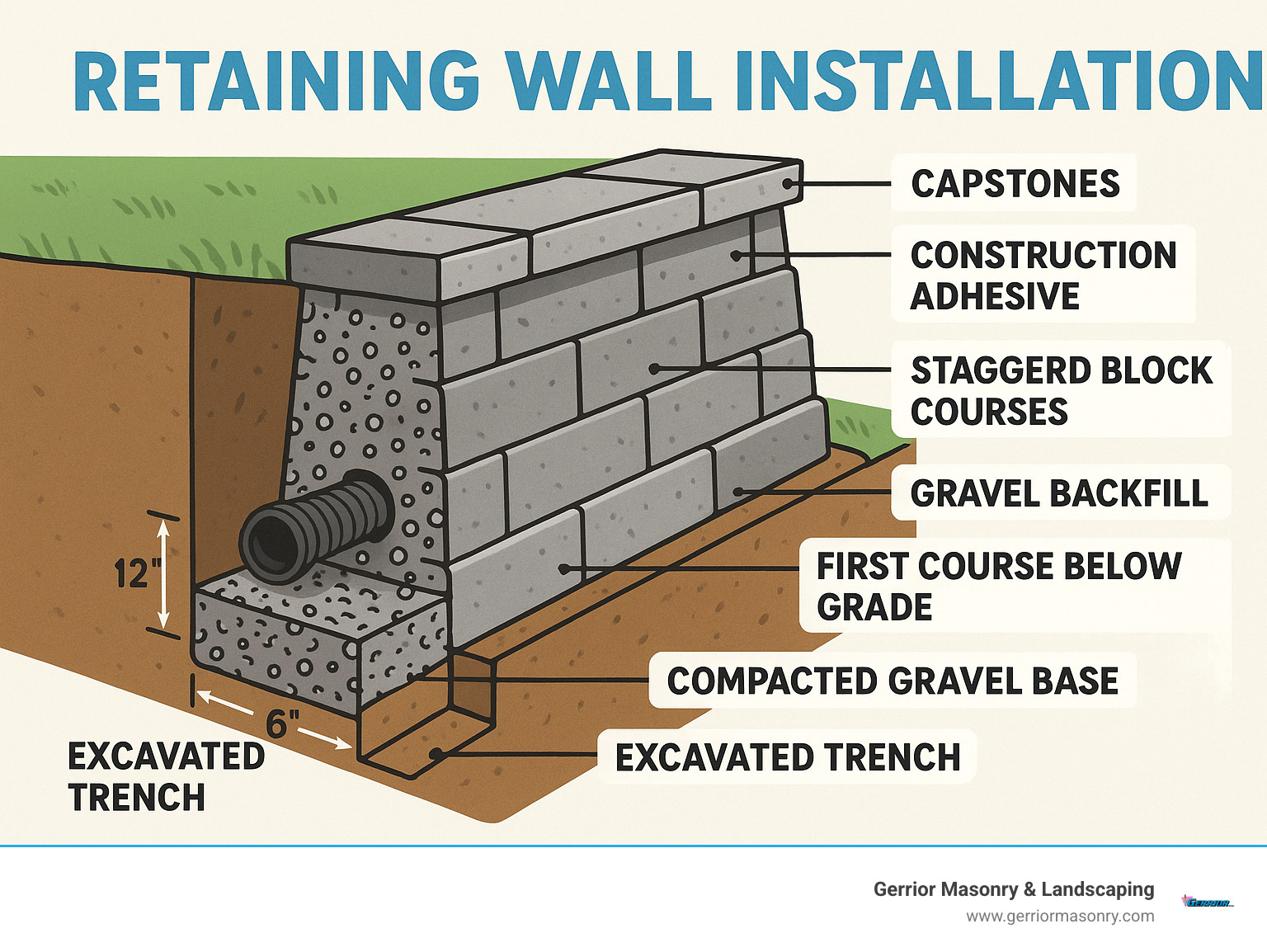
- Excavate properly – Dig trench 4-6 inches deep, 12 inches wide
- Build solid foundation – Add 6 inches of compacted gravel base
- Install first course level – Bury half the first block, level perfectly
- Add proper drainage – Install perforated pipe and gravel backfill
- Stack with reinforcement – Stagger joints, use geogrid for walls over 4 feet
- Finish with capstones – Secure with construction adhesive
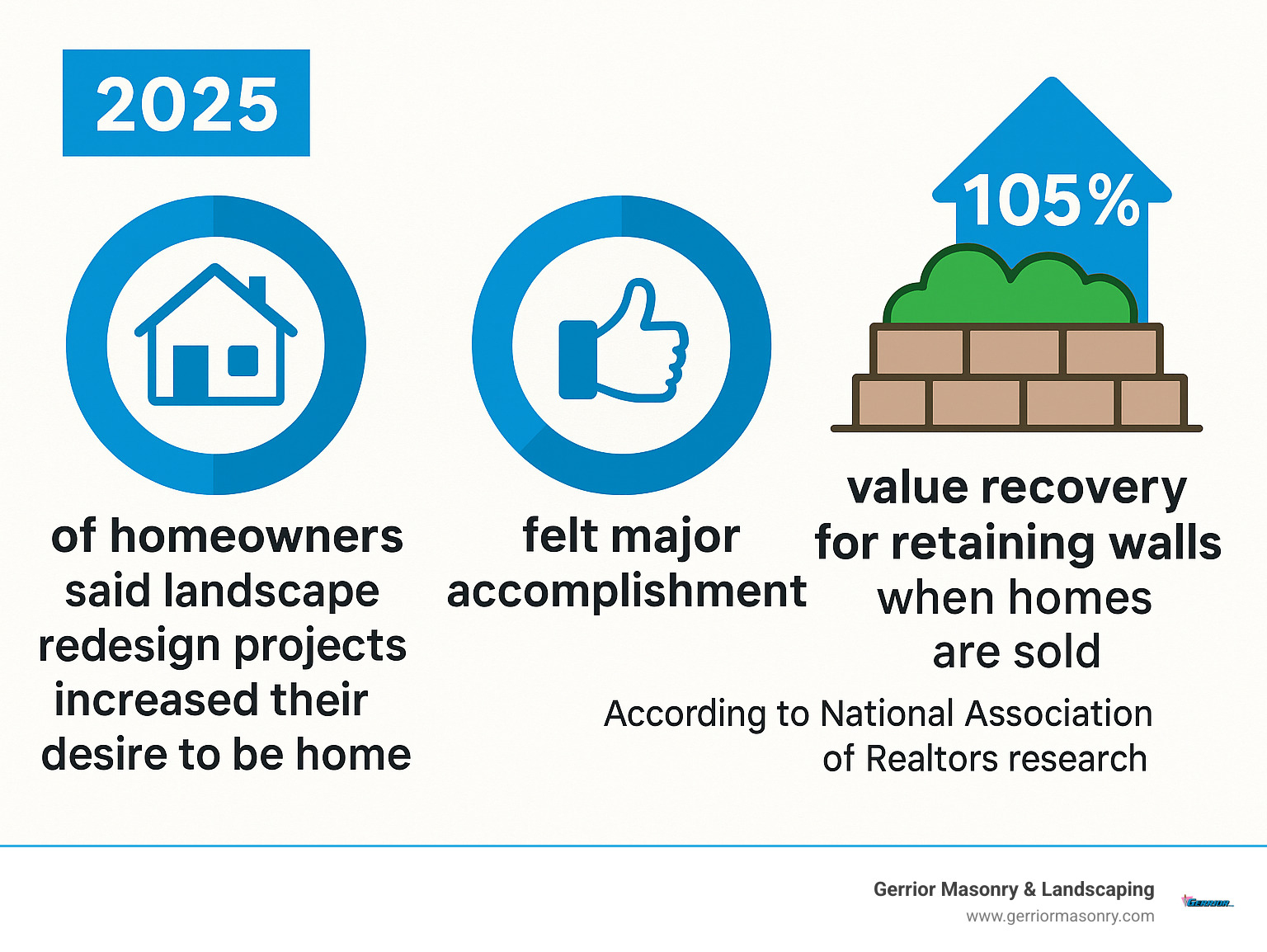
According to the National Association of Realtors, landscape redesign projects show a 105% value recovery when homes are sold, making retaining walls an excellent investment. However, improper installation can lead to wall failure, water damage, and expensive repairs.
The most common mistakes include skipping the planning phase, creating weak foundations, ignoring drainage requirements, and rushing the leveling process. These errors can cause walls to lean, crack, or completely collapse within just a few years.
As Joe Gerrior, owner of Gerrior Masonry & Landscape Construction Corp., I’ve seen countless retaining wall installation projects over my 34 years in the masonry and landscaping industry. My experience has taught me that taking time to do it right the first time saves homeowners thousands in repair costs later.
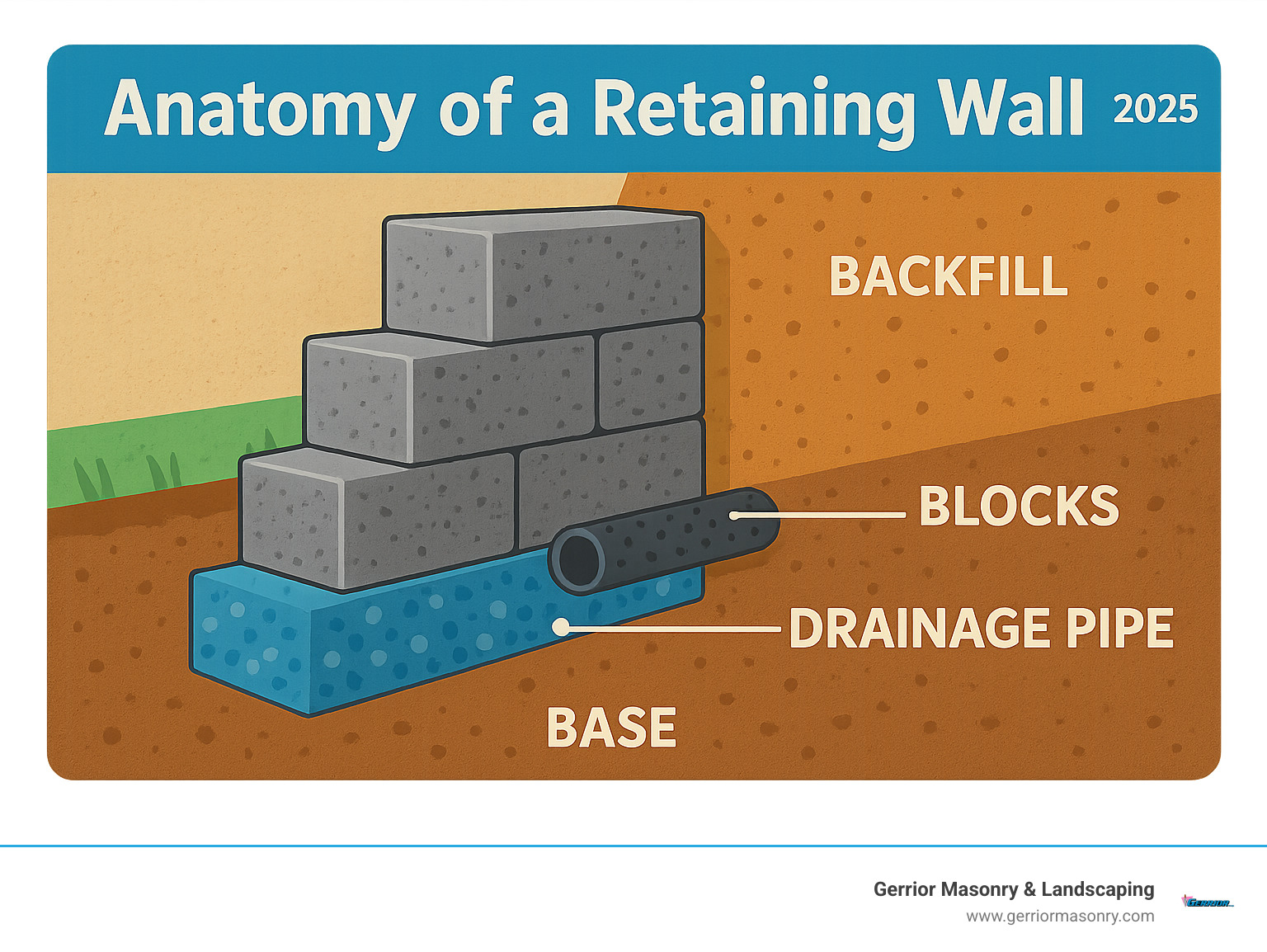
Basic retaining wall installation glossary:
Introduction: More Than Just a Wall
When you picture a retaining wall, you probably see nothing more than a barrier that keeps soil in place. In reality, a well-planned retaining wall installation is a compact engineering project that can reshape your yard, control erosion, and add serious curb appeal.
Key benefits of a properly built wall:
- Stops costly soil erosion on slopes
- Converts steep ground into usable patio or garden space
- Adds architectural interest that can raise property value
A National Association of Realtors study found that landscape redesign projects return roughly 105 % of their cost at resale and make 75 % of homeowners happier to stay home. Those returns only happen, however, when the wall is engineered and installed correctly.
Skipping permits, foundation prep, or drainage can leave you with a leaning, cracked, or collapsed structure in just a few seasons. The rest of this guide shows you how to avoid those headaches.
Before You Dig: Planning Your Retaining Wall Project
I’ve learned over three decades in the masonry business that proper planning prevents poor performance – and nowhere is this more true than with retaining wall installation. The homeowners who skip this crucial step often end up calling us to fix expensive mistakes that could have been easily avoided.
Your planning phase needs to cover four key areas: site assessment, project scope, material selection, and budgeting. During site assessment, you’ll want to look at your soil conditions, existing drainage patterns, slope angles, and any nearby structures. Poor drainage is the number one killer of retaining walls, so understanding how water moves across your property is critical.
Project scope helps you determine the wall height, length, and complexity of your installation. This directly affects whether you can tackle the project yourself or need professional help. Walls over 4 feet typically require engineering consultation and special permits, while walls between 24 to 36 inches high work well for most DIY projects.
Step 1: Design, Layout, and Material Selection
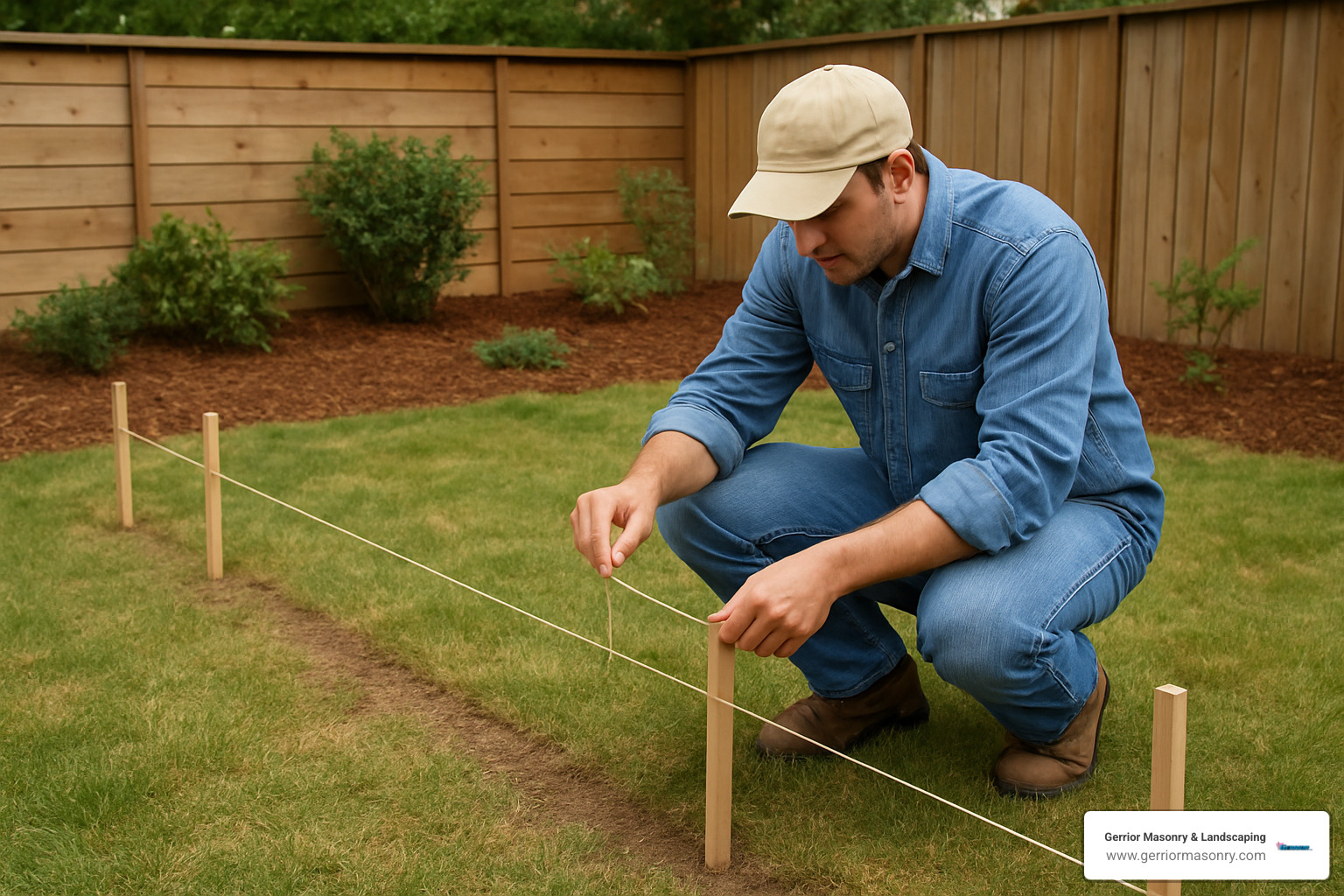
Start your retaining wall installation by marking the wall path using stakes and string. For straight walls, establish a level line using a string level – this becomes your reference point for the entire project. If you’re planning curves vs. straight lines, use a garden hose or spray paint to mark curved paths. Gentle sweeping curves create more beautiful walls than sharp angles, though they’re slightly more challenging to build.
When comparing materials, you’ll find four main options, each with distinct advantages. Interlocking concrete blocks are the most DIY-friendly choice, available in various colors and textures that can mimic natural stone. They typically last 50-100 years with proper installation and are forgiving for beginners.
Natural Stone Retaining walls offer the best combination of beauty and durability, lasting 50-200 years when properly installed. However, they require more skill and experience to build correctly. Poured concrete provides excellent durability and works well for tall walls, but it requires professional installation and can crack over time without proper reinforcement.
Timber walls cost the least upfront but have the shortest lifespan at 10-40 years. They’re prone to rot and insect damage, making them suitable only for temporary solutions or very low walls.
| Material | Cost Range | Durability | Lifespan | Appearance |
|---|---|---|---|---|
| Concrete Blocks | $15-$55/sq ft | High | 50-100 years | Good variety |
| Natural Stone | $10-$85/sq ft | Excellent | 50-200 years | Outstanding |
| Poured Concrete | $20-$45/sq ft | Excellent | 50-100 years | Limited options |
| Timber | $10-$40/sq ft | Poor | 10-40 years | Natural look |
Note: These are average costs based on internet data and not actual costs for Gerrior Masonry services.
Step 2: Checking Local Codes, Permits, and Utilities
Before any excavation begins, you absolutely must call 811 (Call Before You Dig) to have underground utilities marked. This free service prevents dangerous and expensive accidents with gas, electric, water, or telecommunications lines. I’ve seen too many projects turn into disasters when someone hits a gas line or electrical cable.
Local building codes vary significantly from town to town, but most require permit requirements for walls over 3-4 feet in height. Some municipalities have additional restrictions based on setbacks from property lines or proximity to septic systems. It’s worth checking with your local building department early in the planning process.
For walls exceeding 4 feet, engineer consultation becomes necessary. The engineer will analyze soil conditions, drainage requirements, and structural loads to ensure your wall can safely support the intended loads. This isn’t just bureaucratic red tape – it’s genuine safety protection for you and your neighbors.
Average permit costs range from $50 to $450, while engineering design plans typically cost $100 to $220 per hour. These upfront investments prevent much more expensive problems later. Trust me, it’s far cheaper to get the permits and engineering right the first time than to rebuild a failed wall.
The Complete Guide to Retaining Wall Installation
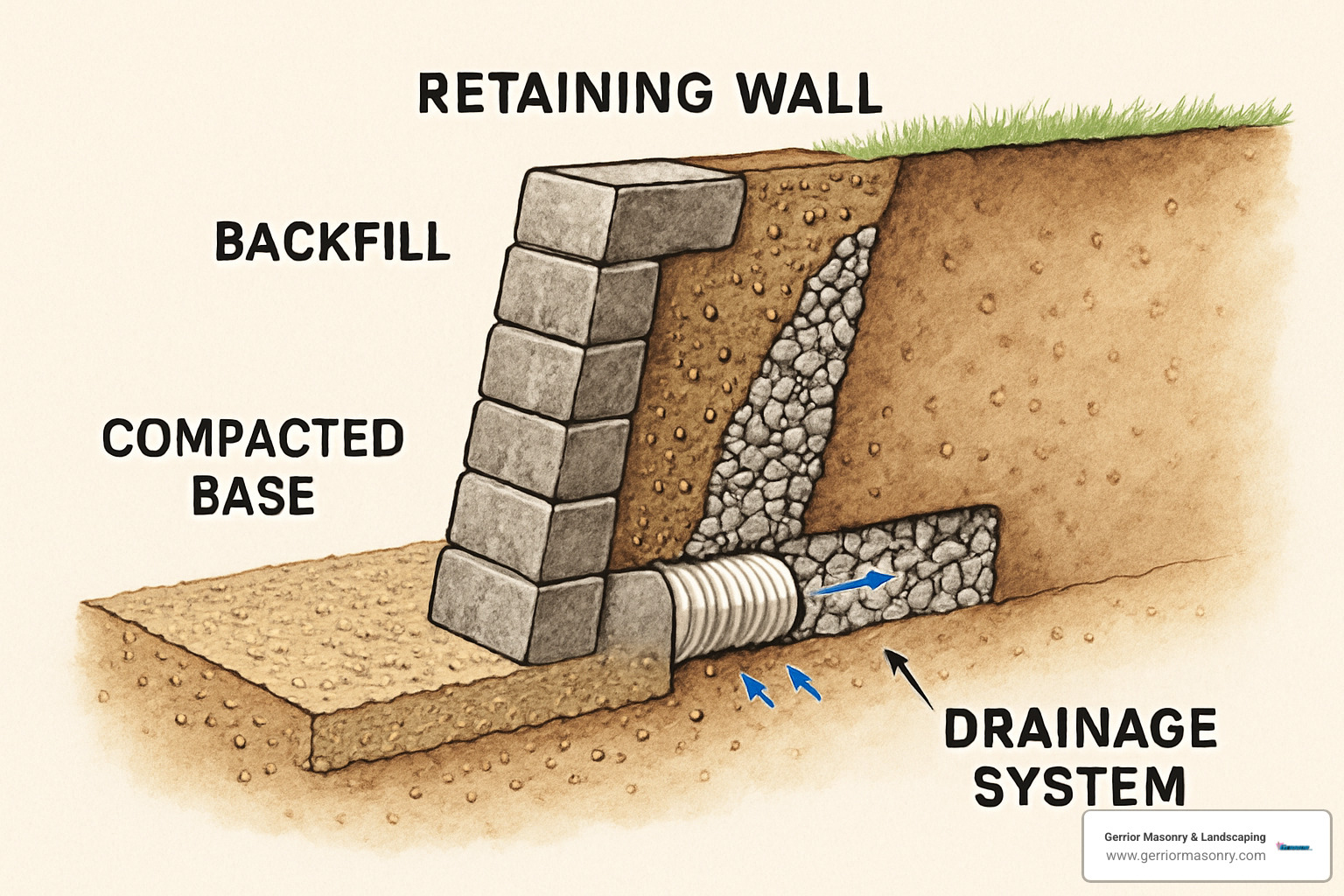
Below is a streamlined version of the process we follow at Gerrior Masonry & Landscaping after more than three decades in the field. Safety first—blocks are heavy, so wear proper protective gear.
1. Excavate & Prepare the Foundation
Dig a trench 4-6 in deep (deeper for tall walls) and about twice the block width. Compact native soil, then add 6 in of ¾-inch crushed gravel in 2-3 in lifts, compacting each layer. Level carefully; an uneven base is responsible for roughly 80 % of wall failures.
2. Lay the First Course
Start at the lowest point, burying about half of each block. Level front-to-back and side-to-side with a rubber mallet. Keep a tight string line on the face so every block stays true.
3. Install Drainage & Backfill
Hydrostatic pressure is enemy #1. Line the excavated soil with landscape fabric, place a 4-in Perforated Drain Pipe Retaining Wall system, and backfill with ¾-in crushed stone at least 12 in behind the wall, compacting in 6-in lifts.
4. Stack, Reinforce & Cap
Stagger joints, brush debris from every course, and backfill as you go. Walls over 4 ft require geogrid placed per engineering specs to tie the wall into the soil mass. Finish with capstones set in construction adhesive.
For a visual reference, see more of our landscape wall projects.
Understanding the Costs of a Retaining Wall Installation
Let’s talk about the elephant in the room – what does retaining wall installation actually cost? After three decades in the masonry business, I’ve learned that homeowners appreciate honest, upfront cost information to help them plan their projects realistically.
Please note: These costs are national averages based on internet data and not actual costs for Gerrior Masonry services.
The typical retaining wall installation project runs $20 to $50 per square foot, though costs can vary dramatically based on your specific situation. If you’re thinking in terms of linear feet, expect to pay $40 to $300 per linear foot for a completed wall.
For a typical 50-foot retaining wall that’s 3 feet high, you’re looking at somewhere between $4,000 and $10,000 for professional installation. I know that’s a wide range, but there’s good reason for it – every project is unique.
Labor costs typically account for the largest portion of your investment, running $10 to $30 per square foot. This includes excavation, foundation preparation, block installation, and proper backfilling. Material costs generally range from $5 to $20 per square foot, depending on your choice of blocks or stone.
Several key factors dramatically influence your final price. Wall height and length are obvious cost drivers – taller walls require deeper foundations, more materials, and often engineering consultation. A 6 to 8-foot high wall can cost $120 to $400 per linear foot because of these additional requirements.
Material choice makes a huge difference in your budget. Natural stone commands premium prices at $10 to $85 per square foot while concrete blocks are more budget-friendly at $15 to $55 per square foot. Specialty materials like weathering steel can push costs to $35 to $135 per square foot.
Site accessibility can make or break your budget. If we can drive equipment right to your backyard, costs stay reasonable. But if we need to hand-carry materials through your house or bring in a crane, labor costs can easily double.
Don’t forget about the hidden costs that catch many homeowners off guard. Land clearing runs $1,500 to $3,000 per acre if you have existing vegetation. Excavation and disposal of soil costs $125 to $225 per cubic yard. Permits range from $50 to $450, while engineering plans cost $100 to $220 per hour for walls over 4 feet.
If your wall needs steel reinforcement (geogrid), add another $2.50 to $5.00+ per square foot to your budget. Poor soil conditions might require special backfill materials or engineering solutions, potentially adding $1,500 to $3,000 to your project cost.
The truth is, Hardscape Retaining Walls are significant investments, but they’re also long-term improvements that can last 50 to 100 years when properly installed. Professional installation ensures proper engineering and performance, often justifying the additional cost through decades of trouble-free service.
Top 5 Beginner Mistakes to Avoid
After thousands of feet of walls, we notice the same five errors again and again. Dodge them and you’re already ahead of the game.
- Skipping the Planning Phase
Call 811, verify property lines, and secure permits before you dig. Ignoring these basics can lead to fines or a forced tear-out. - Weak Foundation
A shallow trench, soil instead of gravel, or lazy compaction guarantees settling and leaning. Dig deep enough and compact that ¾-in gravel base until it feels like concrete. - Poor Drainage
Water build-up can exert thousands of pounds of pressure. Always install a French drain, landscape fabric, and free-draining gravel—never native soil—behind the wall. - Building Too Tall Without Reinforcement
Gravity walls max out around 4 ft. Taller structures need geogrid and often an engineer’s stamp. Don’t gamble; consult a pro for anything higher. - Rushing the Process
Take the time to level the first course and compact every 6-in lift of backfill. Patience here adds decades to the life of the wall.
For more on solid footing, see our guide on Foundation Repointing.
Frequently Asked Questions about Retaining Walls
How long does a retaining wall last?
A properly installed retaining wall typically lasts 50 to 100 years, though this varies significantly based on the materials you choose and how well the installation is executed.
Poured concrete and natural stone walls are the marathon runners of the retaining wall world – they often exceed 100 years with minimal maintenance. I’ve seen natural stone walls from the 1800s that are still going strong, which is pretty remarkable when you think about it.
On the other hand, timber and railroad tie walls are more like sprinters – they look great initially but typically last only 10-20 years due to rot and insect damage. Even pressure-treated lumber will eventually deteriorate when it’s constantly battling soil moisture and freeze-thaw cycles.
Here’s the thing though – the material is only part of the story. Proper installation is the real key to longevity, especially when it comes to drainage and foundation work. In my 30+ years in this business, I’ve seen expensive natural stone walls fail within a few years due to poor drainage, while well-built concrete block walls are still standing strong after decades.
The walls that fail prematurely almost always have drainage problems or foundation issues that could have been prevented with proper installation techniques. It’s like building a house on sand – no matter how beautiful the materials are, it won’t last without a solid foundation.
Can I build a retaining wall on a slope?
Absolutely! Building retaining wall installation projects on slopes is actually one of their primary functions – that’s exactly what they’re designed for. However, steep slopes do present some special challenges that require careful planning.
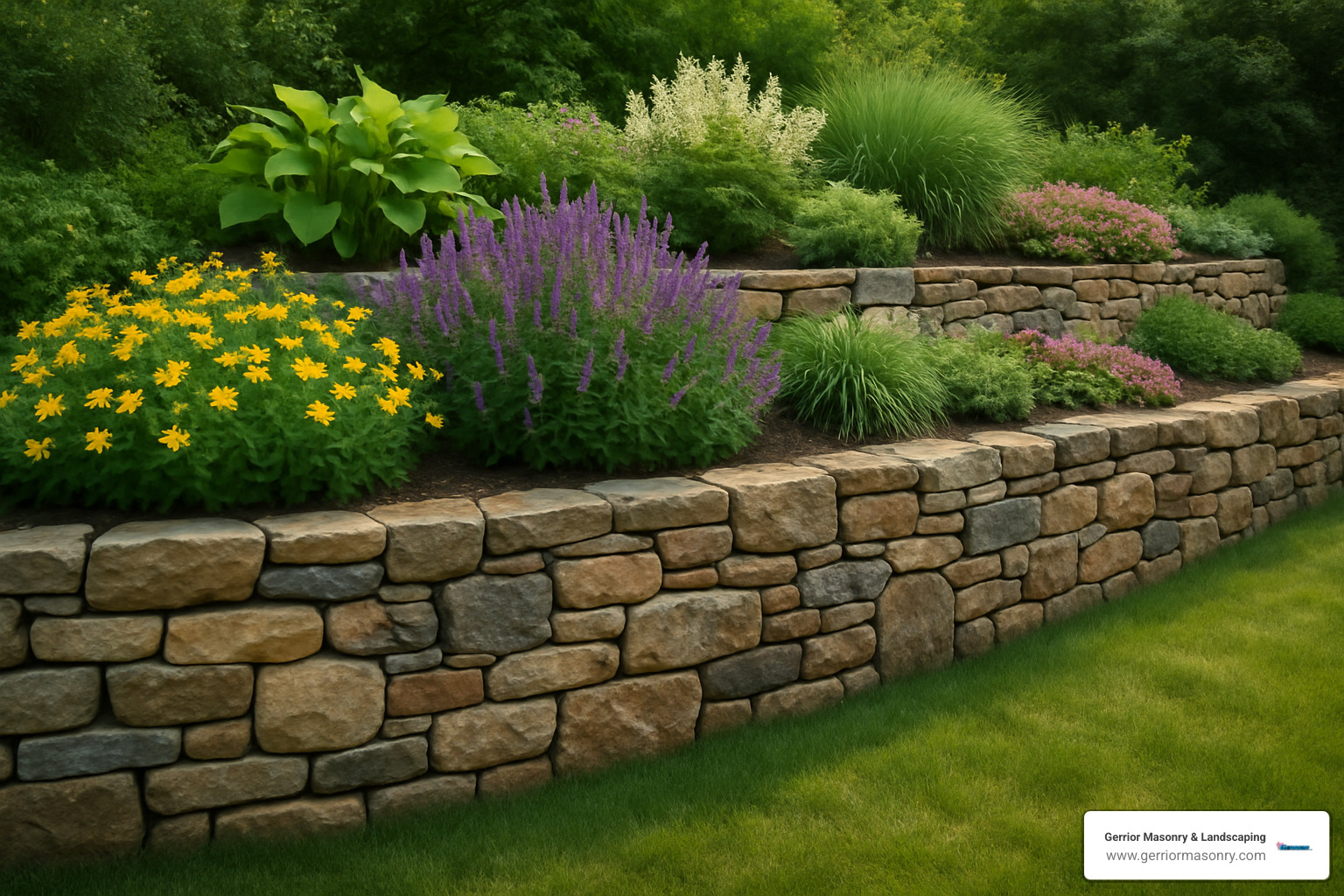
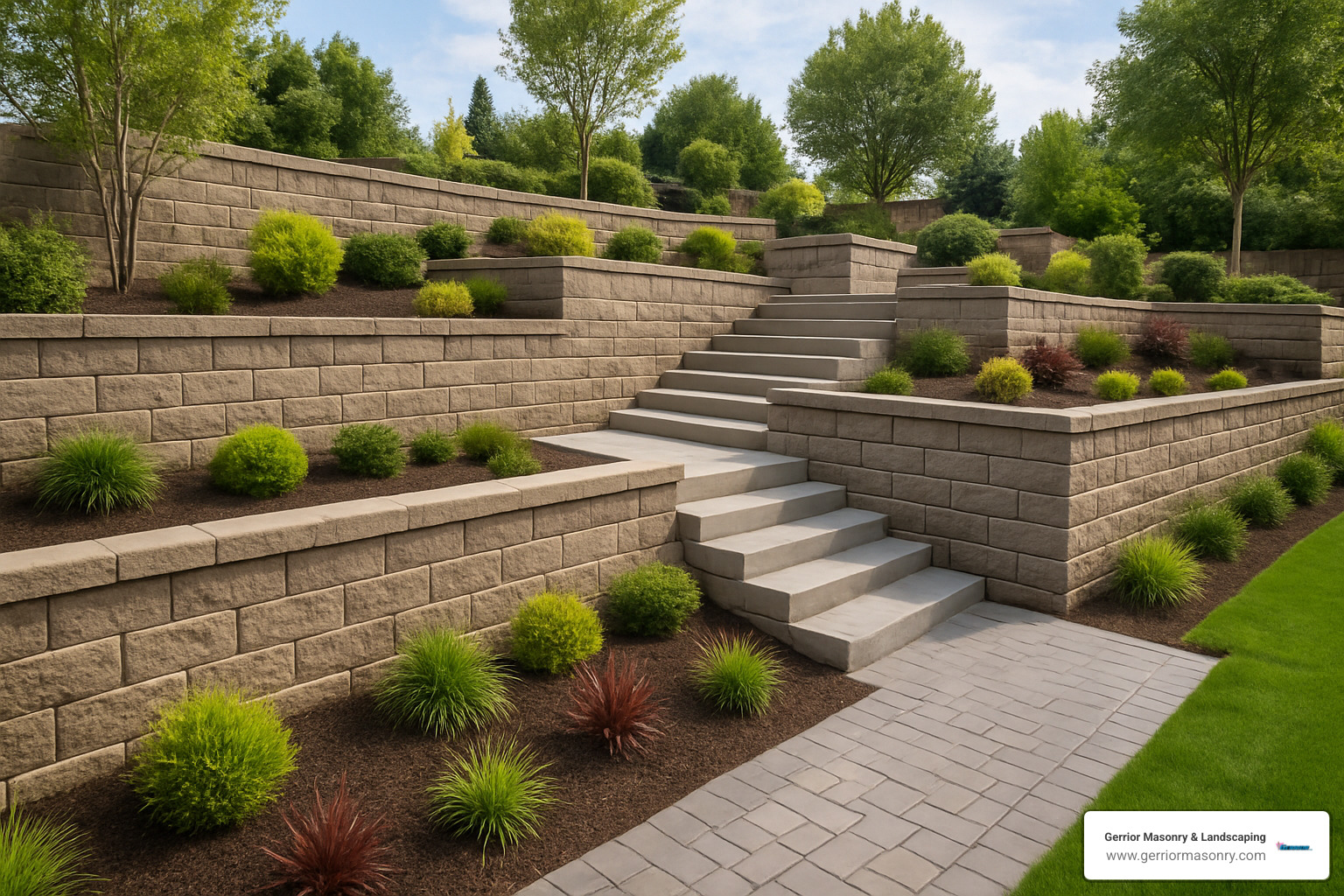
For steep grades, a series of shorter, terraced walls is often much better than one tall wall. Think of it like creating natural steps in your landscape. This approach reduces the load on each individual wall and creates more stable conditions overall.
There’s actually an engineering rule for this: the upper wall height should be less than or equal to the lower wall height, and the distance between walls should be at least twice the height of the lower wall. It sounds complicated, but it’s really just about distributing the pressure more evenly.
Building on slopes also requires special attention to drainage since water naturally wants to flow downhill and can concentrate behind your wall. Proper drainage design becomes even more critical in these situations – you’re essentially redirecting nature’s water flow.
Learn more about building a retaining wall on a slope for detailed guidance on slope-specific techniques that can help you tackle these more challenging projects.
When should I hire a professional?
While small retaining wall installation projects can definitely be tackled by dedicated DIYers, there are several situations where calling in the pros is not just smart – it’s essential.
Any wall over 4 feet high absolutely requires professional expertise. These walls need engineering consultation and often special permits. The consequences of failure are simply too severe to risk improper installation. I’ve seen tall walls collapse suddenly, and it’s not something you want to experience.
Complex soil or drainage issues also call for professional assessment. Clay soils, high water tables, or existing drainage problems require specialized solutions that most homeowners aren’t equipped to handle. It’s like trying to perform surgery with a butter knife – you need the right tools and expertise.
If your wall will be supporting critical structures like a driveway, foundation, or other important elements, professional installation becomes non-negotiable. The potential damage from failure far exceeds any savings from DIY installation.
Sometimes homeowners hire professionals simply because they want guaranteed quality and longevity. Professional installation typically includes warranties and ensures compliance with all building codes. There’s real peace of mind in knowing your wall was built right the first time.
When looking for professionals, seek out certified installers from organizations like the Mason Contractors Association of America (MCAA) to ensure you’re working with qualified experts who understand proper techniques and safety requirements.
Conclusion: Build with Confidence or Call the Professionals
After walking through every aspect of retaining wall installation, you now understand why these projects require such careful attention to detail. The difference between a wall that lasts 50 years and one that fails in just a few seasons comes down to three critical elements: thorough planning, solid foundation preparation, and proper drainage design.
These fundamentals simply cannot be compromised, whether you’re building a small garden wall or a major structural installation. We’ve seen too many homeowners learn this lesson the hard way after their walls start leaning or cracking just a few years after installation.
For smaller projects like a Garden Wall Installation under 3 feet high, a well-planned DIY approach can be both rewarding and cost-effective. There’s real satisfaction in creating something beautiful and functional with your own hands, especially when you follow proper techniques.
However, larger structural walls are definitely best left to experienced professionals. The stakes are simply too high when you’re dealing with walls over 4 feet tall or installations that support critical structures like driveways or foundations. Professional installation ensures safety, compliance with building codes, and the kind of long-term durability that protects your investment.
Think of a retaining wall as a significant investment in your property – because that’s exactly what it is. Whether you choose to build it yourself or hire professionals, taking the time to do it right ensures decades of reliable service and continued improvement to your property value.
The mistakes we’ve outlined throughout this guide – skipping planning, creating weak foundations, ignoring drainage, building too tall without reinforcement, and rushing the process – account for the vast majority of retaining wall failures we’ve witnessed over our three decades in the masonry and landscaping industry.
Don’t let your project become another cautionary tale. If you’re in the Woburn, MA area and want a professionally engineered and beautifully crafted retaining wall, trust the experts at Gerrior Masonry & Landscaping. Our team brings over 30 years of experience to every project, building hardscapes that truly last. We take pride in our skilled craftsmanship and owner oversight on every single job.
We proudly serve communities throughout Middlesex and Essex County, Massachusetts, and we’d love to help make your retaining wall vision a reality.
Explore our Landscape Retaining Wall services to get your project started.
