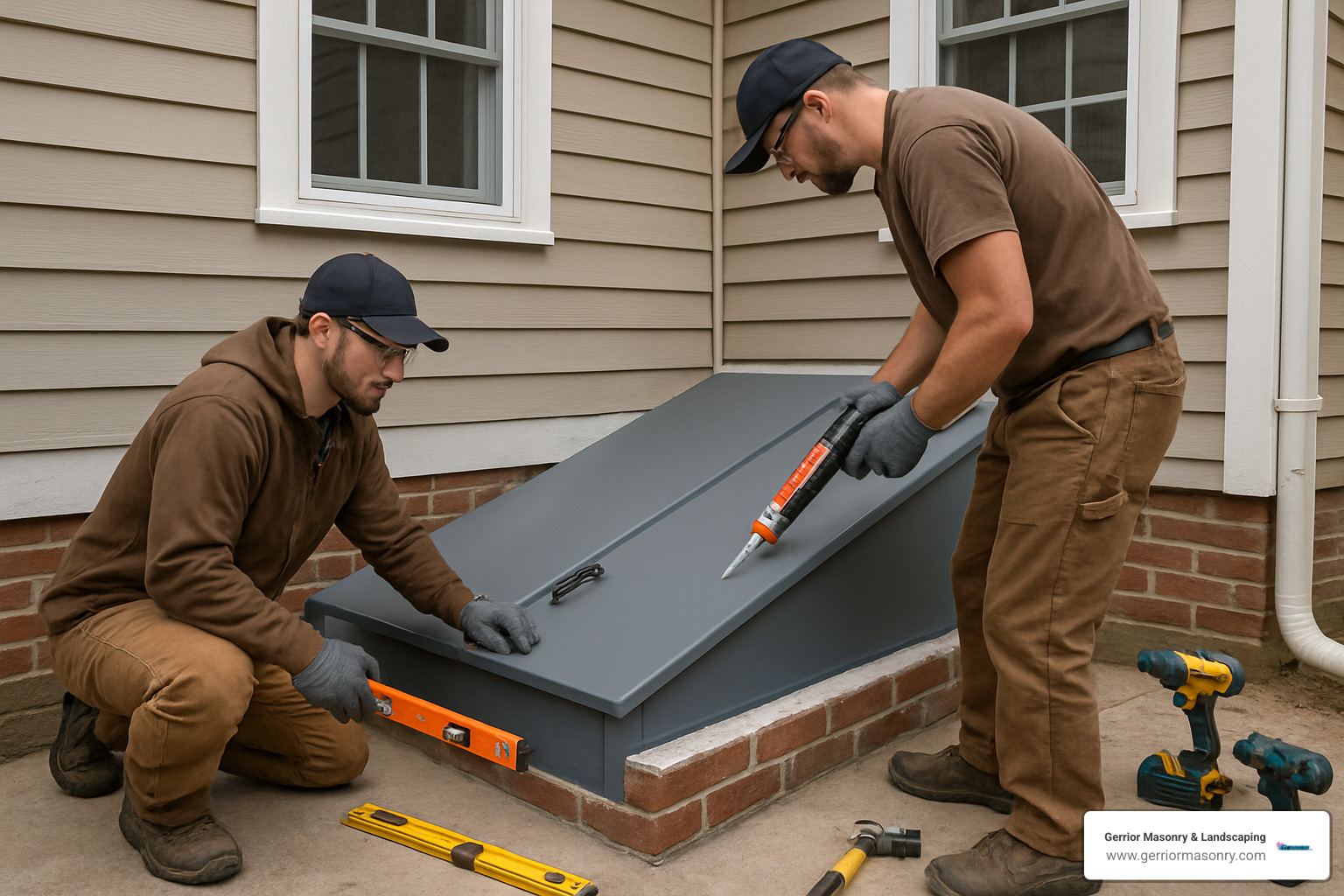
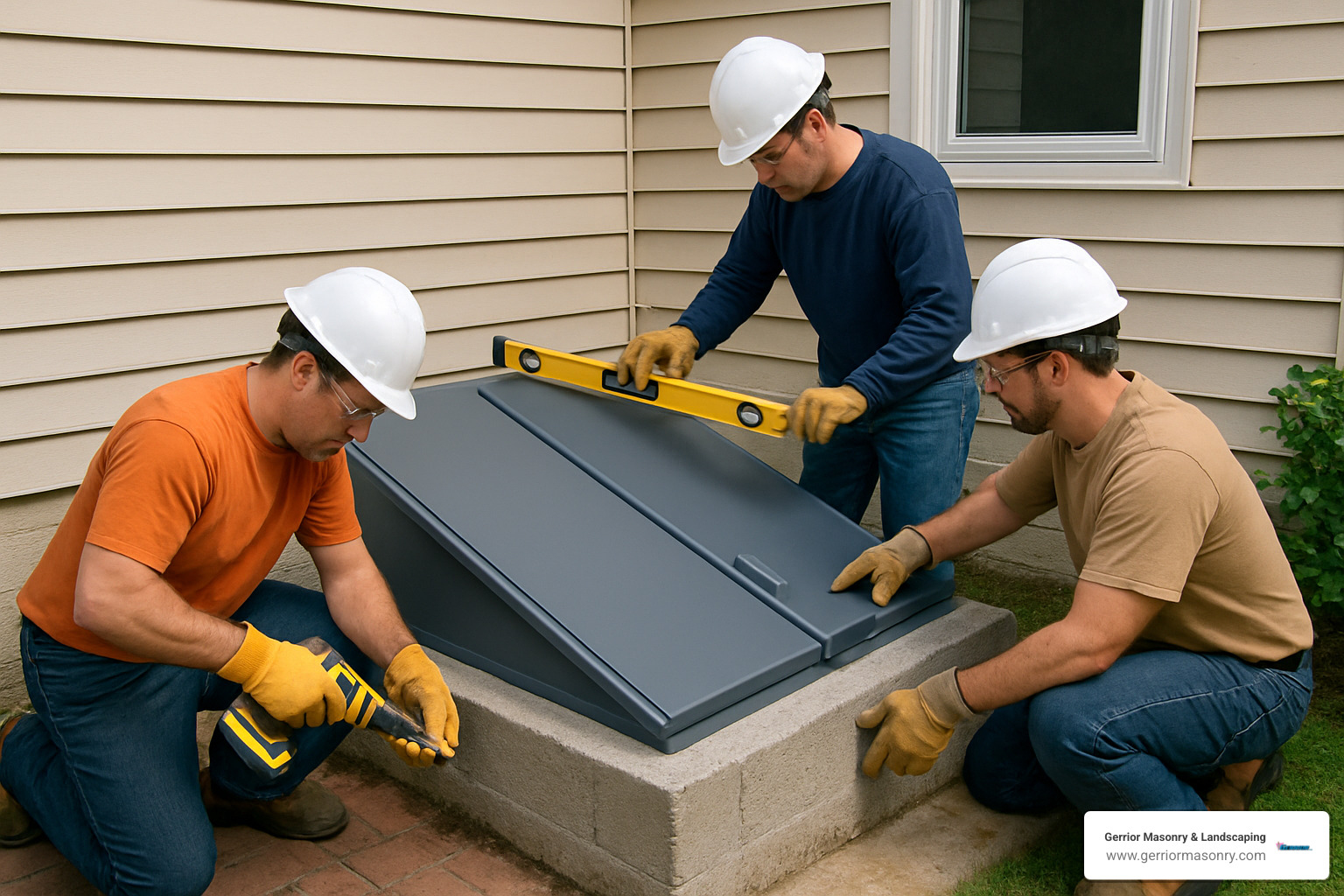
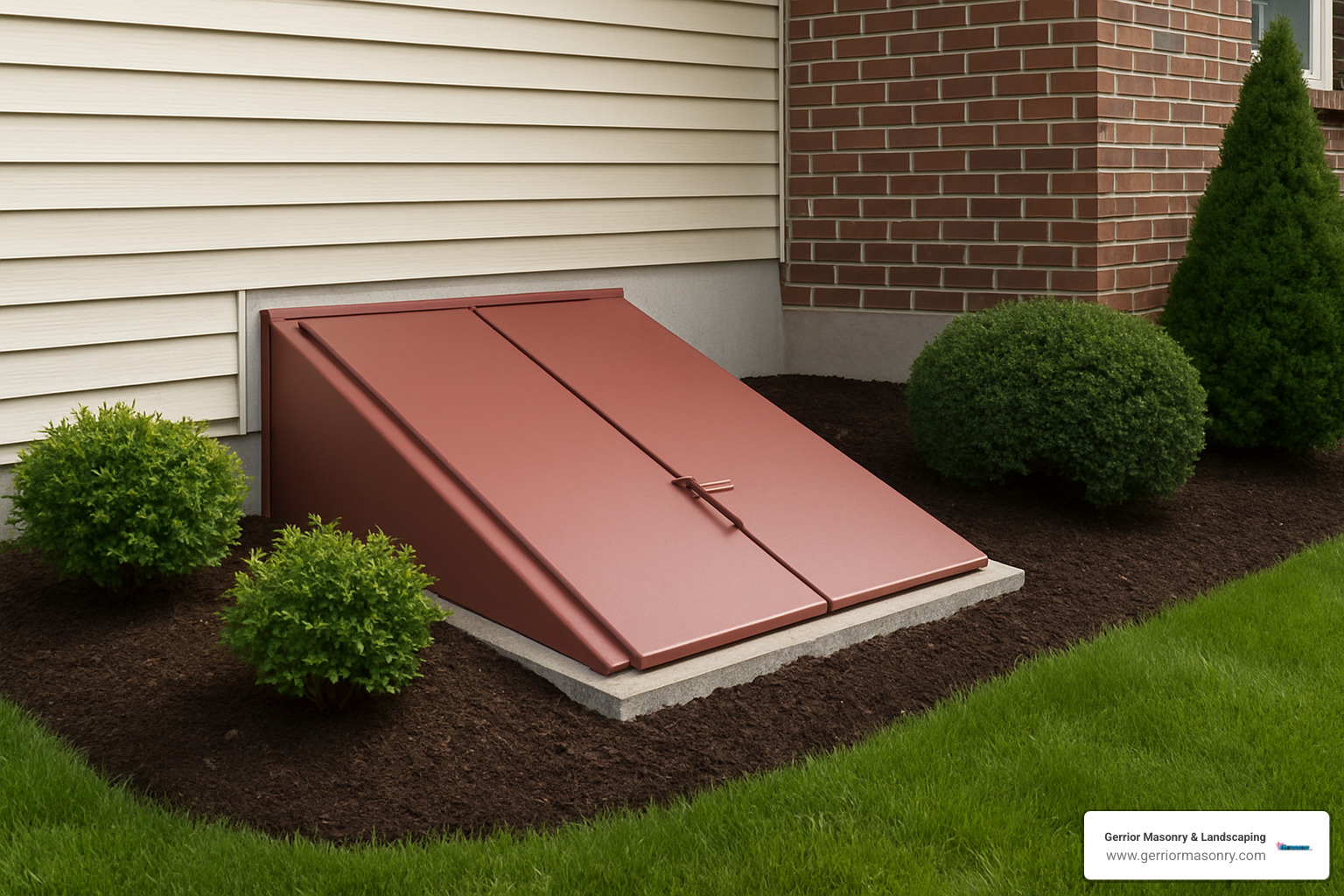
Why Understanding Bilco Door Installation Costs Matters for Massachusetts Homeowners
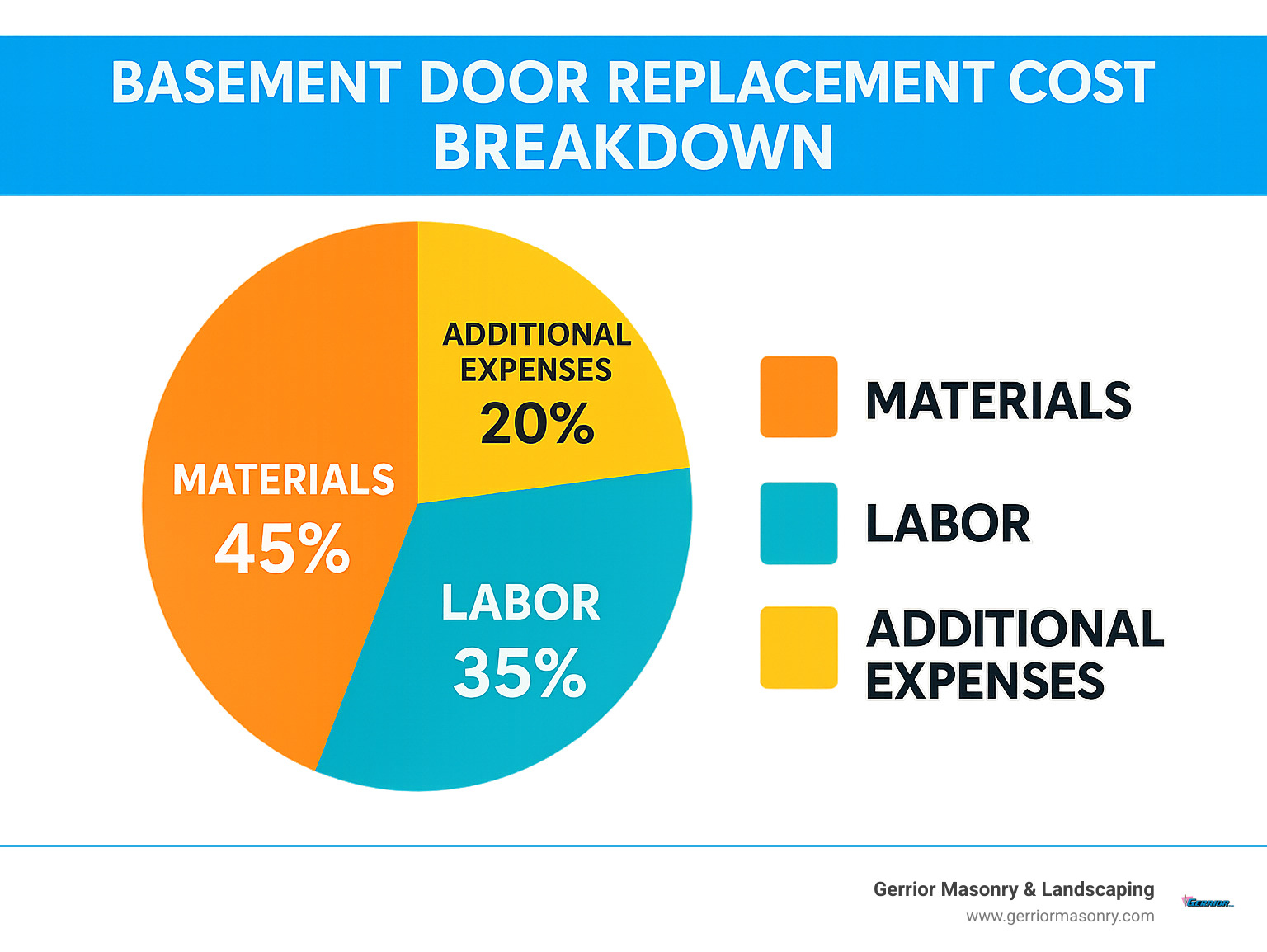
The cost to install bilco door systems typically ranges from $1,500 to $5,000 for a complete installation, though prices can vary from as low as $500 for a simple door replacement to over $6,000 for complex projects requiring excavation and foundation work.
Quick Cost Breakdown:
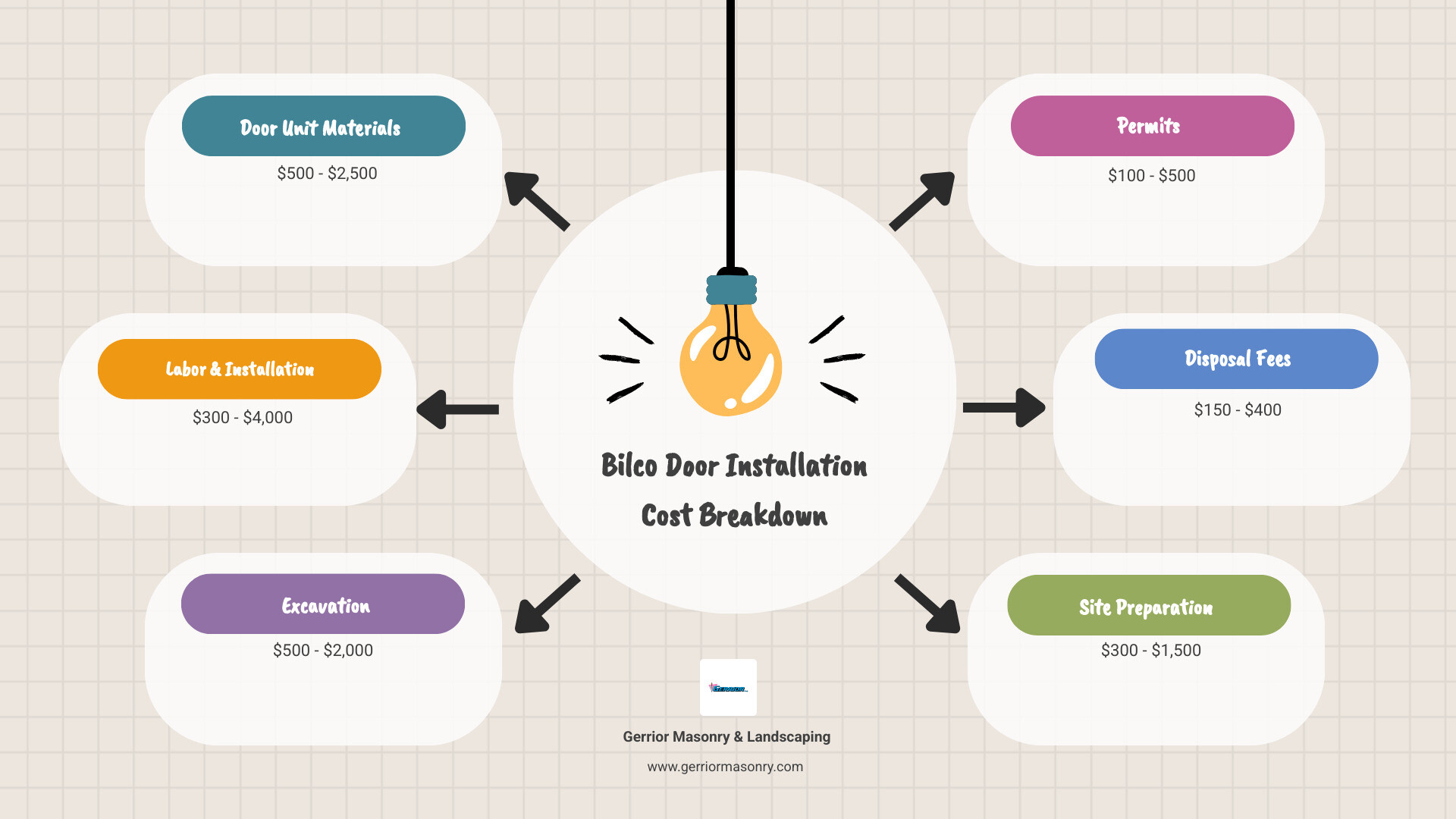
Door unit only: $500 – $2,500 (depending on material and size)
Labor and installation: $300 – $4,000 (based on complexity)
Total average project cost: $1,750 (typical range: $1,500 – $5,000)
Complex installations: Up to $6,000+ (with excavation, permits, and structural modifications)
Note: These are average costs based on internet data and not actual costs for Gerrior Masonry services.
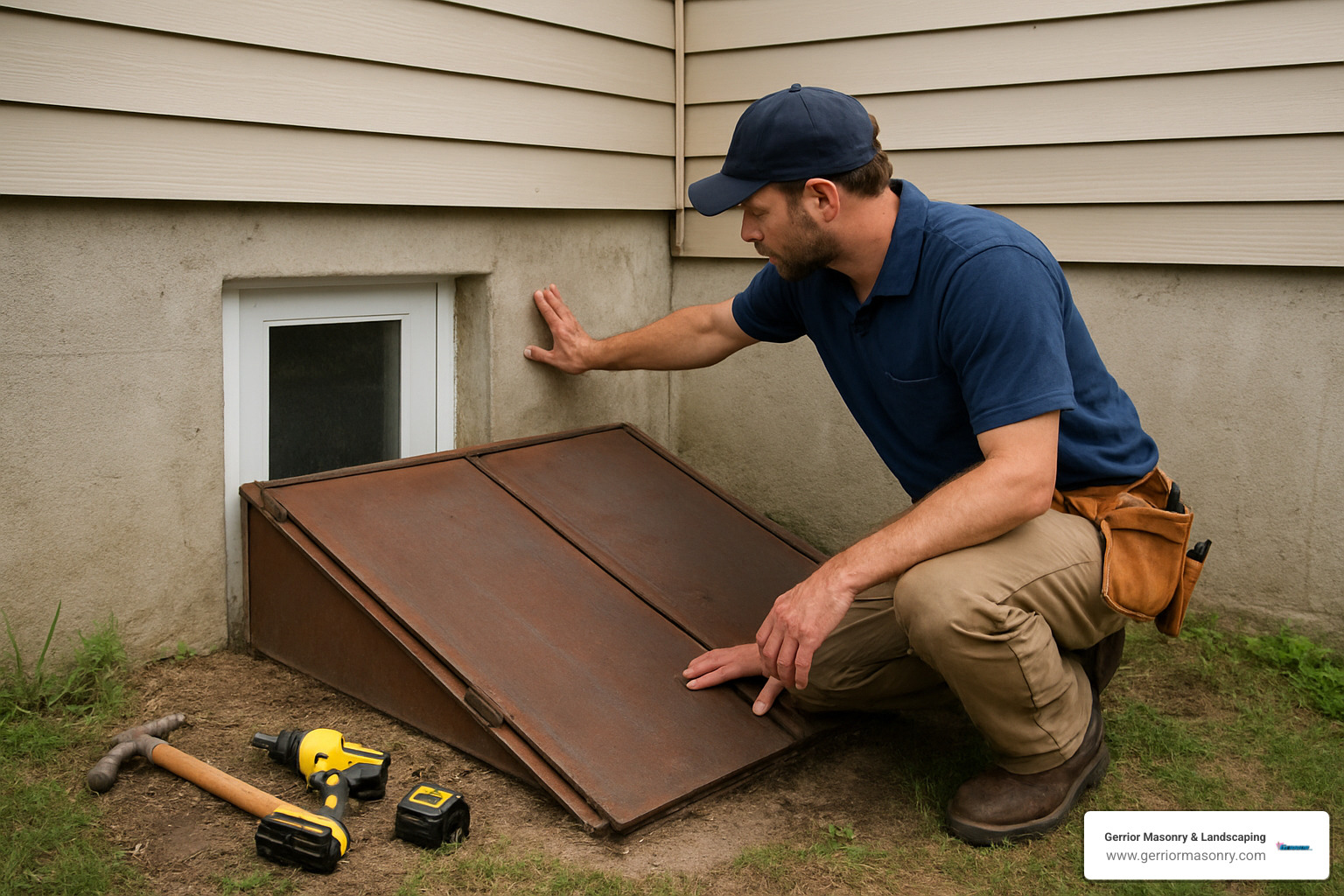
If your basement bulkhead is letting in water, showing signs of rust, or simply won’t open smoothly anymore, you’re likely facing a replacement decision that affects both your home’s functionality and safety. Bilco doors—those angled metal doors that provide exterior access to your basement—serve multiple critical purposes: they protect your basement from the elements, provide emergency egress as required by building codes, and allow easy access for moving large items in and out of your lower level.
The cost to install these systems varies dramatically based on several factors. A straightforward replacement where the existing foundation and framing are in good condition might cost around $1,200 to $2,000. However, if you need to cut into an existing concrete foundation, add masonry work, or modify the structure to meet current building codes, you could be looking at $3,000 to $5,000 or more.
As Joe Gerrior, owner of Gerrior Masonry & Landscape Construction Corp., I’ve overseen hundreds of bulkhead installations and replacements across Massachusetts over the past 34 years, and I understand how confusing the pricing can be for homeowners trying to budget for this essential upgrade. The cost to install bilco door systems depends heavily on your specific situation, from the material you choose to the condition of your existing foundation.
Factors Influencing the cost to install bilco door
When we look at the total bill for a basement entryway, it is rarely just the price of the metal doors themselves. In Massachusetts, where our weather swings from humid summers to heavy, salt-laden winters, the installation environment plays a massive role.
Based on internet data averages, the typical cost to install bilco door units falls between $1,500 and $5,000. However, for a simple swap of an existing door that fits perfectly, you might only spend $800 to $1,200. On the other end of the spectrum, a complex project involving cutting through a concrete foundation to create a brand-new entrance can easily exceed $6,000.
Several variables dictate where your project will land on this scale:
Existing Foundation Condition: If the concrete “casting” or the masonry steps beneath the door are crumbling, we must repair those before a new door can be safely bolted down.
Site Accessibility: If we have to manually move heavy steel doors or concrete through a tight backyard in Winchester or Lexington, labor costs will naturally rise.
Waterproofing Needs: In areas with high water tables, additional masonry work may be required to raise the door above grade to prevent basement flooding.
Material Choices and the cost to install bilco door
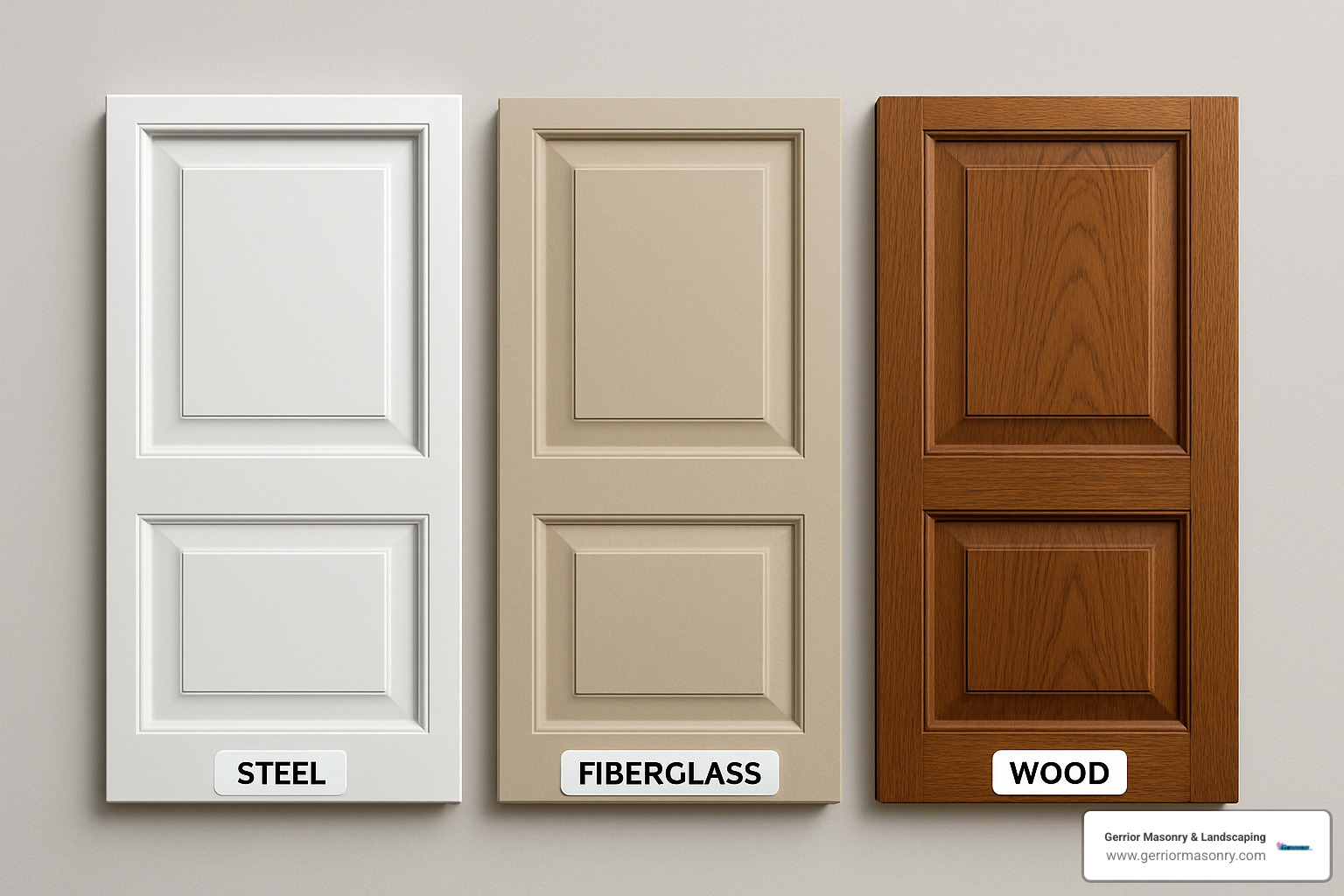
The material you choose is the first major fork in the road for your budget. Bilco and other bulkhead manufacturers offer several options, each with its own price point and performance characteristics.
Material Type
Estimated Material Cost
Pros
Cons
Standard Steel
$500 – $1,000
Most affordable, very secure.
Needs regular painting to prevent rust.
Powder-Coated Steel
$1,000 – $2,500
Durable finish, many colors, rust-resistant.
Higher upfront cost.
Fiberglass
$1,000 – $2,000
Won’t rust or rot, lightweight.
Can be prone to cracking if struck hard.
Aluminum
$1,500 – $3,000
Excellent for coastal air, no rust.
Most expensive option.
Note: These are average costs based on internet data and not actual costs for Gerrior Masonry services.
In our experience serving Middlesex and Essex County, steel remains the most popular choice due to its ruggedness. However, we often recommend powder-coated finishes. While they add about $600 to $800 to the cost to install bilco door systems, they save you the headache of scraping and painting every few years. If you live in a coastal town like Beverly or Marblehead, fiberglass or aluminum might be the smarter long-term investment.
Labor and Complexity in the cost to install bilco door
Labor is often the most variable part of the quote. For a standard replacement, professional labor costs typically range from $300 to $800. But “standard” is a rare word in New England masonry.
If we are performing a fresh bulkhead-replacement, we often encounter hidden complexities:
Excavation: Adding a door where none existed requires digging, which can add $500 to $2,000 depending on soil conditions.
Masonry Work: Fixing structural issues in the concrete “areaway” is vital for a watertight seal.
Permits: Most Massachusetts towns require a building permit for structural changes, usually costing between $100 and $500.
Disposal Fees: Disposing of the old steel unit and broken concrete can cost $150 to $400 in haul-away fees.
Size and Customization Options
Size matters when it comes to your wallet. Bilco offers standard sizes (Size O, B, C, etc.) that fit the majority of modern homes. If your home was built in the 19th century in a place like Salem or Andover, you might have a non-standard opening.
Standard Sizes: These keep the cost to install bilco door units lower, generally between $500 and $900 for the unit.
Extension Panels: If your areaway is extra long, extension panels can add $200 to $500 to the material cost.
Custom Dimensions: Custom-fabricated steel doors can cost $2,500 to $4,000 just for the materials.
When a door doesn’t fit perfectly, we sometimes use bulkhead door replacement parts or modify the masonry opening to accommodate a standard size, which is often more cost-effective.
Professional vs. DIY: Maximizing Value and Longevity
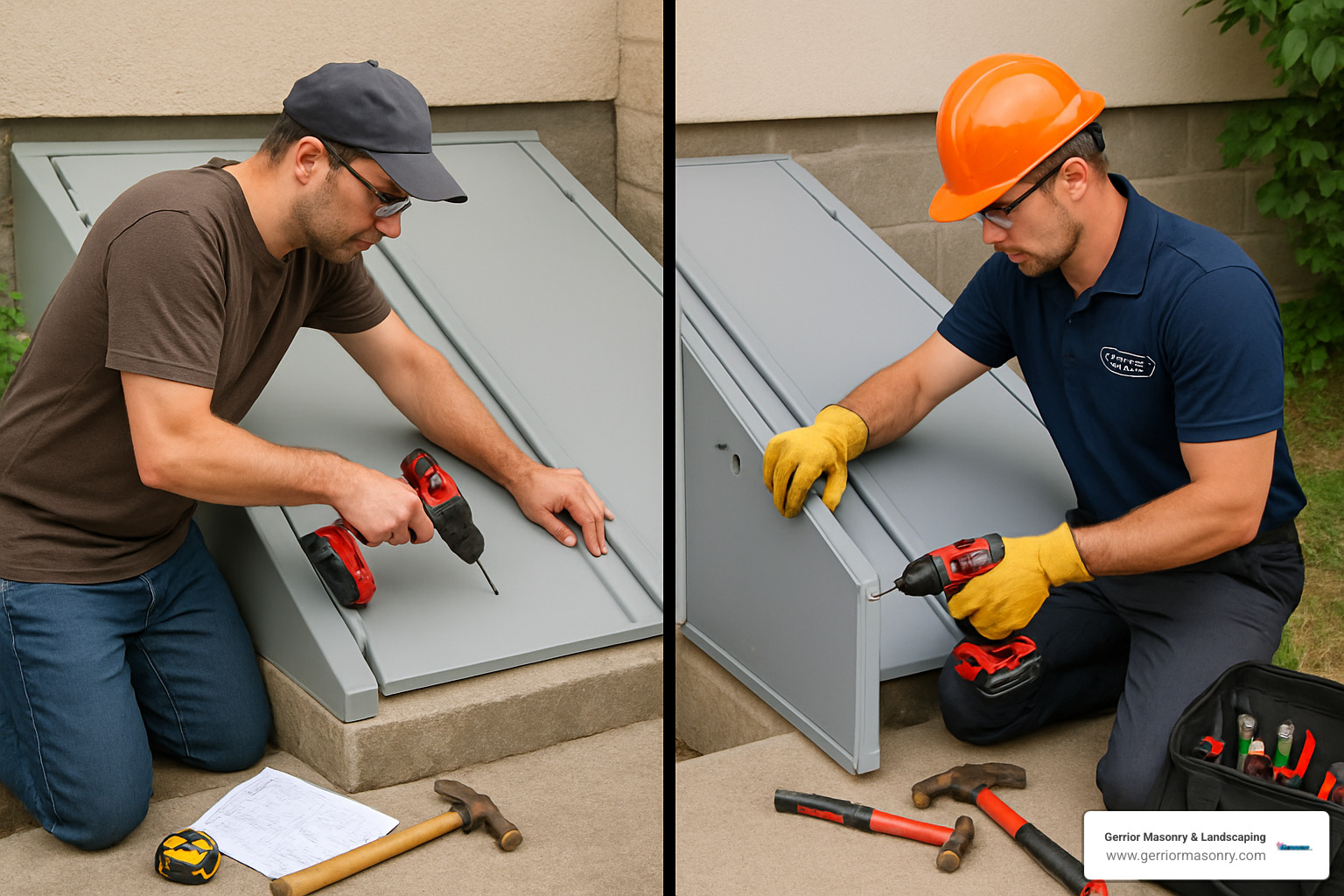
While a DIY installation can save you approximately 40% on the total cost to install bilco door systems, it comes with significant risks regarding safety and durability.
A professional installation ensures three things that a DIY project often misses:
Safety and Code Compliance: In Massachusetts, bulkhead doors are often the primary emergency egress. Professionals ensure the door is installed to specific IRC (International Residential Code) standards.
Structural Integrity: Improperly anchoring heavy doors into old concrete can cause foundation cracks or lead to the door pulling loose under heavy snow loads.
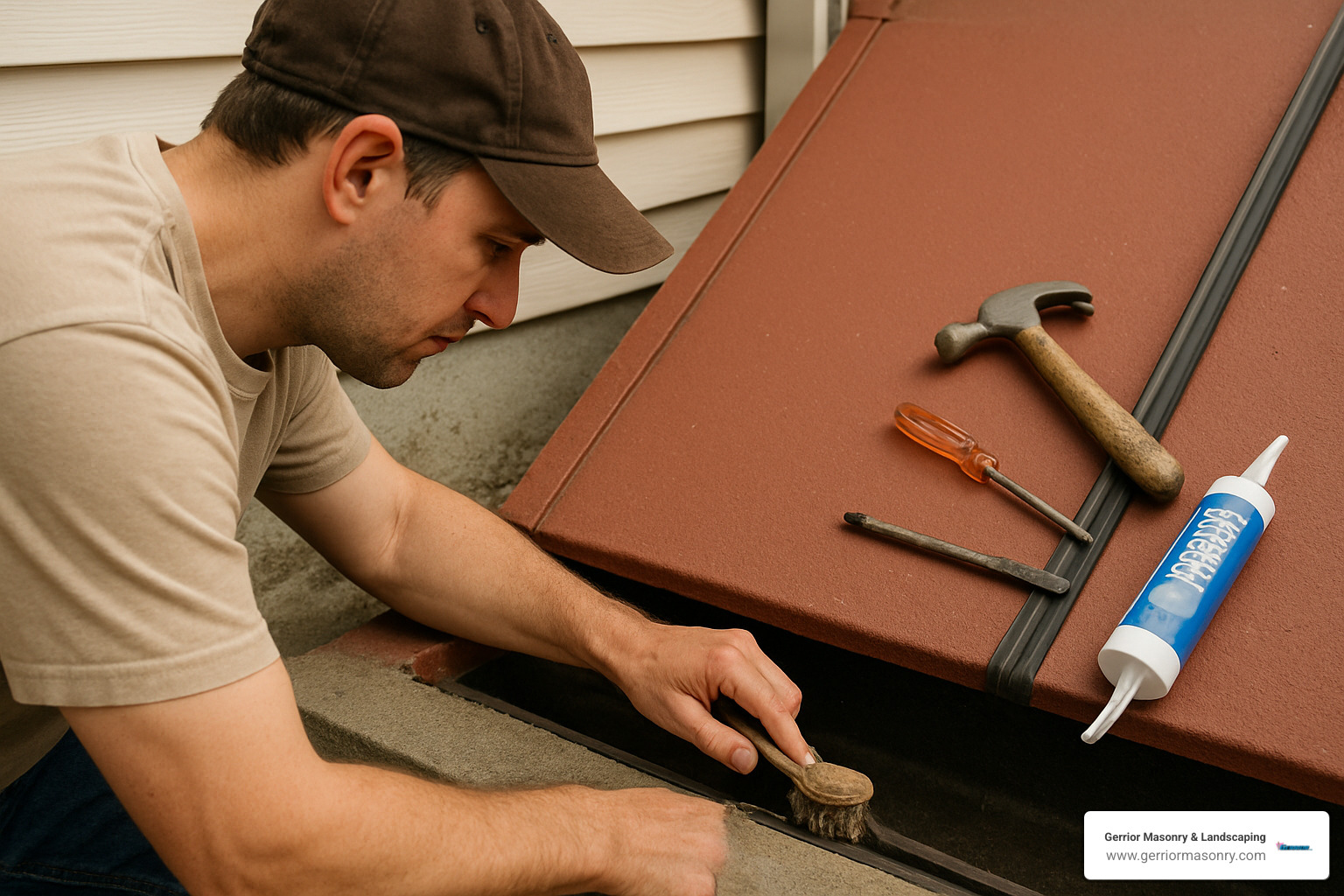
The Watertight Seal: This is the most common point of failure for DIY projects. Proper flashing and sealing between the house siding, masonry, and metal door are essential to prevent leaks.
A professional installation typically takes one to two days. When you consider that a well-installed Bilco door can last 20 to 30 years, the “per year” cost of hiring a pro is very low. For more context, see How Much Does BILCO Door Installation Cost?.
Building Codes and Egress Requirements
If you are finishing your basement to add a bedroom, the cost to install bilco door systems is an investment in legality. According to the IRC, basements must have a “means of egress” for fire safety.
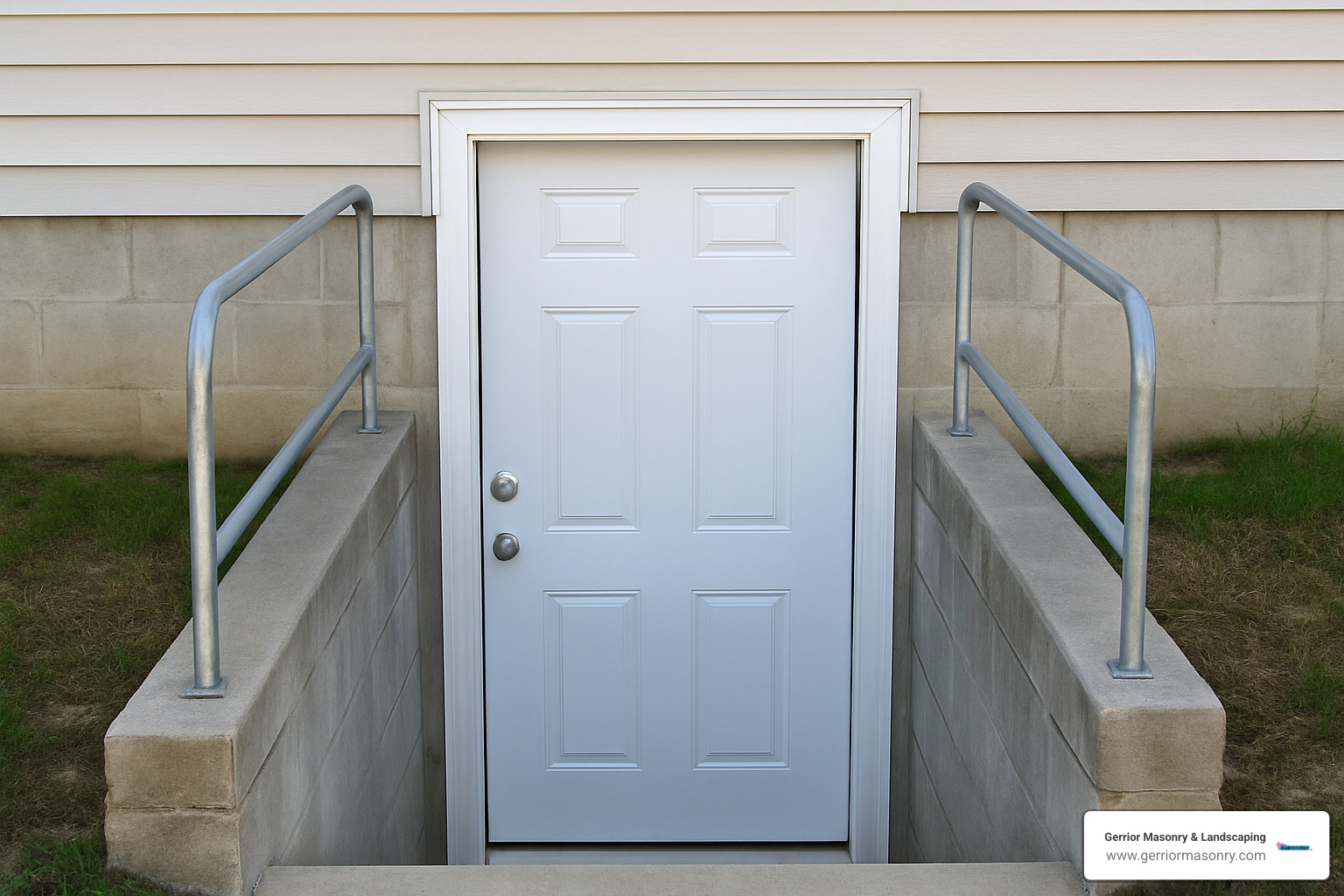
Bilco doors are specifically designed to meet these requirements, featuring internal release mechanisms and gas-spring operators for easy opening. When we install basement entry systems, we ensure that the steps and the door opening meet the minimum width and height requirements mandated by local Massachusetts building inspectors.
Signs You Need a Replacement
How do you know it’s time to stop patching and start replacing?
Visible Daylight: If you can see sunlight through the corners of the door, your conditioned air is escaping and pests can enter.
Advanced Rust: If the metal is flaking or you can poke a screwdriver through it, the bulkhead structural integrity is compromised.
Difficult Operation: If you’re straining to lift the doors, the hinges are likely seized or the frame has warped.
Water Infiltration: Persistent puddles at the bottom of your basement stairs indicate the seal has failed.
Conclusion and Next Steps
Replacing or installing a new Bilco door is one of the most effective ways to protect your home’s foundation and increase its usable square footage. While the cost to install bilco door systems can range from $1,500 for a basic swap to over $6,000 for a structural overhaul, the safety and peace of mind it provides are invaluable.
At Gerrior Masonry & Landscaping, we bring over 30 years of specialized experience to every project. Whether you are in Woburn, Burlington, or anywhere in Middlesex and Essex County, our team ensures that your bulkhead is secure, watertight, and code-compliant. We pride ourselves on owner oversight, ensuring the job is done to the highest masonry standards.
If you’re ready to upgrade your basement access, you can learn more about our bulkhead replacement services or contact us for a consultation.
Note: All pricing figures mentioned in this guide are average costs based on internet data and not actual costs for Gerrior Masonry services. Typical replacement costs average $1,750, with a wide range from $500 to $6,000 depending on project complexity.
Basement entry systems provide direct outdoor access, changing your basement from a storage area into a functional part of your home. They typically feature steel or fiberglass doors in pre-cast concrete or custom-built stairwells.
Quick Overview: Basement Entry System Benefits
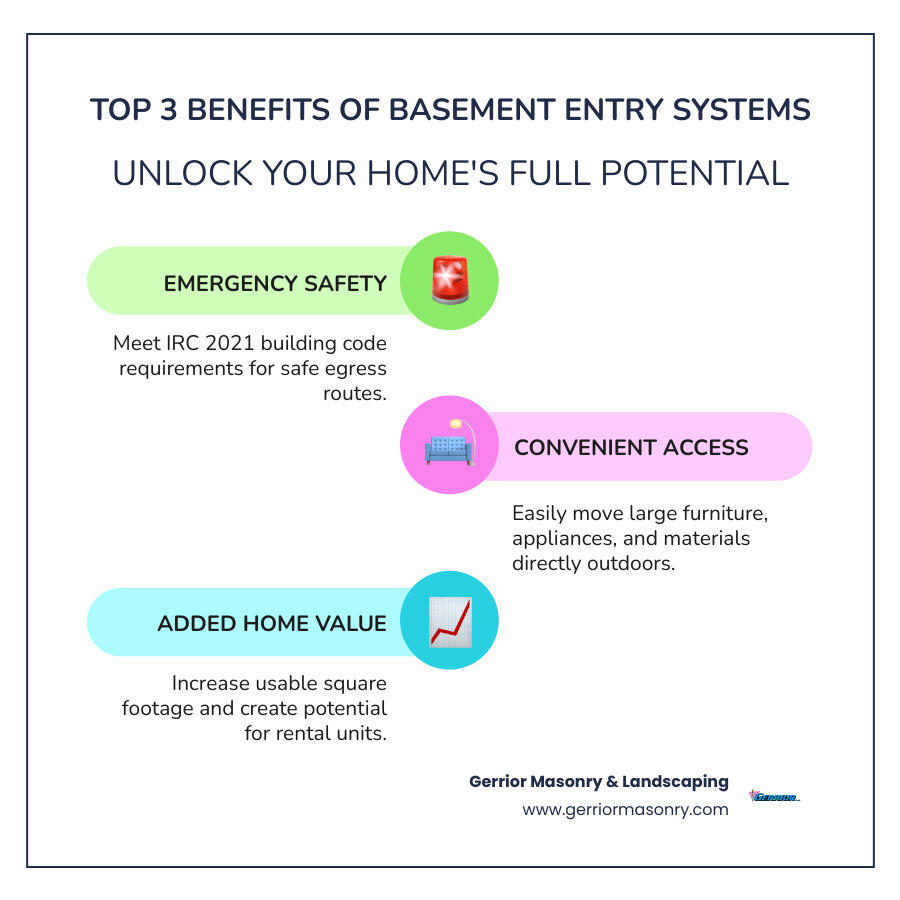
Safety: Meet IRC 2021 building code requirements for emergency egress
Convenience: Easy access for moving large furniture and appliances
Value: Maximize square footage and create potential for rental units
Security: Modern locking systems and durable materials
Adding a complete system—including excavation, foundation cutting, waterproofing, and professional installation—is the fastest way to add convenient basement access. This maximizes your home’s square footage while providing essential emergency outdoor access.
Why Professional Installation Matters
A professionally installed system provides emergency access and a convenient way to move large items. The process requires precise foundation work, drainage, and waterproofing to prevent moisture issues and protect your home’s structure.
I’m Joe Gerrior, owner of Gerrior Masonry & Landscape Construction Corp. For over 34 years, my team has helped Massachusetts homeowners with expert masonry and foundation work. Our experience with basement entry systems covers everything from foundation cutting and waterproofing to complete bulkhead installations that improve safety and home value.
A basement entry system makes your lower level a functional space, adding safety, practicality, and long-term value to your home.
Safety is paramount. A basement entry system provides a crucial emergency escape route, meeting IRC 2021 building code requirements for habitable basements. This isn’t just about code compliance; it’s about peace of mind and ensuring a safe exit when seconds count. For detailed information on these safety requirements, you can check the safe egress information from the ICC. If you’re also considering window options, you’ll find helpful details in our guide to egress windows.
The convenience is a major benefit. A direct outdoor entrance simplifies moving large items like furniture, appliances, or building materials, eliminating the hassle of navigating tight interior stairs and doorways.
Adding accessible square footage significantly boosts your home’s value. A proper entrance can turn your basement into a rental unit, in-law suite, home theater, or gym. This extra usable space is a highly attractive feature for potential buyers.
A basement entry system isn’t just an upgrade; it’s an investment in safety, convenience, and your property’s future value.
Exploring Different Types of Basement Entry Systems
Several options exist for direct basement access. The key is choosing the right system for your home’s layout and your needs.
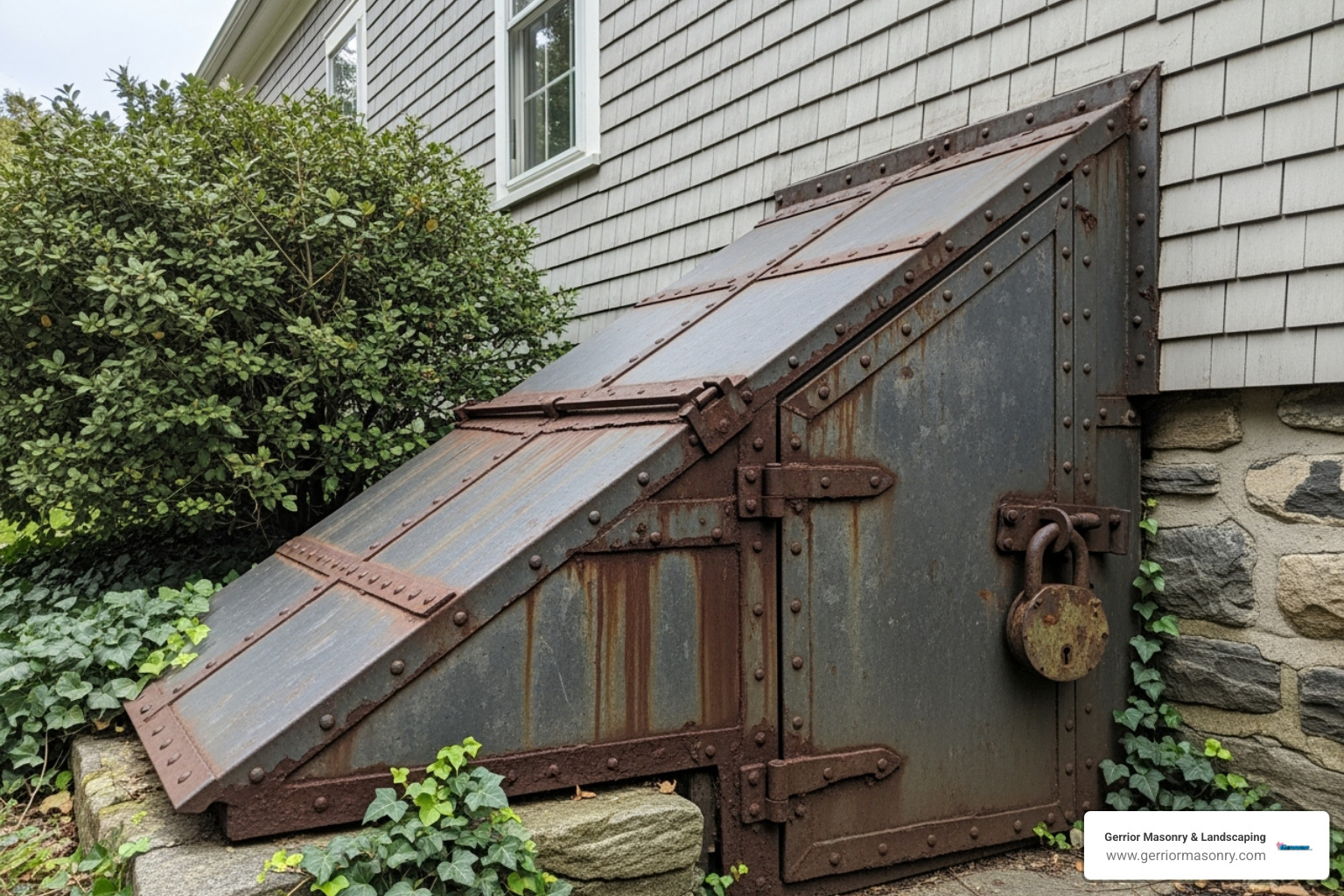
The classic bulkhead door, or cellar door, is a popular choice. These durable, weather-resistant sloped entrances feature steel or fiberglass doors over a concrete stairwell. Their design effectively sheds snow and water, making them ideal for Massachusetts winters.
Walkout entrances are ideal for homes on sloped lots. Doors open directly to a patio or yard, bringing in natural light and fresh air. This transforms a dark basement into a bright, inviting space perfect for family rooms or guest suites.
Pre-cast concrete stairwells are manufactured off-site for consistent quality and fast installation, often completed in just a few hours.
Custom-built stairwells offer complete design flexibility to match specific architectural details or accommodate unique site conditions.
The choice between sloped and vertical entries depends on space and preference. Sloped designs offer traditional weather protection, while vertical systems are more compact. Each type of basement entry system serves the same core purpose: giving you safe, convenient access. For more details, check out our information on basement stairwells.
Choosing the Right Materials for Durability and Performance
The right materials are crucial for long-term performance, especially in Massachusetts’ varied climate. Durability and weather resistance are essential.
Feature
Steel Doors
Fiberglass Doors
Vinyl Doors
Durability
Excellent strength, resists warping but can dent
Outstanding resistance to dents, scratches, and rust
Good weather resistance, can become brittle in extreme cold
Insulation
Moderate, can be improved with insulated cores
Superior insulation properties keep temperatures steady
Moderate insulation capabilities
Maintenance
Requires periodic painting to prevent rust, hinge lubrication needed
Very low maintenance, resists scratches and damage
Easy to maintain, weather-resistant finish
Security
Excellent security with strong construction
High security with robust locking systems
Moderate security, less sturdy than steel or fiberglass
Steel doors are strong, secure, and resist warping. A quality powder-coated finish protects against rust, and with proper maintenance, they can last for decades.
Fiberglass doors offer superior insulation and low maintenance. They resist dents, scratches, and rust. While the upfront cost may be higher, the energy savings and durability are often worth it.
High-density polyethylene is another option, naturally resisting rust, corrosion, and rot. It’s a durable, virtually maintenance-free material.
Prioritize weather resistance and insulation, especially for finished basements. For security, steel is very strong, but modern fiberglass doors with quality locks also provide excellent protection. For more insights, explore our guide to exterior basement doors.
Essential Features for Modern Basement Entry Systems
Modern basement entry systems offer more than basic access, with advanced security, energy efficiency, and design options.
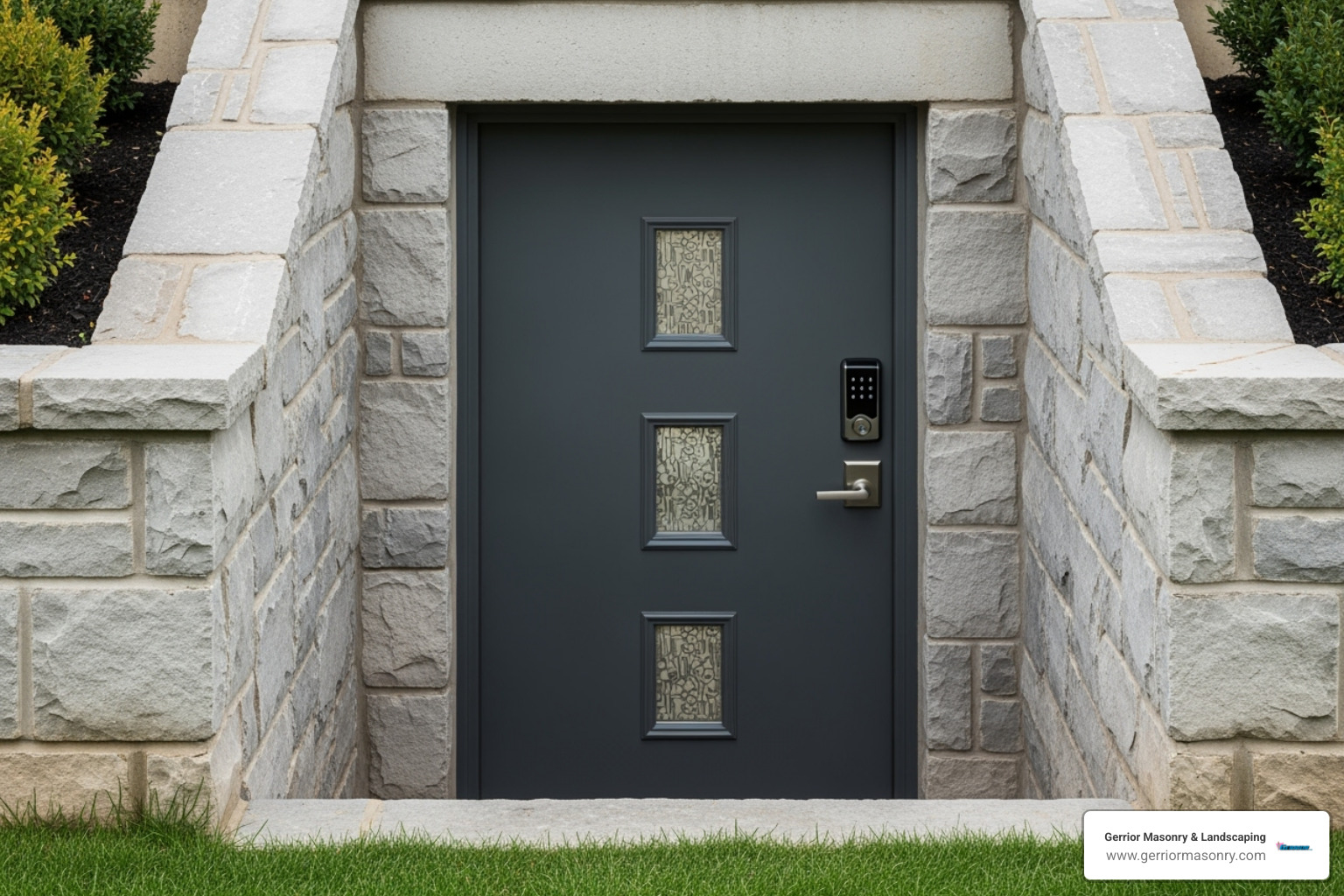
Look for security features like multi-point locking systems. Smart locks and keypads offer remote access control and convenience.
Energy-efficient features like insulated door cores and quality weather stripping reduce heating and cooling costs. Low-E glass is a great option for doors with windows.
Aesthetic options are plentiful. Choose from a wide range of colors and durable finishes, including powder coating or realistic wood-grain textures. Decorative glass inserts can add style and natural light. Options range from clear or frosted glass for privacy to decorative patterns.
With the right combination of security, efficiency, and style, your new entrance can improve both your home’s performance and its curb appeal. For a closer look at various door styles, check out our information on basement doors.
The Installation Process: What to Expect
Installing a basement entry system is a complex construction project requiring professional expertise. Understanding the steps highlights why hiring an expert is crucial.
Site & Foundation Assessment: The process begins with an assessment to evaluate your foundation, check for utilities, and determine the best location. Cutting through concrete block, poured concrete, or stone requires different techniques.
Excavation: Precise excavation is required to accommodate the new stairwell and ensure proper drainage.
Foundation Cutting: This requires specialized tools and is not a DIY job. Mistakes can cause serious structural damage.
Waterproofing & Drainage: Waterproofing the new opening with professional-grade membranes is essential to prevent leaks. A proper drainage system is also installed to prevent water from pooling.
Permitting & Installation: We handle the entire building permit process. Professional installation is essential due to the complex foundation work, waterproofing, and code compliance. Our owner oversight on every project ensures the highest quality.
Installation cost factors vary significantly based on the type of system, site complexity, foundation type, and finishing touches. These are average costs based on internet data and not actual costs for Gerrior Masonry services – we provide customized estimates after thoroughly assessing your specific project. For more on waterproofing, explore our guide to basement waterproofing.
Finalizing Your Project: Maintenance and Professional Expertise
Once your new basement entry system is installed, a little care will ensure its longevity. Understanding maintenance and choosing the right professionals are key to maximizing your investment.
Long-Term Care for Your Basement Entry System
Proper maintenance ensures your basement entry system remains functional and secure. While requirements vary by material, some general practices apply to all systems.
Routine Maintenance Tips:
Cleaning: Keep the stairwell clear of debris to prevent drainage clogs. Clean the door with a mild detergent and water.
Hinge Lubrication: For hinged doors, lubricate the hinges with a silicone-based spray to ensure smooth operation.
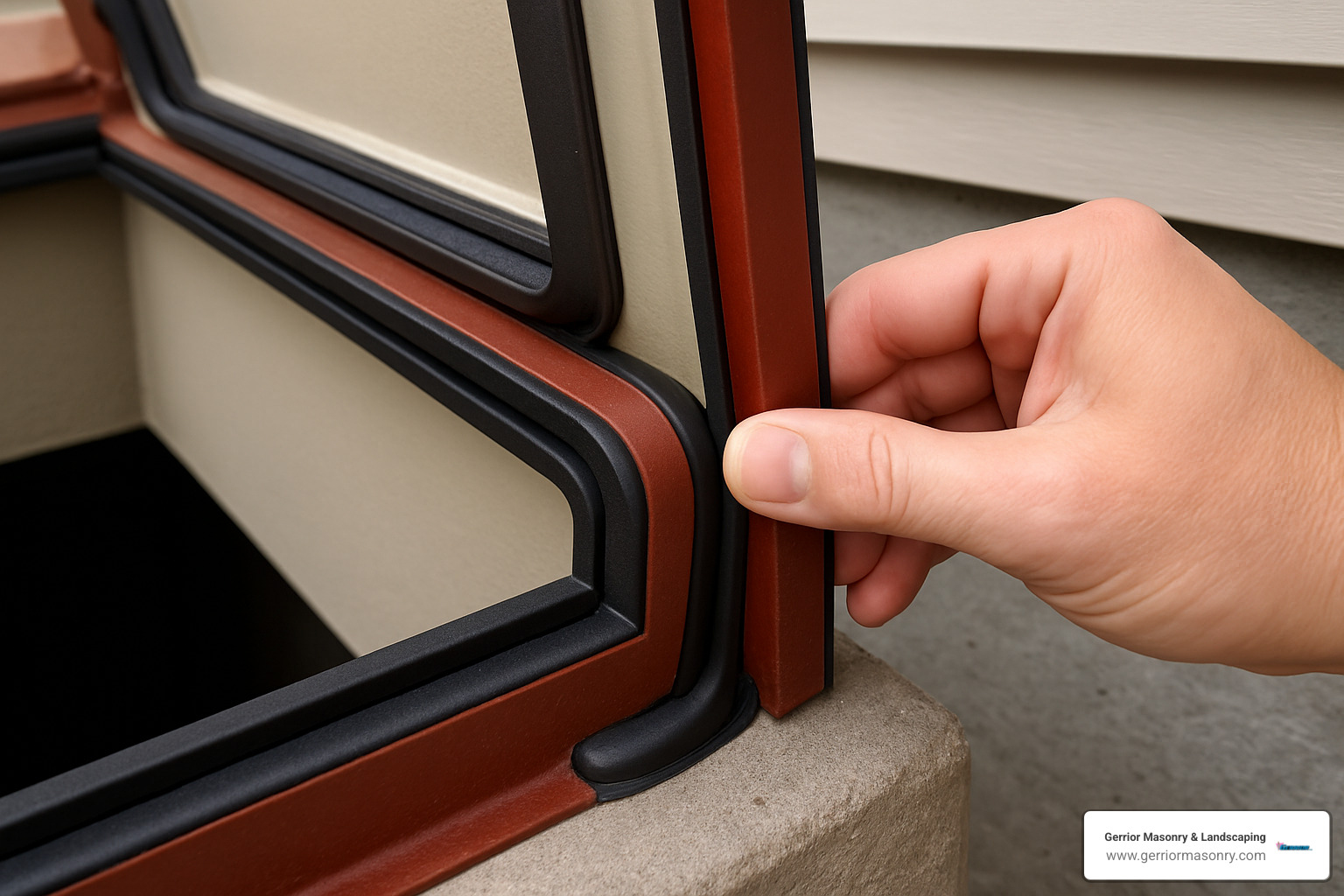
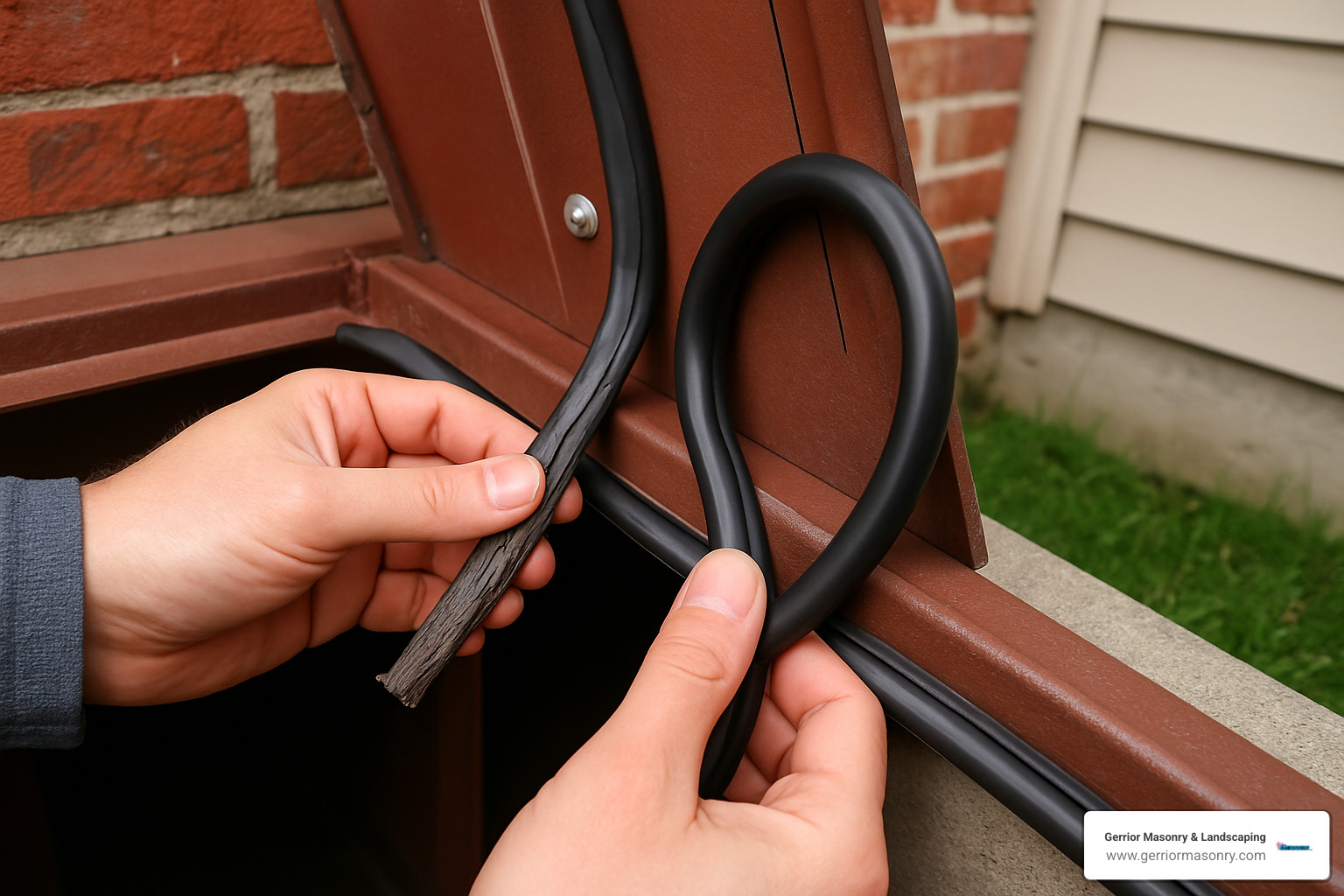
Check Seals: Inspect weatherstripping for wear or cracks and replace it to maintain energy efficiency and waterproofing.
Rust Prevention: On steel doors, touch up any scratches or chips with rust-inhibiting paint to prevent corrosion.
Following these steps prevents minor issues from becoming major problems. For general tips on maintaining your home’s exterior, check out More info about Home Improvement.
Latest Innovations:
Innovations in basement entry systems focus on user experience, durability, and smart home integration.
Gas-spring lift assistance: Makes modern bulkhead doors incredibly easy and safe to open and close.
Composite materials: Offer superior durability and low maintenance, resisting environmental factors.
Smart home integration: Smart locks and keypad entry systems are becoming standard for remote, keyless entry.
These trends lead to more user-friendly, durable, and advanced systems that offer greater convenience and peace of mind.
Choose the Right Partner for Your Installation
A basement entry system offers numerous benefits, including improved safety, increased home value, and convenient access. It’s a significant upgrade for any home.
However, the success of your project depends on quality installation. Professional masonry work is critical for cutting foundations, waterproofing, and meeting building codes. Poor installation can lead to costly water damage and structural issues.
With over 30 years of experience, Gerrior Masonry & Landscaping has the expertise for these complex projects. Our skilled team and owner oversight on every job guarantee that your basement entry system installation meets the highest standards for quality and durability, improving your home’s beauty and value.
Ready to transform your basement with a secure and stylish entry system? We are here to guide you through every step of the process.
Cellar Door Replacement: 7 Powerful Reasons to Upgrade 2025
Why Cellar Door Replacement Matters for Your Home’s Safety and Value
Cellar door replacement is a critical home improvement that protects your basement from water damage, improves energy efficiency, and improves your property’s curb appeal. When done right, a new cellar door (also called a bulkhead door) creates a weatherproof seal that keeps moisture, pests, and drafts out while providing safe emergency egress from your basement.
Timeline: 4-6 hours for DIY, 2-3 hours for professional installation
Key Signs: Rust holes, wood rot, water seepage, visible gaps, or doors that won’t stay square
Best Materials: Steel for durability, wood for aesthetics, polyethylene for low maintenance
When to Replace: Before water damage spreads to your foundation or basement interior
*These are average costs based on internet data and not actual costs for Gerrior Masonry services.
Your cellar door is often the weakest link in your home’s weather protection system. A failing door can lead to thousands in water damage, mold growth, and higher energy bills. The good news? Modern cellar doors are built to last decades with proper installation and minimal maintenance.
Research shows that properly installed cellar doors can prevent costly water damage while adding both security and convenience to your home. Whether you’re dealing with a rusted steel door or rotting wood panels, replacement is often more cost-effective than repeated repairs.
I’m Joe Gerrior, owner of Gerrior Masonry & Landscape Construction, and I’ve been helping Massachusetts homeowners with cellar door replacement and bulkhead repairs for over 34 years. My team has installed hundreds of cellar doors throughout Middlesex and Essex County, and I’ve seen how the right door can transform a basement from a liability into a valuable living space.
What Is a Cellar Door & Why Your Basement Depends on It
A cellar door serves as your basement’s primary connection to the outside world, providing both emergency egress and protection from the elements. Unlike interior doors, cellar doors must withstand extreme weather conditions while maintaining an airtight seal that prevents water infiltration and heat loss.
The primary functions of a cellar door include:
Emergency Egress: Building codes require basement living spaces to have at least one emergency exit. A properly sized cellar door provides the minimum 5.7 square feet of opening area needed for safe evacuation.
Storm Protection: During severe weather, your cellar door acts as a barrier against wind-driven rain, snow, and debris. The sloped design channels water away from your foundation rather than allowing it to pool against your basement walls.
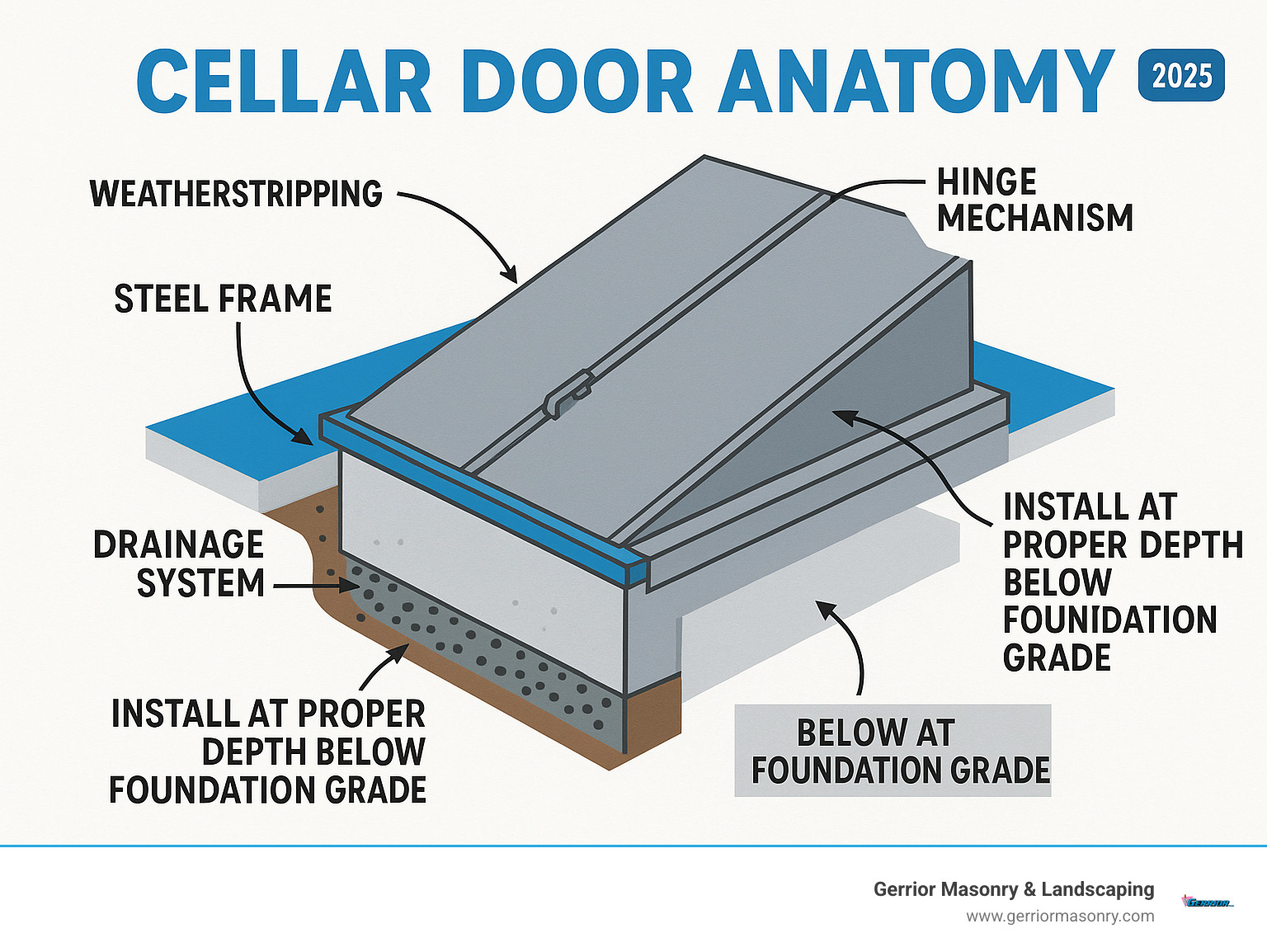
Foundation Integration: Modern cellar doors tie directly into your home’s foundation system, creating a weatherproof seal that prevents frost heave and water penetration. The frame anchors deep into the concrete, distributing load forces across the foundation wall.
Walk-Out Access: For finished basements, cellar doors provide convenient access for moving furniture, appliances, and supplies without navigating narrow interior stairs. This access can significantly increase your basement’s usability and your home’s value.
Insulation and Energy Efficiency: Quality cellar doors feature weatherstripping and thermal breaks that prevent heat loss. A well-sealed door can reduce your heating costs by eliminating drafts and maintaining consistent basement temperatures.
Security: Heavy-duty hinges and locking mechanisms deter unauthorized entry while providing you with secure access to basement storage areas.
How a Bulkhead Differs From Wine-Cellar & Interior Doors
Understanding the differences between cellar door types helps you choose the right replacement for your specific needs:
Basement Egress Doors (what most people call cellar doors or bulkhead doors) are exterior-grade units designed to withstand weather exposure. They feature angled panels that shed water, heavy-duty hinges rated for frequent use, and weatherstripping systems that maintain seals despite temperature fluctuations.
Exterior Grade Construction: Unlike interior doors, cellar doors must resist UV radiation, temperature extremes, and moisture exposure. Materials are specifically chosen for outdoor durability – galvanized steel, marine-grade hardware, and UV-stable plastics.
Sloped vs. Vertical Design: Traditional cellar doors feature a sloped design that naturally sheds water and snow. This differs from vertical wine cellar doors, which prioritize airtight seals for temperature control but aren’t designed for weather exposure.
Gasket Systems: Exterior cellar doors use compression gaskets and weatherstripping designed to maintain seals despite seasonal expansion and contraction. Wine cellar doors focus on vapor barriers and thermal insulation rather than weather resistance.
The key distinction is that exterior cellar doors must function as both a building envelope component and an access point, while interior wine cellar doors only need to control temperature and humidity within a conditioned space.
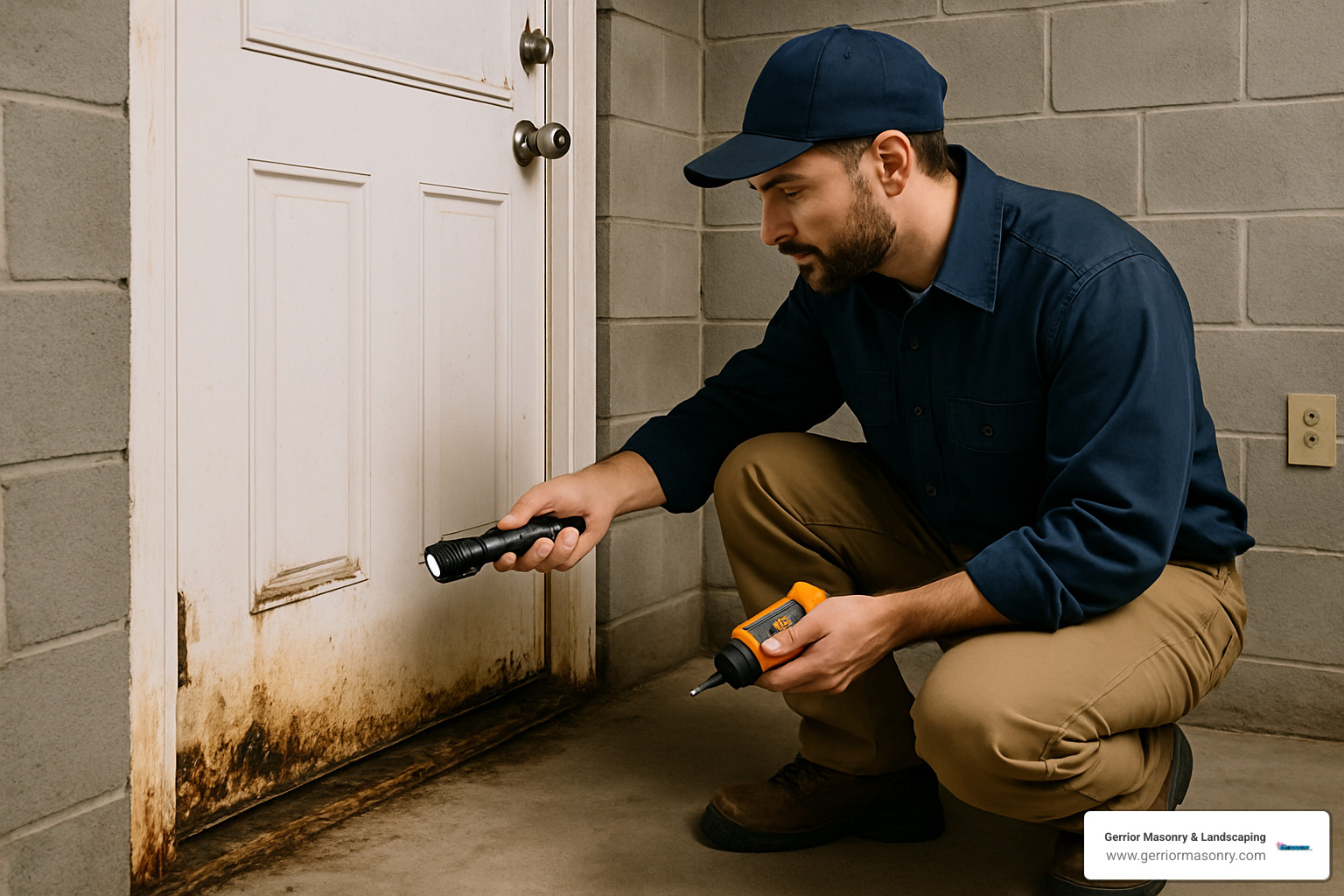
Clear Signs You Need Cellar Door Replacement
Recognizing when your cellar door needs replacement can save you thousands in water damage and energy costs. Here are the most common warning signs we see in our Massachusetts service area:
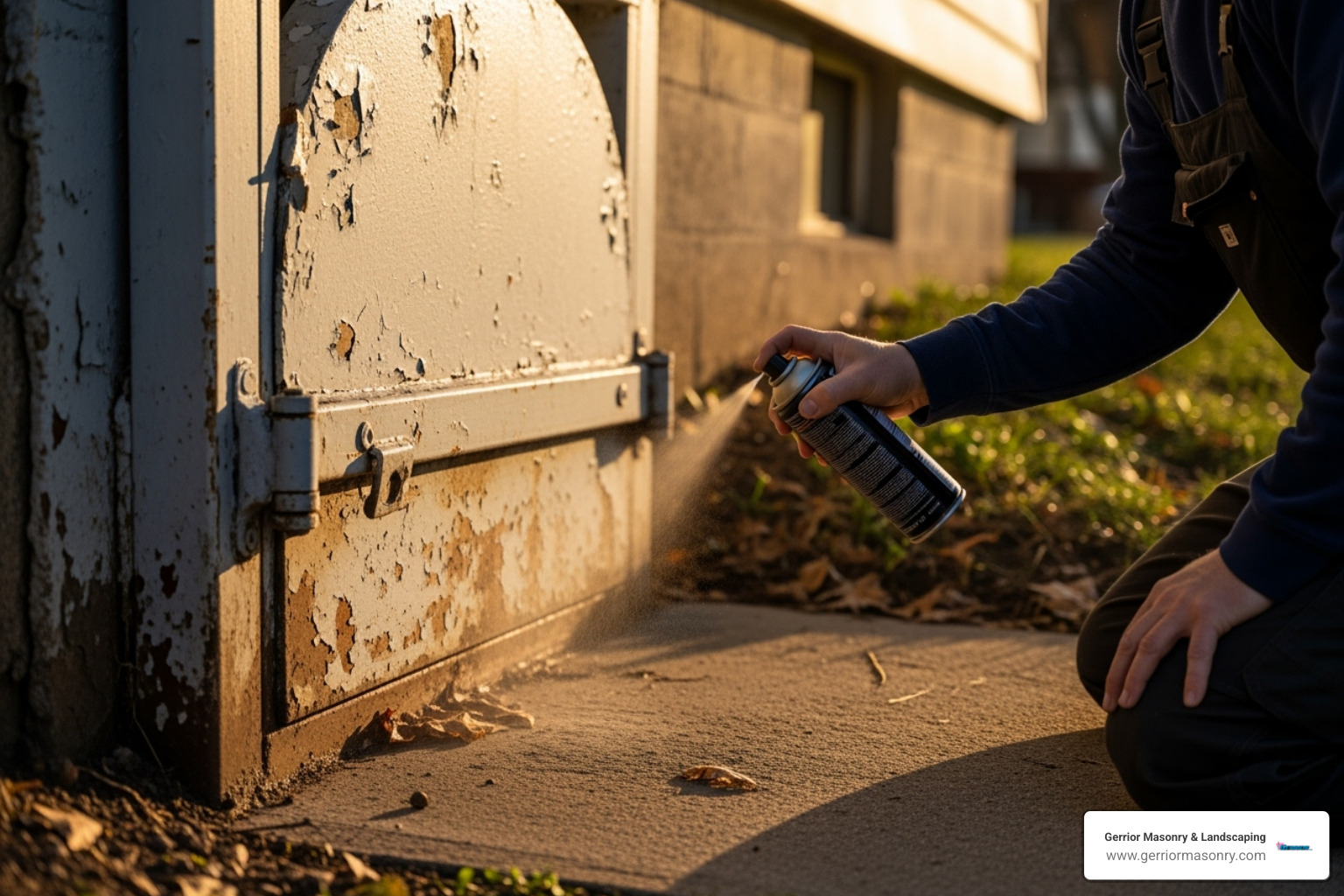
Rust Holes and Corrosion: Steel doors showing rust spots larger than a quarter, or any holes that allow light to pass through, need immediate replacement. Surface rust can be treated, but structural corrosion compromises the door’s integrity.
Wood Rot and Decay: Wooden cellar doors with soft spots, crumbling edges, or visible fungal growth have lost their structural integrity. Wood that’s been repeatedly wet and dry creates ideal conditions for mold growth that can spread to your basement.
Visible Gaps and Drafts: If you can see daylight around the door frame or feel air movement when the door is closed, your weatherstripping has failed. Gaps larger than 1/8 inch allow water infiltration and significant heat loss.
Water Seepage: Water stains on your basement walls near the cellar door, or standing water after storms, indicates that your door’s drainage system has failed. This is often the first sign of more serious foundation problems.
Pest Entry Points: Gaps around the door frame provide entry points for rodents, insects, and other pests. If you’re finding unwanted visitors in your basement, check your cellar door first.
Escalating Repair Costs: When you’re spending more than $200 annually on cellar door repairs, replacement becomes more economical. Repeated fixes often indicate underlying structural problems that repairs can’t solve.
Mold Risk Indicators: Musty odors, condensation on basement walls, or visible mold growth near the cellar door suggest moisture infiltration that could lead to serious health and structural issues.
Hidden Red Flags Most Homeowners Miss
Beyond obvious damage, several subtle signs indicate impending cellar door failure:
Hinge Sag: Doors that don’t close evenly or require lifting to latch properly have worn hinges or frame distortion. This creates gaps that worsen over time.
Misaligned Latches: Hardware that doesn’t engage smoothly or requires force to operate indicates frame movement or foundation settling that affects the door’s fit.
Flaking Paint Inside Frame: Paint failure on the interior frame surfaces suggests moisture infiltration that’s compromising the door’s structural integrity from the inside out.
Concrete Curb Cracks: Hairline cracks in the concrete foundation where the door frame attaches can allow water infiltration and indicate foundation movement that affects door alignment.
These subtle signs often appear months or years before obvious failure, giving you time to plan replacement before emergency repairs become necessary.
For comprehensive bulkhead repair services, including addressing these hidden issues, visit our bulkhead and walkout repairs page.
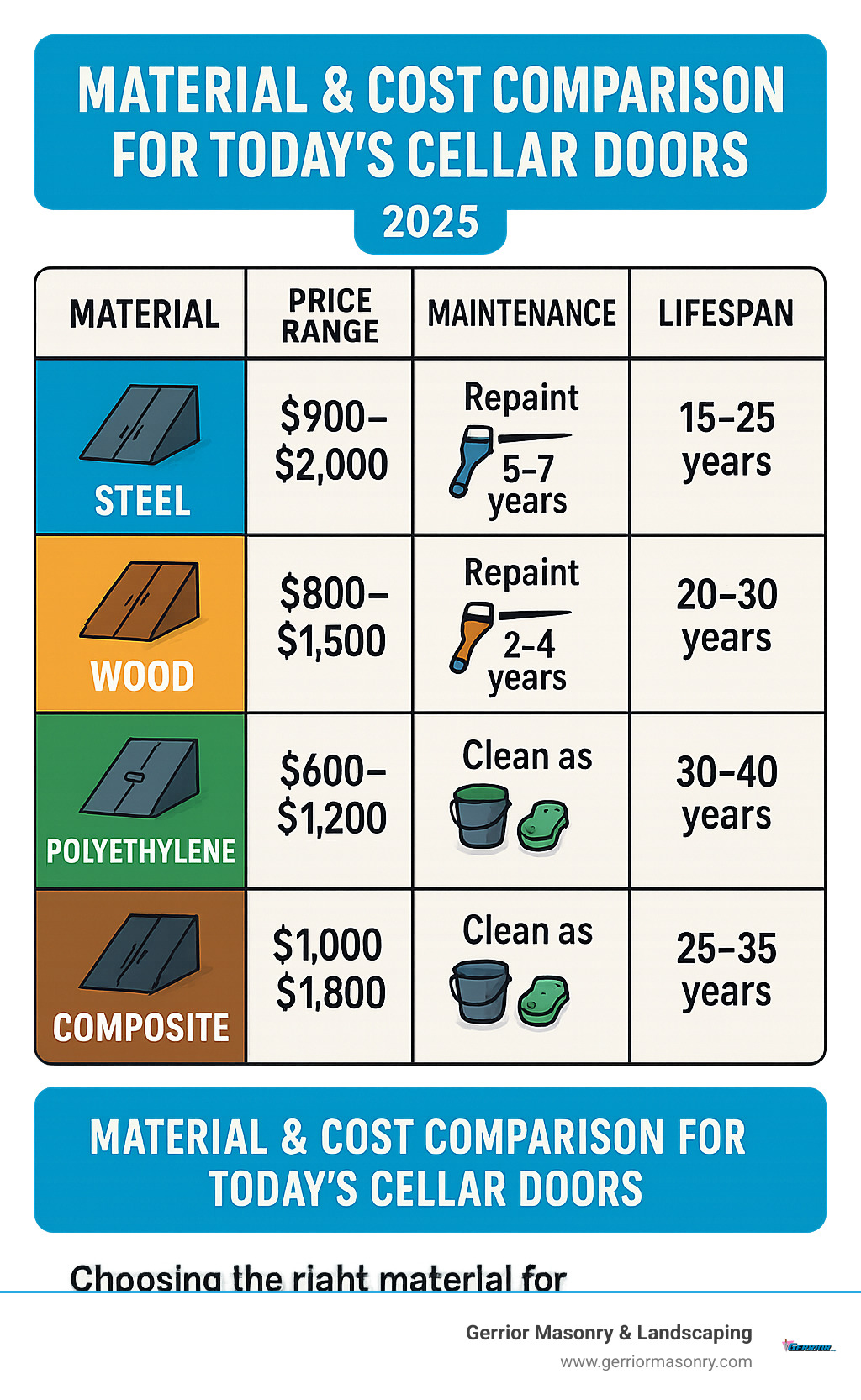
Material & Cost Comparison for Today’s Cellar Doors
Choosing the right material for your cellar door replacement involves balancing upfront costs, maintenance requirements, and expected lifespan. Based on current market data, here’s what you can expect:
Steel Cellar Doors: $900-$2,000 installed*
Lifespan: 15-25 years with proper maintenance
Maintenance: Repaint every 5-7 years, annual hinge lubrication
Pros: Durable, security, moderate cost, widely available
*These are average costs based on internet data and not actual costs for Gerrior Masonry services.
Powder Coat Finishes add $200-$400 to steel doors but provide superior durability compared to standard paint. Factory-applied powder coating can last 10-15 years without touch-ups.
Warranty Considerations: Steel doors typically carry 5-10 year warranties, while polyethylene and composite doors often include 15-20 year coverage. Always verify warranty terms before purchase.
For detailed pricing on current options, check the latest cost data from industry sources.
Steel Cellar Doors—The Longevity Champ
Steel remains the most popular choice for cellar door replacement due to its balance of durability, cost, and availability. Modern steel doors feature significant improvements over older models:
Galvanized Construction: Today’s steel doors use hot-dip galvanizing that provides rust protection for decades. The zinc coating sacrificially protects the underlying steel, even if the surface is scratched.
Anti-Rust Coating Systems: Premium steel doors feature multi-layer coating systems – galvanized base, primer, and topcoat – that provide 15-20 years of rust protection with minimal maintenance.
Welded vs. Bolted Construction: Quality steel doors use continuous welding rather than bolted assemblies, eliminating weak points where water can penetrate and cause corrosion.
Mid-Range Pricing: Steel doors offer the best value proposition for most homeowners, providing professional-grade durability at moderate cost compared to premium materials.
Repaint Cycles: With proper surface preparation, steel doors can be repainted every 5-7 years to maintain appearance and protection. This flexibility allows you to update colors as your home’s exterior changes.
The key to steel door longevity is proper installation and maintenance. Doors that are correctly sealed and annually inspected can last 20-25 years with minimal repairs.
Wood cellar doors offer best aesthetic appeal and can be custom-built to match your home’s architectural style. However, they require more maintenance and careful material selection:
Species Selection: Cedar, mahogany, and cypress are preferred for exterior cellar doors due to their natural rot resistance. These woods contain oils that repel moisture and insects.
Carpentry Skill Requirements: Wood doors require skilled installation to ensure proper fit and weatherproofing. Tongue-and-groove construction with stainless steel fasteners provides the best durability.
Stain and Seal Maintenance: Wood doors need annual inspection and re-staining every 2-3 years. Solid-color acrylic stains provide better protection than clear finishes and are easier to maintain than paint.
Insulation Value: Wood provides natural insulation properties superior to steel, helping reduce energy costs. Properly constructed wood doors can achieve R-values of 3-5.
Preservative Treatment: Any wood in contact with concrete or masonry must be treated with preservative to prevent rot. This is critical for long-term durability.
The main drawback of wood doors is their susceptibility to weather damage and the ongoing maintenance required to preserve their appearance and structural integrity.
Polyethylene & Fiberglass—No-Rust, Higher Ticket
Modern synthetic materials offer the ultimate in low-maintenance cellar door solutions, though at a premium price point:
UV-Stable Formulations: Quality polyethylene doors use UV inhibitors that prevent degradation from sun exposure. These doors maintain their color and structural integrity for decades without fading.
Molded Shell Construction: Unlike assembled doors, molded polyethylene doors are formed as single units, eliminating joints where water can penetrate. This construction method provides superior weatherproofing.
Color-Through Material: The color is integrated throughout the material rather than applied as a surface coating. This means scratches and minor damage don’t expose different-colored substrate.
Premium Cost Range: The higher upfront cost is offset by virtually no maintenance requirements and extended lifespan. Over 20-30 years, total cost of ownership often equals or beats steel doors.
Thermal Performance: Polyethylene doors provide excellent insulation properties, often outperforming steel and wood in energy efficiency testing.
The main considerations with synthetic doors are the higher initial investment and limited color options compared to painted steel doors.
DIY vs Professional Cellar Door Replacement
Cellar door replacement can be a DIY project for experienced homeowners, but it requires mid-level carpentry skills and specialized tools. Here’s what you need to know:
Required Tools:
Angle grinder with cutting discs
Hammer drill with masonry bits
Level (4-foot minimum)
Pry bar and demolition tools
Socket wrench set
Caulk gun and weatherproofing materials
Safety equipment (glasses, gloves, dust mask)
Skill Level Assessment: This project requires a 5 out of 5 skill level according to industry standards. You’ll need experience with:
Concrete cutting and drilling
Frame alignment and leveling
Weatherproofing and sealant application
Heavy lifting (doors can weigh 100+ pounds)
Time Estimate: Plan for 4-6 hours for a complete replacement, plus additional time for concrete patching and finishing work.
Safety Considerations: Working with heavy steel doors and power tools requires proper safety equipment. The lifting and positioning aspects pose injury risks for inexperienced installers.
Permit Requirements: Most municipalities require permits for cellar door replacement. Check with your local building department before starting work.
Liability Factors: Improper installation can lead to water damage, foundation problems, and code violations. Consider whether the potential savings justify the risks.
Step-by-Step DIY Cellar Door Replacement
If you decide to tackle cellar door replacement yourself, follow these detailed steps:
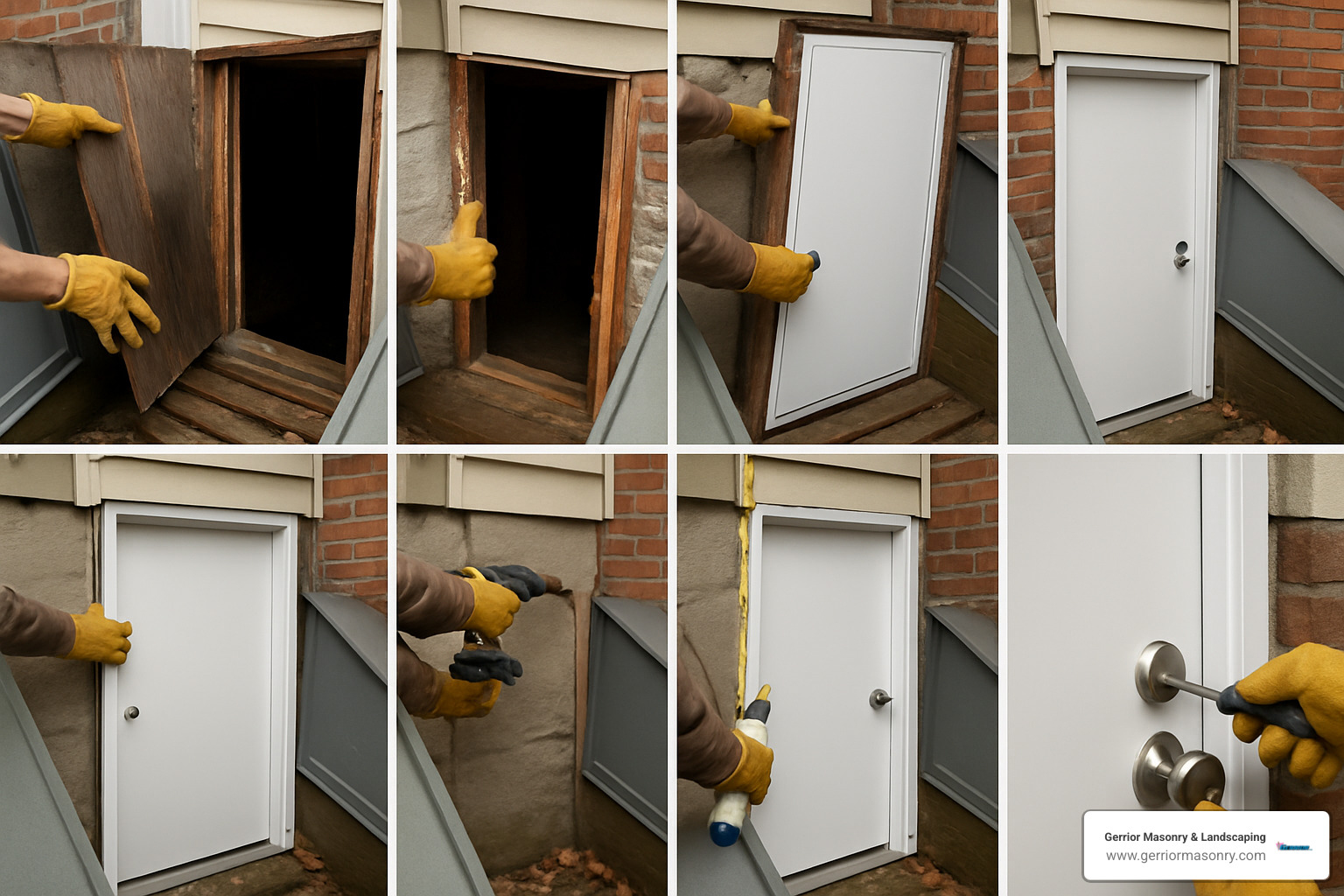
Step 1: Remove the Old Door and Frame
Disconnect hinges and remove door panels
Use angle grinder to cut through frame anchors
Pry out old frame sections with care to avoid foundation damage
Clean debris from the opening
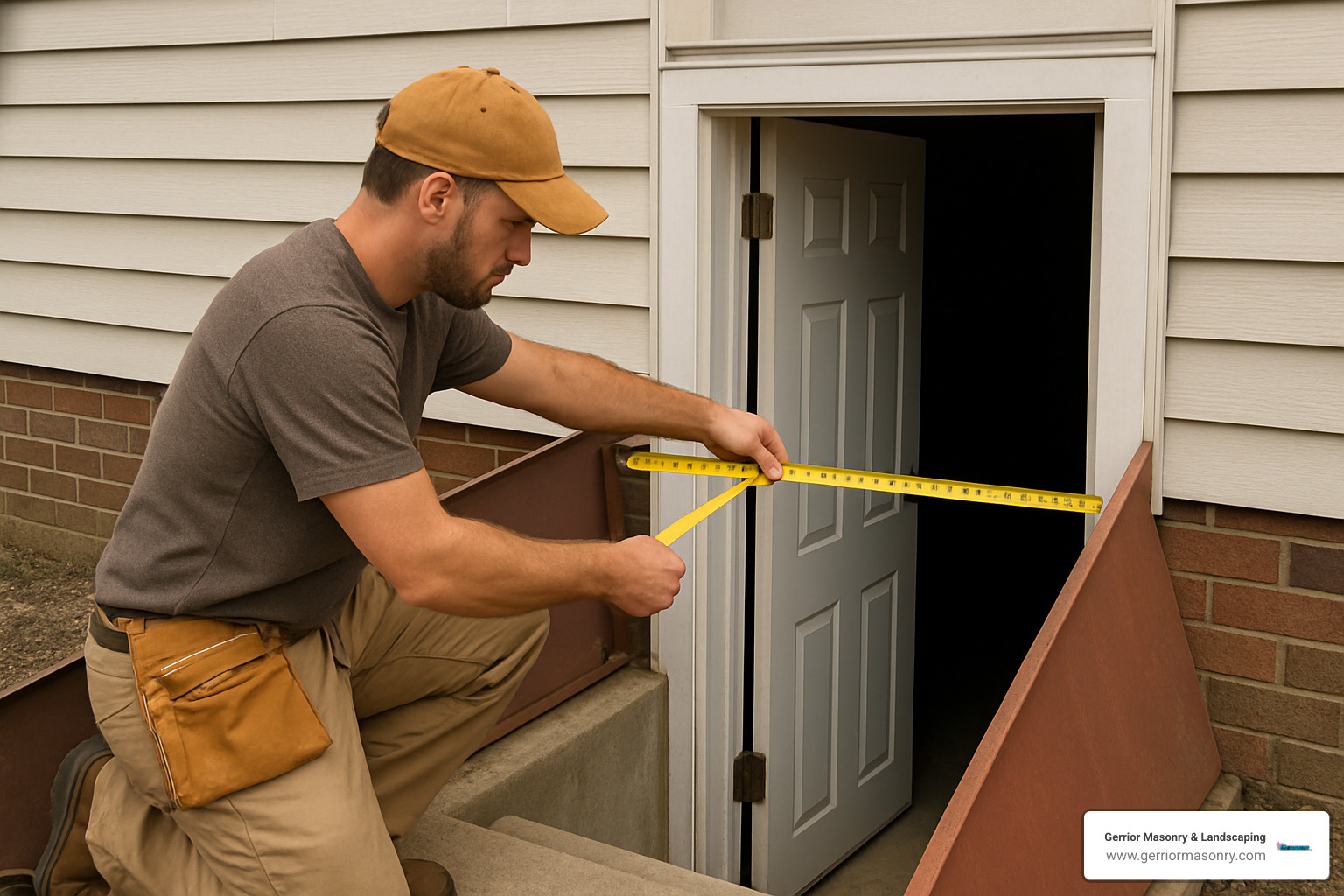
Step 2: Measure the Rough Opening
Measure width, depth, and height at multiple points
Check for square using diagonal measurements
Note any irregularities that need correction
Verify measurements against new door specifications
Step 3: Patch and Prepare Concrete
Fill any holes or cracks with fast-setting concrete
Level the foundation surface where the frame will sit
Allow concrete to cure for at least one hour
Clean and dampen the surface before proceeding
Step 4: Set the New Frame
Apply self-stick membrane to pressure-treated sills
Position frame in opening and check for level
Use shims to adjust alignment as needed
Mark anchor bolt locations
Step 5: Anchor the Hardware
Drill pilot holes for masonry anchors
Apply silicone sealant to anchor points
Secure frame with appropriate fasteners
Verify frame remains square and level
Step 6: Install and Adjust Doors
Mount hinges to door panels
Hang doors and check for proper alignment
Adjust torsion springs for smooth operation
Test latching mechanisms
Step 7: Weatherseal and Finish
Apply weatherstripping around frame perimeter
Seal all gaps with appropriate caulk
Prime any exposed metal surfaces
Apply finish coat according to manufacturer specifications
Several situations make professional installation the better choice:
Structural Repairs Needed: If your foundation curb is cracked, settling, or damaged, professional masonry work is required before door installation.
Masonry Curb Rebuild: When the concrete foundation needs reconstruction or significant repair, specialized tools and expertise are necessary.
Custom Sizes Required: Non-standard openings may require custom fabrication or frame modifications that exceed typical DIY capabilities.
Heavy Steel Doors: Large or premium steel doors can weigh 150+ pounds and require specialized lifting equipment and multiple installers.
Warranty Considerations: Professional installation often includes warranty coverage that protects your investment and ensures code compliance.
Time Constraints: Professional installation typically takes 2-3 hours compared to a full day for DIY work.
At Gerrior Masonry & Landscape Construction, we handle all aspects of cellar door installation, from foundation repairs to final weatherproofing. Our experienced team ensures your new door meets all local codes and provides decades of reliable service.
Proper sizing and code compliance are critical for successful cellar door replacement. Here’s what you need to know:
Egress Code Requirements: Basement living spaces must have emergency exits with minimum 5.7 square feet of opening area. The opening must be at least 20 inches wide and 24 inches high, with a maximum sill height of 44 inches above the basement floor.
Rise and Run Clearances: The area in front of the cellar door must provide adequate clearance for emergency egress. Most codes require a minimum 36 inches of clear space in front of the door.
Standard Sizing Systems: Most manufacturers use sizing systems like the BILCO “C” and “O” series:
“C” Series: Sloped doors for flat foundations (most common)
“O” Series: Flat doors for sloped foundation walls
Sizes typically range from 4 feet to 6 feet wide
Custom Fabrication Options: Non-standard openings may require custom doors, which typically cost 25-50% more than standard sizes but ensure proper fit and code compliance.
Child-Safe Latches: Modern cellar doors include safety features that prevent accidental opening by children while allowing emergency egress by adults.
Drainage Slope Requirements: Proper installation requires a minimum 1/4 inch per foot slope away from the door to prevent water accumulation.
For professional door sizing assistance, check the door sizing tool recommended by industry professionals.
Choosing a Door That Fits & Looks Right
Beyond code compliance, consider these factors for optimal results:
Measure Twice, Order Once: Accurate measurements are critical. Measure the width, depth, and height at multiple points to account for foundation irregularities.
Match Your Roofline: Choose door styles that complement your home’s architecture. Traditional sloped doors work with most styles, while contemporary flat doors suit modern homes.
Color Coordination: Select colors that harmonize with your home’s exterior. Neutral colors like white, gray, or earth tones provide timeless appeal.
Security Upgrades: Consider keyed locks, reinforced hinges, and tamper-resistant hardware for improved security.
Accessibility Features: If basement access is needed by elderly or mobility-impaired individuals, consider doors with assisted opening mechanisms.
For a complete selection of styles and options, visit our basement access doors page.
Care, Maintenance & Common Mistakes
Proper maintenance extends your cellar door’s lifespan and prevents costly repairs. Here’s our recommended maintenance schedule:
Annual Inspection Checklist:
Check weatherstripping for wear or damage
Inspect hinges and hardware for rust or looseness
Examine frame for cracks or separation from foundation
Test door operation and latch alignment
Clear debris from drainage areas
Repaint Schedule: Steel doors should be repainted every 5-7 years, or when surface rust appears. Sand lightly, prime bare metal, and apply high-quality exterior paint.
Lubricate Moving Parts: Apply white lithium grease to hinges and latch mechanisms twice yearly. Avoid petroleum-based lubricants that attract dirt.
Snow and Ice Management: Keep doors clear of snow accumulation. Use plastic shovels to avoid scratching surfaces, and apply ice melt products sparingly.
Avoid Concrete Contact: Never allow concrete, mortar, or masonry materials to contact door surfaces, as they can cause accelerated corrosion.
Common Installation Mistakes to Avoid:
Overtightening Anchor Bolts: Excessive torque can crack concrete or distort the door frame, leading to alignment problems and water infiltration.
Skipping Vapor Barriers: Failing to install proper vapor barriers between steel frames and concrete allows moisture infiltration that causes premature rust.
Inadequate Drainage: Poor grading or blocked drainage systems cause water accumulation that can undermine the foundation and door integrity.
Wrong Fastener Types: Using standard bolts instead of galvanized or stainless steel fasteners creates corrosion points that weaken the installation.
Storage Hacks to Extend Door Life
Simple protective measures can significantly extend your cellar door’s lifespan:
Leaf Guards: Install mesh screens over drainage areas to prevent leaf accumulation that blocks water flow.
De-icing Pads: Place rubber mats or wooden boards under doors during winter to prevent ice formation that can damage hinges and seals.
Breathable Covers: During extreme weather, temporary covers can protect doors from hail or debris while allowing air circulation to prevent condensation.
Seasonal Adjustments: Adjust door tension and alignment seasonally to account for foundation movement and temperature changes.
These simple steps can add 5-10 years to your door’s service life while reducing maintenance requirements.
Conclusion
Cellar door replacement is a critical investment in your home’s safety, energy efficiency, and value. A properly installed door protects your basement from water damage, provides emergency egress, and can significantly improve your home’s curb appeal.
The key benefits of timely replacement include:
Improved Home Safety: Modern cellar doors meet current egress codes and include safety features that protect your family during emergencies.
Return on Investment: Quality cellar doors typically return 70-80% of their cost in increased home value, while preventing costly water damage that can exceed the door’s cost many times over.
Energy Savings: Properly sealed doors can reduce heating costs by 10-15% by eliminating basement drafts and maintaining consistent temperatures.
Peace of Mind: Knowing your basement is protected from weather, pests, and unauthorized entry provides invaluable peace of mind.
Whether you choose steel for durability, wood for aesthetics, or polyethylene for low maintenance, the most important factor is proper installation by experienced professionals who understand local codes and conditions.
At Gerrior Masonry & Landscape Construction, we’ve been helping Massachusetts homeowners with cellar door replacement for over three decades. Our skilled team ensures your new door provides decades of reliable service while meeting all safety and building code requirements.
Ready to protect your basement and improve your home’s value? Contact us today for a free consultation and estimate. We’ll help you choose the right door for your needs and budget, then install it with the craftsmanship and attention to detail that comes from 34 years of experience.
For more information about our comprehensive bulkhead services, visit our bulkhead replacement page.
Gerrior Masonry & Landscape Construction is based in Woburn, MA, proudly serving homeowners throughout Middlesex and Essex County, Massachusetts.
Basement Hatch Replacement: 5 Powerful Tips for Success 2025
Why Basement Hatch Replacement Matters for Your Home
Basement hatch replacement is a critical home improvement project that addresses water intrusion, energy loss, and safety concerns while improving your property’s value and functionality.
Quick Basement Hatch Replacement Options:
Steel doors – Most durable, 30+ year lifespan, $800-2,400
Electric lift systems – Push-button convenience, $2,000-5,000
Note: These are average costs based on internet data and not actual costs for Gerrior Masonry services.
If you’ve noticed flaking paint, soft or rotting wood, water puddles after rain, or difficulty opening your basement hatch, it’s time for a replacement. Old bulkhead doors can let in moisture, pests, and cold air while creating safety hazards.
Modern basement hatches solve these problems with weather-sealed construction, insulated panels, and tamper-resistant locks. Homeowners report up to 80% reduction in water intrusion and 30-50% improvement in basement humidity after upgrading to quality replacement hatches.
The replacement process involves careful measurement, proper demolition, foundation assessment, and professional installation with weatherproof sealing. Most projects take 1-2 days and require permits in many Massachusetts communities.
I’m Joe Gerrior, owner of Gerrior Masonry & Landscape Construction Corp, and I’ve been helping Massachusetts homeowners with basement hatch replacement projects for over 34 years. My team specializes in both standard installations and custom masonry solutions that match your home’s architectural style.
Your basement hatch might not be glamorous, but it works hard. Also called a bulkhead or cellar door, it covers the stairs leading to your basement entrance and must keep weather out, provide secure access, and offer emergency egress.
When we discuss basement hatch replacement, we are talking about safety, moisture control, energy savings, and pest exclusion—not just appearance.
Safety first: Modern codes require a clear, reliable exit for all finished basements. A failing hatch can block that exit.
Energy loss & pests: Drafts raise heating bills and invite rodents and insects.
After hundreds of bulkhead replacements throughout Massachusetts, we’ve learned that most hatches built before 1990 need replacement within 20-30 years. The good news? Today’s materials outperform anything that was available a decade ago.
Signs It’s Time for Basement Hatch Replacement
Know the warning signs so you can act before damage spreads:
Flaking paint & rust on metal surfaces.
Soft, spongy wood or cracked masonry around the frame.
Sticking or sagging doors that no longer open freely.
Puddles or ice inside the hatch after storms.
Visible gaps or missing weatherstripping.
Can I DIY a Basement Hatch Replacement?
It’s tempting, but basement hatch replacement is rarely a weekend project. Precise measurement, concrete cutting, waterproofing, and code compliance require professional tools and experience. Small errors can cause ongoing leaks or foundation damage, and most warranties exclude DIY installs.
Permit requirements in Massachusetts add another layer—drawings, inspections, and egress verification. Our bulkhead door replacement near me service rolls permits, installation, and warranty into one package so you don’t have to juggle paperwork or heavy lifting.
Top Basement Hatch Replacement Options Compared
Choosing the right basement hatch replacement can feel overwhelming with so many options available. After helping Massachusetts homeowners for over 34 years, I’ve learned that the best choice depends on your specific needs, budget, and home style. Let me walk you through the most popular options we install and what makes each one special.
The three main categories we work with are weather-sealed steel doors, composite and fiberglass options, and custom concrete and masonry caps. Each has its sweet spot depending on what you’re trying to accomplish. Steel doors dominate our installations because they handle New England weather like champs, while composite materials appeal to homeowners who want low maintenance.
When it comes to operation, you’ll also need to decide between manual and electric lift systems. Manual doors work great for most situations, but if you have mobility concerns or just love convenience, electric lifts with push-button operation are worth considering.
Note: All pricing mentioned reflects average costs based on internet data and not actual costs for Gerrior Masonry services.
Weather-Sealed Steel
Steel basement hatches are the workhorses of the industry, and there’s a good reason why we install more of these than any other type. In Massachusetts, where we get everything from nor’easters to scorching summer heat, steel doors just keep performing year after year.
Galvanized construction forms the foundation of quality steel doors. The hot-dip galvanization process creates a zinc coating that bonds directly to the steel, providing rust resistance that lasts decades. I’ve seen properly maintained galvanized doors still looking great after 30 years of New England weather.
The powder coat finish takes durability even further. Unlike regular paint that can chip and peel, powder coating is baked on at high temperatures, creating a finish that resists scratches, fading, and weather damage.
Modern steel doors also come with excellent insulation options. Foam-filled panels can dramatically reduce heat loss through your basement hatch, which is especially important if you use your basement as living space.
Based on internet data, steel doors typically range from $800 to $2,400, with premium insulated models reaching $3,600 or more. The 30-year lifespan makes them one of the most cost-effective long-term investments you can make for your home.
Composite & Fiberglass
If you’re tired of dealing with rust, rot, and constant maintenance, composite and fiberglass doors might be exactly what you need. These materials have revolutionized basement hatch replacement for homeowners who want to install it and forget about it.
The rot-proof construction means you’ll never have to worry about water damage destroying your door. Unlike wood that swells, warps, and eventually rots, or steel that can rust if the coating gets damaged, composite materials maintain their integrity regardless of moisture exposure.
Lightweight design is another huge advantage, especially for homeowners who struggle with heavy doors. A typical steel door can weigh 150 pounds or more, while composite doors often weigh half that.
The color options available in composite materials are impressive. You can choose from earth tones, bold colors, or classic neutrals, and most won’t fade or require repainting for many years.
Composite and fiberglass options typically cost $600 to $1,800 based on internet data, with high-end models reaching $2,700 or more.
Custom Concrete & Masonry Caps
When you own a historic home or want something truly unique, custom masonry solutions create basement hatches that look like they were always part of your home’s original design. These aren’t just functional—they’re architectural features that add real character and value.
Integrated stairs are one of our most popular custom features. Instead of separate concrete steps leading down to a standard door, we can build beautiful stone or concrete stairs that flow seamlessly into the hatch design.
Working with architect specifications allows us to match existing materials, proportions, and design elements. Whether your home features fieldstone, brick, or specific concrete finishes, we can create a hatch that looks like it was part of the original construction plan.
The durability of custom masonry is best. While steel and composite doors might last 20-30 years, properly built masonry installations can easily last 50+ years with minimal maintenance.
Based on internet data, custom masonry solutions typically range from $1,500 to $4,500, with elaborate designs reaching $6,750 or more.
At Gerrior Masonry, our basement bulkhead replacement service includes custom masonry options that we design specifically for your home and needs.
Cost & Installation Process Breakdown
Understanding the complete cost structure and installation process helps homeowners budget appropriately and set realistic expectations for their basement hatch replacement project.
Complete Cost Breakdown (based on internet data):
– Basic steel door: $800-1,200
– Mid-range fiberglass: $1,000-1,800
– Premium steel with insulation: $1,200-2,400
– Custom masonry solution: $1,500-4,500
– Electric lift systems: $2,000-5,000
Note: These are average costs based on internet data and not actual costs for Gerrior Masonry services.
Factors Influencing Final Cost:
– Site Access: Difficult access requiring special equipment increases labor costs
– Foundation Condition: Existing damage requiring repair before installation
– Custom Sizing: Non-standard dimensions requiring fabrication
– Upgrade Features: Insulation, security locks, or electric operators
Our basement door replacement cost guide provides detailed information about pricing factors specific to Massachusetts installations.
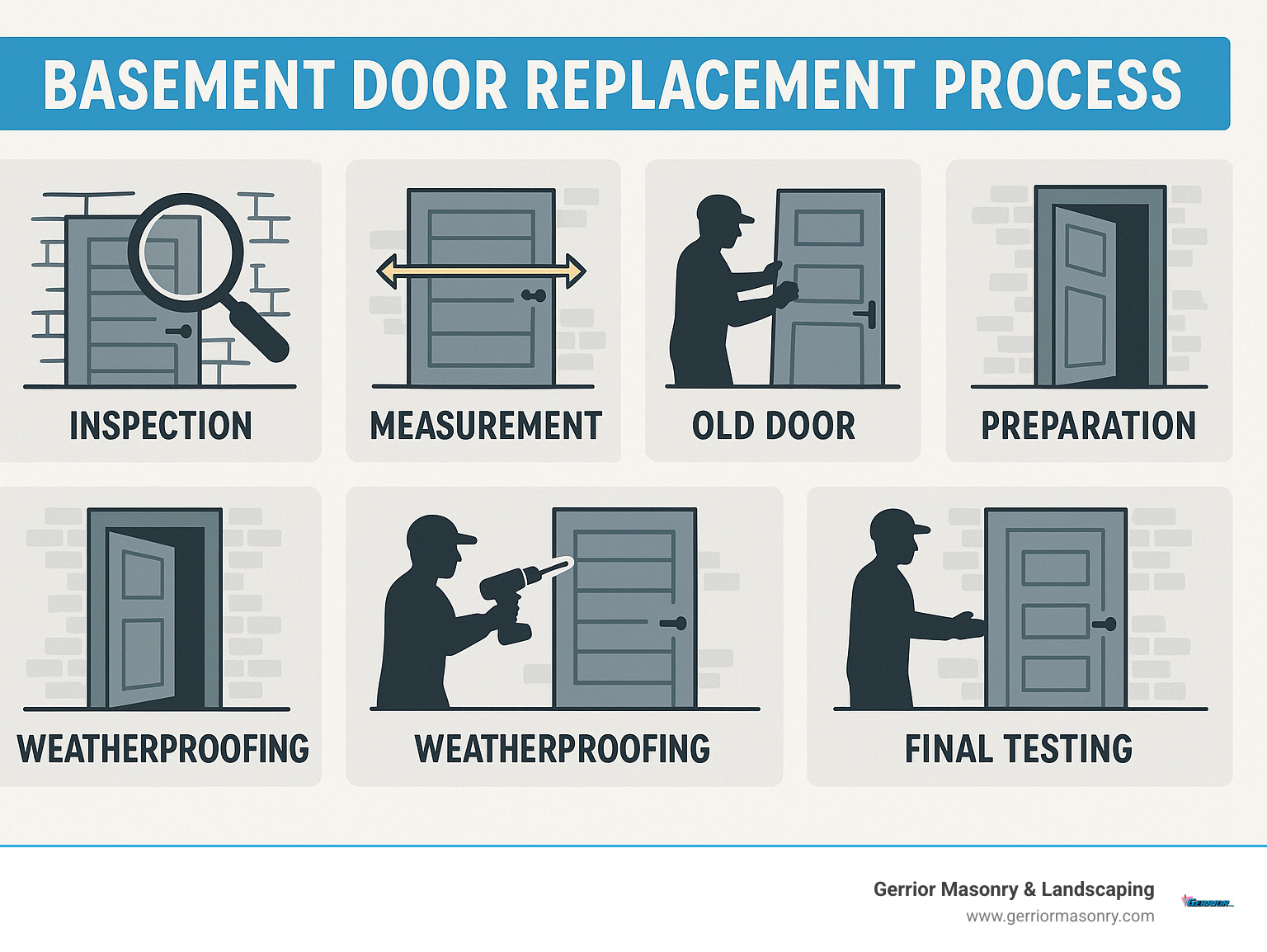
Step-by-Step Professional Installation
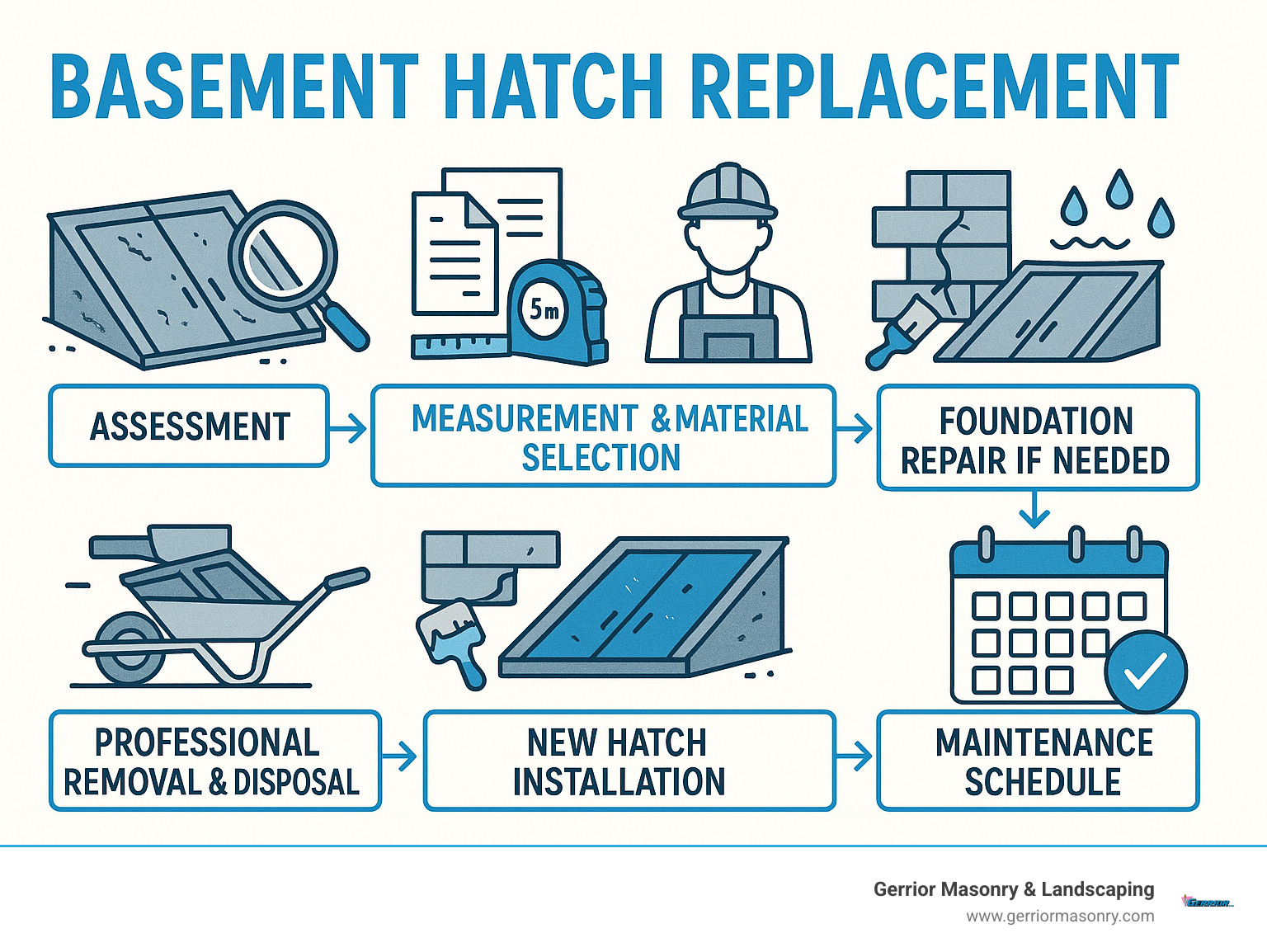
Professional basement hatch replacement follows a systematic process that ensures proper fit, weatherproofing, and long-term performance:
Day 1: Assessment and Preparation
1. Precise Measurement: We measure the existing opening and assess foundation condition
2. Material Ordering: Custom fabrication begins based on exact specifications
3. Permit Application: We handle all required permits and inspections
4. Site Preparation: Protect landscaping and establish safe work areas
Day 2: Removal and Installation
1. Careful Demolition: Remove old hatch while preserving foundation integrity
2. Foundation Assessment: Inspect and repair any structural issues
3. Curb Preparation: Level and square the foundation opening
4. Frame Installation: Set new frame with proper alignment and support
Day 3: Finishing and Testing
1. Weatherproofing: Install flashing, gaskets, and sealants
2. Hardware Installation: Mount hinges, springs, and locking mechanisms
3. Operation Testing: Verify smooth door operation and proper sealing
4. Final Inspection: Complete permit inspection and cleanup
Most installations take 1-2 days, depending on complexity and weather conditions. Our team coordinates all aspects to minimize disruption to your daily routine.
Making It Weatherproof & Secure
Proper weatherproofing separates professional installations from DIY attempts. Our weatherproofing system includes:
Primary Water Barriers:
– EPDM Rubber Gaskets: Compression seals that maintain flexibility in temperature extremes
– Butyl Flashing Tape: Self-adhering membrane that creates permanent water barriers
– Overlapping Flanges: Design that sheds water away from foundation walls
Security Features:
– Tamper-Resistant Locks: Heavy-duty mechanisms that resist forced entry
– Reinforced Hinges: Stainless steel hardware rated for high-cycle use
– Smart Sensors: Optional monitoring systems that alert homeowners to unauthorized access
Drainage Improvements:
– Proper Slope: Ensure water flows away from the foundation
– Drain Installation: Add drainage systems where needed
– Waterproof Coatings: Apply foundation sealers during installation
Our bulkhead repair service addresses these weatherproofing elements to prevent future problems.
Maintenance, Upgrades & Prevention Tips
A little annual care keeps your new hatch performing for decades.
Spring – Rinse off winter salt, inspect for rust, and touch up paint early.
Summer – Repaint steel doors every 5-7 years while weather is dry.
Fall – Clear leaves and make sure drains stay open.
Winter – Brush off snow so weight and ice don’t strain hinges.
Quick checks:
Inspect gaskets & weatherstripping; replace if brittle.
Lubricate hinges and springs once a year.
Upgrade gas struts or add ventilation grates when needed.
Our average cost of bulkhead replacement research shows that homeowners who stay on top of maintenance get 40-50 % more life out of their doors.
Boosting Energy Efficiency & Air Quality
Modern, well-sealed hatches with insulated panels and proper vapor barriers can cut basement heat loss by up to 60 % and drop humidity 30-50 %. Less moisture means less mold, fewer odors, and lower heating bills. For best results, choose doors with R-values of 8 or higher and keep the area ventilated.
Gerrior Masonry & Landscape Construction is based in Woburn, MA, and services Middlesex and Essex County, Massachusetts.
Frequently Asked Questions about basement hatch replacement
Do I need a permit to replace a basement hatch?
Yes, most Massachusetts communities require permits for basement hatch replacement projects, and honestly, this catches a lot of homeowners by surprise. I’ve seen too many DIY projects get shut down halfway through because the homeowner didn’t realize they needed official approval.
Building codes are pretty specific about basement hatches, especially since they often serve as emergency exits. Your new hatch needs to meet egress width requirements – that’s a minimum of 32 inches for emergency exit purposes. The local inspector will also want to see that your installation can handle structural load calculations and meets current waterproofing standards for below-grade construction.
The inspection process typically involves an initial permit application with basic project drawings, a foundation inspection before we start the installation, and a final inspection once everything’s complete. Some communities even require certificate of occupancy updates if your basement is used as living space.
Here’s the good news: at Gerrior Masonry, we handle all the permit paperwork and coordinate inspections as part of our service. You don’t have to figure out which forms to fill out or schedule inspector visits – we take care of all that bureaucratic stuff so you can focus on picking out your new hatch.
How long does a new hatch last?
This is probably the question I get asked most often, and the answer depends on what you choose and how well you take care of it. Think of it like buying a car – a basic model with no maintenance won’t last as long as a premium model that gets regular tune-ups.
Steel doors are the marathon runners of basement hatches, typically lasting 30+ years with proper maintenance. I’ve seen some well-maintained steel hatches from the 1980s that are still going strong. Fiberglass and composite doors usually give you a solid 20-25 years in our New England climate, while custom masonry solutions can easily hit 50+ years with minimal fussing.
Here’s what really makes the difference: regular maintenance can extend your hatch’s life by 40-50%. That means annual inspections, keeping up with repainting, and addressing small issues before they become big problems. On the flip side, I’ve seen expensive hatches fail in half their expected time because they were completely ignored.
Massachusetts weather is tough on everything, so climate exposure plays a huge role. The quality of the initial installation matters too – a properly installed basic hatch will outlast a premium hatch that wasn’t installed correctly.
What size hatch do I order?
Getting the size right is absolutely critical, and measuring for a basement hatch replacement is trickier than most people think. I’ve seen homeowners confidently order a hatch based on a quick measurement, only to find it doesn’t fit when delivery day arrives.
We start by measuring the foundation opening – width and length – but that’s just the beginning. We also need to evaluate your existing curb condition and dimensions, make sure there’s adequate clearance for the doors to open properly, and determine whether standard sizes will work or if you need custom fabrication.
Most residential installations use standard sizes like 32″ x 54″ (the smallest code-compliant size), 42″ x 60″ (the most common size we install), or 48″ x 72″ for larger openings where you need to move equipment in and out. Custom sizes are definitely available, but expect a 2-4 week lead time and a 20-40% premium over standard pricing.
The tricky part is the overlap – your new hatch needs to overlap the curb by typically 2-4 inches all around for proper weatherproofing. You also need to consider door swing clearance and factor in any foundation repairs that might be needed.
That’s why we always do our own measurements before ordering. It saves everyone the headache of returns, delays, and frustrated phone calls.
Conclusion
Your basement hatch replacement project is more than just swapping out an old door—it’s an investment in your home’s safety, comfort, and value. After helping Massachusetts homeowners with these projects for over 34 years, I’ve seen how the right replacement can transform a problematic basement entrance into a reliable, weatherproof access point.
Safety should always come first in any basement hatch project. Modern hatches provide proper emergency egress while meeting current building codes, giving you peace of mind that your family has safe exit routes when needed. Old, failing hatches can become safety hazards during emergencies, making replacement a critical home improvement priority.
The cost ranges we’ve discussed—from $800 to $5,000 based on internet data—reflect the variety of options available to fit different budgets and needs. These are average costs based on internet research and not actual pricing for our services. The wide range exists because every home is different, and factors like custom sizing, foundation repairs, and material choices significantly impact final costs.
Quality materials make all the difference in New England’s harsh climate. Whether you choose galvanized steel for maximum durability, composite materials for low maintenance, or custom masonry for architectural appeal, investing in proven materials saves money over time. I’ve seen too many homeowners regret choosing the cheapest option when winter weather tests their decision.
Professional installation protects your investment in ways that DIY approaches simply can’t match. Proper weatherproofing, foundation assessment, and code compliance require specialized knowledge and tools. We handle all permits, coordinate inspections, and provide warranties that give you confidence in your investment.
Regular maintenance extends your hatch’s lifespan significantly. Simple tasks like annual rust checks, gasket inspections, and proper lubrication can add decades to your door’s life. We always provide maintenance schedules custom to your specific installation.
At Gerrior Masonry & Landscape Construction, our bulkhead replacement service combines decades of experience with modern materials and techniques. We understand that every home is unique, and we take pride in providing solutions that match your specific needs and budget.
Ready to eliminate those water problems, drafts, and security concerns? Let’s discuss your basement hatch replacement project and create a solution that protects your home for decades to come.
Gerrior Masonry & Landscape Construction is based in Woburn, MA, and services Middlesex and Essex County, Massachusetts.
Basement Door Replacement Near Me: 7 Best Expert Picks 2025
Finding Reliable Basement Door Replacement Services Near You
If you’re searching for basement door replacement near me, here’s a quick guide to finding local contractors:
Check online directories like HomeAdvisor, Angi, or Google Maps
Read customer reviews focusing on basement-specific projects
Request multiple quotes from at least 3 licensed contractors
Verify credentials including insurance and local licensing
Ask about warranties on both labor and materials
When your basement door starts showing signs of wear and tear, finding a qualified local contractor becomes a priority. Basement doors—whether traditional swing doors or bulkhead cellar doors—are critical components of your home’s security, energy efficiency, and protection against water damage. A failing basement door can lead to increased utility bills, potential water intrusion, and even compromise your home’s safety.
The average basement door replacement costs between $1,000 and $6,000, depending on the door type, materials, and any additional work needed. Steel doors like the popular Bilco models typically start around $1,500 installed, while custom solutions or those requiring significant foundation work can exceed $5,000.
Most replacement projects take 1-2 days to complete, though specialty orders may require 3-4 weeks lead time for materials. Proper installation is crucial, as improperly secured frames can lead to ongoing issues with water infiltration and drafts.
I’m Joe Gerrior, owner of Gerrior Masonry & Landscape Construction Corp., and I’ve personally overseen hundreds of basement door replacement near me projects throughout Massachusetts over our 34+ years in business, specializing in bulkhead replacements that stand the test of time and New England weather.
Do I Really Need a New Basement Door? Key Warning Signs
After three decades of inspecting basement entries throughout Massachusetts, I’ve seen how easy it is to overlook your basement door until serious problems develop. This isn’t just another entry point—it’s a critical barrier protecting your home’s foundation, energy efficiency, and security.
So how do you know when it’s time to replace rather than repair? Let’s look at the warning signs that experienced contractors like our team at Gerrior Masonry recognize immediately.
Most homeowners call us only after noticing visible rot or decay in wooden components or experiencing persistent drafts even when the door is fully closed. By then, the damage has often progressed beyond simple fixes. Other common red flags include water leaks during rain, rusted hardware that’s difficult to operate, swollen frames preventing proper closure, and insect damage to wooden components.
Safety concerns like non-compliance with updated building codes or inadequate emergency egress dimensions shouldn’t be ignored either. These aren’t just regulatory issues—they directly impact your family’s safety during emergencies.
If you’re experiencing two or more of these issues, it’s likely time to search for basement door replacement near me rather than continuing with temporary patches.
Structural & Moisture Red Flags
Beyond the obvious visual cues, there are several structural and moisture-related warning signs that demand immediate attention:
Lintel cracks above the door opening suggest structural stress that could worsen over time. When we see frame separation from the surrounding foundation wall, we know water has likely been infiltrating for months or even years.
“One basement I inspected in Middlesex County had pooling water at the base after every rainstorm,” recalls our senior installer. “The homeowner thought it was normal until we showed them the extensive damage happening behind the scenes.”
That musty or moldy smell near your basement door? It’s not just unpleasant—it’s your home telling you something’s wrong. When we inspect basements throughout Essex County, we often find that water damage has been slowly deteriorating the door assembly long before becoming visibly obvious.
Performance & Security Red Flags
Your basement door should operate smoothly and provide adequate security. When it doesn’t, that’s nature’s way of telling you it’s time for an upgrade.
A door sticking or difficult to open/close isn’t just annoying—it could become dangerous during an emergency evacuation. Broken or malfunctioning locks compromise your home’s security, especially since basement entries are often less visible from the street.
Energy efficiency matters too. If you’re noticing significant thermal loss (those cold spots near the door in winter) or visible gaps that let in drafts, pests, or moisture, you’re literally watching your heating dollars escape.
“I never realized how much heat we were losing through our old bulkhead until we replaced it,” one Woburn client told us recently. “The difference in our heating bill was noticeable the very first month.”
Signs of previous break-in attempts should never be ignored. Modern replacement doors offer significantly improved security features compared to older models, providing peace of mind along with better performance.
For more information about maintaining your existing door while you consider replacement options, visit our guide on bulkhead door replacement parts.
When multiple warning signs appear, temporary fixes often end up costing more in the long run than a proper replacement. A quality basement door installation protects your home’s structure, improves energy efficiency, and improves security—three investments that always pay dividends.
Choosing the Right Door: Materials, Styles & Brands Simplified
When it comes to selecting a new basement door, the options can feel overwhelming. As someone who’s guided hundreds of Massachusetts homeowners through this decision, I’ve seen how the right choice can transform both the function and appearance of your home.
Let’s break down your options into simple, practical terms that will help you make the best decision for your home and budget.
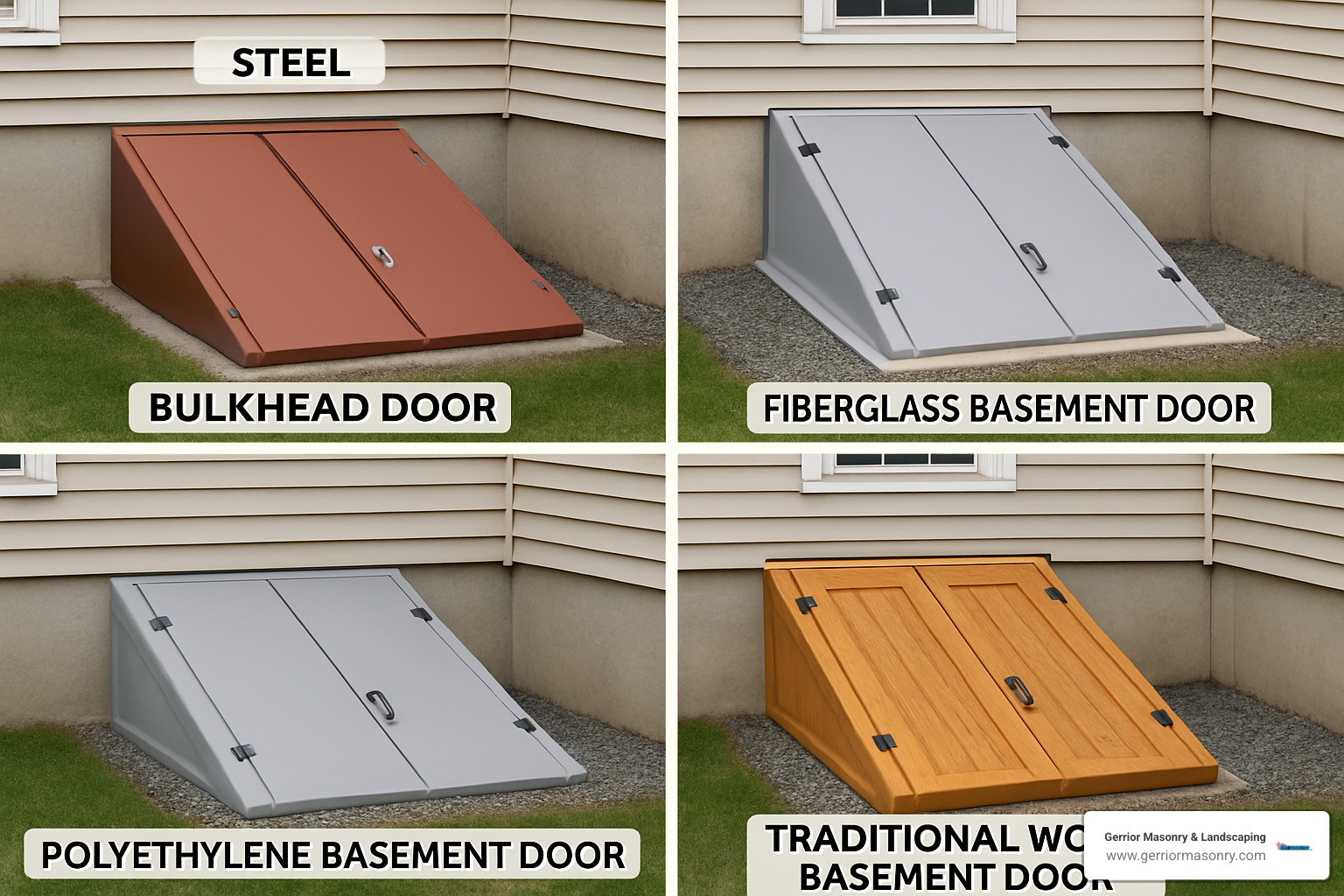
Material Showdown
The material you choose for your basement door is perhaps the most critical decision you’ll make in this process. Each option brings its own set of advantages and considerations:
Material
Durability
Maintenance
Cost Range*
Best For
Steel
20-30+ years
Low-Medium
$1,200-$3,600
Security, durability
Fiberglass
25-40+ years
Very Low
$1,500-$4,500
Moisture resistance, insulation
Polyethylene
30-50+ years
Minimal
$1,600-$4,800
Extreme weather, zero maintenance
Wood
10-20 years
High
$800-$2,400
Aesthetics, historic homes
*Cost ranges reflect average internet pricing data for materials and installation combined, not actual pricing for Gerrior Masonry services.
Steel doors remain the most popular choice among our Middlesex County clients, and for good reason. Products like the Bilco Classic Series offer exceptional security and stand up beautifully to our harsh New England winters. With proper care (mainly keeping them painted to prevent rust), they’ll serve you reliably for decades. The Bilco Classic Series has earned an impressive 4.4/5 rating from over 540 reviewers, which speaks volumes about its quality.
Fiberglass options have gained popularity in recent years, particularly for homeowners concerned about energy efficiency. These doors provide superior insulation and won’t corrode or rot, even with our challenging freeze-thaw cycles. While they come at a higher initial price point, many of our clients find the long-term energy savings and virtually maintenance-free ownership well worth the investment.
For those willing to invest in the ultimate “set it and forget it” solution, polyethylene doors like the Bilco Ultra Series represent the gold standard. Made from high-density plastic, these doors will never need painting and can withstand decades of harsh weather without deteriorating. The Driftwood model has maintained a solid 4.1/5 customer rating, with owners particularly appreciating never having to worry about maintenance.
Wood doors, while less common for exterior basement entrances, still have their place—particularly for historic homes in places like Lexington or Concord where maintaining architectural authenticity is important. Just be prepared for regular maintenance to prevent rot and insect damage.
Matching Door to Foundation & Egress Codes
Your foundation’s configuration and local building codes aren’t just considerations—they’re requirements that will guide your door selection:
When we visit homes with sloped foundations, we often recommend specialized doors designed for this exact situation. The Bilco Classic Series for Sloped Foundations (maintaining an impressive 4.4/5 rating from 114 reviews) provides a custom solution that ensures proper fit and function.
Massachusetts has specific basement egress requirements that can’t be overlooked. Your basement door must provide a clear opening of at least 5.7 square feet, with minimum dimensions of 20 inches wide and 24 inches high. Additionally, the door must be operable from the inside without requiring keys or tools—a critical safety feature in emergency situations.
“We always begin by checking the local building codes,” explains our project manager. “What’s acceptable in Woburn might not meet the requirements in Burlington or Winchester. These details matter, especially if you’re finishing your basement for additional living space.”
For homeowners concerned about fire safety, we often recommend doors with higher fire ratings and easy-operation mechanisms. Many modern doors include hydraulic lifters that make even heavy steel doors easy to open in emergency situations.
The angle of your foundation entry also plays a crucial role in determining the right door style. Flat entries work well with traditional swing doors, while angled entries typically require bulkhead-style doors with appropriate pitch to shed water effectively.
When you’re searching for basement access doors, proper sizing is essential. We always take precise measurements of your existing opening before recommending specific products, ensuring a perfect fit that will provide years of trouble-free service and protection for your home.
Gerrior Masonry & Landscape Construction—based in Woburn, MA—proudly serves Middlesex and Essex County homeowners seeking expert basement door and bulkhead replacements.
Cost & Financing: What You’ll Pay (and Why)
When it comes to basement door replacement, understanding the real costs helps you budget properly and evaluate contractor quotes with confidence. After all, this isn’t just about buying a door—it’s an investment in your home’s security, energy efficiency, and protection.
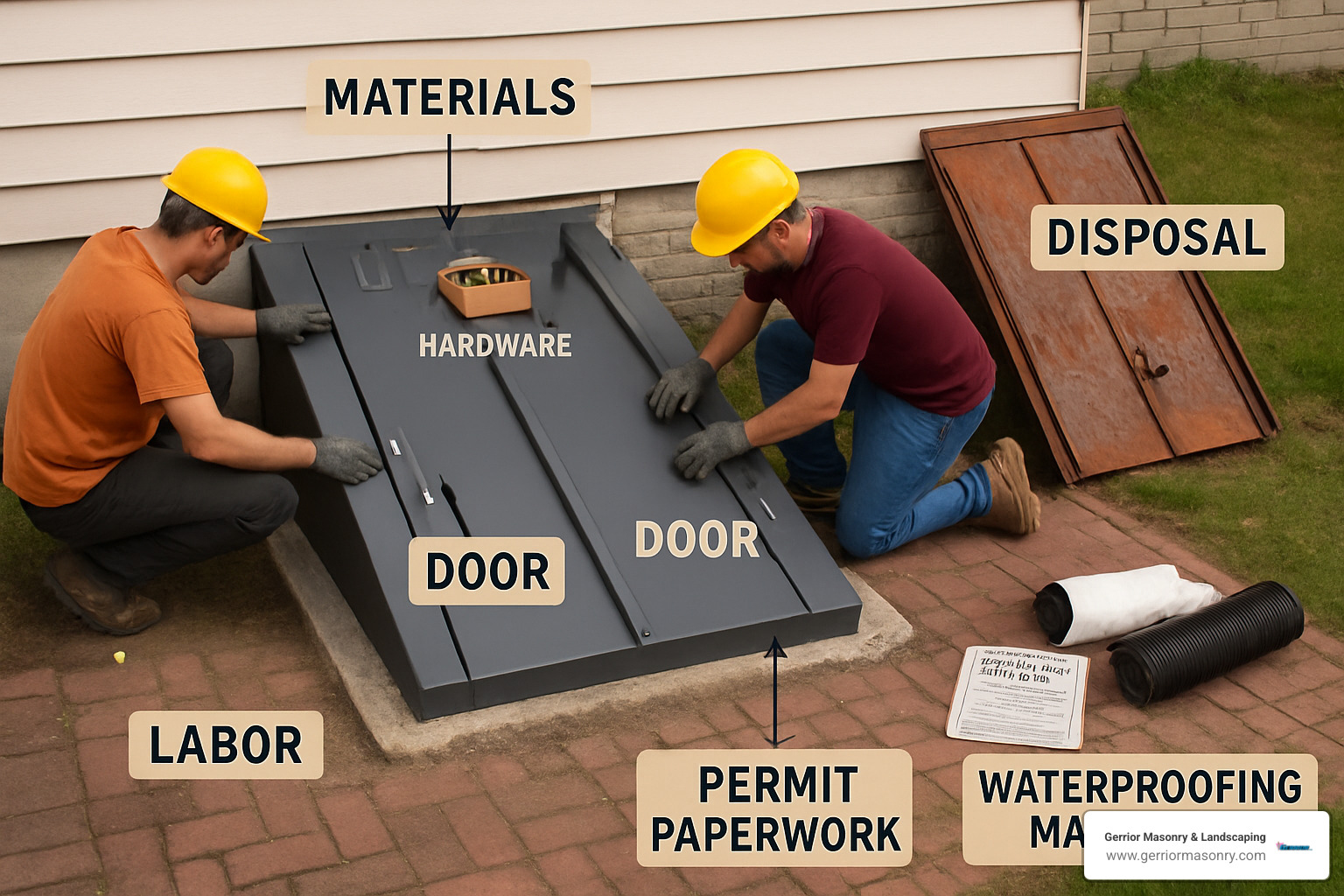
The total cost for a basement door replacement near me project typically ranges from $1,000 to $6,000+, based on internet pricing data. This wide range exists because every project has unique variables:
Labor costs: Most installations require 4-8 hours of skilled work
Door material and quality: From basic steel to premium materials
Disposal fees: Getting rid of that old, heavy door isn’t free
Permit costs: Typically $50-$200, depending on your town
Hardware upgrades: Quality locks, hinges, and hydraulic lifters
Waterproofing measures: Essential for a truly long-lasting installation
Regional labor rates: Massachusetts tends to run higher than national averages
Contingency expenses: Those surprise issues that often hide behind old doors
Factors That Drive Price Up or Down
Your final bill will be influenced by several key factors that can either increase or decrease your costs significantly.
What makes prices climb? Foundation issues are the big one—if we find damage or need to modify your foundation, costs will increase. Custom sizing requirements also add to the bottom line, as do premium finishes that improve aesthetics and durability. Need it done yesterday? Emergency installations almost always cost more, as do projects scheduled during the peak spring/summer season when demand is highest.
On the flip side, there are ways to keep costs reasonable. Standard door sizes are always more affordable than custom work. Choosing basic materials rather than premium options saves money upfront (though may cost more long-term). Many homeowners don’t realize that off-season installation (fall/winter) often comes with better pricing, as contractors look to keep crews busy during slower months.
“One of the smartest things a homeowner can do is clear the area around their bulkhead before we arrive,” explains our project manager. “That simple step can save us time and save you money.”
Sample Cost Range & Saving Tips
Based on internet pricing data (not actual Gerrior Masonry pricing), here’s what Massachusetts homeowners might expect for different scenarios:
A basic steel bulkhead door replacement in a standard size typically runs $1,200-$3,600 all-in. If you’re looking at a premium fiberglass or polyethylene door with upgraded hardware, expect to pay $1,800-$5,400. For projects requiring custom doors with foundation modifications, costs can reach $2,500-$7,500+.
Want to save on your project? Timing is everything. Schedule during fall or winter when contractor schedules open up and prices often drop. Roll up your sleeves and handle prep work yourself—clearing debris, removing stored items, and providing clear access can reduce labor hours.
Don’t forget to check for potential rebates from utility companies. Many Massachusetts utilities offer incentives for energy-efficient home improvements, which can include well-insulated basement doors.
Finally, explore these financing options if needed: home equity lines of credit often offer the best rates, contractor financing programs provide convenience, dedicated home improvement loans are designed specifically for these projects, and some credit cards offer 0% introductory rates that can be smart if you’ll pay off the balance quickly.
“We always recommend homeowners check with MassSave before starting any project,” notes our office manager. “They often have programs that can help offset costs for improvements that increase your home’s energy efficiency.”
Basement Door Replacement Near Me: Finding & Vetting Local Pros
When you type “basement door replacement near me” into your search bar, you’ll likely get flooded with options. But how do you separate the true professionals from those who might leave you with a leaky, poorly installed door? Let’s walk through finding the right contractor for your basement door project.
How to Search “basement door replacement near me” Effectively
Finding qualified local pros doesn’t have to feel overwhelming. Start by getting specific with your search terms. Instead of the generic “basement door replacement near me”, try something like “bulkhead door installation Woburn MA” or “basement door replacement Middlesex County” to narrow down results to truly local businesses.
Google Maps can be your best friend in this search. Look for contractors who have a physical storefront or office (always a good sign of an established business), multiple positive reviews, and—this is key—actual photos of completed basement door projects. I always tell homeowners that a contractor who responds thoughtfully to customer reviews, even negative ones, typically demonstrates better customer service.
Don’t stop at Google, though. Specialized directories like Angi, HomeAdvisor, and Houzz verify contractor credentials and showcase reviews from actual customers. The Better Business Bureau can also reveal how a company handles disputes—a critical insight into their business practices.
When you’ve narrowed down to a few promising options, reach out for quotes from at least three contractors. This gives you a chance to compare not just prices, but also the quality of materials they recommend, warranty coverage, timeline commitments, and who will handle permits. A good contractor will explain these details without prompting.
Before making your final decision, verify their credentials thoroughly. This means checking their local business license, confirming they carry liability insurance (at least $1 million in coverage), and ensuring they have workers’ compensation for their team. For branded doors like Bilco, ask if they’re a certified installer—this often means they’ve received specialized training.
Red Flags When Googling “basement door replacement near me”
After three decades of installing basement doors throughout Massachusetts, we’ve heard plenty of horror stories from homeowners who chose the wrong contractor. Watch for these warning signs:
No physical address or just a P.O. Box might indicate a fly-by-night operation. Legitimate contractors have real workshops or offices you can visit.
Limited knowledge of local permit requirements is a major red flag. Every town in Massachusetts has specific building codes, and a contractor unfamiliar with permits in your area likely lacks experience.
Pressure sales tactics or estimates that seem too good to be true usually are. Quality basement door installation requires proper materials and time—corners cut on quotes often mean corners cut on your installation.
Vague warranty terms or reluctance to put guarantees in writing should send you running. A confident contractor stands behind their work with clear, written warranties.
“I always tell homeowners to ask directly about permits,” says Joe Gerrior, our founder. “Some contractors try to skip this step to save money, but it can create serious problems for you if there’s ever a home inspection or insurance claim.”
Other warning signs include requesting full payment upfront (a reasonable deposit is normal, but never the full amount), having no portfolio of previous basement door installations to show you, sparse online reviews, or lacking manufacturer certifications for the products they install.
At Gerrior Masonry & Landscape Construction, we believe transparency builds trust. That’s why we walk our clients through the entire process—from consultation to final inspection—ensuring there are no surprises along the way.
Gerrior Masonry & Landscape Construction—based in Woburn, MA—proudly serves Middlesex and Essex County homeowners seeking expert basement door and bulkhead replacements.
DIY vs. Professional Installation & The Step-by-Step Process
Thinking about tackling that basement door replacement yourself? Before you grab your toolbox, let’s weigh the pros and cons of DIY versus hiring professionals like us at Gerrior Masonry. As someone who’s overseen hundreds of these installations, I can tell you there’s more to it than meets the eye!
Professional Workflow in 7 Steps
When we handle a basement door replacement near me project, we follow a time-tested process that ensures your new door will perform flawlessly for years to come:
Address any rot, water damage, or structural issues
Apply waterproofing materials where needed
Install flashing if required
New Door Setting and Anchoring
Center door in opening with proper clearances
Use plastic shims at critical points
Secure with appropriate masonry anchors (Tapcon screws)
Ensure door is level, plumb, and square
Weatherproofing and Insulation
Apply high-quality exterior caulk
Install spray foam insulation in gaps
Add weather stripping as needed
Test for water tightness
Hardware Installation and Adjustment
Mount hinges, locks, and handles
Install hydraulic lifters if applicable
Adjust for smooth operation
Secure all fasteners
Final Walkthrough and Testing
Demonstrate proper operation
Review maintenance requirements
Provide warranty documentation
Complete final inspection
Most professional installations take between 4-8 hours for a standard door. More complex projects—like those requiring foundation work or custom sizing—might stretch into a second day. We’ve got installation down to a science after three decades in the business!
Can a Confident DIYer Handle It?
I’m always impressed when homeowners tackle challenging projects themselves. That said, basement door installation comes with some unique challenges that give even experienced DIYers pause.
The trickiest part? Proper anchoring to masonry. Those Tapcon screws need to be installed just right—too tight and you risk cracking the concrete; too loose and your door won’t seal properly. Our crews have specialized tools and years of experience getting this critical step perfect.
If you’re still considering the DIY route, here’s what you’ll need in your toolbox:
* Masonry drill and bits (with hammer function)
* Tapcon screws and installation kit
* Level, square, and measuring tape
* Caulking gun and exterior-grade caulk
* Reciprocating saw
* Pry bar and hammer
* Safety equipment (gloves, goggles, dust mask)
One of our lead installers, Mike, loves to tell customers: “The difference between a door that lasts 5 years and one that lasts 25 years often comes down to how well it’s anchored and sealed.” He’s not wrong—we regularly replace doors that were DIY installations gone wrong.
Warranty considerations are another factor. Most manufacturers will void warranties if their doors aren’t professionally installed. That $200-300 you might save on installation could cost you thousands if something goes wrong and the warranty doesn’t cover it.
Water sealing is another critical skill that’s hard to master without experience. New England weather is notoriously tough on basement doors, and even small sealing mistakes can lead to major water issues down the road.
For most homeowners in Middlesex and Essex Counties, professional installation provides peace of mind, warranty protection, and often saves time and frustration. But if you’re experienced with masonry work and structural projects, a DIY approach might be viable for standard installations.
Remember though—if you start the project and hit unexpected complications (which happens more often than not), we’re always happy to step in and help. There’s no shame in calling the pros when a project gets complicated!
Gerrior Masonry & Landscape Construction—based in Woburn, MA—proudly serves Middlesex and Essex County homeowners seeking expert basement door and bulkhead replacements.
Permits, Codes, Energy & Security Upgrades
When it comes to basement door replacement, there’s more to consider than just the door itself. Understanding permits, building codes, and potential upgrades can save you headaches and improve your home’s value.
In Massachusetts, permit requirements vary depending on your specific town or city. Generally speaking, you’ll need a building permit when:
Your project changes the size of the door opening
You’re making structural modifications to the foundation
The replacement involves electrical components
The door serves as a required emergency egress route
Most Massachusetts municipalities charge between $50 and $200 for these permits, depending on your location and project scope. The good news? When you work with professional contractors like us at Gerrior Masonry, we handle all the permitting paperwork for you, ensuring your installation meets current building codes.
Beyond simply replacing what you had before, a basement door replacement near me project offers the perfect opportunity to upgrade your home’s energy efficiency, security, and safety features.
For energy efficiency, consider doors with higher R-value insulation (typically R-5 to R-12) that can dramatically reduce heat transfer. Quality weather-stripping and gasket upgrades seal out drafts, while thermal breaks prevent cold from conducting through the door frame. Some homeowners even opt for reflective coatings that help reduce summer heat gain.
“I’m always surprised by how many homeowners don’t realize the energy impact of their basement doors,” shares our energy specialist. “A well-insulated basement door with proper sealing can make a noticeable difference on your heating bill by eliminating what’s often a major source of air leakage.”
Security is another important consideration. Most quality bulkhead doors, including popular Bilco models, offer keyed exterior locks for added protection. For swing-type doors, deadbolt installations provide extra security. Some homeowners also add interior security bars or motion-activated lighting above the entrance for additional peace of mind.
Safety features shouldn’t be overlooked either. Hydraulic lifters make opening and closing heavy bulkhead doors much easier while preventing accidental slamming. Non-slip treads on steps reduce fall risks, especially during New England’s wet seasons. For families with young children, child safety locks or alarms can prevent unauthorized access to potentially dangerous basement stairs.
Maintenance & Warranty Essentials
Your new basement door is an investment that deserves proper care. With some simple maintenance, it will perform beautifully for decades.
Every few months, take time to lubricate hinges and hardware with a silicone-based lubricant. Check and clean any drainage channels or weep holes that help water flow away from the door. Remove leaves, dirt, and debris from the door threshold that might prevent proper closure.
Once a year, inspect weather stripping and gaskets for wear or damage. Look for any signs of water infiltration around the frame. Test all locks and security features to ensure they’re working properly. If your door has hydraulic lifters, verify they’re operating smoothly and holding the door securely when open.
Every couple of years, touch up any scratches in painted steel doors to prevent rust. If your door has any exposed wood components, reseal them to prevent moisture damage. Also check all anchoring points to make sure they remain tight and secure.
Most quality basement doors include manufacturer warranties ranging from 10 to 25 years for materials. Installation warranties vary by contractor—at Gerrior Masonry, we stand behind our workmanship with comprehensive labor warranties that give you complete peace of mind.
“There’s an important distinction between manufacturer and installer warranties,” explains our customer service team. “The manufacturer covers material defects in the door itself, while our installer warranty addresses the quality of our workmanship. Both parts are essential for your complete protection.”
Proper maintenance not only extends your door’s lifespan but often preserves these valuable warranties. A little attention a few times a year can prevent costly repairs down the road and keep your Waterproof Bulkhead Doors functioning perfectly year after year.
Gerrior Masonry & Landscape Construction—based in Woburn, MA—proudly serves Middlesex and Essex County homeowners seeking expert basement door and bulkhead replacements.
Frequently Asked Questions about Basement Door Replacement
How long does a typical replacement take?
When homeowners ask me about timelines, I tell them that a standard basement door replacement near me project usually takes 4-8 hours from start to finish. That’s assuming we don’t find any hidden surprises like structural damage or rot once we remove the old door.
For more complex installations—like those requiring foundation modifications or custom fitting—we typically schedule a full 1-2 days to ensure everything is done properly. And if you’re ordering a custom door, keep in mind that manufacturers often need 3-4 weeks lead time before we can begin the actual installation.
“The biggest timeline variable is what we find when we remove the old door,” explains our lead installer. “Sometimes what looks like a simple replacement reveals underlying issues that need addressing for the new door to function properly and last for decades.”
Do I need a permit for a bulkhead door in Massachusetts?
Yes, most Massachusetts cities and towns require a building permit for basement door replacement near me projects, especially for bulkhead doors that serve as emergency exits. This requirement isn’t just bureaucratic red tape—it ensures your new door meets current building codes for safety and structural integrity.
At Gerrior Masonry, we handle all permit applications as part of our service. We’ve worked with building departments throughout Middlesex and Essex Counties for over three decades and understand the specific requirements in each municipality. This saves our clients the headache of navigating the permitting process themselves.
What maintenance keeps my new door watertight?
Water infiltration is the number one enemy of any basement door. To keep your investment watertight year after year, I recommend following these key maintenance steps:
Regularly clean out the drainage channels and weep holes to prevent blockages. In New England, these can quickly fill with leaves, pine needles, or debris. Check and replace weatherstripping at the first sign of wear—this is your door’s first line of defense against water. Inspect the caulking around the frame annually and renew it as needed.
Keep the area around your door clear of plants, mulch, and debris that could trap moisture. Ensure your yard is properly graded to direct water away from the door rather than toward it. For steel doors, apply a rust inhibitor every 2-3 years to prevent corrosion. And finally, test your door’s operation regularly to ensure it closes completely and creates a proper seal.
“Many water issues we see could have been prevented with simple maintenance,” notes our service manager. “Just five minutes of attention a few times a year can add years to your door’s lifespan.”
How do I know if my basement door meets current code requirements?
Building codes evolve over time, and many older basement doors no longer meet current standards. Today’s codes typically require:
A minimum clear opening width of 32 inches and height of 78 inches for proper egress. No more than one lock or latch requiring a key, tool, or special knowledge to operate from inside (this is a critical safety feature for emergency exits). Self-closing and self-latching mechanisms on certain doors, particularly those between the basement and attached garage. Specific fire rating requirements depending on the door’s location in your home.
If you’re unsure about your door’s compliance, I’d recommend scheduling a professional inspection. This is particularly important if your basement door serves as an emergency escape route for a finished basement with bedrooms.
What’s the difference between a bulkhead door and a standard basement door?
I’m often asked to explain the difference between these two common basement entry types. A bulkhead door (sometimes called a cellar door) is that angled or curved assembly that covers exterior stairs leading down to your basement. It typically consists of two doors that open upward and outward—think of the “doors to nowhere” that Dorothy encounters in The Wizard of Oz!
A standard basement door, on the other hand, is just like any other exterior door in your home—a conventional hinged door installed in a vertical wall. While both provide access to your basement, they have different installation requirements, maintenance needs, and price points.
Can I replace just the door without replacing the entire frame?
While technically possible in some cases, I generally don’t recommend replacing just the door without addressing the frame. Here’s why: your door and frame function as a system, working together to create a secure, weathertight seal. Issues with the frame—such as rot, water damage, or misalignment—will quickly compromise even the highest quality new door.
Additionally, most manufacturers’ warranties become void if you install their door in an existing frame. This means you could lose valuable protection against defects or premature failure.
“In thirty-plus years of installing doors, I’ve rarely seen a case where the frame was in perfect condition while the door needed replacement,” shares our senior technician. “They typically age and deteriorate together.”
A professional assessment can determine if your frame is still in good condition, but in my experience, complete replacement usually provides better long-term value and performance.
Gerrior Masonry & Landscape Construction—based in Woburn, MA—proudly serves Middlesex and Essex County homeowners seeking expert basement door and bulkhead replacements.
Conclusion
Replacing your basement door is more than just a home improvement project—it’s an investment in your home’s safety, energy efficiency, and protection against the elements. Whether you’re dealing with a deteriorating bulkhead, a drafty walkout door, or outdated hardware, professional replacement offers significant benefits:
Improved security for your home
Improved energy efficiency and lower utility bills
Better protection against water damage
Increased home value and curb appeal
Peace of mind during severe weather
When searching for “basement door replacement near me”, the quality of installation is just as important as the quality of the door itself. Professional installation ensures proper fit, sealing, and operation—critical factors for long-term performance.
At Gerrior Masonry & Landscape Construction, we bring over 30 years of experience to every basement door replacement project. Our team understands the unique challenges of New England weather and how to create basement entries that stand the test of time.
We invite you to contact us for a free consultation and estimate for your basement door replacement needs. Our experts will guide you through the selection process, handle all permitting requirements, and ensure a flawless installation that improves your home’s safety and efficiency.
Gerrior Masonry & Landscape Construction—based in Woburn, MA—proudly serves Middlesex and Essex County homeowners seeking expert basement door and bulkhead replacements.
Basement Door Replacement Cost: 10 Best Value Tips 2025
Understanding Basement Door Replacement Costs in 2024
If you’re looking for quick answers about basement door replacement cost, here’s what you need to know:
Type of Basement Door
Materials Cost
Installation Cost
Total Average Cost
Steel Bulkhead
$800-$1,600
$500-$3,000
$1,300-$4,600
Fiberglass
$1,000-$2,000
$500-$3,000
$1,500-$5,000
Wood
$500-$1,500
$500-$3,000
$1,000-$4,500
Vinyl
$1,000-$1,600
$500-$3,000
$1,500-$4,600
Walkout Door
$2,000-$5,000
$1,000-$5,000
$3,000-$10,000
The basement door replacement cost typically ranges from $900 to $6,000 nationwide, with most homeowners spending around $1,750 for a standard installation. This price varies widely based on door material, size, installation complexity, and your location.
Why such a big range? Your final cost depends on several key factors:
Door material (steel, wood, fiberglass, or vinyl)
Size and type (standard vs. custom dimensions)
Labor complexity (simple replacement vs. structural changes)
Location (prices in Massachusetts differ from those in Texas)
Additional features (waterproofing, insulation, smart locks)
I’m Joe Gerrior, owner of Gerrior Masonry & Landscape Construction Corp., and I’ve overseen hundreds of basement door replacements across Massachusetts over the past 34 years, giving me extensive insight into real-world basement door replacement cost factors that affect local homeowners. Our team specializes in ensuring your basement entrance is not only secure and weatherproof but also complements your home’s exterior.
What Is a Basement Door (Bulkhead/Cellar/Bilco/Walkout) and Why It Matters
Whether you call it a bulkhead, cellar door, Bilco (after the popular manufacturer), or walkout entrance, your basement door is far more than just an extra way to get into your home. As we’ve seen at Gerrior Masonry, these specialized entrances are critical components that protect your home’s foundation while providing essential access.
“I’ve replaced hundreds of basement doors over three decades, and homeowners are often surprised by how much these entrances actually do for their homes,” says Joe Gerrior, our founder. “They’re not just doors—they’re safety systems.”
Your basement door serves multiple vital functions that directly impact your home’s safety, value, and compliance with building regulations:
Building code compliance is perhaps the most important function—most local codes require basements to have emergency exits (egress points) separate from interior stairways. This isn’t just red tape; it’s about keeping your family safe.
Storm protection is another critical role, as a properly sealed basement door creates a barrier against rain, snow, and potential flooding. Here in Massachusetts, where we experience everything from nor’easters to summer downpours, this protection is invaluable.
Large-item access might seem obvious, but the practical benefit of moving furniture, appliances, or storage items directly into your basement without navigating tight interior stairs is something homeowners appreciate daily.
Ventilation opportunities are another advantage, especially in older homes where basement air quality can be a concern. A basement door provides options for fresh air circulation in below-grade spaces.
Security features of modern basement doors also provide an additional layer of protection for your home, with many newer models offering improved locking mechanisms and stronger materials to prevent unauthorized access.
Key Functions at a Glance
When we talk with homeowners about basement door replacement cost, we always emphasize the multifunctional nature of these entrances:
Emergency exit capabilities can literally be lifesaving—if interior stairways are blocked during a fire or other emergency, your basement door provides an alternate escape route. This is especially important if you have a finished basement where people spend time.
Weather sealing technology has improved dramatically in recent years. Today’s doors create substantially better protection against the elements than older models, preventing water infiltration that can lead to thousands in repair costs.
Property value improvement is another benefit many homeowners don’t consider. A well-maintained, attractive basement entrance contributes significantly to curb appeal and overall home value—something particularly important in competitive real estate markets like those in Middlesex and Essex Counties.
As one recent customer told us after their replacement: “I never realized how much that old rusted bulkhead was detracting from our home’s appearance until we saw the new one installed. It’s like a facelift for the whole property!”
The right basement door doesn’t just protect your home—it improves it, both functionally and aesthetically. And while the basement door replacement cost might seem significant upfront, the long-term value in terms of safety, energy efficiency, and property protection makes it one of the smartest investments you can make in your home’s exterior.
Basement Door Types & Average 2024-2025 Costs
When it comes to selecting a new basement door, you’ll find several options that balance durability, appearance, and basement door replacement cost. As a Massachusetts homeowner, your choice will affect not just your budget but also how well your basement entrance performs in our New England weather.
Material Price Ranges (Based on Internet Data)
Let’s look at what you can expect to pay for different materials, keeping in mind these are average costs based on internet data, not actual prices for Gerrior Masonry services.
Steel Doors ($900-$1,600)
Steel offers excellent security and stands up to our harsh Massachusetts winters. While they’re tough enough to last 15-20 years, they can develop rust in our humid summers if not properly maintained. Many of our Woburn clients appreciate steel’s fire-resistant properties, though they do conduct cold in winter.
Fiberglass Doors ($1,200-$1,750)
If you’re looking for longevity, fiberglass is hard to beat with its 30+ year lifespan. These doors provide superior insulation and weather resistance—perfect for those nor’easters that blow through Essex County. They cost more upfront but require almost no maintenance, making them popular with our busy homeowners.
Wood Doors ($800-$1,200)
There’s something timeless about wood doors that many of our clients in historic neighborhoods prefer. They offer natural insulation and can be customized to match your home’s character. The trade-off? You’ll need to maintain them regularly to prevent rot, especially with our snowy winters and humid summers. With proper care, expect 10-15 years of service.
Vinyl Doors ($1,000-$1,600)
Lightweight and virtually maintenance-free, vinyl doors have become increasingly popular in Middlesex County. They won’t corrode like metal and don’t need painting like wood. They can last 15-25 years, though extreme temperature swings can sometimes cause warping.
Don’t forget to budget for removal and disposal costs ($130-$400), which include disconnecting hardware, removing the old door and frame, and hauling everything away—a service we handle seamlessly for our clients.
Door Material
Initial Cost
Lifespan (Years)
Maintenance Level
Energy Efficiency
Steel
$900-$1,600
15-20
Medium
Medium
Fiberglass
$1,200-$1,750
30+
Low
High
Wood
$800-$1,200
10-15
High
Medium
Vinyl
$1,000-$1,600
15-25
Low
Medium-High
Standard vs. Custom Basement Door Replacement Cost
Your basement opening might determine whether you need a standard or custom solution:
Standard/Prefabricated Doors ($900-$2,500)
Most of the basement doors we install in Woburn homes are standard sizes, typically 48″-60″ wide. These ready-made units are more affordable and quicker to install, which means less disruption to your family. For straightforward replacements, prefab doors offer excellent value while still providing the protection your home needs.
Custom Doors ($2,500-$6,000+)
Some of our clients, particularly those with older homes in Essex County, have uniquely sized openings that require custom solutions. While these doors cost more and take longer to produce, they’re sometimes the only way to ensure a proper fit. A custom door isn’t just about aesthetics—it’s about creating a perfect seal against New England’s notorious weather.
In my 30+ years of installing basement doors throughout Massachusetts, I’ve found that investing in the right door for your specific situation pays dividends in longevity and performance. Whether you need a standard steel bulkhead or a custom wood solution, we can help you steer the options to find the perfect balance of durability, appearance, and basement door replacement cost.
Factors Influencing Basement Door Replacement Cost
When planning your basement door project, understanding what drives basement door replacement cost helps you budget more accurately and spot potential savings opportunities. As we’ve seen with hundreds of Massachusetts installations, several key factors can significantly impact your final price.
Cost Breakdown: Materials vs. Labor vs. Extras
Your basement door project isn’t just about the door itself. Here’s how the typical costs break down:
The materials usually account for 40-60% of your total investment. This includes not just the door, but also framing materials, hardware, and sealants that ensure everything fits properly and stays watertight.
Labor costs make up another 30-50% of your budget, typically ranging from $300-$3,000 depending on complexity. Why such a wide range? Well, installing a standard steel door in an existing frame is much simpler than completely reconstructing a bulkhead entrance! Professional installers typically charge $50-$150 per hour, with most installations taking 6-12 hours to complete properly.
Don’t forget the extras that round out your project: disposal of old materials (5-10%), permits required by your town (2-5%), and crucial waterproofing measures (10-25%) that protect your basement from moisture damage.
As Joe from our team likes to say, “The door is just the beginning of the story—it’s the proper installation that writes the happy ending.”
Regional Price Swings Across the U.S.
Your zip code has a surprising impact on your basement door replacement cost. Based on our research of average costs across the country:
In Massachusetts, where we work, expect to pay $1,500-$3,500, while Californians typically shell out $1,800-$4,000. Down in Texas, the same project might cost $1,300-$2,900, and Georgia homeowners generally pay $1,200-$2,800.
Other regional averages include New York at $1,600-$3,800, Michigan at $1,100-$2,600, and Washington state at $1,700-$3,800.
These variations stem from differences in local labor rates, material availability, climate considerations, and building code requirements. Here in New England, our costs tend to run higher because we need doors that can withstand harsh winters, comply with strict building codes, and meet higher regional labor rates.
Additional Expenses Homeowners Forget
Many homeowners are surprised by necessary extras that weren’t in their initial budget. Don’t get caught off guard by these common additions:
Framing and structural work often adds $250-$800 if your existing frame is damaged or you’re changing door dimensions. Concrete modifications to steps or landings typically run $5-$10 per square foot, while addressing foundation cracks before installation can cost $250-$800 per crack (but saves thousands in potential water damage later).
Quality hardware upgrades ($50-$300) make a huge difference in daily use and security. Some homeowners are now opting for smart lock systems ($300-$800) that offer keyless entry or remote access capabilities.
Proper drainage improvements around your basement entrance ($40-$85 per linear foot) prevent flooding issues, while comprehensive waterproofing ($6-$15 per square foot) provides essential moisture protection. Don’t forget painting or finishing ($200-$500) for both appearance and weather resistance.
As we often tell our Massachusetts clients, proper water management around your bulkhead is just as important as the door itself. For more detailed information about installation considerations, check out our guide on Bulkhead Door Installation.
According to scientific research on door materials and insulation, proper installation and material selection can significantly impact your home’s energy efficiency and security—making the right choices worth every penny.
DIY vs. Professional Replacement & Project Timeline
One of the biggest decisions affecting your basement door replacement cost is whether to tackle the project yourself or hire professionals.
Pros and Cons of DIY on basement door replacement cost
That tempting 30-40% savings on your basement door replacement cost makes DIY installation appealing, doesn’t it? Many homeowners love the flexibility of working at their own pace and the satisfaction that comes from completing a home project themselves. I’ve seen the pride on homeowners’ faces when they finish a project with their own two hands.
But before you grab your tools, consider what you’re getting into. Basement doors aren’t lightweight—they often weigh between 100-300+ pounds, making them a real wrestling match for even the strongest DIYers. You’ll also need specialized tools that might cost more than you expect if you don’t already own them.
The trickiest part? Proper waterproofing. I can’t tell you how many “fixed” basement doors I’ve had to repair after DIY installations led to leaks and water damage. There’s a reason professionals train specifically for these installations—they’re more complex than they look.
Code compliance is another hidden challenge. Each municipality has specific requirements, and missing these can lead to failed inspections or even fines. Plus, most manufacturers won’t honor warranties on DIY installations if problems arise later.
If you’re considering the DIY route, it’s best suited for pre-hung doors in existing, properly-sized openings. For anything involving structural changes, concrete work, or custom doors, professional expertise typically pays for itself in the long run.
How Long Does a Replacement Take?
When homeowners ask me how long their basement door replacement will take, I always say, “It depends on whether you’re watching the clock or doing the work!”
For a professional installation, the timeline is quite predictable:
– Preparation: 2-4 hours for inspection, measurements, and removing the old door
– Installation: 4-8 hours depending on complexity
– Finishing touches: 1-2 hours for sealing, testing, and cleanup
Most of our professional installations at Gerrior Masonry & Landscape Construction are completed within a single day, minimizing disruption to your home and daily routine.
If you’re going the DIY route, plan for:
– Preparation: 4-6 hours (this includes multiple trips to the hardware store!)
– Installation: 8-16 hours, typically spread over several days
– Finishing touches: 2-4 hours for sealing and cleanup
– Curing time: Allow 24 hours for sealants and concrete work to properly set
Weather can throw a wrench in even the best-laid plans. Rain delays are common for exterior work, and extreme temperatures can affect how materials set and cure. Material delivery times (especially for custom doors) can extend your timeline, as can permit approval processes.
Sometimes the biggest delays come from surprises hiding behind that old door—rotted framing, water damage, or foundation issues that weren’t visible until removal. At Gerrior Masonry, we’ve seen it all, which is why we build a little flexibility into our scheduling.
Rushing a basement door installation often leads to problems down the road. Whether you DIY or hire professionals, allowing adequate time for proper installation will protect your investment and your home for years to come.
Gerrior Masonry & Landscape Construction is based in Woburn, MA, and services Middlesex and Essex County, Massachusetts.
Smart Ways to Save Money & Boost ROI
Looking to get the most value from your basement door replacement cost? You don’t have to break the bank to get a quality installation. With some strategic planning, you can maximize your investment while still getting a door that keeps your basement secure and dry for years to come.
5 Negotiation and Saving Tips
At Gerrior Masonry, we’ve helped hundreds of Massachusetts homeowners find smart ways to manage their replacement projects. Here are our top money-saving strategies:
Schedule during slower seasons to catch contractor discounts. In New England, late fall through winter typically sees lower demand, which can translate to 10-15% savings on your basement door replacement cost. As we often tell our customers, “The weather might be colder, but so are the prices!”
Bundle your projects for better value. If you’re also planning foundation repairs, walkway installation, or other masonry work, combining them with your basement door replacement often leads to package pricing. We frequently help homeowners save by coordinating multiple improvements in one visit.
Consider mid-range materials with expert installation rather than premium materials with basic installation. A well-installed mid-tier door often outperforms a top-of-the-line door that’s poorly fitted. As Joe Gerrior likes to say, “It’s not just what you install, but how you install it that matters.”
Check for energy efficiency rebates with your utility company. Many Massachusetts utilities offer incentives for weatherproofing improvements that reduce energy consumption. These rebates can offset 5-15% of your basement door replacement cost.
Reuse quality hardware where possible. If your existing hinges, locks, or handles are still in good condition, ask your contractor if they can be transferred to your new door. This small adjustment can save $50-$200 on your project.
Don’t forget to consult with your tax professional about potential home improvement deductions. Energy-efficient upgrades sometimes qualify for tax credits that can further reduce your effective costs.
Can a New Basement Door Increase Property Value?
Absolutely! When homeowners ask me if replacing their basement door is worth it, I point to several tangible returns:
Most homeowners recoup 60-90% of their basement door replacement cost in increased home value, especially when selling within a few years. This makes it one of the better exterior improvement investments you can make.
Beyond the financial return, you’ll enjoy lower utility bills thanks to improved insulation and weather sealing. Many of our customers report noticeably drier, warmer basements after we install properly sealed doors.
The curb appeal factor shouldn’t be underestimated either. As Massachusetts realtor Sarah Mitchell told me recently, “When I’m showing homes with finished basements, buyers always notice the basement entrance. A new, secure-looking door makes them feel the entire space has been well-maintained.”
Perhaps most importantly, a properly installed basement door prevents potentially thousands in water damage to your foundation and basement contents. That’s not just savings—it’s peace of mind during New England’s notorious rain and snow storms.
Basement Door Replacement Cost vs. Other Exterior Doors
To help you budget appropriately, here’s how basement door replacement cost compares to other exterior door projects based on national averages:
Your standard front entry door typically runs $500-$4,500 installed, while sliding patio doors average $500-$3,500. Neat French doors command $600-$5,800, and garage doors (with openers) generally cost $2,800-$6,500. By comparison, storm doors are relatively affordable at $100-$1,000, while security doors with advanced features range from $600-$5,000.
Basement doors usually fall in the middle of this spectrum, though walkout basement doors requiring significant structural modifications can approach the higher end. The investment makes sense when you consider that, unlike some doors that are primarily aesthetic, your basement entrance serves critical functional purposes—emergency egress, weather protection, and large item access.
For the most accurate estimate for your specific situation, we’re always happy to provide a no-obligation consultation. Every home is unique, and at Gerrior Masonry & Landscape Construction, we tailor our approach to your property’s specific needs. We proudly serve Woburn and all of Middlesex & Essex County, Massachusetts.
Frequently Asked Questions about Basement Door Replacement Cost
How often should a basement door be replaced?
Your basement door isn’t something you think about often—until it starts causing problems. Most basement doors will serve you faithfully for 15-30 years, though this timeline varies quite a bit depending on several factors.
Material quality plays a huge role in longevity. Those premium fiberglass doors might cost more upfront, but they’ll reward you with 30+ years of service. Steel doors typically last 15-20 years, while wood doors—though charming—might need replacement after just 10-15 years without diligent maintenance.
Where you live matters too. Here in Massachusetts, our basement doors face harsh winter conditions, freeze-thaw cycles, and occasionally, coastal salt exposure. These environmental factors can accelerate wear compared to milder climates.
“I’ve seen well-maintained fiberglass doors still performing beautifully after 25 years,” says Joe Gerrior, “while neglected steel doors can develop serious rust issues in less than a decade, especially near the coast.”
What are the signs it’s time to budget for basement door replacement cost?
Your basement door will usually give you plenty of warning signals before complete failure. Here are the telltale signs it’s time to start thinking about basement door replacement cost:
Water infiltration is the most serious red flag—if you’re finding puddles or dampness around your basement entrance after rain, your door is no longer providing proper protection. This moisture can lead to much more expensive foundation problems if ignored.
Physical deterioration is also obvious: rust spots on metal components, wood that’s soft to the touch, or cracks in fiberglass panels. When you notice these issues, they’ll only get worse with time.
Operational problems are another clear indicator—does your door require a shoulder check to open? Does it refuse to close properly? These aren’t just annoyances; they’re signs of structural issues.
Energy loss becomes apparent in colder months when you feel drafts or notice higher heating bills. Modern replacement doors offer significantly better insulation than older models.
Security concerns should never be ignored. If locks are compromised or the door itself feels flimsy, your home’s safety could be at risk.
Even purely aesthetic issues like peeling paint or an outdated appearance can be legitimate reasons for replacement, especially if you’re considering selling your home in the near future.
What warranties or guarantees come with new basement doors?
Understanding warranty coverage should be part of your basement door replacement cost calculations, as it protects your investment for years to come.
Manufacturer warranties vary significantly by material and brand. Steel doors typically come with 10-20 year material warranties, while premium fiberglass doors often boast impressive limited lifetime coverage. Vinyl doors generally include 10-25 year protection, and wood doors—being natural materials—usually carry shorter 1-10 year warranties.
The installation warranty is just as important as the product warranty. At Gerrior Masonry & Landscaping, we stand behind our workmanship with solid guarantees covering everything from proper operation to waterproofing integrity. This installation coverage is something you’ll typically miss out on with DIY projects.
Be aware that most warranties come with reasonable conditions—regular maintenance is typically required, and DIY installation often voids manufacturer protection entirely. Always keep your warranty documentation in a safe place, and check if the warranty can transfer to new owners if you sell your home.
“We always provide our customers with clear written warranties,” explains Joe Gerrior. “A quality basement door is an investment in your home’s protection, and that investment should come with peace of mind.”
One last tip: read the fine print before purchase. Some warranties look impressive at first glance but contain significant limitations in the details.
Gerrior Masonry & Landscape Construction proudly serves Woburn and all of Middlesex & Essex County, Massachusetts.
Conclusion
When it comes to basement door replacement cost, knowledge truly is power. Now that you understand the factors influencing prices—from materials and labor to regional variations—you’re equipped to make choices that balance your budget with long-term value.
Your basement entrance isn’t just a utility feature; it’s a critical component of your home’s safety, efficiency, and curb appeal. While the national average ranges from $900 to $6,000, investing in quality often pays dividends through extended lifespan and better protection.
Think beyond the door itself when budgeting. Those “hidden” costs—removal, disposal, structural adjustments, and weatherproofing—play crucial roles in the success of your project. And don’t forget that timing matters! Scheduling your replacement during slower seasons (typically late fall and winter here in Massachusetts) can lead to significant savings without sacrificing quality.
A properly installed basement door does so much more than provide access. It creates a reliable barrier against New England’s harsh weather, prevents costly water damage to your foundation, improves your home’s energy efficiency, and improves security. These benefits translate to both immediate comfort and long-term property value—with most homeowners recouping 60-90% of their investment when selling.
While DIY installation might seem tempting for the budget-conscious, professional installation offers peace of mind that’s often worth the additional expense. At Gerrior Masonry & Landscaping, we bring over three decades of local experience to every project. We understand Massachusetts building codes, regional weather challenges, and the specific structural considerations needed for a lasting installation.
Our approach is straightforward: we provide clear, detailed estimates that account for all aspects of your project—no surprise costs or hidden fees. From initial consultation to final cleanup, we handle every step with the care and attention to detail that’s made us a trusted name in Middlesex and Essex Counties.
Ready to explore your options for Bulkhead Replacement? We’d be happy to provide a personalized assessment of your basement entrance and discuss solutions custom to your home’s specific needs.
Gerrior Masonry & Landscape Construction is based in Woburn, MA, and services Middlesex and Essex County, Massachusetts. Our deep roots in the region mean we understand the unique challenges of New England homes and how to address them effectively.