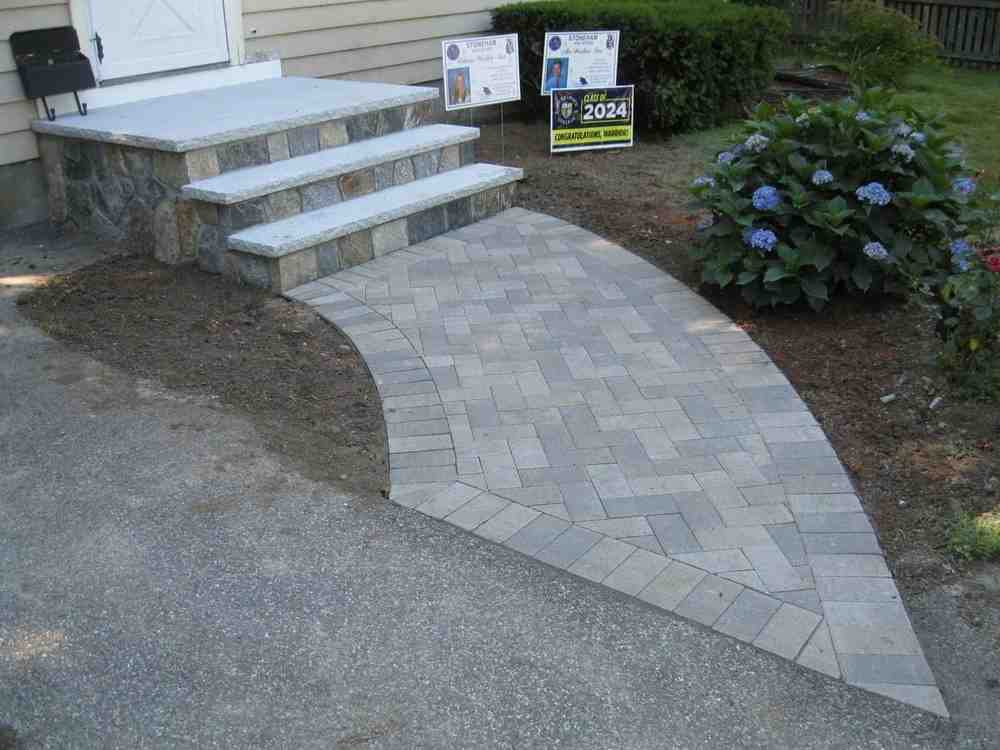
How Much Does a Stone Walkway Cost? 7 Powerful Facts 2025
Understanding Stone Walkway Costs: The Complete Investment Guide
How much does a stone walkway cost depends on your material choice, size, and installation complexity, but here’s what you can expect to pay in 2024-2025:
Quick Cost Overview:
- Budget Range: $1,500 – $45,000 total project cost
- Per Square Foot: $8 – $50 installed
- National Average: $2,665 for most homeowners
- Small Walkway (20′ x 4′): $1,160 – $4,000
- Large Walkway (70′ x 4′): $4,060 – $14,000
Your front walkway is more than just a path—it’s the first impression visitors get of your home. Whether you’re considering natural flagstone, concrete pavers, or brick, understanding the full cost breakdown helps you make smart decisions about this important investment.
The price range is wide because stone walkways aren’t one-size-fits-all. A simple gravel path might cost $2-8 per square foot, while premium natural stone can run $30-50 per square foot installed. Labor typically represents 40-60% of your total cost, with regional rates varying significantly.
Site preparation, permits, and design complexity all impact your final bill. A straight concrete paver path costs far less than a curved natural stone walkway with built-in lighting and decorative borders.
I’m Joe Gerrior, owner of Gerrior Masonry & Landscape Construction Corp., and I’ve been helping Massachusetts homeowners understand exactly how much does a stone walkway cost for over 34 years. My experience installing everything from simple stepping stone paths to elaborate natural stone walkways gives me insight into the real costs and value of different approaches.
How Much Does a Stone Walkway Cost in 2024-2025?
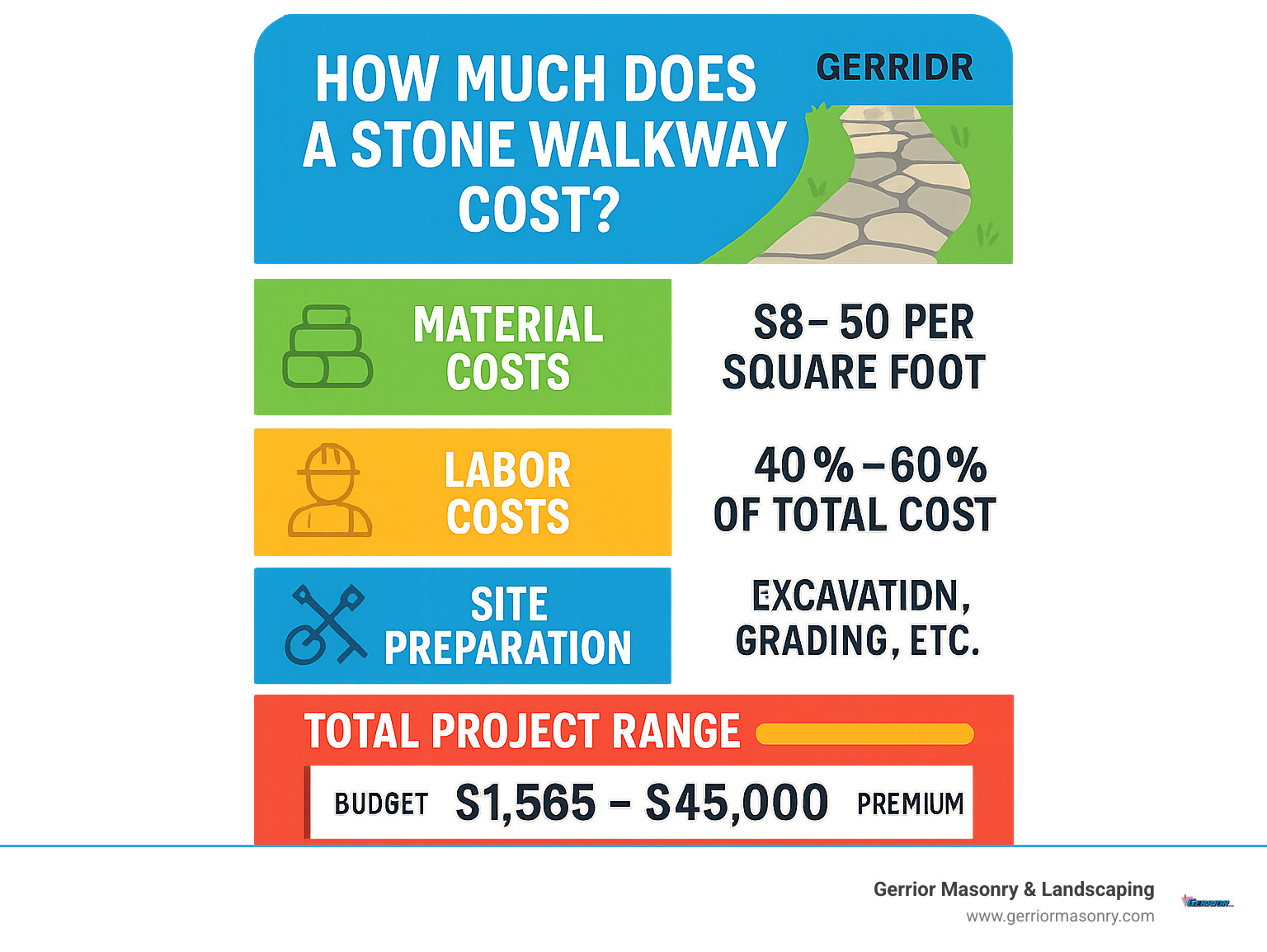
If you’re wondering how much does a stone walkway cost in today’s market, you’re looking at a national average range of $1,565 to $45,000. Most homeowners end up spending around $2,665, though this number tells only part of the story.
The enormous price spread reflects real differences between projects. A simple gravel path costs dramatically less than an elaborate natural stone entrance walkway with built-in lighting and curved borders.
Construction costs have climbed steadily in 2024-2025, and walkway installation hasn’t been immune. According to the Bureau of Labor Statistics, construction wages continue their upward trend, directly impacting your project costs.
The typical range for walkway installation now runs $40-50 per square foot, though your actual cost depends heavily on material choice and design complexity. Size matters too—here’s how different project scales compare:
| Project Size | Dimensions | Square Footage | Cost Range |
|---|---|---|---|
| Small | 20′ x 4′ | 80 sq ft | $1,160 – $4,000 |
| Medium | 35′ x 4′ | 140 sq ft | $2,030 – $7,000 |
| Large | 70′ x 4′ | 280 sq ft | $4,060 – $14,000 |
Average Stone Walkway Cost–How Much Does a Stone Walkway Cost?
The national median cost of $2,665 gives you a baseline, but understanding what drives walkway pricing helps you budget more accurately. Material costs typically range from $8-50 per square foot, while labor averages around $75 per hour.
High-end projects easily reach $12,000-45,000 when you’re talking about premium natural stone installations with decorative features. But these aren’t just expensive paths—they’re permanent landscape investments that can last 50-100 years with proper maintenance.
Note: These are average costs based on internet data and not actual costs for Gerrior Masonry services.
Think of it this way: if your walkway lasts 75 years, even a $7,500 installation costs just $100 per year. That’s less than most people spend on lawn care annually.
Cost per Square Foot for “How Much Does a Stone Walkway Cost” by Material
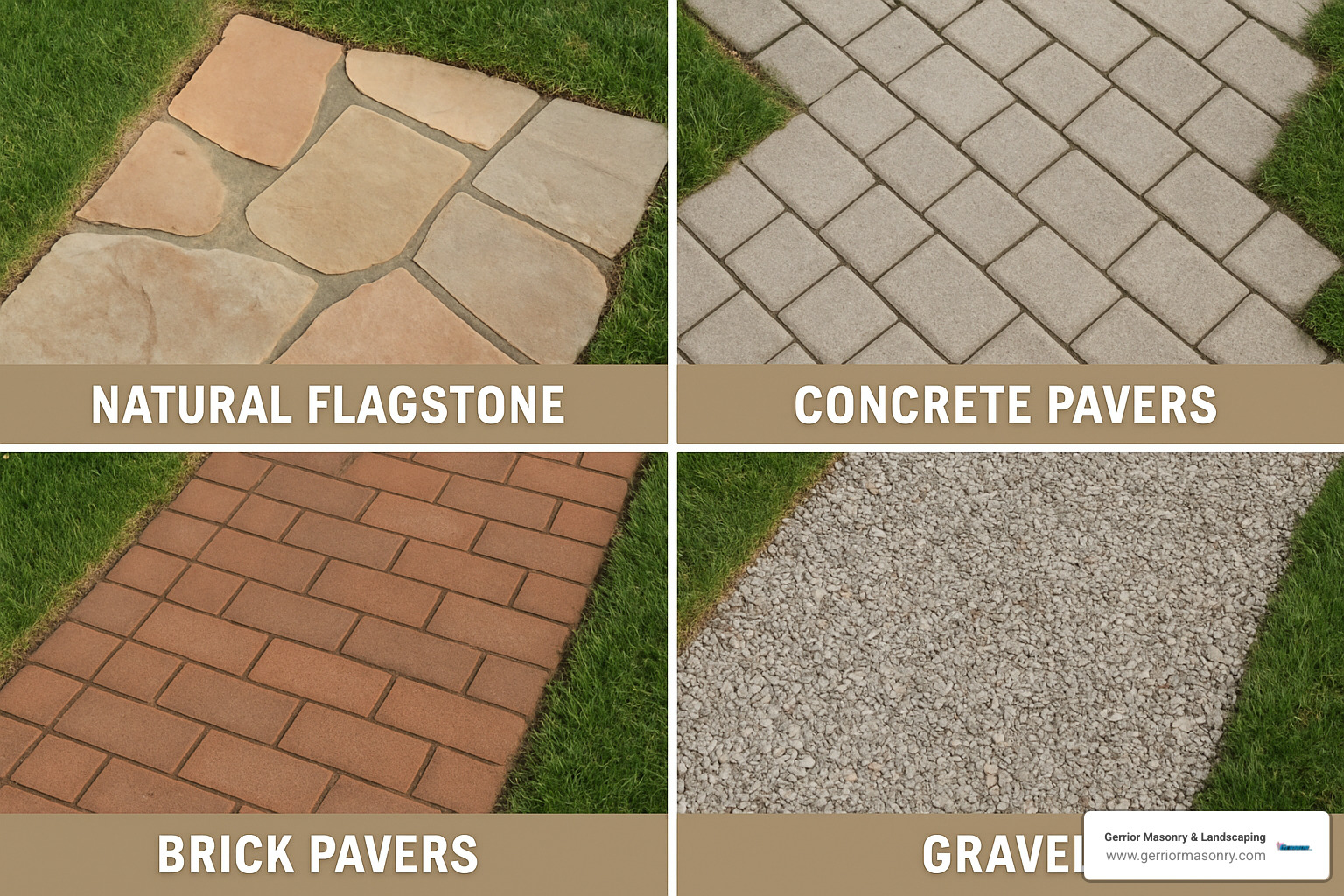
Material choice is where how much does a stone walkway cost really gets interesting. The price differences are substantial, and each material brings its own personality to your landscape.
Natural stone like flagstone and bluestone commands $30-50 per square foot because you’re getting something truly unique. Each piece has its own character, and skilled installation is essential.
Concrete pavers hit the sweet spot at $8-20 per square foot. They offer excellent durability, consistent appearance, and come in dozens of colors and patterns. For most homeowners, they provide the best balance of cost and performance.
Brick pavers fall in the middle at $10-25 per square foot. They bring classic charm and work beautifully with traditional home styles.
Gravel paths are your budget champion at $2-8 per square foot. They’re perfect for informal garden paths and can be installed quickly.
Stepping stones offer a compromise at $5-12 per square foot. They create defined pathways without the formal look of continuous paving.
Small vs. Large Builds: How Much Does a Stone Walkway Cost When Size Doubles?
Here’s where walkway economics get interesting. When you double the size, you don’t necessarily double the cost. Larger projects benefit from economies of scale because fixed costs like site mobilization, permits, and equipment setup get spread over more square footage.
A small walkway (20′ x 4′ = 80 sq ft) typically costs $1,160-4,000. This covers basic front entrance paths or simple garden connections.
Medium walkways (35′ x 4′ = 140 sq ft) run $2,030-7,000. These handle longer distances or wider paths that accommodate two people walking side by side.
Large walkways (70′ x 4′ = 280 sq ft) cost $4,060-14,000. At this scale, you’re often looking at main entrance features or paths that connect multiple outdoor spaces.
The cost per square foot often decreases as size increases, but larger walkways frequently include design complexity like curves, grade changes, or decorative elements that can push costs higher.
More info about cost of paving stone walkway
Factors That Influence Stone Walkway Pricing
When homeowners ask “how much does a stone walkway cost,” they’re often surprised by the wide range of answers. That’s because your final price depends on much more than just the stones themselves.
Site preparation is where many projects encounter unexpected costs. What looks like a simple, flat yard might hide drainage problems, underground utilities, or soil that won’t compact properly. Poor drainage can add $500-3,000 to your project.
Excavation requirements vary dramatically from site to site. Standard excavation runs 6-8 inches deep, but challenging sites with poor soil or drainage issues may require deeper excavation or special base preparation. This can add $2-5 per square foot to your project cost.
Delivery fees might seem minor, but stone materials are heavy. In Massachusetts, delivery fees typically range from $100-500 depending on how much material you need and how far it has to travel.
Regional labor rates significantly impact your total cost. Here in Massachusetts, skilled masons command higher wages than the national average—typically $85-125 per hour in the greater Boston area.
Design complexity can make or break your budget. A straight concrete paver path costs far less than a curved natural stone walkway with decorative borders. Every curve, pattern change, and custom feature adds labor time.
Permits and codes aren’t usually required for most residential walkways, but connecting to public sidewalks or installing extensive drainage systems may require permits costing $200-1,000.
More info about installing paver walkway
Labor vs. Material Split
Understanding how much of your budget goes to labor versus materials helps you make smarter decisions about where to spend and where to save.
Labor typically represents 40-60% of your total project cost. This might seem high, but stone walkway installation is skilled work that requires proper base preparation, precise leveling, and attention to drainage details.
Regional rates in Massachusetts range from $65-110 per hour, with experienced crews commanding premium prices. The good news? You’re paying for expertise that prevents costly repairs down the road.
Crew size impacts your project timeline and daily costs. Most walkway projects work best with 2-3 skilled workers.
Seasonality affects both availability and pricing. Spring and fall are peak seasons when demand is highest and rates reflect that demand.
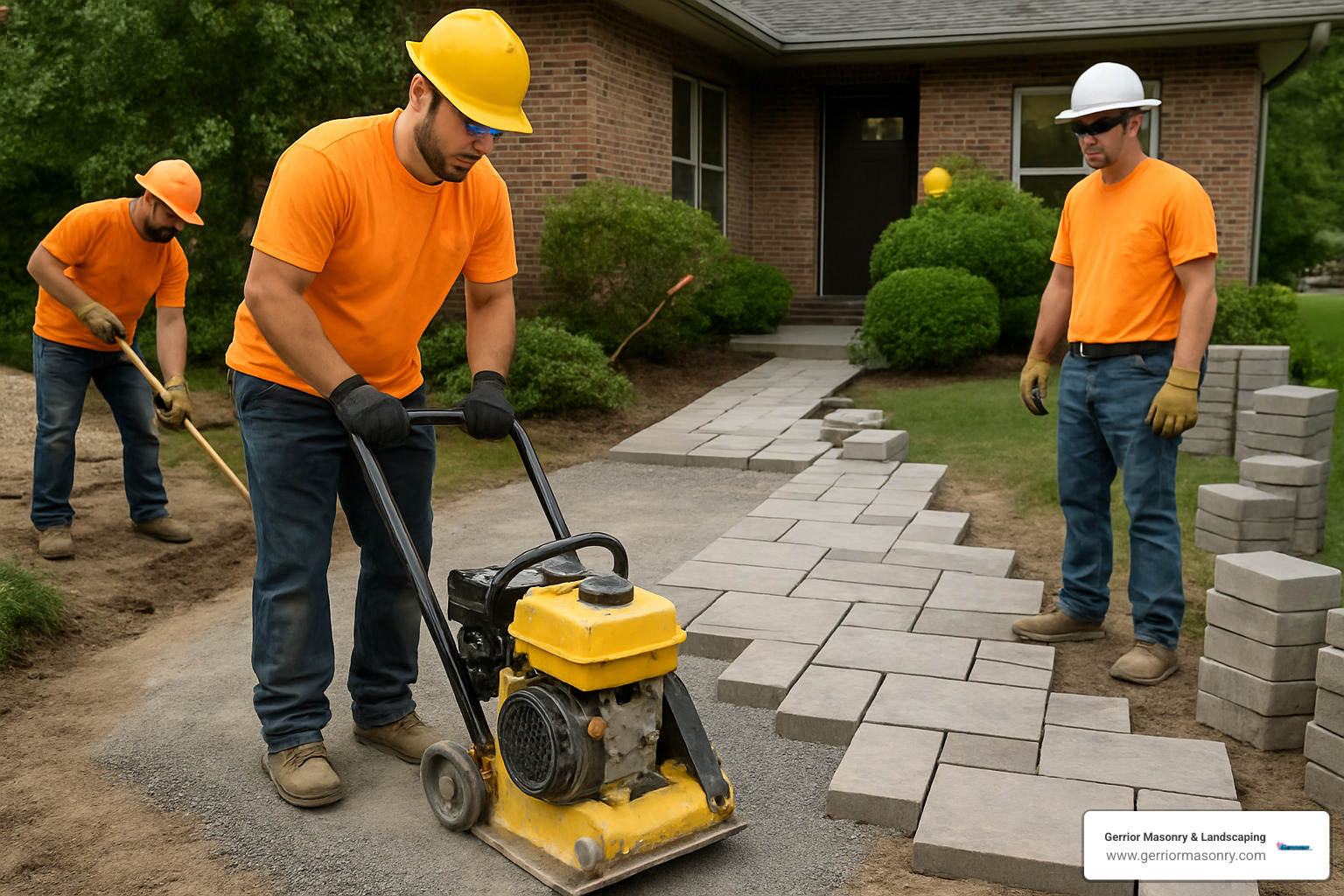
Here’s something many homeowners don’t realize: since labor costs remain relatively constant regardless of material choice, upgrading from concrete pavers to natural stone might only increase your material cost by $15 per square foot while the labor cost stays the same.
Design Add-Ons & Extras
The difference between a basic walkway and a landscape centerpiece often comes down to the extras you choose. These features can transform your project, but they require careful budgeting from the start.
Curved pathways add 20-40% to labor costs because they require more precise cutting and fitting. The visual impact is dramatic, but curves need skilled installation to look natural and professional.
Integrated lighting ranges from $200-800 per walkway depending on the number of fixtures and electrical requirements. Low-voltage LED systems offer the best combination of safety, beauty, and energy efficiency.
Heated cables cost $12-15 per square foot installed but eliminate winter snow and ice concerns. They’re particularly valuable for walkways with slopes or areas that don’t get much sun.
Decorative borders add $5-18 per linear foot but create visual definition and help contain the main walkway materials. They’re one of the most cost-effective ways to lift your walkway’s appearance.
Landscaping integration typically costs $500-2,000 for plantings and edging that tie your walkway into the surrounding landscape.
Built-in seating areas range from $1,500-5,000 per seating area but transform a simple walkway into an outdoor living space. Stone steps cost $200-800 per step but are often necessary for sloped sites and add substantial visual appeal.
Material Options: Pros, Cons & Cost Per Square Foot
Your material choice dramatically impacts both how much does a stone walkway cost and how your finished walkway looks and performs over time. After 30+ years of installing walkways throughout Massachusetts, I’ve learned that the “best” material depends on your budget, style preferences, and long-term maintenance expectations.
The good news? Every material option—from premium natural stone to budget-friendly gravel—can create a beautiful walkway when properly installed. The key is understanding what you’re getting for your investment.
Natural Stone (Flagstone, Bluestone)
Cost: $30-50 per square foot installed
Lifespan: 100+ years with proper maintenance
Natural stone represents the premium choice for homeowners who want a walkway that truly stands the test of time. When I install a bluestone or flagstone walkway, I tell clients they’re building something their grandchildren will still be using.
Bluestone, quarried in Pennsylvania and New York, offers that classic blue-gray color that complements both traditional and modern homes. Each piece has subtle color variations that create visual interest without being overwhelming. Flagstone provides more dramatic color variation, with pieces ranging from buff to deep red depending on the quarry source.
The durability is exceptional—properly installed natural stone walkways can last over a century. I’ve repaired 80-year-old bluestone walkways that needed nothing more than joint sand replacement. The stone itself was as solid as the day it was installed.
However, natural stone requires the highest upfront investment and needs periodic sealing every 3-5 years at $2-10 per square foot. The installation also requires skilled craftsmen who understand how to work with irregular pieces and create proper drainage.
Note: These are average costs based on internet data and not actual costs for Gerrior Masonry services.
Concrete & Clay Pavers
Cost: $8-20 per square foot installed
Lifespan: 50-75 years
Concrete pavers offer the best value proposition for most homeowners. Modern manufacturing has created pavers that closely mimic natural stone textures and colors at a fraction of the cost. I’ve installed concrete paver walkways that guests assume are natural stone until they look closely.
The consistency of manufactured pavers makes installation faster and more predictable, which helps control costs. When a paver gets damaged—say from a heavy delivery truck—you can replace individual pieces without disrupting the entire walkway.
Clay brick pavers cost slightly more than concrete but offer superior color retention. That warm red color won’t fade like some concrete pavers might over time. They’re particularly beautiful in historic neighborhoods where they complement traditional architecture.
The main drawback is the manufactured appearance. While high-quality pavers look great, they lack the unique character that comes with natural stone. Joint sand also requires periodic maintenance—usually every 2-3 years—to prevent weeds and maintain stability.
More info about paver walkway designs
Gravel & Stepping-Stone Paths
Cost: $2-8 per square foot installed
Maintenance: Moderate (annual raking and weed control)
Gravel walkways prove that budget-friendly doesn’t mean boring. They’re perfect for cottage-style gardens, informal pathways, and areas where you want a more natural, less structured appearance. I’ve created stunning gravel paths that wind through perennial gardens and feel like they’ve been there forever.
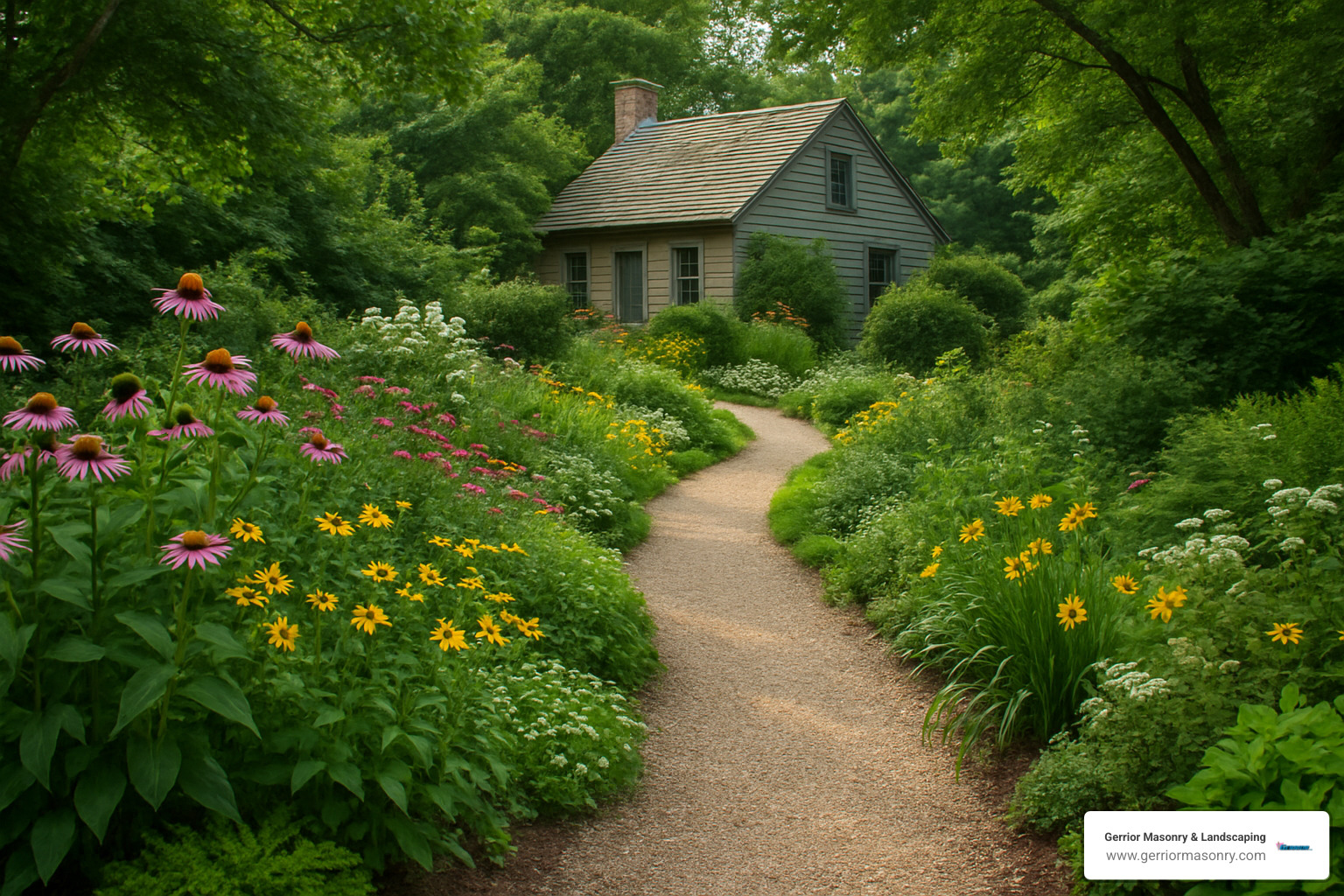
The installation is straightforward but still requires proper base preparation and edging to prevent gravel migration. We typically use weed fabric underneath and metal or stone edging to keep everything contained. The result is a walkway that provides excellent drainage and can handle New England’s freeze-thaw cycles without cracking.
Stepping stone paths combine gravel’s affordability with stone’s durability. Individual stones cost $25-85 each, with installation adding $15-25 per stone. This approach works beautifully for light-traffic areas and creates an organic, natural feel.
The main consideration with gravel is ongoing maintenance. Annual raking keeps the surface level, and occasional weeding maintains the clean appearance. Snow removal can be tricky—you’ll need to shovel carefully to avoid scattering gravel onto adjacent lawn areas.
Despite the maintenance requirements, gravel walkways offer best flexibility. Want to add a curve or widen a section? It’s easy to modify without major reconstruction. This makes gravel an excellent choice for evolving landscapes or temporary solutions.
DIY vs. Professional Installation: What Will You Really Save?
The “how much does a stone walkway cost” question usually leads to the next one: “Can I do this myself?” I get this question almost daily, and my honest answer is always the same—it depends on your skills, your available time, and what you’re trying to build.
Here’s the reality check: DIY can save you 40-60% of the total project cost, but that doesn’t mean it’s always the smart choice. You’ll spend 2-4 times longer than a professional crew, and tool rental costs alone can run $200-800 for a typical project.
The bigger concern? Poor drainage, uneven settling, and premature failure are common DIY issues that end up costing more than professional installation would have cost initially. I’ve seen too many “weekend warrior” walkways that needed complete rebuilding within five years.
Note: These are average costs based on internet data and not actual costs for Gerrior Masonry services.
More info about DIY paver walkway
DIY Cost Checklist
Before you decide to tackle this yourself, let’s talk about what you’ll actually need. Plate compactor rental runs $50-80 per day, and you’ll need it for at least two days for proper base preparation. A masonry saw rental adds another $40-60 per day—essential for cutting pavers to fit.
Then there’s the materials: base stone costs $30-50 per ton, sand runs $15-50 per cubic yard, and polymeric sand for joints costs $25-40 per bag. If you don’t already own the hand tools, expect to spend $100-200, plus another $50-100 for proper safety equipment.
Here’s what surprises most DIYers: A 35′ x 4′ walkway that costs $2,030 professionally installed often ends up costing $2,978 when you factor in all the rental fees, material waste, and the value of your time. That “savings” evaporates quickly when you’re working evenings and weekends for three months.
When to Hire a Pro
Some situations practically demand professional installation. Steep grades requiring retaining walls or extensive grading are beyond most DIY capabilities. Complex patterns like herringbone or circular designs look simple but require years of experience to execute properly.
Permit requirements for connecting to public sidewalks involve paperwork and inspections that most homeowners prefer to avoid. Drainage issues requiring subsurface solutions can turn a simple walkway into a major excavation project.
But here’s the biggest reason to hire professionals: resale value. A properly installed walkway by experienced contractors adds significant value to your property. A DIY job that settles unevenly or develops drainage problems? That’s a liability when you’re trying to sell.
My experience over 30+ years shows that professional installation typically pays for itself through proper drainage, base preparation, and long-term durability. The question isn’t whether you can do it yourself—it’s whether you should.
Frequently Asked Questions About How Much Does a Stone Walkway Cost
How many stones or pavers do I need for my walkway?
This is one of the most common questions I get from homeowners planning their walkway project. The calculation is straightforward, but getting it right saves you from costly delays or waste.
Start by measuring your walkway’s total square footage (length × width). Then divide by the coverage area of your chosen material. Here’s where experience matters: always order 5-10% extra for cuts, breakage, and future repairs. Trust me, you’ll need it.
Let’s say you’re planning a 35′ × 4′ walkway = 140 square feet. For standard 12″ × 12″ pavers, you’d need 140 pavers. If you’re using flagstone (averaging 2 square feet per piece), you’d need about 70 pieces. Add 10% extra, and you’re looking at 154 pavers or 77 flagstone pieces.
The “extra” material isn’t waste—it’s insurance. Stone can break during installation, and having matching pieces for future repairs is invaluable. After 34 years in this business, I’ve seen too many homeowners struggle to find matching materials years later.
How long will a stone walkway last and what does upkeep cost?
How much does a stone walkway cost over its lifetime includes both installation and maintenance. The good news? A properly installed stone walkway is one of the longest-lasting home improvements you can make.
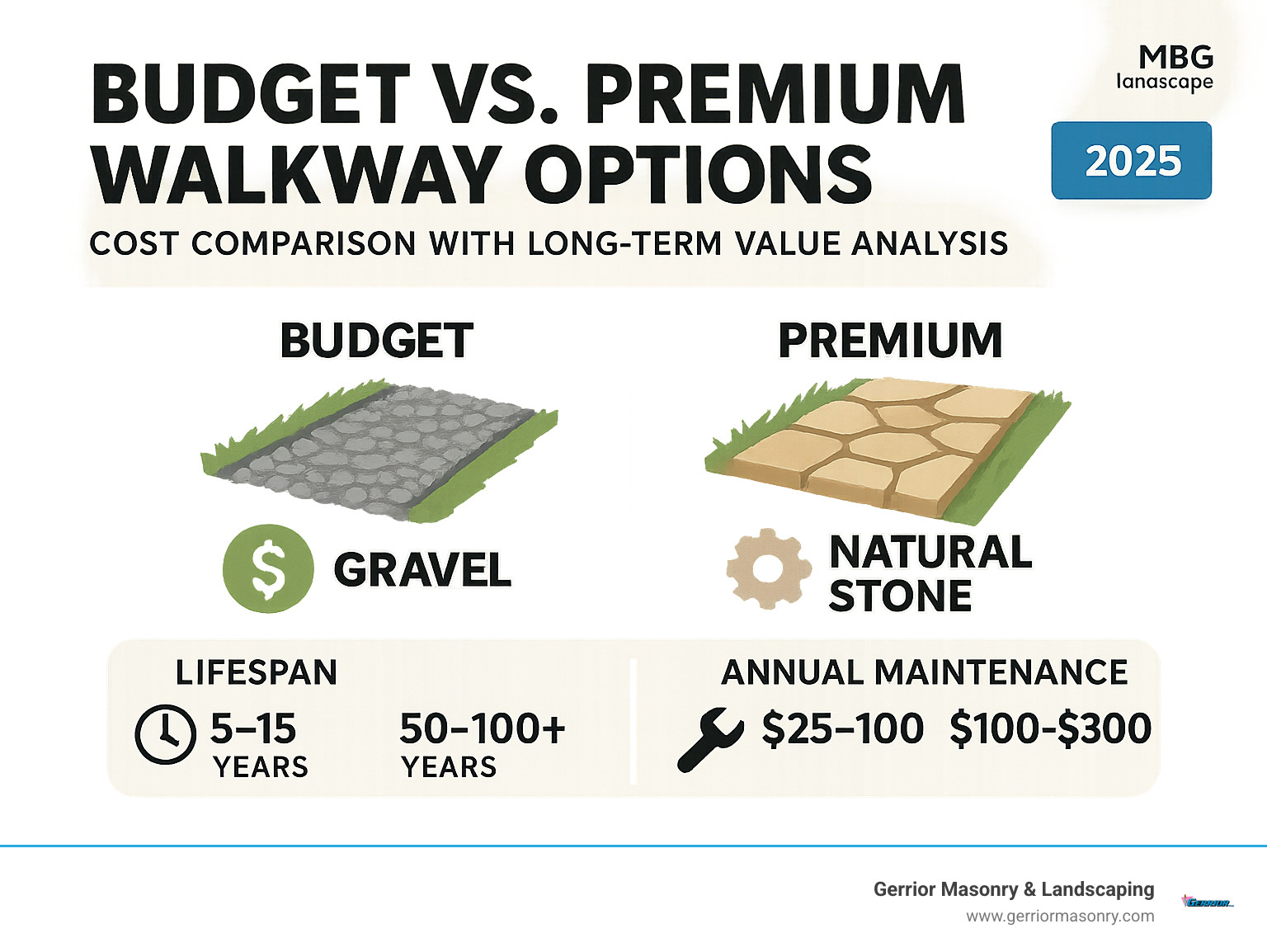
Natural stone walkways can last 50-100+ years with proper care. I’ve worked on bluestone walkways installed in the 1920s that still look fantastic. Concrete pavers typically last 25-50 years, while brick pavers fall in the 25-75 year range depending on quality. Gravel paths are the exception, needing refreshing every 5-15 years.
Annual maintenance costs are surprisingly reasonable. Natural stone requires $100-300 yearly for sealing and joint sand replacement. Concrete and brick pavers need $50-200 for cleaning and joint maintenance. Gravel paths cost just $25-100 annually for raking and weed control.
The key factor is installation quality. I’ve seen 50-year-old walkways that look nearly new alongside 10-year-old walkways needing complete replacement due to poor installation. Proper base preparation and drainage make all the difference in longevity.
What budget-friendly tips can cut my stone walkway cost?
Smart homeowners ask this question because there are legitimate ways to reduce costs without sacrificing quality. Here are strategies that actually work:
Reusing existing materials can save significant money. We often incorporate existing stones or bricks into new designs, creating unique character while cutting material costs. Simplifying the layout is another big saver—straight paths cost 20-30% less than curved designs due to reduced labor time.
Off-season booking during fall and winter can save 10-20% on installation costs. Many contractors offer discounts during slower periods. Standard sizes avoid expensive custom cuts and special orders that inflate material costs.
Consider phased installation if budget is tight. Complete high-priority sections first, then expand later. This approach spreads costs over time while ensuring the most important areas get professional attention.
Bundling projects with other landscaping work often reduces overall costs through shared mobilization and equipment rental.
Here’s what not to skimp on: proper base preparation, adequate edge restraints, and quality materials. These “false economies” lead to premature failure and costly repairs. I’ve rebuilt too many walkways where homeowners tried to save money in the wrong places.
The smartest approach balances upfront costs with long-term value. A well-installed walkway pays for itself through durability, low maintenance, and increased property value.
Conclusion
How much does a stone walkway cost? After exploring all the variables, you now know the answer depends on your specific situation. A basic gravel path might cost $1,500, while an elaborate natural stone walkway with lighting and curves can reach $45,000. Most homeowners find their sweet spot around $2,665 for a quality walkway that transforms their home’s first impression.
The wide price range isn’t meant to confuse you—it reflects the incredible variety of options available. Your walkway can be as simple or sophisticated as your budget allows, and both approaches can deliver excellent results when done right.
Here’s what matters most: match your material choice to your budget, but never compromise on proper installation. I’ve seen too many homeowners choose expensive natural stone only to have problems because they skipped proper base preparation. Meanwhile, others have chosen concrete pavers and gotten decades of beautiful service because they invested in quality installation.
The math is straightforward once you understand it. Material costs range from $8-50 per square foot, with labor representing 40-60% of your total investment. Design complexity can push costs higher, but it also creates a walkway that becomes a true landscape feature rather than just a path.
You’re not just buying a walkway—you’re investing in your home’s curb appeal and your daily experience. A well-built walkway provides safe, attractive access for 50-100 years. When you break down the cost over that lifespan, even premium materials become quite reasonable.
Proper installation makes all the difference between a walkway that settles and cracks after five years and one that looks great for decades. This is why we always recommend focusing on the contractor’s experience and reputation rather than just the lowest bid.
Whether you choose budget-friendly concrete pavers or splurge on premium bluestone, the key is working with someone who understands drainage, base preparation, and the local climate challenges we face here in Massachusetts.
More info about hiring a paver walkway installer
At Gerrior Masonry & Landscaping, we’ve been answering the question “how much does a stone walkway cost” for homeowners throughout Middlesex and Essex County for over 30 years. Based in Woburn, MA, we bring owner-supervised craftsmanship to every project, ensuring your walkway investment provides lasting value and beauty for decades to come. Every walkway we build reflects our commitment to quality installation that stands the test of time.