
Why Masonry Wall Design Can Transform Your Yard
Masonry wall design is one of the most impactful upgrades you can make to your outdoor space — combining real structural strength with lasting visual appeal.
Here’s a quick look at the most popular garden wall styles to inspire your project:
| Wall Style | Best For | Common Materials |
|---|---|---|
| Dry-stacked stone | Natural, rustic look | Fieldstone, granite |
| Mortared brick | Classic, formal gardens | Clay brick |
| Concrete block retaining | Slope and erosion control | CMU, filled-cell block |
| Decorative garden wall | Borders and raised beds | Manufactured block, stone veneer |
| Composite/multi-wythe wall | Insulated or load-bearing walls | Brick + CMU |
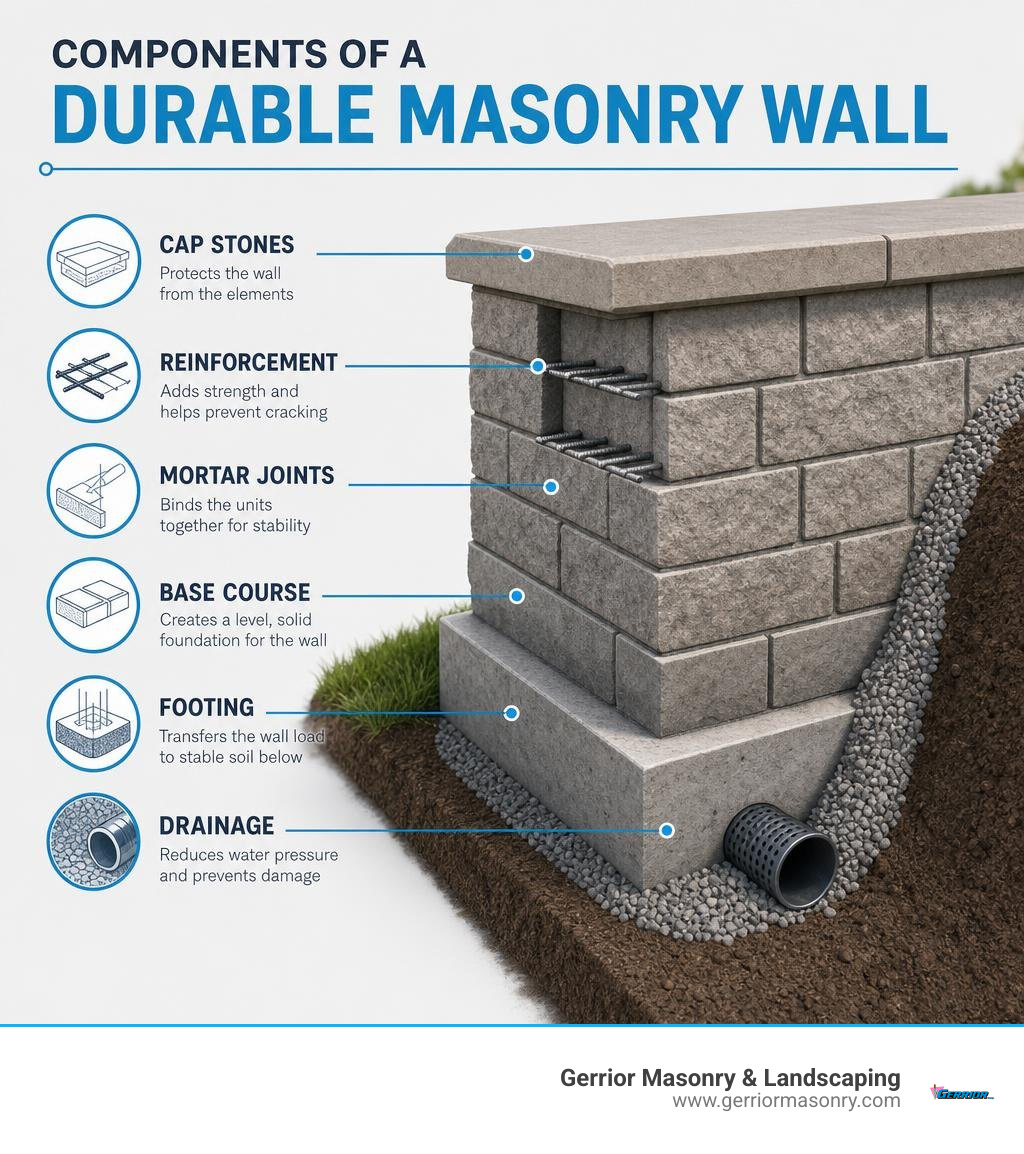
A well-built masonry wall does more than look great. It controls erosion, manages stormwater, creates usable outdoor spaces on sloped lots, and adds long-term value to your property. Homeowners across Woburn, Winchester, and Lexington are using garden walls to turn awkward slopes and bare borders into standout landscape features.
Whether you want a low decorative border around a flower bed or a full retaining wall to reclaim a hillside, the design choices — materials, height, mortar type, reinforcement — all affect how well it performs and how long it lasts.
I’m Joe Gerrior, owner of Gerrior Masonry & Landscape Construction Corp., with over 34 years of hands-on experience in masonry wall design and construction for residential and commercial clients across Massachusetts. That experience means I’ve seen what holds up through our tough Massachusetts winters — and what doesn’t, and I’ll share exactly what to look for in this guide.
Learn more about Masonry wall design:
Structural Engineering Principles of Masonry Wall Design
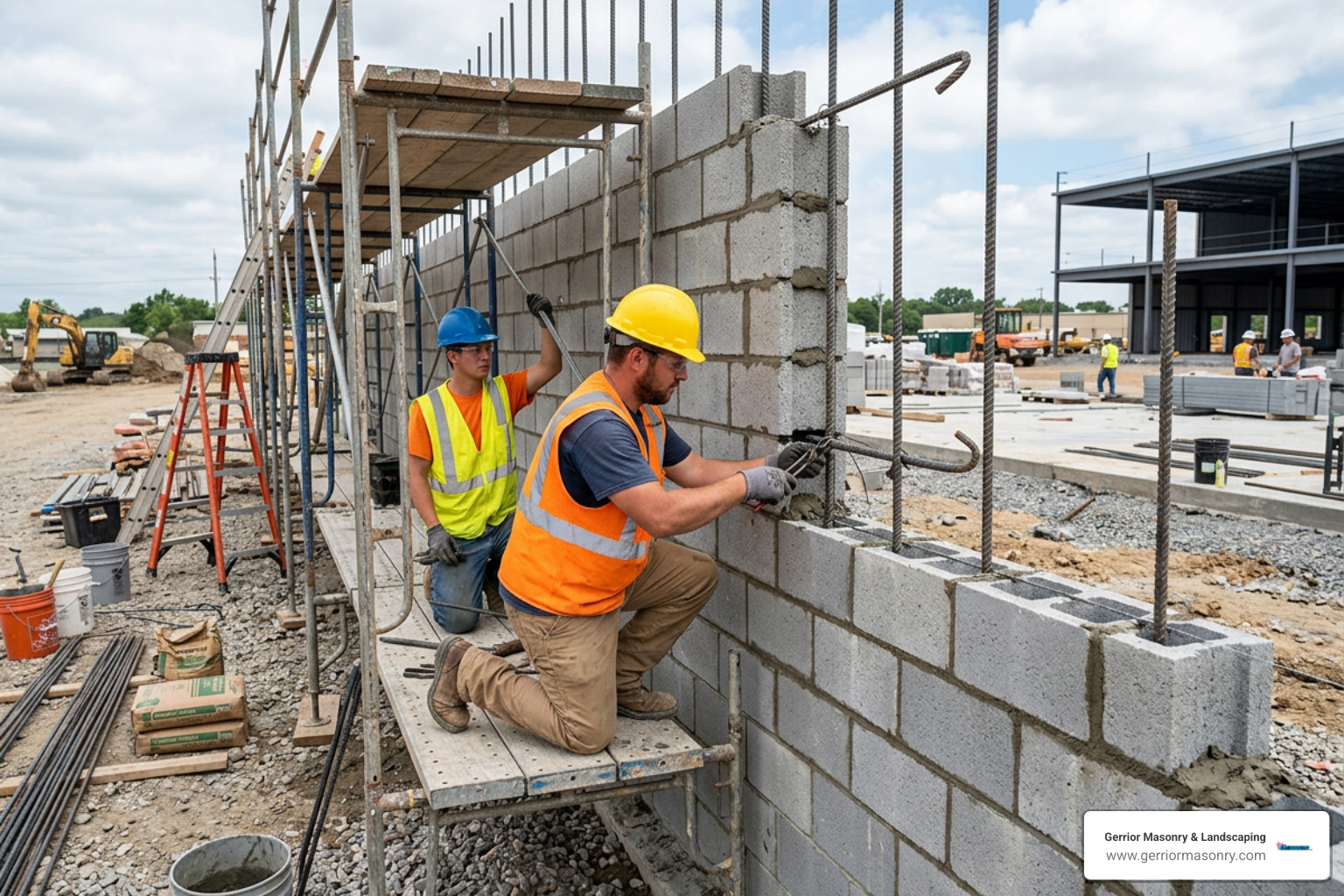
When we design a masonry wall, we aren’t just stacking blocks. We are applying proven structural engineering principles to ensure the wall stands tall against Massachusetts’ harsh freeze-thaw cycles.
Historically, engineers relied on the working stress design (WSD) method. This traditional approach focuses on elastic behavior, ensuring that the actual service-load stresses do not exceed a fraction of the material’s ultimate strength. However, modern structural engineering has shifted toward Strength Design of Masonry, which uses factored loads and nominal strengths multiplied by strength-reduction factors (such as $phi = 0.6$ for unreinforced flexure and axial load). Strength design is highly favored today because it more accurately models the true behavior of the materials under ultimate limit states.
When walls are subjected to combined axial (vertical) and flexural (lateral/bending) loads, we must account for second-order effects, commonly known as P-delta effects. As a wall deflects laterally under wind or soil pressure, the vertical load ($P$) acts on this deflection ($Delta$), creating additional bending moments. In high-seismic zones, these calculations are even more critical. Under modern codes, such as those detailed in the Masonry Wall Plan Review checklists, structural elements must be designed with robust connections and continuous reinforcement to withstand lateral forces.
To verify the structural integrity of existing masonry walls without causing damage, we utilize non-destructive evaluation (NDE) techniques. These include ultrasonic pulse velocity testing, radar imaging, and flatjack testing, which help us assess the strength of older structures during restoration projects.
Material Selection: Clay vs. Concrete in Masonry Wall Design
Choosing between clay brick and concrete masonry units (CMUs) is about more than just aesthetics; it dictates how the wall handles moisture and structural loads.
- Clay Brick: Naturally expands over time due to moisture absorption. It offers a timeless look and is perfect for traditional Brick and Stone Walls.
- Concrete Blocks (CMU): Shrink as they cure and dry. They are the workhorses of structural retaining walls, offering high compressive strength (typically a minimum of 2,000 psi).
The mortar we mix is just as critical. We select mortar types based on the structural demands:
- Type S: High-strength mortar (minimum 1,800 psi) recommended for structural, below-grade, and lateral load-resisting systems in towns like Belmont and Burlington.
- Type N: Medium-strength mortar (minimum 750 psi) ideal for general above-grade exterior walls and non-structural garden borders.
- Type O: Low-strength mortar used primarily for historic restoration and tuckpointing.
Slenderness and Load Calculations in Masonry Wall Design
To prevent structural buckling, we must carefully calculate the slenderness ratio, which is the ratio of the wall’s effective height ($h$) to its effective thickness ($t$). If a wall is too thin for its height, it will fail under vertical loads.
The table below outlines the structural limits and load formulas specified under standard building codes:
| Property / Limit | Solid Masonry Units | Hollow Masonry Units | Filled Cell / Grouted Masonry |
|---|---|---|---|
| Max Slenderness Ratio (Walls) | 30 | 20 | 25 |
| Max Slenderness Ratio (Columns) | 25 | 15 | 20 |
| Allowable Axial Load (Walls) | $P = c(0.25f’m)Ag$ | $P = c(0.25f’m)Ag$ | $P = c(0.25f’m)Ag$ |
| Allowable Axial Load (Columns) | $P = c(0.20f’m)Ag$ | $P = c(0.20f’m)Ag$ | $P = c(0.20f’m)Ag$ |
| Calculation of $A_g$ (Gross Area) | Actual thickness | Net cross-sectional area | Actual thickness |
Note: The slenderness ratio cannot exceed 40 when using Type H mortar. Additionally, if load eccentricity exceeds 1/3 of the wall thickness, the tensile stresses must be checked or the wall must be reinforced.
Reinforcement and Shear Wall Analysis
For structural walls that must resist soil pressure or seismic forces, reinforcement is mandatory.
- Minimum Reinforcement: Standard codes require a minimum vertical reinforcement area of $0.0025A_n$ for columns, and at least 0.20 square inches of steel within 16 inches of wall corners and openings.
- Maximum Reinforcement: To ensure the masonry fails in a ductile manner (where the steel yields before the masonry crushes), the maximum reinforcement ratio is strictly limited based on strain-gradient limits.
In shear walls, which resist in-plane lateral forces, we calculate the rigidity of the wall segments to determine how lateral forces are distributed. Shear reinforcement must be spaced no further apart than $d/2$ (where $d$ is the distance from the compression fiber to the centroid of tension steel) or 48 inches. For masonry columns and pilasters, lateral ties must be placed at a maximum spacing of 16 bar diameters, 48 tie diameters, or the least dimension of the column to prevent buckling of the vertical steel.
Lintel Design and Arching Action
Lintels are the horizontal structural members that span openings (like gates, windows, or archways) in a masonry wall. When designing a lintel, we check the loading, deflection limits, and bearing pressures.
One of the most elegant concepts in masonry engineering is arching action. If there is a sufficient height of masonry above an opening, the masonry units will naturally transfer the vertical loads diagonally to the sides of the opening. This creates a triangular arching effect at a 45-degree angle.
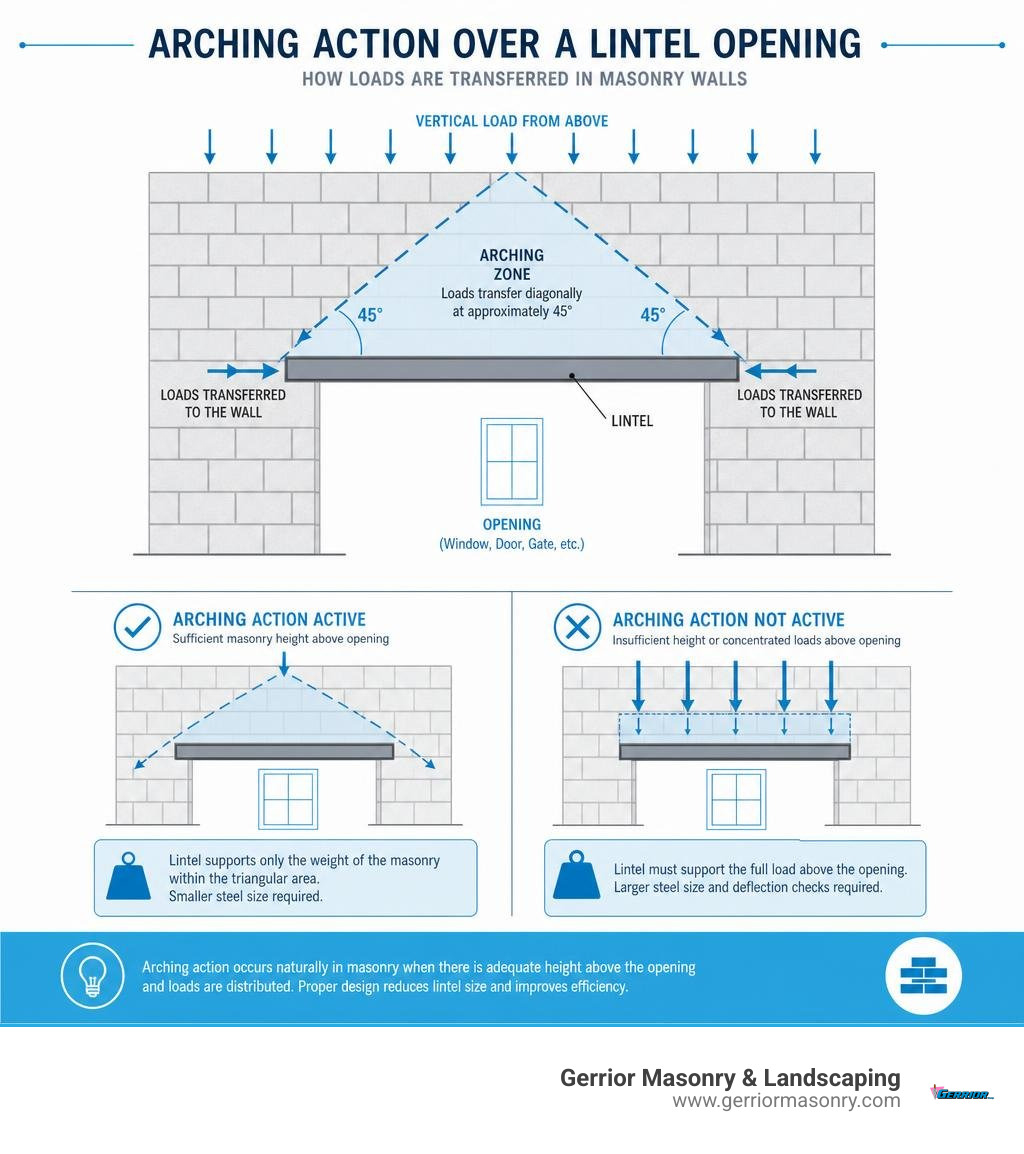
When arching action is active, the lintel only has to support the dead weight of the masonry within that triangular area, greatly reducing the required steel size. However, if the masonry height above the opening is insufficient, or if there are concentrated loads (like joists) hitting the wall directly above the opening, arching action cannot be assumed, and the lintel must be designed to carry the full load. Under standard codes, lintels supporting unreinforced masonry are limited to a deflection of $L/600$ to prevent cracking in the bed joints.
Crack Control and Joint Detailing
Cracking is the natural enemy of any masonry wall. Because clay brick expands and concrete block shrinks, we must detail joints correctly to accommodate these opposing movements:
- Control Joints: Used in concrete block (CMU) walls. These are continuous vertical joints filled with a flexible sealant that allow the concrete to shrink without cracking the block.
- Expansion Joints: Used in clay brick walls. These joints are completely free of mortar and allow the brick to expand safely under thermal and moisture changes.
By placing these joints at regular intervals—typically near corners, changes in wall height, and openings—we prevent unsightly cracking and keep your garden wall structurally sound for decades.
Elevating Your Landscape with Professional Masonry Wall Design

While a low garden border can sometimes be built as a weekend project, any wall that holds back soil, manages a slope, or exceeds three feet in height requires professional design and installation. A failing retaining wall is not only an eyesore—it is a major safety hazard that can cause thousands of dollars in property damage.
When planning your budget, it is helpful to look at general industry pricing. Based on online data and general Massachusetts averages:
- Simple decorative garden borders can range from $3,000 to $8,000.
- Engineered, structural retaining walls typically range from $10,000 to $25,000 or more, depending on the height, soil conditions, and chosen materials.
Please note: These ranges represent average costs sourced from publicly available internet data and are not the actual prices of Gerrior Corp. Every site is unique, and custom engineering is required for accurate project pricing.
Partnering with Gerrior Masonry & Landscaping for Your Massachusetts Yard
If you want a stunning, durable wall that is engineered to survive Massachusetts’ brutal winters, partner with the team at Gerrior Masonry & Landscaping. Based near Woburn, MA, we have spent over 30 years building high-quality hardscapes for homeowners in Winchester, Lexington, Newton, and the surrounding areas.
Our unique strength is our skilled team and direct owner oversight on every single project. We don’t cut corners. From calculating the exact slenderness ratio to installing flawless drainage systems, we handle it all.
Whether you need a new Retaining Wall Installation, a custom Landscape Walls design, or a professional Stone Wall Restoration for an older structure, we are here to help.
Let’s build something beautiful together. Fill out our simple online request form to schedule your consultation!
