
Why Choosing the Right Mortar Matters for Your Rock Wall

Building a rock wall that lasts requires more than just stacking stones. The best mortar mix for rock wall construction is the key to durability, bonding stones, sealing out water, and allowing for subtle movement without cracking. The right choice ensures your wall withstands New England’s freeze-thaw cycles for decades.
The two most common options are:
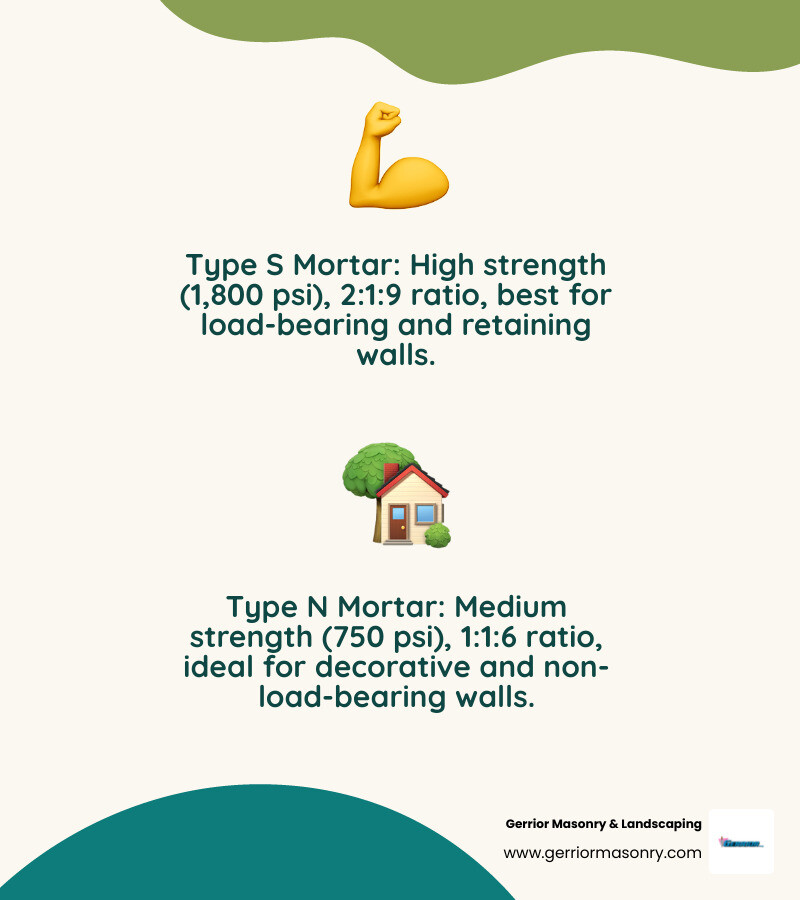
- Type S Mortar: A high-strength mix (1,800 psi) for load-bearing retaining walls and below-grade use.
- Type N Mortar: A medium-strength mix (750 psi) for decorative, non-load-bearing walls above grade.
The ratio of cement, lime, and sand dictates the mortar’s strength and workability. Using a mix that’s too strong can damage softer stones, while one that’s too weak will fail.
I’m Joe Gerrior, owner of Gerrior Masonry & Landscape Construction Corp. With over 34 years of experience building walls in Massachusetts, I know that matching the mortar to the stone, project needs, and local climate is crucial. In this guide, I’ll share what you need to know.
Choosing the Best Mortar Mix for Your Rock Wall
When building a durable rock wall, the mortar is the unsung hero holding it all together. But with several options, how do you choose the best mortar mix for rock wall construction? Let’s compare the most common types.
Understanding Mortar Types: Type S vs. Type N
Mortar types are classified by ASTM standards based on their compressive strength. For rock walls, we primarily use Type N and Type S.
- Type N Mortar: A general-purpose, medium-strength mortar with a compressive strength of around 750 psi. Composed of 1 part Portland cement, 1 part lime, and 6 parts sand, it’s the go-to choice for most non-load-bearing, above-grade walls like decorative garden features or veneers. Its higher lime content gives it excellent flexibility, allowing it to accommodate subtle movements from thermal expansion and contraction. This makes it particularly suitable for softer, more porous stones, as it won’t overpower and crack them. You can find pre-mixed bags of medium-strength Type N mortar at most hardware stores.
- Type S Mortar: A high-strength mix with a minimum compressive strength of 1,800 psi, designed for serious durability. Made from 2 parts Portland cement, 1 part hydrated lime, and 9 parts sand, it offers superior bond strength compared to Type N. This robust adhesion is critical for load-bearing structures like retaining walls, which must resist immense lateral pressure from soil and water. We recommend Type S for foundations, any wall built below grade, and structures exposed to heavy loads, high winds, or the intense freeze-thaw cycles common in New England. Look for high-strength Type S mortar for these demanding projects.
Other mortar types exist for specific uses: Type M (2,500 psi) is the strongest available, but its high cement content makes it extremely rigid and less workable. While used for heavy-duty foundations, it’s often too hard for most rock wall applications and can cause softer stones to fail under stress. At the other end of the spectrum, Type O (350 psi) and Type K (75 psi) are very soft, high-lime mortars. They are primarily used for repointing and restoring historic masonry made with soft, handmade bricks or delicate stone, where a sacrificial, highly breathable mortar is needed to protect the original material.
Here’s a quick comparison of Type S and Type N:
| Feature | Type S Mortar | Type N Mortar |
|---|---|---|
| Strength (PSI) | Over 1,800 psi | Around 750 psi |
| Mix Ratio | 2 parts Portland cement, 1 part lime, 9 parts sand | 1 part Portland cement, 1 part lime, 6 parts sand |
| Best Use Cases | Load-bearing walls, retaining walls, foundations, areas with high winds | Non-load-bearing walls, decorative garden walls, exterior walls in mild exposure |
| Grade Level | Above- and below-grade applications | Above-grade applications only |
Key Ingredients and Their Ratios
Understanding mortar’s components—Portland cement, hydrated lime, sand, and water—is key to a successful mix. The ratio of these ingredients determines the mortar’s final properties.
- Portland Cement: This is the primary binder that provides compressive strength. The more cement in the mix, the stronger and faster-setting the mortar will be, but it will also be more rigid and less permeable.
- Hydrated Lime: Lime is the magic ingredient for workability and durability. It makes the mortar smooth, sticky, and easy to spread. Crucially, it adds flexibility, helps the mortar self-heal minor cracks over time (a process called autogenous healing), and increases vapor permeability, allowing trapped moisture to escape. This “breathability” is vital for the long-term health of the stone. You can learn more about the benefits of lime in mortar.
- Sand: Sand acts as the aggregate, providing bulk and preventing excessive shrinkage as the mortar cures. It’s critical to use clean, sharp, well-graded masonry sand (meeting ASTM C144 standards). “Well-graded” means it contains a variety of particle sizes, which fit together tightly to create a dense, strong mortar. Never use play sand or beach sand, as their rounded particles and potential salt content will create a weak, unreliable mix.
- Water: Water is necessary to activate the chemical reaction (hydration) that gives cement and lime their binding properties. Use clean, potable water. The amount is critical; too much water creates a soupy mix that drastically reduces strength, while too little makes it unworkable. The goal is a smooth, buttery consistency that holds its shape on a trowel.
A common, versatile ratio for many rock walls is 1 part cement, 1 part lime, and 6 parts sand. This is the recipe for Type N mortar.
Special Considerations for Your Rock Wall Project
The right mortar depends on your wall’s purpose and environment.
- Freestanding vs. Retaining Walls: Decorative freestanding walls generally only need the flexibility of Type N mortar. Retaining walls, however, are engineered structures. They must withstand immense lateral soil pressure and hydrostatic pressure from groundwater, which is magnified by freeze-thaw cycles. This requires the superior bond strength of Type S mortar, along with a proper concrete footing, robust drainage systems (like gravel backfill and perforated pipes), and weep holes to relieve pressure.
- Load-Bearing Needs: Any wall supporting a structure, such as a porch roof or an upper floor, is load-bearing and requires a high-strength mortar like Type S to ensure safety and stability.
- Below-Grade Applications: Any portion of a wall below ground level will be in constant contact with moisture and soil. It must be built with Type S or M mortar to resist water penetration and the pressure of the surrounding earth.
- Stone Type: A fundamental rule of masonry is that the mortar should never be harder than the masonry unit. Porous stones like sandstone and limestone need a flexible, breathable, lime-rich mortar (like Type N) to prevent moisture from getting trapped, which can lead to spalling (flaking or peeling of the stone face) during a freeze. Dense, hard stones like granite or basalt can easily handle stronger, cement-heavy mortars like Type S.
- Mortar Color and Joint Appearance: The final look is heavily influenced by the mortar. Color can be customized with pigments or by choosing different colored sands. The joint profile is equally important for both aesthetics and performance. A concave or V-joint is excellent for shedding water, while a raked joint creates deep shadows but can collect water. A flush joint provides a rustic look but offers less water resistance. For more ideas, see our stone wall services page.
How to Find the Best Mortar Mix for a Rock Wall
You can use pre-mixed bags or mix your own for greater control and cost savings on large projects.
- Pre-mixed Mortar: Convenient and consistent. Just add water to a bag of Quikrete Type N or S.
- Mixing Your Own: More economical for large jobs and allows for customization. A good starting point is 6 parts sand, 1 part cement, and 1 part lime.
Mixing and Applying Mortar Best Practices:
Always wear safety glasses and nitrile gloves.
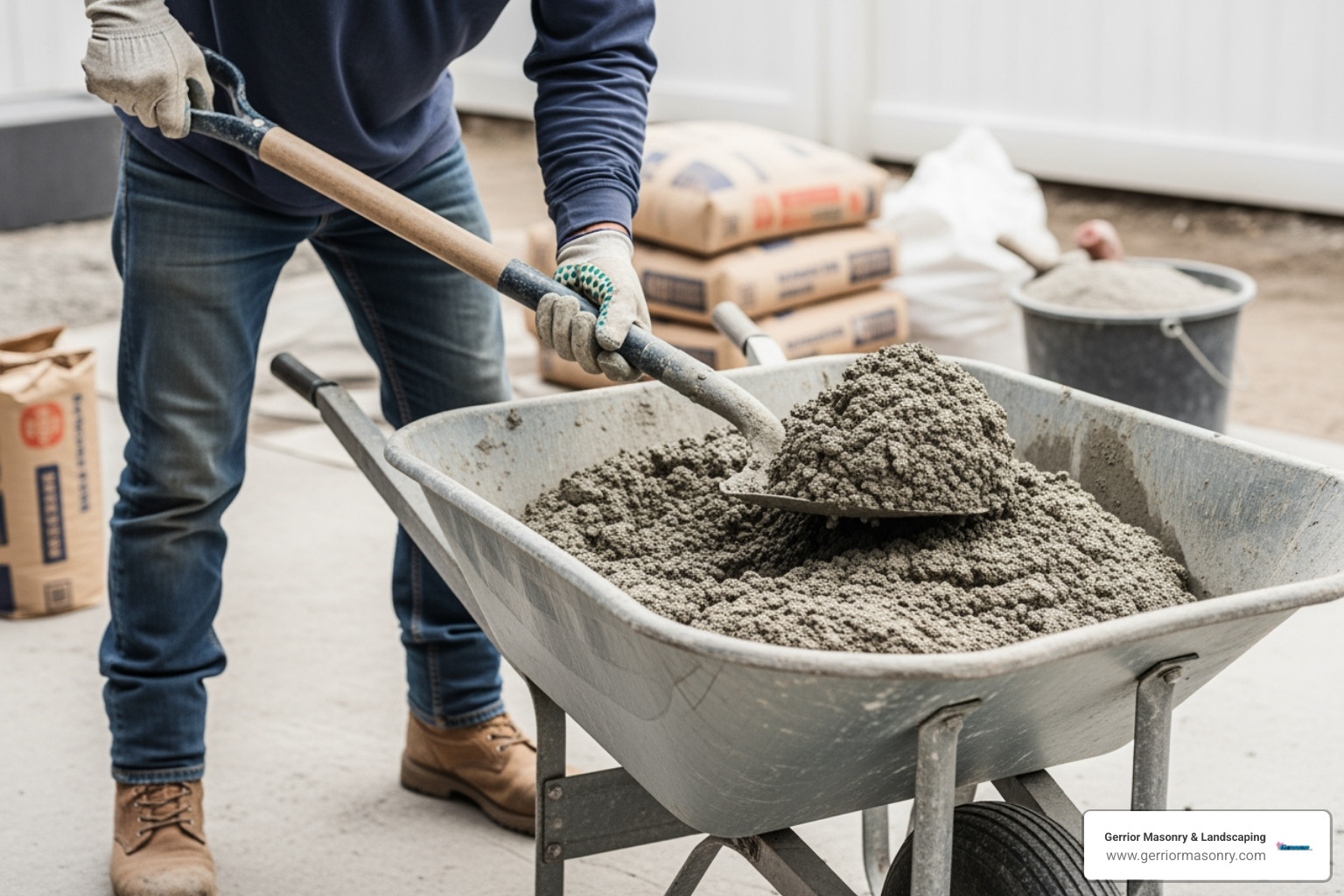
- Prepare: Use a clean wheelbarrow or mixing tub. Lightly dampen the stones with a hose or spray bottle. This prevents the dry stones from wicking essential moisture out of the mortar too quickly, which would result in a weak bond.
- Mix: Combine all dry ingredients thoroughly before adding any water. Add about two-thirds of the estimated water, mix, and then add the remaining water gradually. Mix for a minimum of five minutes to ensure all components are fully integrated and you reach a smooth, thick, peanut butter-like consistency.
- Apply: Use a pointing trowel to apply a full 1-inch-thick bed of mortar onto the previous course of stones.
- Set Stones: Press each stone firmly into the mortar bed with a slight twisting motion to ensure full contact and a strong bond. “Back buttering” the stone (applying mortar to its bottom surface) can also help. Fill all vertical joints completely to ensure the wall is solid.
- Tool Joints: Wait until the mortar is “thumbprint hard”—firm enough to hold a thumbprint without smearing. Then, use a jointing tool to compact the mortar, creating a dense, weather-resistant surface and a clean, professional appearance.
- Cure: Proper curing is critical for strength. Protect fresh mortar from direct sun, wind, frost, and rain for at least 72 hours. In hot, dry weather, gently mist the wall with water periodically to slow evaporation and allow the cement to hydrate fully. Only mix as much mortar as you can use within about 90 minutes.
Common Mistakes to Avoid When Choosing the Best Mortar Mix for a Rock Wall
Avoiding these pitfalls is key to a long-lasting wall.
- Using Mortar That’s Too Strong: This is the most common error. A mortar that is harder than the stone will not allow for natural movement, transferring stress directly to the stones and causing them to crack or spall. The mortar joint should be the sacrificial element, not the stone.
- Incorrect Ratios or Improper Mixing: Guessing at measurements or adding too much water is a recipe for disaster. An overly wet mix will be significantly weaker, more prone to shrinkage cracks, and less durable. Use buckets for consistent volume measurements.
- Ignoring Weather Conditions: Applying mortar in freezing temperatures will cause the water to freeze and expand, destroying the mix before it can cure. Extreme heat and wind can dry it out too quickly, halting the hydration process and preventing it from reaching full strength.
- Forgetting About Drainage: Especially for retaining walls, failing to install a proper drainage system behind the wall is a critical failure. Hydrostatic pressure will build up and can push over even the strongest wall. Mortar alone cannot fight back against immense water pressure.
- Not Considering Stone Porosity: Using a dense, low-permeability mortar (like Type M or S) with a porous stone (like sandstone) traps moisture inside the stone. When that moisture freezes, it expands and blows the face off the stone.
- Using the Wrong Product for the Job: Never use concrete mix, thin-set tile mortar, or other adhesives in place of proper masonry mortar. These products have different properties and are not designed for building a structural, weather-exposed rock wall. Always match the mortar type to the project’s specific demands.
Build a Rock Wall That Lasts a Lifetime
Choosing the best mortar mix for rock wall construction is critical for a long-lasting, beautiful result. By matching the mortar type—strong Type S for retaining walls or flexible Type N for decorative ones—to your specific stone and project needs, you ensure structural integrity. Understanding the roles of cement, sand, and especially lime, which adds flexibility and breathability, is key.
Proper mixing, application, and avoiding common mistakes like using a mix that’s too strong or ignoring weather conditions will prevent future failures. While DIY is an option, professional craftsmanship guarantees a rock wall that not only looks stunning but also endures for generations. With over 30 years of experience, the skilled team at Gerrior Masonry & Landscaping creates durable, beautiful masonry structures built to withstand the New England climate.
For more information on our comprehensive masonry services and how we can bring your vision to life, visit our masonry services page.
Gerrior Masonry & Landscape Construction is based in Woburn, MA, and proudly serves the surrounding communities throughout Middlesex and Essex County, Massachusetts.
