Why a Dry Well for Gutter Downspout Matters for Your Massachusetts Home
A dry well for gutter downspout is an underground structure that collects and slowly infiltrates rainwater runoff from your roof, preventing pooling, erosion, and foundation damage. Here’s what you need to know:
Quick Answer: Building a Dry Well
- Size it right – A typical 3’x3’x3′ gravel-filled dry well handles runoff from about 132 square feet of roof in a 1-inch storm
- Location matters – Place it at least 10 feet from your foundation with good soil drainage
- Basic components – You’ll need crushed stone, landscape fabric, a plastic chamber or gravel pit, and 4-inch PVC pipe
- Drainage time – Your dry well should empty within 72 hours after rain
- Soil test first – Dig a test hole to confirm your soil can absorb at least 0.5 inches of water per hour
With spring comes the rain, which is essential for your yard and garden, but can unfortunately cause damage to your house. Water buildup near foundations leads to mold, rot, and costly repairs. A dry well diverts this water safely underground where it slowly percolates into the surrounding soil.
Why homeowners choose dry wells:
- Prevents basement flooding and foundation cracks
- Eliminates muddy pools and mosquito breeding grounds
- Protects landscaping from erosion
- Recharges groundwater naturally
- Lasts 20-30 years with proper maintenance
The science is straightforward: one inch of rain produces about 62 gallons of runoff for every 100 square feet of roof. That water needs somewhere to go. Without proper drainage, it flows toward your foundation, saturates your yard, and creates ongoing problems.
I’m Joe Gerrior, and over 34 years running Gerrior Masonry & Landscape Construction, I’ve installed countless drainage solutions including many dry wells for gutter downspouts throughout Massachusetts. Our team has seen how proper water management protects homes and eliminates chronic drainage headaches.
In this guide, I’ll walk you through everything you need to know about planning, sizing, and installing a dry well system that actually works for New England weather.
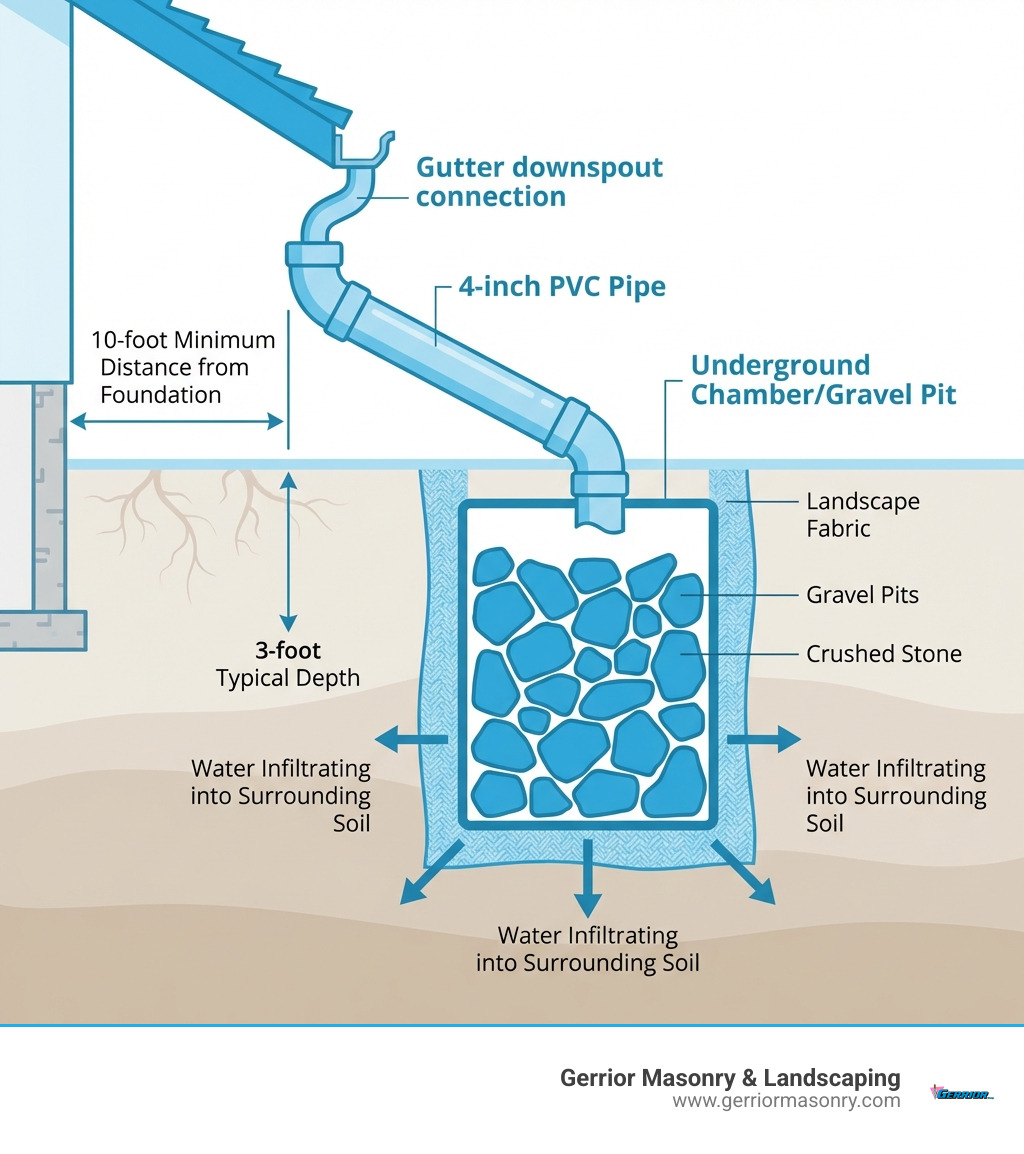
Dry well for gutter downspout terms you need:
Planning and Sizing Your Dry Well for Gutter Downspout Runoff
Before you grab a shovel and start digging up your lawn, we need to talk about the “boring” part: the math. Don’t worry, we won’t make you do calculus, but proper sizing is the difference between a dry basement and a flooded one. If your dry well is too small, it will overflow during the first heavy New England thunderstorm.
The Math of Rain
To size a dry well for gutter downspout use, you first need to know how much water you’re dealing with. One inch of rain produces about 62 gallons of runoff for every 100 square feet of drainage area. If you have a 2,000-square-foot roof and it rains two inches, you’re looking at a staggering 333 gallons of water.
A typical 3’x3’x3’ dry well filled only with crushed stone stores about 11 cubic feet (roughly 82.5 gallons) of water. This is because the gravel itself takes up about 60% of the space, leaving only 40% “void space” for the water to sit while it waits to soak into the ground. According to scientific research on dry well design and sizing, you should design your system to handle at least the first 1 inch of rainfall, which accounts for the vast majority of storm events in our region.
The Percolation Test (The “Perc” Test)
Soil is the most important part of this equation. If you have heavy clay (common in some parts of Middlesex County), the water won’t soak in fast enough. To see if your soil can handle a dry well, follow these steps:
- Dig a hole about 1 foot deep in the area where you want the well.
- Fill it with water and let it drain completely to saturate the surrounding earth.
- Refill the hole a second time and note the water level and the time.
- Check it again after 15 minutes.
- Multiply that drop by 4 to get the hourly infiltration rate.
We look for a rate of at least 0.5 inches per hour. If it takes more than 72 hours for your test hole to empty, a dry well might not be the best fit for your specific yard conditions.
Choosing the Right Dry Well for Gutter Downspout Systems
There are three main ways to build these, and each has its pros and cons:
- Gravel-Filled Pits: This is the “old school” method. You dig a large hole, line it with fabric, and fill it with #57 crushed stone. It’s inexpensive but requires a much larger hole because the rocks take up so much volume.
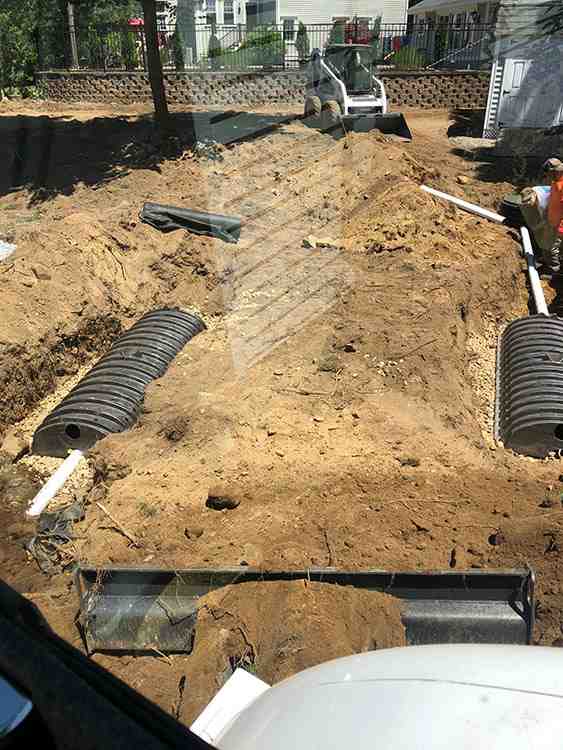
- Prefabricated Plastic Chambers: These are very popular now. A common model is the NDS Flo-Well. These units are roughly 24″x24″x29″ and provide 50 gallons of detention volume. Because they are hollow, they offer about 2.5 times more detention volume than an equivalent-sized gravel pit. They are lightweight and much easier for a DIYer to handle.
- Concrete Systems: These are heavy-duty and usually reserved for commercial properties or very large residential estates. They require heavy machinery to install but can last a lifetime.
When we talk about dry well vs French drain, a French drain is meant to move water along a path, while a dry well is meant to hold it in one spot until it disappears.
Location and Soil Requirements for a Dry Well for Gutter Downspout
Location is everything. If you put your dry well too close to the house, you’re just injecting water right next to your foundation—the exact opposite of what we want!
- Distance: Always place the dry well at least 10 feet away from your home’s foundation. If you have a basement, 20 feet is even better.
- Utilities: Before you dig, you must call 811 to have your utility lines marked. Hitting a gas or power line will turn a weekend project into a local news story very quickly.
- Slope: The pipe leading from your downspout to the well must have a downward slope of at least 1/4 inch per foot. This ensures gravity does the work for us.
- Groundwater: There should be at least 2 to 4 feet of separation between the bottom of your dry well and the seasonal high water table. If your yard is already a swamp, a dry well won’t have anywhere to push the water.
In Massachusetts, we also have to consider the frost line. When installing a dry well for gutter downspout systems, the pipes should ideally be buried deep enough to prevent ice dams from forming inside the drainage lines during a freeze-thaw cycle. If the water in the pipe freezes, the next rain or snowmelt will have nowhere to go, backing up into your gutters and potentially under your shingles.
For more detailed insights on protecting your home, check out our guide on drainage around foundation.
Step-by-Step Guide to Installing a Dry Well for Gutter Downspout
Ready to get your hands dirty? Let’s walk through the installation process. We’ll focus on the plastic chamber method, as it’s the most efficient for most Massachusetts homeowners.
Step 1: Excavation
Mark out a circle about a foot wider than your chamber. For a standard Flo-Well, you’ll be digging a hole roughly 4 feet wide and 3 to 4 feet deep. You also need to dig a trench from your downspout to the hole. This trench should be about 8-12 inches deep, getting deeper as it moves toward the well to maintain that 1/4-inch-per-foot slope.
Step 2: Prepping the Hole
Line the bottom and sides of the hole with non-woven geotextile fabric. This is crucial! It acts as a filter, allowing water through while keeping soil and silt from clogging up your rocks or chamber. According to scientific research on managing rooftop downspout disconnection, keeping sediment out is the number one way to ensure your dry well lasts for decades.
Step 3: Setting the Base and Chamber
Add about 2-3 inches of crushed stone (#57 is best) to the bottom of the hole and level it. Place your plastic chamber on top. If you are using a DIY barrel, make sure you have drilled plenty of 1-inch holes in the sides to let water out.
Step 4: Piping
Connect your 4-inch PVC pipe to the downspout using an adapter. Run the pipe through the trench and into the top or side port of the dry well chamber. Use PVC glue for watertight connections near the house, but you can use perforated pipe once you are a few feet away from the foundation to allow some leaching along the way.
Step 5: Backfilling
Fill the space around the outside of the chamber with more crushed stone. This creates extra storage and helps with filtration. Once the stone is about 3 inches from the top of the ground, fold the landscape fabric over the top of the stone. This “burrito wrap” prevents dirt from washing down into your system. Finally, top it with soil and sod.
Materials and Tools for DIY Installation
If you’re tackling this as a DIY project, here is your shopping list:
- Prefabricated Dry Well Kit: (Like the 50-gallon NDS Flo-Well).
- Crushed Stone: 1/2” to 1 1/2” washed stone (#57).
- Filter Fabric: Non-woven geotextile (avoid the cheap stuff that tears easily).
- PVC Piping: 4-inch diameter solid and/or perforated.
- PVC Fittings: 90-degree elbows and downspout adapters.
- Tools: Sturdy digging shovel, pickaxe (for rocky MA soil), level, and measuring tape.
If you find that your yard needs a bit more help than just a single well, you might also consider a DIY catch basin for French drain to handle surface water before it reaches the well.
Connecting Downspouts and Managing Overflow
What happens when we get one of those massive “Nor’easters” that drops four inches of rain in a day? Your dry well will eventually fill up. You need an overflow plan.
- Pop-up Emitters: We often install a “pop-up emitter” on a separate pipe leading away from the dry well. When the well is full, the pressure pushes up a small green lid on the surface of your lawn, allowing excess water to flow safely over the grass rather than backing up into your gutters.
- Pretreatment: To prevent your well from filling with leaves and roof grit, install gutter screens or a small catch basin with a debris grate. It’s much easier to clean a surface grate than to dig up a buried dry well!
- First-Flush Diversion: Some advanced systems divert the first few gallons of “dirty” water (containing roof oils and dust) away from the well to keep the infiltration area cleaner.
For more information on how these parts fit into a total home system, see our page on residential drainage solutions.
Maintenance and Cost Considerations
A well-built dry well for gutter downspout is mostly “set it and forget it,” but it does need a little love.
Maintenance Tips:
- Clean your gutters: If your gutters are full of leaves, your dry well will eventually become a “mud well.”
- Inspect the fabric: Every few years, check the area around the well for sinkholes, which could indicate the fabric has failed.
- Sediment removal: If you have a silt trap or catch basin, clean it out every spring and fall.
Before starting your project, check with your local building department. Some Massachusetts municipalities have specific regulations regarding where you can discharge stormwater. While most residential dry wells are encouraged because they recharge the aquifer, some towns may have specific setback requirements from property lines or septic systems. Ensuring you are in compliance now prevents legal headaches or issues when you eventually sell your home.
Average Costs (Internet Data Estimates): Please note that these are average costs based on general internet data and are not actual quotes for Gerrior Masonry services.
| System Type | DIY Estimated Cost | Professional Install Range |
|---|---|---|
| Simple Gravel Pit | $200 – $400 | $800 – $1,500 |
| Plastic Chamber Kit | $350 – $600 | $1,200 – $2,500 |
| Multi-Well Engineered System | $1,000+ | $3,500 – $5,000+ |
Costs can vary wildly depending on how deep we have to dig, how many downspouts we are connecting, and whether we hit the infamous “Massachusetts ledge” (solid rock).
Professional Results with Gerrior Masonry & Landscaping
While a dry well for gutter downspout can be a DIY project for a very motivated homeowner with a strong back, it is heavy, technical work. Getting the pitch wrong by even half an inch can result in water standing in your pipes, which freezes in the winter and causes major headaches.
At Gerrior Masonry & Landscaping, we bring over 30 years of experience to every project. Our owner oversees the work to ensure the masonry and drainage are up to local building codes and will stand up to the tough New England climate. We don’t just dig holes; we design integrated systems that protect your home’s foundation and improve your property value.
If you’re tired of stepping into a swamp every time you walk into your backyard, we can help. We’ve been the trusted dry well installers for homeowners from Woburn to Salem and everywhere in between.
Gerrior Masonry & Landscape Construction is based in Woburn, MA, and services Middlesex and Essex County, Massachusetts.