
French Ditch: 1 Proven Solution for Dry Homes
Understanding Water Problems Around Your Home
A french ditch is a drainage system consisting of a gravel-filled trench with a perforated pipe that redirects water away from your property to prevent flooding and foundation damage.
Quick Facts About French Ditches:
- What it is: Underground drainage trench filled with gravel and perforated pipe
- Purpose: Collects and redirects groundwater away from foundations and problem areas
- Cost: DIY projects range $1,500-$5,000+, professional installation $5,000-$18,000+ (average costs based on internet data)
- Lifespan: 20+ years with proper maintenance
- Best for: Soggy yards, basement water issues, foundation protection
Water pooling around your home is a serious threat to your property’s foundation and value. Whether you’re dealing with a soggy lawn, water in your basement, or muddy areas that never dry, these problems won’t fix themselves. The good news is that French drains have been solving drainage problems for over 150 years. Named after Henry Flagg French, these simple systems use gravity to move water away from where you don’t want it, protecting your investment and restoring your outdoor space.
As Joe Gerrior, owner of Gerrior Masonry & Landscape Construction, I’ve installed countless french ditch systems across Massachusetts over the past 34 years. I’ve seen how the right drainage solution can transform a property and protect homeowners from costly water damage.
Understanding the French Ditch: How It Works and Why You Might Need One
What is a French Drain (French Ditch) and How Does It Work?
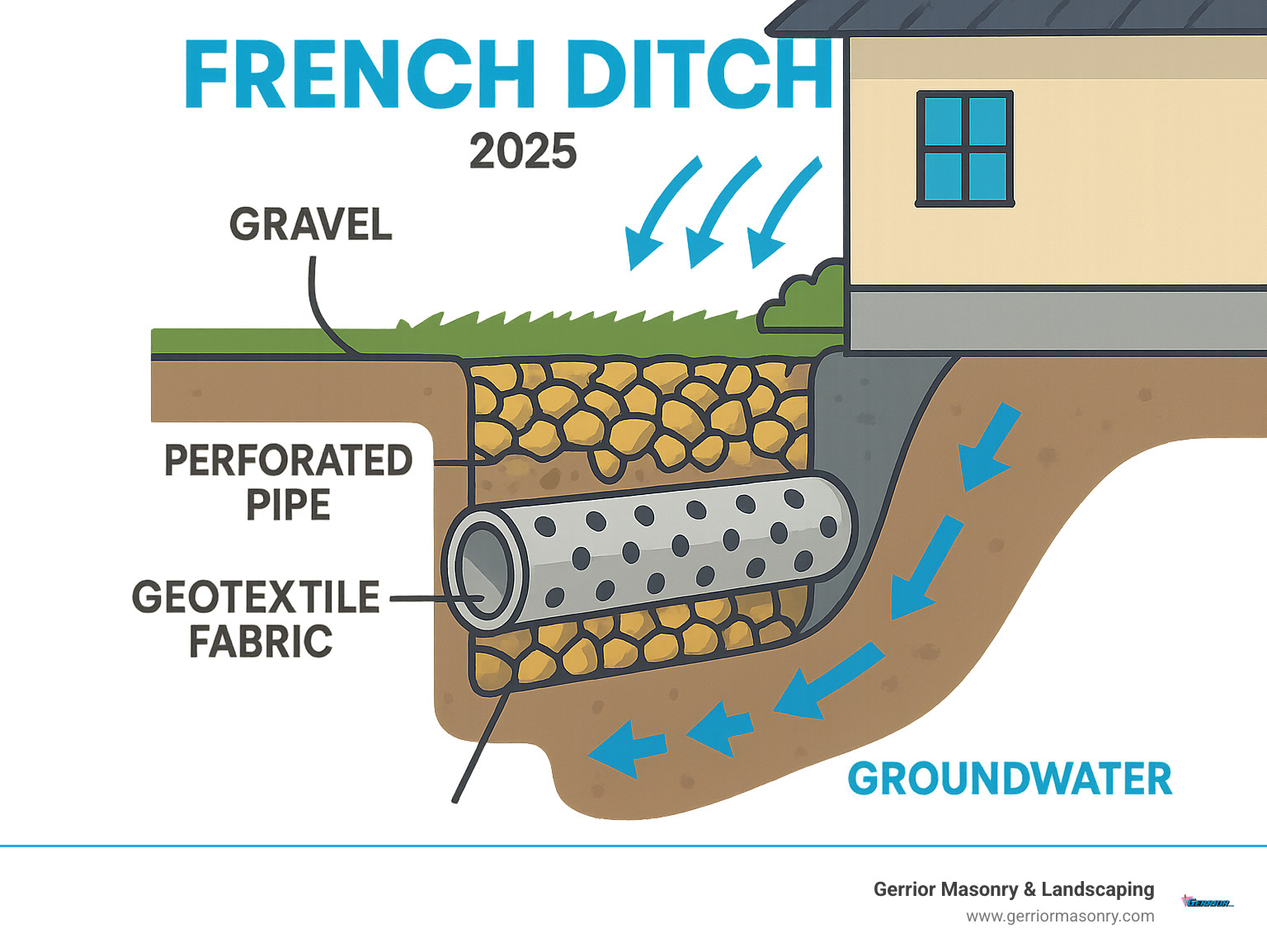
At its core, a french ditch is an underground drainage solution. It consists of a shallow trench, typically 18 to 24 inches deep, lined with a water-permeable fabric, filled with gravel, and containing a perforated pipe.
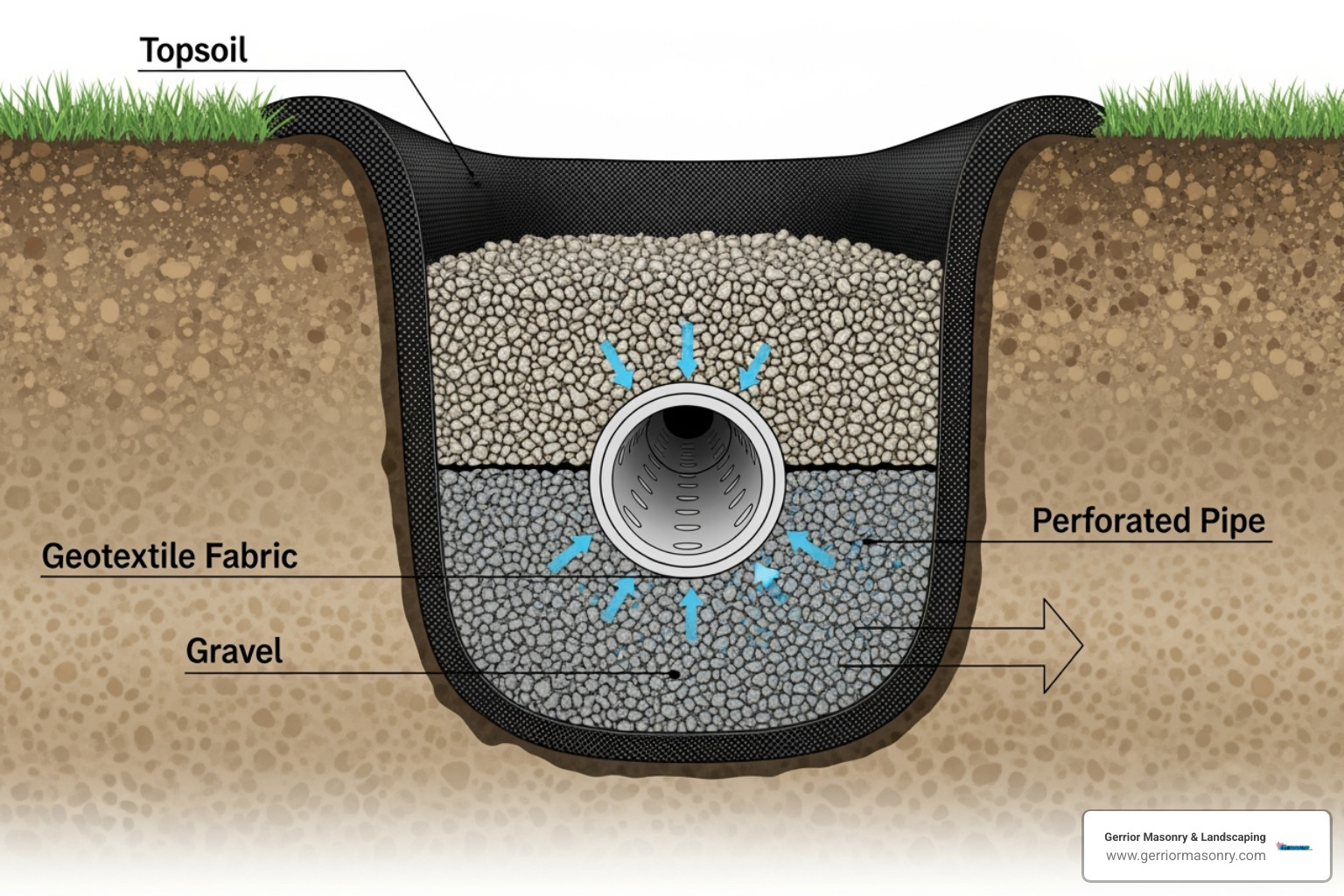
The system works by providing an easy path for water. Groundwater seeps through the gravel into the perforated pipe. The pipe is laid on a slight downward slope—at least one inch of drop for every 10 feet—allowing gravity to channel the water away from your foundation to a designated outlet like a municipal storm drain, a dry well, or a rain garden. The geotextile fabric liner is crucial, as it prevents soil and roots from clogging the system.
The system is not named after the country, but after Henry Flagg French, an American farmer from Concord, Massachusetts, who popularized the concept in his 1859 book, Farm Drainage. Modern materials like non-woven fabric and PVC piping have simplified installation and improved effectiveness.
For more comprehensive information about different drainage systems, including dry wells, and how they can benefit your property, we recommend exploring our detailed guide on drainage systems & dry wells. You can also dig into the historical text that popularized this method by checking out Henry F. French’s seminal work on Farm Drainage.
Key Benefits and Telltale Signs of Needing a French Ditch
How do you know if a french ditch is the right solution for your property? Look for these telltale signs:
Common Signs You Might Need a French Drain:
- Soggy Yard or Patio: Your lawn remains squishy for days after rain, or puddles form in low spots.
- Water Pooling Near Foundation: This is a major red flag that can lead to serious structural issues.
- Basement Leaks or Dampness: Water seeping into your basement or damp spots on walls indicate hydrostatic pressure building against your foundation. Learn more about preventing these issues by exploring our basement waterproofing services.
- Musty Odors in Crawl Space: Excessive moisture can lead to mold, mildew, and structural damage.
- Foundation Cracks: Water pressure can cause cracks. For existing issues, our foundation repair services can provide lasting solutions.
- Soil Erosion: A french ditch can help manage water flow and prevent soil from washing away.
The benefits of installing a french ditch are substantial:
- Prevents Water Damage: Shields your home from water intrusion, protecting your foundation and interior spaces.
- Protects Foundation: Alleviates pressure on foundation walls, preventing cracks and leaks.
- Makes Yard Usable: Transforms waterlogged areas into functional, enjoyable outdoor spaces.
- Increases Property Value: Effective drainage is a significant selling point.
- Reduces Pest Problems: Eliminates standing water where mosquitoes and other insects breed.
- Preserves Landscaping: Helps maintain healthy soil conditions for your plants.
Types of French Drains: Exterior, Interior, and Deep Drains
While the concept is consistent, applications vary. We primarily work with three main types:
- Exterior French Drain (Curtain Drain): Installed outside the home, this common type intercepts surface and groundwater before it reaches the foundation. It’s excellent for soggy yards.
- Interior French Drain (Basement Drain): Used for existing basement leaks, this system is installed inside the basement. A trench is cut into the concrete slab, and a pipe channels water to a sump pump, which pumps it out.
- Deep Drain (Footer Drain): Installed deep at the foundation’s base during construction, this drain relieves hydrostatic pressure from below. It’s a proactive measure for new builds.
Here’s a comparison of these types:
| Feature | Exterior French Drain (Curtain Drain) | Interior French Drain (Basement Drain) | Deep Drain (Footer Drain) |
|---|---|---|---|
| Aesthetics | Can be hidden under landscaping, grass, or decorative stone. | Mostly hidden, but requires breaking and repairing basement floor. | Completely hidden, installed during construction. |
| Maintenance | Relatively easy access for cleaning inlet grates. | Requires access to sump pump; less direct access to pipe for flushing. | Very difficult to access for maintenance once installed. |
| Cost | Lower to moderate. Average professional installation $10-$50 per linear foot. | Higher. Average professional installation $40-$100 per linear foot. | Varies depending on construction phase; often integrated into foundation work. |
| Effectiveness | Excellent for intercepting water before it reaches the foundation. | Highly effective for existing basement water intrusion. | Best for preventing water issues from the outset during construction. |
| Primary Use | Yard drainage, diverting surface water, protecting foundations from outside. | Remedying active basement leaks and moisture. | Proactive foundation protection during new construction. |
Installing a French Ditch: Process, Costs, and Key Considerations
While a DIY approach is possible, professional installation is recommended for a long-lasting, effective system.
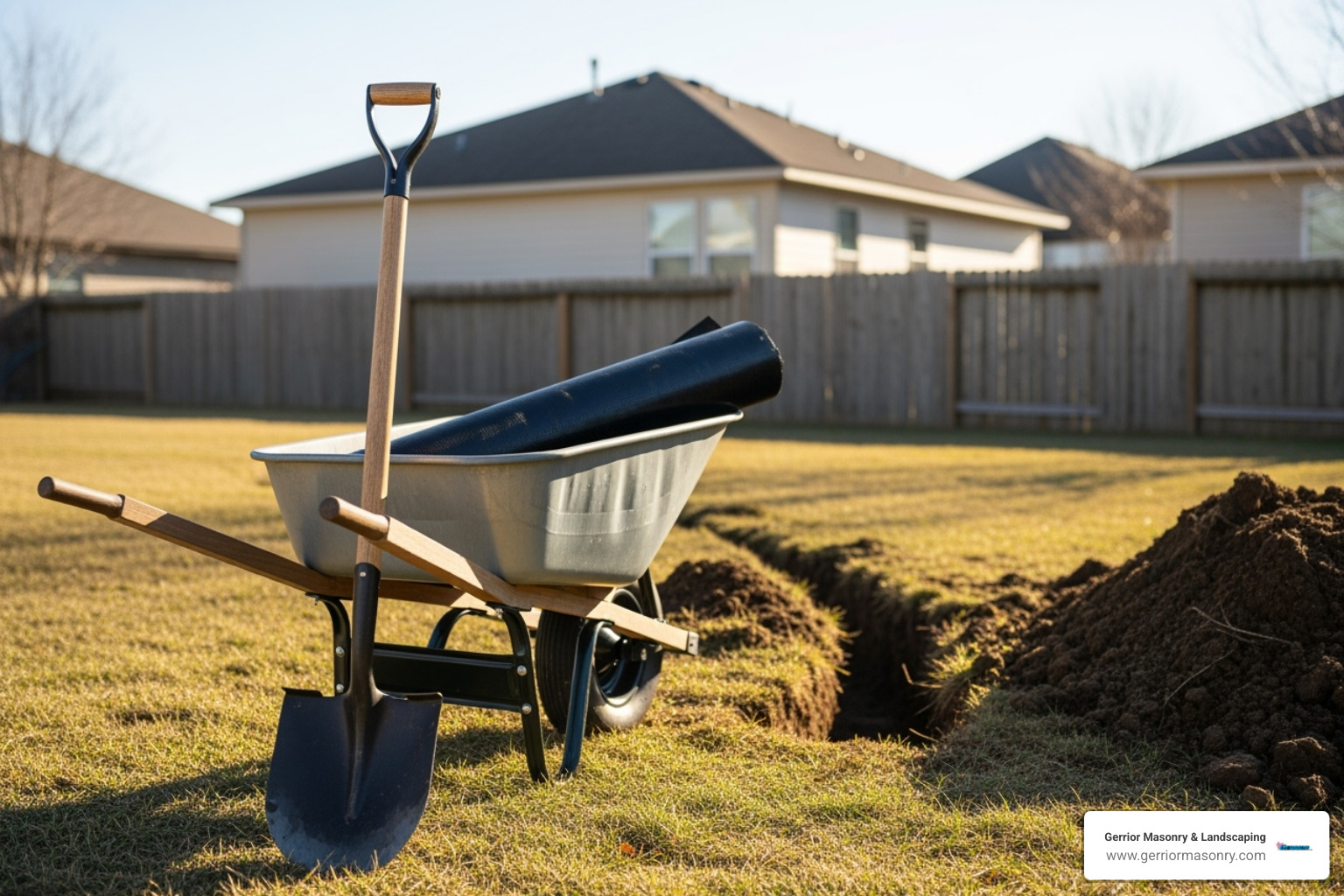
Key Materials:
- Perforated Pipe: Typically 4-inch diameter PVC or flexible corrugated pipe.
- Washed Gravel/Aggregate: Coarse, washed gravel (¾-inch or larger) allows water to pass through while filtering debris.
- Landscape Fabric (Geotextile): A water-permeable fabric that lines the trench to prevent soil and roots from clogging the system.
General Installation Steps:
- Plan: Identify the problem area and a suitable outlet at a lower elevation. Always call 811 before you dig to locate utility lines.
- Dig: Excavate a trench about 18-24 inches deep and 9-12 inches wide, maintaining a slope of at least 1 inch per 10 feet. Our expert excavation services are ideal for this precision work.
- Line: Place geotextile fabric in the trench, leaving enough excess to wrap over the top later.
- Add Gravel & Pipe: Add a 3-inch gravel base, lay the perforated pipe (holes down), and connect sections.
- Cover: Cover the pipe with gravel, then fold the fabric over the top to create a protective envelope.
- Backfill: Fill the rest of the trench with more gravel, or topsoil for planting grass.
Costs Associated with Installing a French Ditch:
Costs vary based on length, depth, soil conditions, and whether it’s a DIY or professional job.
Please note: The following are average costs based on internet data and not actual costs for Gerrior Masonry & Landscaping services. We encourage you to contact us for a personalized quote.
- DIY French Drain: Can cost $1,500 and up. This is labor-intensive, and mistakes can lead to system failure.
- Professional Exterior French Drain: Typically $10 to $50 per linear foot, with average total costs around $5,000.
- Professional Interior French Drain: More complex and can cost $40 to $100 per linear foot, with total costs potentially reaching $18,000 or more.
Key Considerations:
- Utility Lines: Call 811 before digging to avoid dangerous and expensive accidents.
- Soil Type: Heavy clay soils may require a wider trench or other measures to ensure proper drainage.
- Permits: Check with your municipality, especially if connecting to a storm drain. For non-residential regulations, see the EPA’s guidelines on Class V Injection Wells.
- Outlet Location: Ensure water drains to a suitable location without impacting neighbors.
Maintaining Your French Drain and Knowing When to Consider Alternatives
A well-installed french ditch can last for 20-plus years with minimal maintenance.
Annual Maintenance:
- Clear Inlets/Outlets: Keep grates and exit points free of leaves and debris.
- Flush the System: Periodically flush the pipe with a garden hose to clear sediment.
Specific Applications:
- Protecting Retaining Walls: A french ditch behind a retaining wall relieves water pressure.
- Keeping Patios Dry: Installing a drain along a patio edge diverts runoff.
When a French Drain is NOT the Appropriate Solution:
A French drain isn’t a silver bullet. Consider alternatives if you have:
- Lack of Adequate Slope: The system relies on gravity. A sump pump may be needed for flat properties.
- No Suitable Outlet: You must have a place for the water to go.
- Major Grading Issues: Regrading or creating swales might be a better primary solution.
- Gutter-Related Surface Water: Address downspout and gutter issues first.
In any complex drainage scenario, we recommend a professional assessment to find the most cost-effective solution for your property.
Your Drainage Solution Partner in Massachusetts
A French drain is a simple concept, but effective installation requires precision. Getting the slope, materials, and placement right is key to a system that lasts for decades, not just one season.
With over 34 years of experience, Gerrior Masonry & Landscaping has tackled drainage challenges across Massachusetts. We understand local soil and weather patterns, and we bring that accumulated knowledge to your property.
What sets us apart is owner oversight on every project. Joe Gerrior personally ensures your drainage system meets our high standards, giving you peace of mind that the job is done right the first time. No shortcuts, no unsupervised subcontractors.
From basement moisture in Woburn to standing water around an Andover patio, we design systems to handle the demanding Massachusetts weather. A properly installed french ditch protects your largest investment from devastating water damage while giving you back your outdoor spaces.
Gerrior Masonry & Landscape Construction is based in Woburn, MA, and services Middlesex and Essex County, Massachusetts. Contact us for a consultation on your hardscaping and drainage needs.
