
Why Block Paving Installation Transforms Your Outdoor Space
Block paving installation creates durable, attractive surfaces for driveways, patios, and walkways that can last decades with proper installation. Here’s what you need to know to get started:
Quick Overview:
- Excavation depth: 150mm-400mm total (sub-base + bedding + pavers)
- Sub-base layer: 100mm-150mm of compacted Type 1 material
- Bedding layer: 30-50mm sharp sand
- Drainage fall: Minimum 1:60 slope (1cm drop per 60cm)
- Joint spacing: 2-5mm between pavers
- Key tools: Plate compactor, block cutter, screed rails, spirit level
Block paving offers homeowners a practical way to enhance curb appeal while adding real value to their property. Unlike poured concrete, individual pavers can be replaced if damaged, and the interlocking design distributes weight effectively across the surface. The installation process requires careful preparation – from proper excavation and sub-base compaction to precise screeding and final jointing – but the results are worth the effort.
Many Massachusetts homeowners underestimate the importance of proper base preparation. As one experienced builder notes, “Do it properly, do it right, do it once” when it comes to sub-base installation, since skimping on this critical layer is the most common cause of sunken driveways and uneven surfaces.
I’m Joe Gerrior, owner of Gerrior Masonry & Landscape Construction Corp., and over 34 years I’ve overseen countless block paving installation projects throughout Massachusetts. My team and I have learned that proper planning and attention to detail during each installation phase make the difference between a patio that lasts a season and one that performs beautifully for decades.
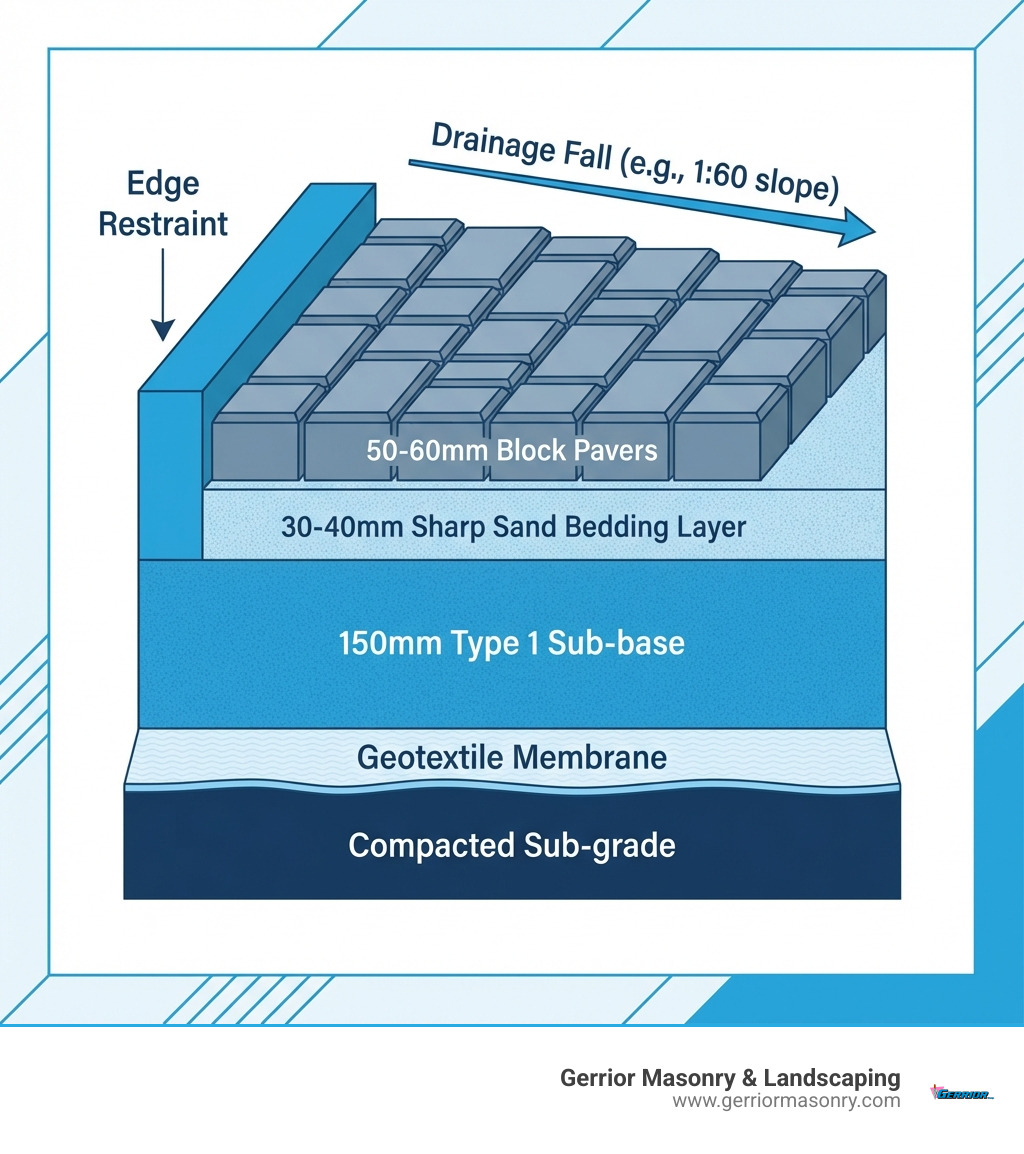
Important block paving installation terms:
Planning and Preparing for Your Block Paving Installation
Before you pick up a shovel, you need a solid plan. A successful block paving installation starts on paper. We always recommend sketching out your home and garden to determine the exact dimensions. This isn’t just about aesthetics; it’s about ensuring the ground can handle the weight of vehicles or foot traffic and, most importantly, that water has somewhere to go. In Massachusetts, you must also contact ‘Dig Safe’ (811) before any excavation to ensure you don’t strike underground utility lines, which can be a costly and dangerous mistake.
In hardscaping, drainage is king. For a driveway or patio to last, you must ensure proper falls. We generally aim for a minimum 1:80 cross fall and a 1:100 longitudinal fall. If you’re working on a relatively flat area, you’ll need to dig in a gradual slope—roughly a 1cm drop for every 60cm of length—to prevent pooling water. For more complex projects, you might need to look into More info about driveway drainage pavers to see how permeable systems can help. Proper drainage prevents the freeze-thaw cycle from shifting your pavers during harsh New England winters.
Speaking of drainage, you should be aware of SUDS (Sustainable Drainage Systems) regulations. While these are often cited in government guidance on permeable surfacing, the core principle applies here in Massachusetts too: if you are paving over a large area (typically over 5 square meters), you must ensure water drains into a natural border, a lawn, or a soakaway. If the water runs directly onto a public sidewalk or street, you might actually need planning permission or a specific permit from your local municipality.
Essential Tools and Materials for Block Paving Installation
You wouldn’t try to bake a cake without a whisk, and you shouldn’t try block paving installation without the right gear. Here is the “must-have” list for a professional-grade DIY project:
- Plate Compactor (Wacker Plate): This is non-negotiable. You’ll use it to compact the sub-base and the final pavers. A minimum centrifugal force of 15kN is recommended for driveways.
- Block Cutter or Splitter: Essential for those neat edges. For clay pavers, a diamond-tipped saw blade is often better for precision.
- Sharp Sand (Grit Sand): This is used for the 30mm-50mm bedding layer. It’s more durable than standard play sand and provides better drainage.
- Kiln-Dried Sand: This fine, moisture-free sand is swept into the joints at the very end to lock everything together through friction.
- Edge Restraints: These act like a picture frame, holding the entire structure in place and preventing lateral shift.
- Screed Rails and a Spirit Level: To ensure your sand bed is perfectly flat (but sloped for drainage!).
Choosing the right pavers is also vital for longevity. Check out More info about durable driveway pavers to understand which materials stand up best to New England winters.
Calculating Quantities and Excavation Depths
One of the biggest mistakes DIYers make is under-ordering materials. Always add a wastage factor of 5-10% to your total square footage. This accounts for the blocks you’ll inevitably break while cutting or the odd “oops” moment during the layout. For complex patterns like a 45-degree herringbone, you might even want to bump that wastage factor to 12%.
Your excavation depth is determined by the intended use of the area and the local soil conditions. In areas with heavy clay, you may need to dig deeper to replace unstable soil with more compacted stone:
- Patios/Paths: Usually require a total depth of about 150mm to 200mm.
- Driveways: Require a deeper foundation, often 250mm to 400mm, to support the weight of cars and prevent rutting.
The layers typically break down like this:
- Sub-base: 100mm to 150mm of Type 1 MOT (crushed stone, typically 3/4 inch minus). 125mm of uncompacted stone will compact down to about 100mm.
- Bedding Layer: 25mm to 50mm of sharp sand.
- Paver Thickness: Usually 50mm for domestic use or 60-80mm for heavy-duty driveways.
Step-by-Step Guide to Block Paving Installation
Once the area is marked out and services (like gas and electric lines) are located, it’s time to dig. Following a Step-by-step guide to construction ensures you don’t miss the small details that prevent large failures.
1. Sub-base Construction: After excavating, lay a geotextile membrane. This prevents your expensive crushed stone from sinking into the Massachusetts clay over time. Spread your Type 1 material in layers of no more than 100mm and run the plate compactor over it at least 6-7 times. The sub-base should mirror the final slope of your patio to ensure uniform thickness of the sand layer above.
2. Edge Restraints: Install your kerbs or edge blocks on a concrete foundation (usually a 1:6 cement-to-ballast mix). “Haunch” them by adding concrete up the outside of the block to roughly halfway. This “frame” is what gives your driveway its structural integrity, preventing the blocks from spreading outward under the weight of a vehicle.
3. The Laying Course: Spread damp sharp sand over the compacted sub-base. We recommend using screed rails (gas pipes or metal bars work great) to get an even surface. Use a straight-edge timber to pull the sand flat across the rails. Once screeded, do not walk on the sand bed.
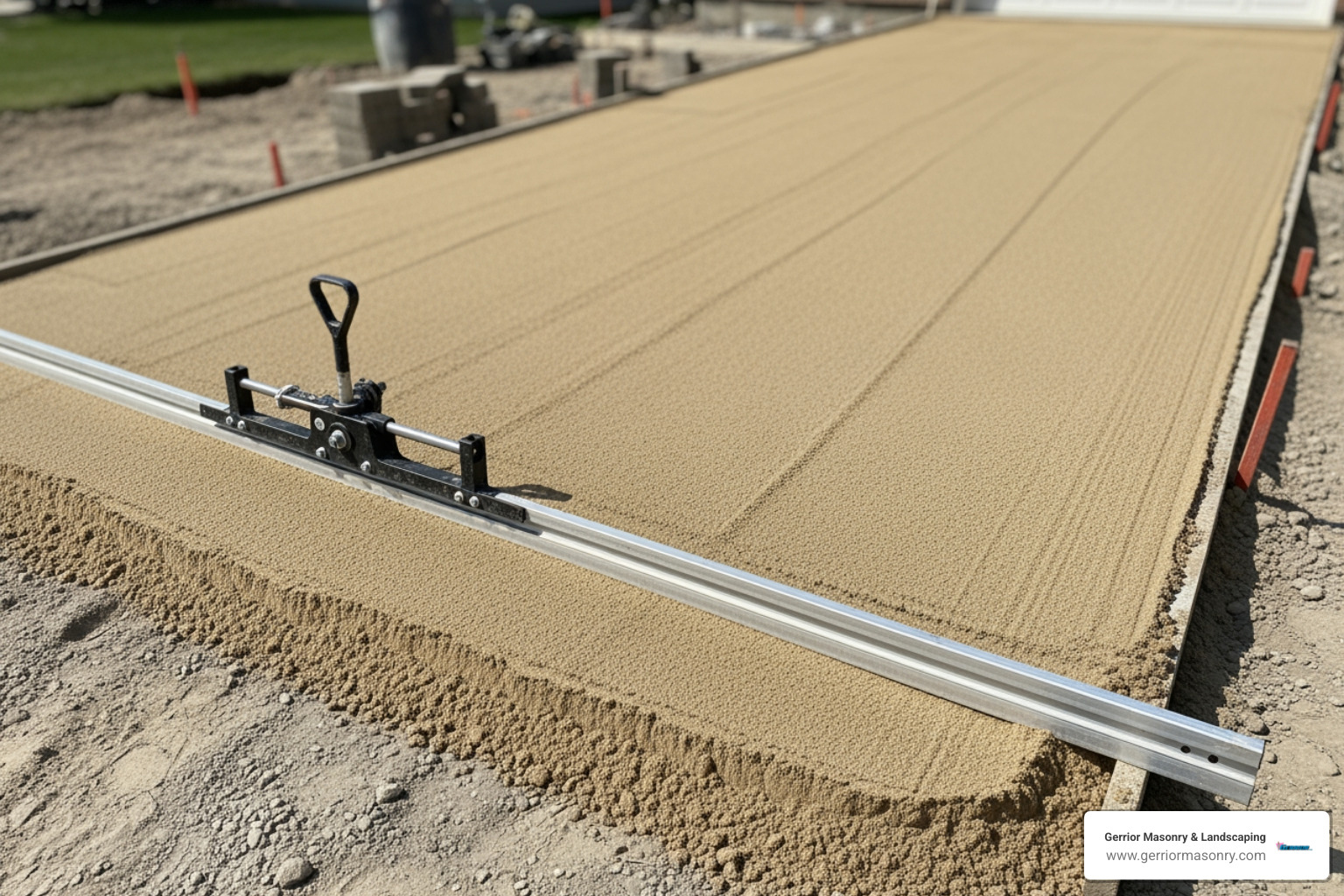
Mastering the Layout: Patterns for Block Paving Installation
The pattern you choose isn’t just about looks—it’s about strength. When laying, use the “click and drop” method: place the paver against the edge of the previous one and lower it straight down to avoid disturbing the sand bed.
- Herringbone (45° or 90°): This is the gold standard for driveways. The interlocking nature of the blocks prevents them from shifting or “creeping” when car tires turn on them.
- Stretcher Bond: Mimics a traditional brick wall. It’s simple and elegant for paths but less suited for heavy vehicle traffic.
- Basketweave: Great for patios where you want a vintage, woven look.
Pro Tip on Color Blending: Never pull pavers from just one pack at a time. To avoid “banding” or large blotches of different shades, always draw blocks from at least three different packs simultaneously, picking them diagonally. This ensures a beautiful, natural blend of colors across the entire surface. For more on this, see More info about paver driveway installation.
Cutting, Compacting, and Jointing Your Pavers
Once your main area is laid, you’ll be left with gaps at the edges.
Cutting: Use a block splitter or a power saw with a diamond blade. Always wear safety goggles and ear protection. A good rule of thumb is that no cut block should be smaller than one-third of its original size. If you have a tiny gap, it’s often better to shift the pattern slightly than to use a sliver of a brick that will just pop out later. Small slivers lack the mass to stay seated in the sand.
Jointing: Wait for a dry day! Spread fine, kiln-dried silica sand over the surface and sweep it into the joints. This sand acts as the “glue” that creates the interlock. If the sand is even slightly damp, it will bridge the gap rather than falling to the bottom, leading to joint failure.
Final Compaction: Run your plate compactor over the finished pavers. If you are using textured or decorative blocks, always use a rubber mat (neoprene pad) on the bottom of the compactor to prevent scuffing or cracking the faces of your new pavers. After the first pass, you’ll notice the sand has settled. Add more kiln-dried sand, sweep again, and compact one last time. You can find more detailed guidance at More info about installing a paver walkway.
Maintenance and Long-Term Care
Block paving is remarkably low-maintenance, but it isn’t “no-maintenance.” You may notice a white powdery substance called efflorescence shortly after installation. This is a natural salt migration and usually disappears on its own within a few months.
| Feature | Flexible Construction (Recommended) | Rigid Construction (Mortar-Bound) |
|---|---|---|
| Bedding | Sharp Sand | Mortar Mix (1:3) |
| Joints | Kiln-Dried Sand | Mortar/Grout |
| Repair | Easy (Replace single blocks) | Difficult (Requires chipping out) |
| DIY Friendly | Yes | No (Requires masonry skills) |
Maintenance Tips:
- Sealing: We recommend applying a joint stabilizer or sealant (like Resiblock) a few months after installation. This prevents weed growth and stops the sand from washing away during heavy rain.
- Weed Prevention: Regularly apply a weed killer. Most “weeds” in block paving actually grow from seeds dropped into the sand joints from above, not from underneath.
- Pressure Washing: Be careful! Heavy pressure washing can blast out the jointing sand. If you must power wash, always be prepared to re-apply kiln-dried sand once the area is dry.
- Subsidence: If an area sinks, it’s usually a sub-base issue. With flexible paving, you can lift the blocks, add more sand/stone, and relay them. Learn more at More info about brick pavers installation.
Professional Results and Project Costs
While many homeowners enjoy the challenge of a DIY block paving installation, it is back-breaking work that requires precision. If the sub-base isn’t compacted perfectly, or the drainage isn’t calculated correctly, you could end up with an expensive mess. Professional installers have the heavy machinery required to ensure the sub-base is rock-solid.
Based on internet data, the average cost for block paving installation ranges from $10 to $75 per square foot.
- Basic DIY materials: Might run you $10-$20 per square foot.
- Standard Professional Install: Often falls between $25 and $40 per square foot.
- Complex/High-End Custom Designs: Can exceed $75 per square foot depending on the materials used and site preparation needs.
Please note: these are average costs based on general internet data and are not actual quotes for Gerrior Masonry & Landscaping services. Every project is unique, and factors like soil condition, accessibility, and chosen patterns will influence the final price.
If you want the peace of mind that comes with over 30 years of experience and owner oversight on every job, we are here to help. Whether it’s a small walkway or a massive driveway, we ensure your investment stands the test of time. For more information, check out More info about patio installation near me.
Gerrior Masonry & Landscape Construction is based in Woburn, MA, and services Middlesex and Essex County, Massachusetts.
