
Why Travertine Pool Coping Installation Is Worth Getting Right
Travertine pool coping installation is one of the most impactful upgrades you can make to a backyard pool. Done right, it creates a clean, safe edge around your pool while adding lasting beauty to the entire outdoor space. Travertine is a unique form of limestone deposited by mineral springs, especially hot springs. Its fibrous, marble-like texture and attractive earth-tone colors make it a premier choice for homeowners looking to elevate their landscape from ordinary to extraordinary.
Here’s a quick overview of what the professional installation process involves:
- Choose your coping size and profile – larger pieces (12″x24″) for straight-edge pools, smaller (6″x12″) for curved or kidney shapes.
- Prepare the bond beam – the concrete shelf must be clean, level, and structurally sound before any stone goes down.
- Select your installation method – mud-set (mortar bed) for most pools, dry-set for specific deck areas in cold climates with freeze-thaw cycles.
- Dry-lay first – arrange all pieces around the perimeter to check for color blending and fit before committing to adhesive.
- Cut and set – use a diamond blade wet saw for precision, applying flexible thin-set mortar at least 1″ deep for a secure bond.
- Grout and seal – finish joints with sanded grout, then apply a high-quality penetrating sealer to protect the stone.
Travertine is popular for pool edges for good reason. It stays cooler underfoot than concrete or brick, which is a lifesaver during those humid Massachusetts summers. It also offers natural slip resistance due to its porous surface, handles pool chemicals like chlorine and salt exceptionally well, and looks elegant for decades. Unlike synthetic materials, travertine’s color won’t fade over time; in fact, many believe it looks better as it ages.
That said, the details matter a lot. An uneven bond beam, the wrong type of mortar, or skipping the sealer can lead to cracked stones, water damage, or a surface that becomes slippery and unsafe. I’m Joe Gerrior, owner of Gerrior Masonry & Landscape Construction Corp., a family-owned business with over 30 years of experience in masonry and hardscaping — including travertine pool coping installation across Massachusetts. In this guide, I’ll walk you through everything you need to know to plan, install, and maintain a travertine pool coping project the right way.
Planning and Materials for Travertine Pool Coping Installation
Before we even mix a bag of mortar or fire up the saw, we have to talk about the “P” word: Planning. If you’ve ever tried to assemble a piece of Swedish furniture without the instructions, you know that skipping the preparation phase usually ends in a few leftover screws and a lot of frustration. With travertine pool coping installation, the stakes are a bit higher—these stones can weigh up to 65 pounds each, and once they are set in mortar, they are not easily moved.
Travertine is a natural limestone formed by mineral springs. Because it’s a product of Mother Nature, no two stones are exactly alike. This is part of its charm, but it means we need to be strategic. When ordering your materials, we always recommend adding a 10-15% waste factor to your total linear footage. This covers those tricky miter cuts, the occasional breakage during shipping, and ensures you have enough matching stones if a piece needs replacement down the road. Furthermore, travertine comes in different grades—Premium, Standard, and Commercial. For pool coping, we always suggest Premium grade, as it has fewer large holes (voids) and more consistent thickness, which is vital for a level walking surface.
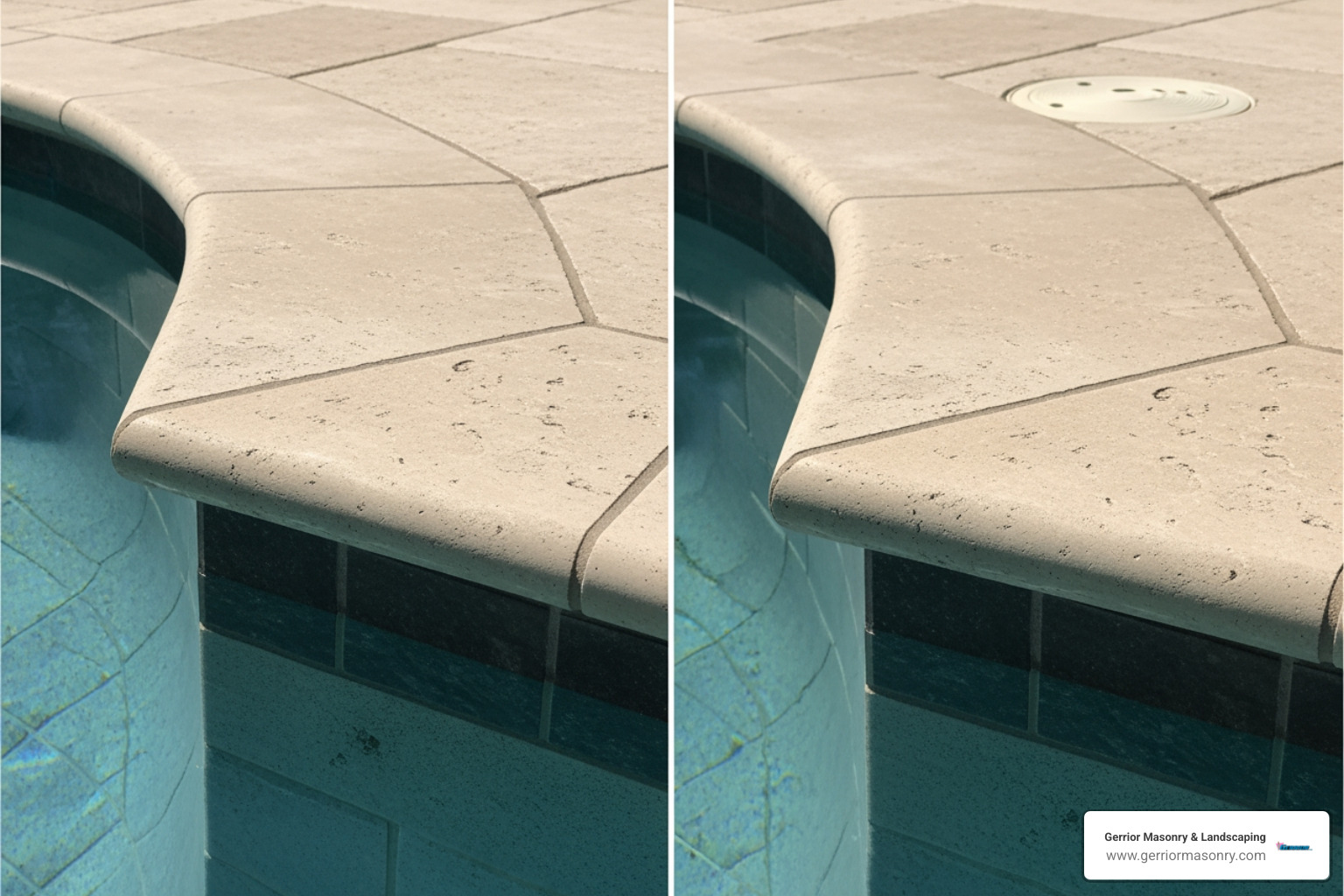
One of the first decisions you’ll make is the “profile” or the shape of the edge. This choice affects both the look of the pool and the comfort of the swimmers.
- Bullnose Coping: This is the classic choice. It features a rounded edge that is gentle on swimmers’ legs as they climb out of the water. It provides a soft, traditional look that fits almost any backyard aesthetic.
- Drop-Face (or Remodeled) Coping: This has an “L” shape that hangs down over the pool tile. It’s a popular choice for renovations because it hides the old pool edge perfectly and creates a thick, modern look that makes the stone appear much more substantial.
To ensure your installation lasts through our tough Massachusetts winters, follow a scientific approach to travertine installation methods that accounts for substrate stability and thermal expansion.
Selecting Sizes and Profiles for Travertine Pool Coping Installation
The shape of your pool dictates the size of the stone. It’s a bit like a puzzle where the pieces must be chosen to minimize gaps and maximize structural integrity.
- Straight-Edge Pools: For rectangular or modern geometric pools, larger pieces like 12″x24″ or 12″x12″ are ideal. They create fewer grout lines and a sleek, continuous look that emphasizes the long lines of the pool.
- Curved-Edge Pools: If you have a kidney-shaped or freeform pool, smaller sizes like 4″x8″ or 6″x12″ are your best friends. Smaller stones allow us to follow the curve of the pool more tightly without creating massive, wedge-shaped gaps between the pieces. For very tight radii, we may even use custom-cut radius coping.
We often create templates for complex curves to ensure every cut is precise. The goal is a consistent overhang (usually about 1 to 1.5 inches) over the interior of the pool. This not only looks professional but helps direct water splash-back away from the bond beam, protecting the underlying structure. For more inspiration on how coping integrates with the rest of your backyard, check out our pool deck and patio services.
Essential Tools and Base Preparation Requirements
You wouldn’t use a butter knife to cut a steak, and you certainly shouldn’t use a standard masonry saw for travertine. To get those clean, crisp edges without chipping the natural stone, a wet saw with a diamond blade is non-negotiable. The water keeps the blade cool and suppresses the dust, which is essential for both the quality of the cut and the safety of the crew.
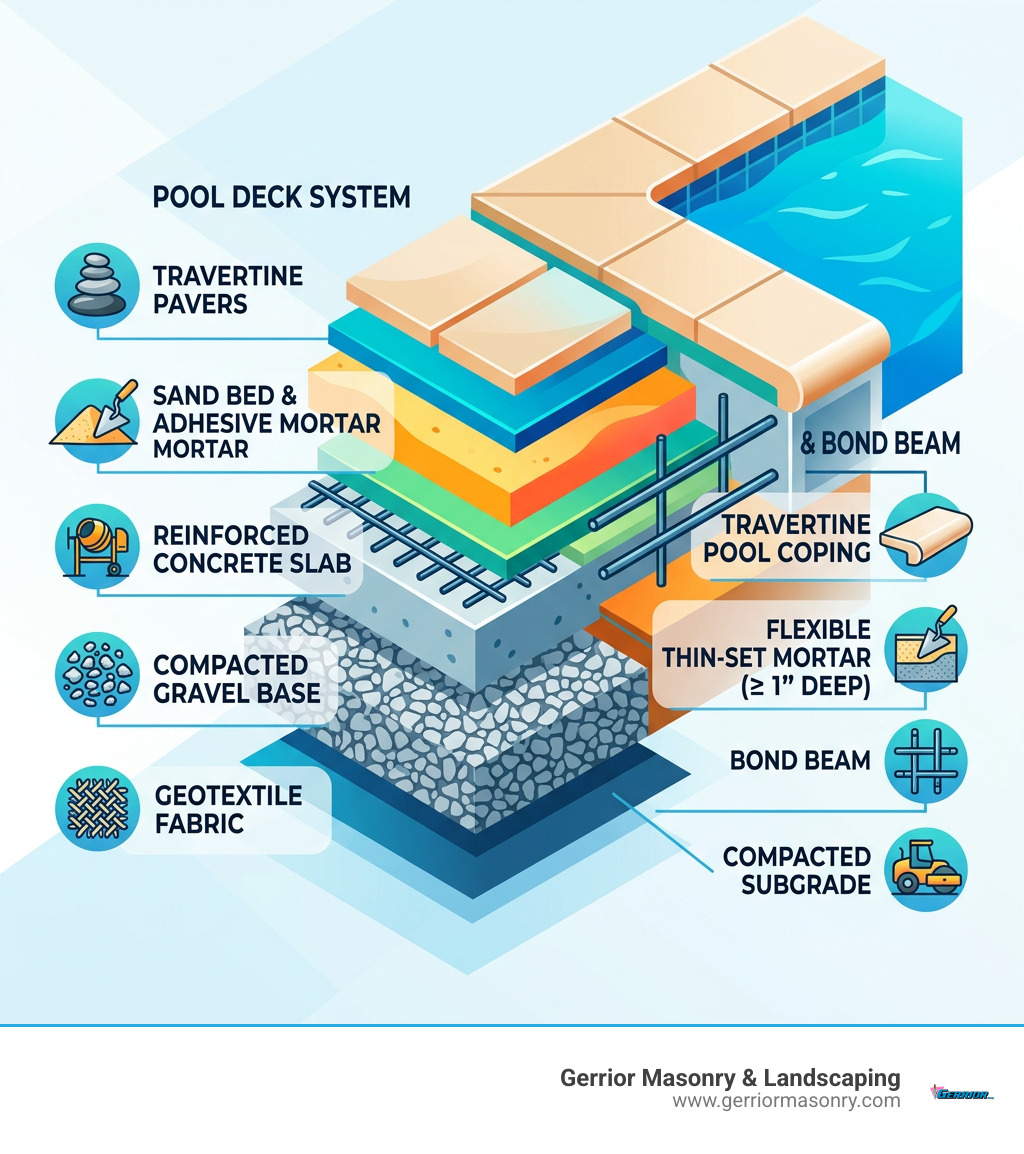
The most critical part of the entire project, however, is the bond beam. This is the concrete “shelf” at the top of the pool wall where the coping sits. Over time, or during the initial pour, the bond beam can sag or become uneven—sometimes by as much as 5/8 of an inch. If the base isn’t level, your coping won’t be either, leading to trip hazards and pooling water.
Preparation steps include:
- Cleaning: Scrubbing the bond beam with a wire brush to remove any loose debris, old mortar, or algae.
- Leveling: Using a high-strength Type S mortar or a specialized leveling mix to ensure a perfectly flat surface before the stone is applied.
- Subbase: For the surrounding deck, a 4-6 inch concrete slab or a 6-8 inch layer of compacted crushed gravel is required to prevent shifting during the winter months.
Our team at Gerrior Masonry takes this preparation seriously because we know that a pretty stone is only as good as the foundation beneath it. You can learn more about our foundational work on our masonry services page.
Professional Techniques for Travertine Pool Coping Installation
Now we get into the technical execution. There are two primary ways to set these stones: Mud-set and Dry-set. In the Boston area, where the ground likes to dance (aka freeze and thaw) every winter, choosing the right one is the difference between a lifetime of beauty and a spring spent fixing expensive cracks. The expansion and contraction of the soil in Massachusetts can be brutal on masonry, so we prioritize flexibility and strength in every joint.
Regardless of the method, drainage is king. We always install coping and decks with a 1/8″ to 1/4″ per foot slope away from the pool. This prevents water from pooling against the stone or running back into the pool, which can lead to staining or ice damage in the winter. For more on the technical side of stone longevity, see this research on travertine stone maintenance.
Dry-Laying and Cutting for Travertine Pool Coping Installation
We have a rule at Gerrior: Measure twice, cut once, and dry-lay everything. Before a single drop of mortar touches the pool, we arrange every piece of coping around the entire perimeter. This is a time-consuming step, but it is vital for a high-end finish.
- Color Blending: Since travertine is natural, colors vary between crates. Dry-laying allows us to mix and match pieces from different pallets so you don’t end up with a “patchwork” look where one side of the pool is significantly darker than the other.
- Miter Cuts: Corner pieces require precise miter cuts. We use our wet saw to ensure these joints are tight and symmetrical. For a 90-degree corner, we cut two 45-degree angles to create a seamless transition.
- Safety First: Cutting stone creates fine dust and significant noise. We always use proper eye protection, earplugs, and dust control measures to protect our workers and your property.
Once the layout looks perfect, we mark the stones and the bond beam so we know exactly where each piece returns. This is a great time to visualize how the coping will transition into your paver patio.
Mud-Set vs. Dry-Set Application Methods
Which method should you use? The answer depends on the specific part of the project.
- Mud-Set (Mortar): This is the standard for most travertine pool coping installations. We apply a flexible thin-set mortar (like FlexBond) over the bond beam. A 1-inch mortar bed is typically used to allow for micro-adjustments in level. This creates a permanent, rock-solid bond that prevents the coping from moving when people jump off the edge. We also use a “back-buttering” technique, applying a thin layer of mortar to the back of the stone itself to ensure 100% coverage.
- Dry-Set: Common in colder climates for the actual patio area, this involves laying stones over a bed of sand and crushed gravel. It allows for “flex” during freeze-thaw cycles. However, for the coping specifically—the edge that hangs over the water—we almost always prefer a secure mud-set to prevent the heavy stones from sliding into the deep end! We also ensure there is a proper expansion joint between the mud-set coping and the dry-set deck to allow for independent movement.
For a deeper dive into which method fits your specific property, visit our hardscaping services page.
Finishing, Sealing, and Long-Term Maintenance
Once the stones are set and the mortar has cured for at least 24 hours, we fill the joints. For mud-set coping, we use a sanded grout that matches the natural tones of the travertine. This grout helps lock the stones together and prevents water from seeping into the mortar bed.
Sealing is the secret sauce. Travertine is porous, meaning it has tiny holes that can soak up oils, sunscreen, and pool chemicals. If left unsealed, these substances can cause deep stains that are difficult to remove.
- Penetrating Sealer: We recommend a high-quality penetrating sealer. Unlike topical sealers that sit on top and can make the stone slick, penetrating sealers soak into the pores to protect the stone from the inside out without changing the slip-resistance.
- Schedule: You should re-seal your travertine every 2-3 years, depending on usage and weather exposure.
- Cleaning: Use a pH-neutral cleaner specifically designed for natural stone. Avoid harsh acids, bleach, or “big box store” cleaners that can etch the stone and dull its natural luster.
If you want to see the finished results of a properly sealed project, take a look at our pool project gallery.
Estimated Costs and Professional Installation Benefits
Let’s talk numbers. Based on general internet data, the average cost for travertine pool coping installation ranges from $25 to $150 per linear foot. This is a significant investment, but one that adds substantial value to your home.
Why such a wide range in pricing?
- Materials: Premium travertine costs more but has fewer structural defects and better color consistency. Custom-cut radius pieces also add to the material cost.
- Complexity: A rectangular pool is straightforward; a freeform pool with waterfalls, raised beams, or integrated spas requires significantly more labor and custom cutting.
- Labor: Professional masonry requires a skilled team that understands the nuances of natural stone and local climate challenges.
Note that these are average costs based on internet data and not actual costs for Gerrior Masonry services. However, when you hire a professional like us, you’re paying for 30+ years of experience in the Middlesex and Essex County climate. We know how to handle the “heave” of a Massachusetts winter so your pool looks just as good in ten years as it does on day one. For more about our history and owner-oversight promise, read about Gerrior Masonry.
Whether you are in Woburn, Lexington, or Beverly, we are here to help you build your poolside paradise. Our commitment to quality ensures that your travertine installation will be a source of pride for your home for many years to come.
Gerrior Masonry & Landscape Construction is based in Woburn, MA, and services Middlesex and Essex County, Massachusetts. Average costs listed are based on general internet data and do not reflect actual pricing for Gerrior Masonry services.
