What Is Retaining Wall Engineering — and Why Does It Matter?
Retaining wall engineering is the science of designing structures that hold back soil, rock, or other materials where the ground changes elevation abruptly.
Here’s a quick overview of what it involves:
- Purpose: Stabilize slopes, prevent erosion, and create usable flat land on uneven terrain
- When it’s needed: Any time there’s a significant grade change — think sloped backyards, walkout basements, parking areas, or sunken patios
- Key forces involved: Lateral soil pressure, water pressure, surcharge loads (vehicles, structures), and seismic forces
- Who needs it: Homeowners, commercial property owners, and contractors in Massachusetts dealing with elevation changes
- When engineering is legally required: Most municipalities require a licensed engineer and a building permit for any retaining wall 4 feet or taller under the International Building Code (IBC)
Getting this wrong is costly. A wall designed only for dry soil can fail when heavy rains hit — and saturated soil can weigh up to 3,000 pounds per cubic yard, compared to just 2,000 pounds when dry. Rebuilding a failed retaining wall can cost three to four times the original project price.
For Massachusetts homeowners in towns like Woburn and Andover, where sloped lots, freeze-thaw cycles, and wet springs are common, proper retaining wall engineering isn’t optional — it’s essential.
I’m Joe Gerrior, owner of Gerrior Masonry & Landscape Construction Corp., and over 34 years of hands-on masonry and hardscaping work across Massachusetts has shown me exactly what separates a wall that lasts from one that leans, cracks, or collapses. In this guide, I’ll walk you through the core principles of retaining wall engineering so you can make smart, informed decisions about your property.
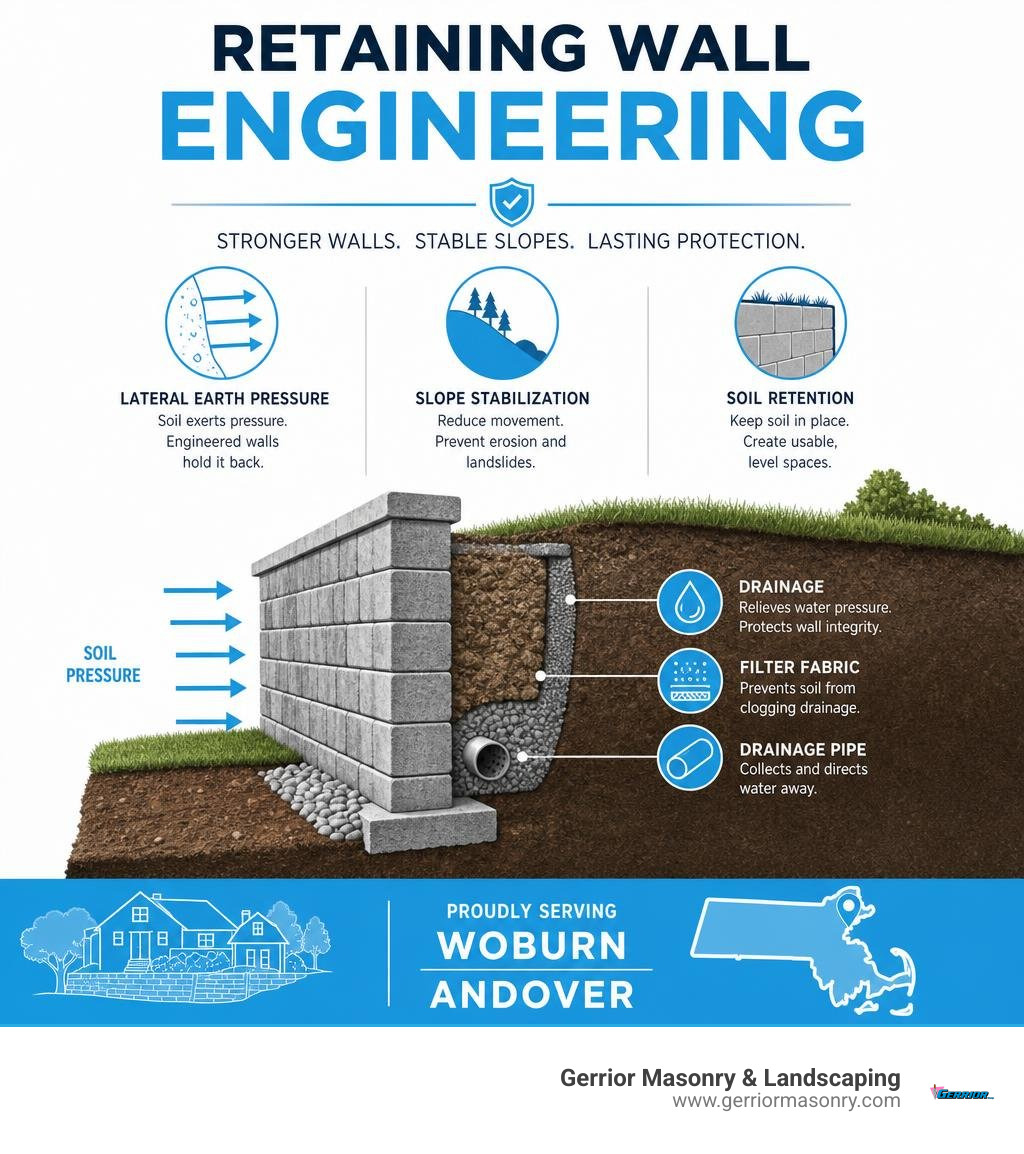
Retaining wall engineering glossary:
The Core Principles of Retaining Wall Engineering
At its heart, retaining wall engineering is a constant battle against gravity and lateral earth pressure. When we cut into a slope in towns like Arlington or Belmont to build a flat backyard patio, the soil behind that cut naturally wants to slide downward. The retaining wall is the only thing standing in its way.
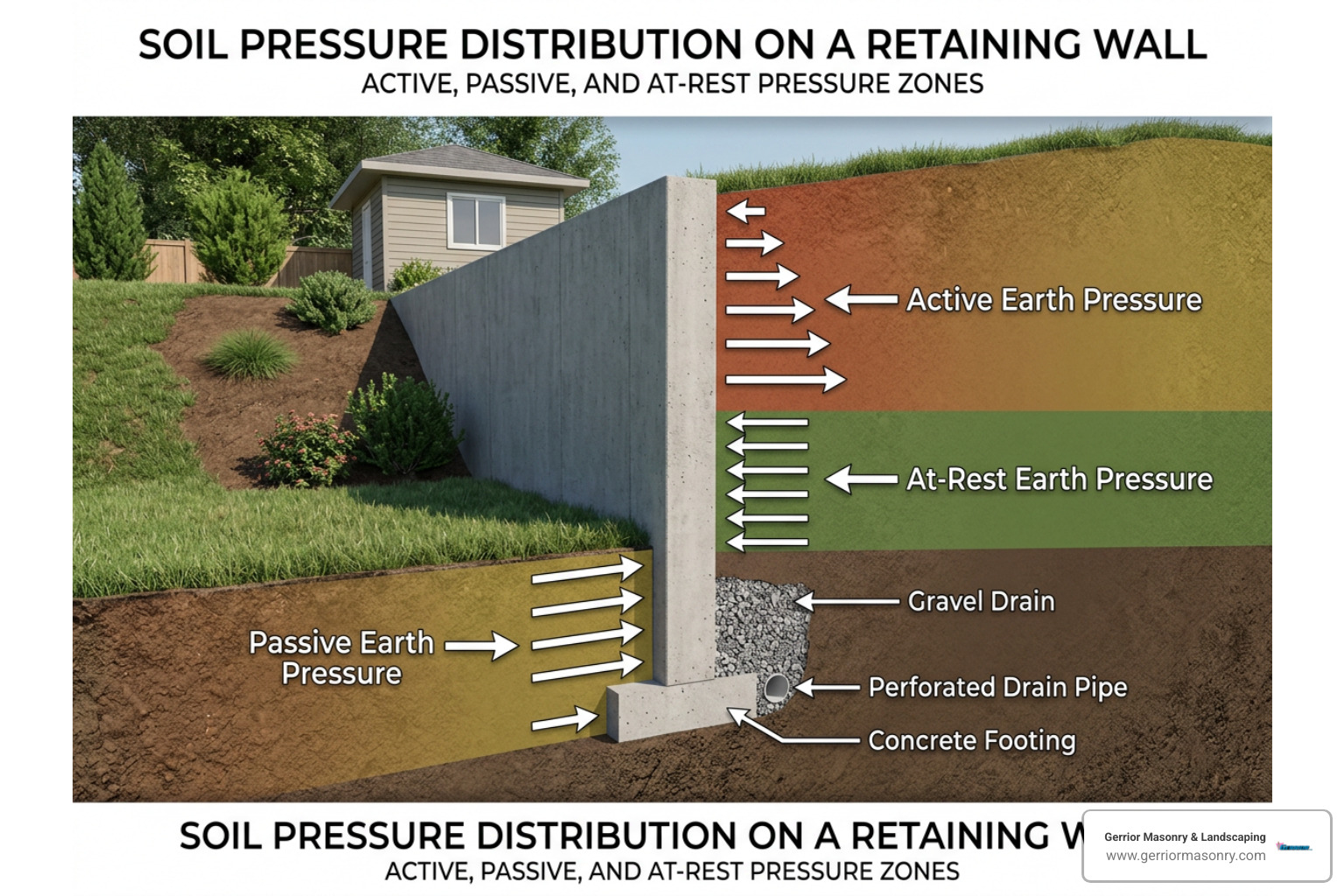
To design a wall that stands the test of time, we must understand the three primary types of lateral earth pressure:
- Active Pressure ($P_a$): This occurs when the retaining wall is flexible enough to deflect slightly away from the retained soil. This minor movement allows the soil to expand, reaching its active state and exerting the minimum lateral force against the wall.
- Passive Pressure ($P_p$): This is the resistance generated by the soil in front of the wall (at the toe) as the wall pushes against it. Passive pressure helps prevent the wall from sliding forward.
- At-Rest Pressure ($P_o$): This applies to highly rigid, non-deflecting walls (such as basement walls integrated into a foundation). Because the wall cannot budge, the soil remains “at rest,” exerting significantly higher lateral pressure than in the active state.
Beyond the weight of the dirt itself, engineers must calculate surcharge loads. A surcharge is any load placed on top of the retained soil, such as a driveway, a parking lot, a fence, or even heavy snow accumulation. In earthquake-prone areas or regions with heavy vibration, seismic loading must also be factored in, creating an inverse triangular load distribution that places maximum bending stress at the base of the wall.
Understanding how to balance these forces is the key to retaining wall design and stability.
Soil Mechanics and Retaining Wall Engineering Design
Every stable structure begins with the ground beneath it. In retaining wall engineering, soil is not just “dirt”—it is a complex, highly variable construction material. Geotechnical engineers classify soils based on their grain size, moisture sensitivity, and shear strength.
Two primary soil types dictate how a wall is designed:
- Granular Soils (Sand and Gravel): These soils have a high internal friction angle ($phi$) and zero cohesion. They drain water exceptionally well and are the preferred material for backfilling behind a wall because they do not swell when wet.
- Cohesive Soils (Clay and Silt): These soils have high cohesion but are highly plastic when wet. They hold onto water, swell significantly, and exert immense hydrostatic pressure.
Moisture content is the ultimate wildcard. As mentioned, dry topsoil weighs roughly 2,000 pounds per cubic yard, but when saturated with water, that same soil swells to 3,000 pounds. This added water weight exerts an additional hydrostatic pressure of 62.4 pounds per cubic foot (pcf) against the back of the wall. Furthermore, excessive moisture can decrease the load-bearing capacity of the foundation soil beneath the wall by as much as 50%. This is why site-specific projects, such as a complex Belmont, MA Reinforced Masonry Retaining Wall Design, require rigorous soil evaluation to prevent settling and shifting over time.
Types of Retaining Walls and Their Engineering Applications
Depending on the height of the slope, soil conditions, and spatial constraints, we utilize different types of retaining walls to secure the earth.
| Wall Type | How It Works | Best Applications | Height Limitations |
|---|---|---|---|
| Gravity Wall | Relies entirely on its own massive weight to resist lateral soil pressure. | Garden beds, low landscape transitions in Beverly. | Generally under 4 feet unless constructed with massive precast blocks. |
| Cantilever Wall | Uses an “L” or “T” shaped reinforced concrete footprint. The weight of the soil resting on the heel holds the wall in place. | Deep excavations, highway projects, commercial developments. | Highly economical up to 15–20 feet. |
| Tieback Wall | Uses anchors or cables driven deep into the stable soil behind the failure plane. | Extremely tight spaces where a wide footing isn’t possible. | Virtually unlimited; great for high-stress urban zones. |
| Coherent Gravity (Geogrid-Reinforced) | Uses layers of geogrid mesh to bind the soil behind the block face into a single, cohesive gravity mass. | Tall residential slopes, commercial parking lots. | Can easily exceed 20 feet with proper engineering. |
For properties with steep elevation changes, a single massive wall isn’t always the best choice. Tiered walls (terraces) can break up the elevation beautifully, but they require careful setback calculations. If the upper wall is built too close to the lower wall (closer than twice the height of the lower wall), its weight acts as a massive surcharge load, requiring advanced structural calculations during the retaining wall installation process.
Structural Stability, Drainage, and Professional Engineering
Building a wall that stands straight for decades requires a combined effort of geotechnical exploration, structural engineering, and precise masonry execution. Under the International Building Code (IBC), a retaining wall is a structural element.
At Gerrior Masonry & Landscaping, we provide professional oversight on every project we build, ensuring that your investment is fully protected. Whether you are adding decorative landscape walls to your garden or stabilizing a massive commercial slope in Woburn or Andover, our over 30 years of experience guarantees a flawless result.
To get started on your next project, call us today at +781-713-1225 or Request an Estimate online.

When to Hire a Licensed Professional for Retaining Wall Engineering
It is a common question: Do I really need an engineer for this?
The general rule of thumb is the 4-foot rule. According to most Massachusetts municipal building codes, any retaining wall that stands 4 feet or taller (measured from the bottom of the buried footing to the top of the wall) requires a building permit and a design stamped by a licensed Professional Engineer (PE). However, you should absolutely hire an engineer even for shorter walls if:
- The wall supports a surcharge load (such as a driveway, parking area, or building foundation).
- There is a slope rising above the top of the wall or falling away from the toe of the wall.
- Groundwater or natural springs are present on the site.
When budgeting, keep in mind that retaining wall design costs vary depending on the complexity of the site. Based on publicly available online industry data, basic engineering design costs range from $2 to $20 per square foot (please note that these are average internet-sourced costs and do not reflect the actual rates of Gerrior Corp).
While hiring an engineer adds an upfront cost, it is a fraction of the total project price. Because rebuilding a failed wall can cost 3 to 4 times more than the initial installation, finding qualified retaining wall builders near me in towns like Arlington is the best way to safeguard your property.
Critical Stability Checks and Failure Prevention
During the design phase, an engineer performs four critical external stability checks to ensure the wall will not fail:
- Sliding Resistance: Checks if the lateral soil pressure will push the wall forward. The safety factor against sliding is typically set at 1.5. If resistance is too low, we can increase the footing size or add a concrete shear key beneath the base.
- Overturning Resistance: Checks if the wall will tip forward over its toe. The safety factor against overturning must be at least 1.5 to 2.0.
- Bearing Capacity: Verifies that the soil beneath the footing can support the weight of the wall and the soil resting on it without settling.
- Global Stability: Evaluates the entire slope to ensure a deep-seated rotational slide won’t take out the wall and the hillside together.
Modern engineers use advanced design methodologies, such as Internal Compound Stability (ICS) and the Limit Equilibrium Method (LEM). As detailed in industry references like the Allan Block Engineering Design Manual, ICS analysis goes beyond traditional checks by evaluating potential failure planes that pass through the retained soil, the geogrid-reinforced mass, and the block facing simultaneously. This allows us to design safer, more cost-effective walls in towns like Beverly.
Advanced Drainage Solutions and Moisture Control
If you ask any structural engineer why retaining walls fail, nine times out of ten, the answer is water. When water pools behind a wall, it creates immense hydrostatic pressure.
To prevent this, we engineer robust drainage systems into every wall we build:
- Granular Backfill: We place a column of clean, angular gravel or sand directly behind the wall facing. This allows water to quickly migrate downward rather than pooling in the soil.
- Perforated Drain Pipes: A perforated drain pipe retaining wall features a rigid PVC pipe at the base of the gravel backfill layer to collect water and carry it safely away from the structure.
- Weep Holes: For solid concrete or masonry walls, weep holes are spaced along the bottom of the wall to let trapped water escape naturally.
- French Drains: Combining a retaining wall with French drain systems at the top or base of a slope helps redirect surface runoff before it can saturate the retaining zone.
By combining proper soil mechanics, structural calculations, and advanced drainage, professional retaining wall engineering ensures your landscape remains beautiful, functional, and safe for a lifetime. Ready to secure your property’s slopes? Contact Gerrior Masonry & Landscaping today to speak with our local hardscaping experts!