
Why Retaining Wall Drainage Determines Whether Your Wall Stands or Falls
Retaining wall drainage is the system that moves water away from the soil behind your wall — and it is the single most important factor in whether a retaining wall lasts for decades or fails within a few years.
Here is a quick summary of what you need to know:
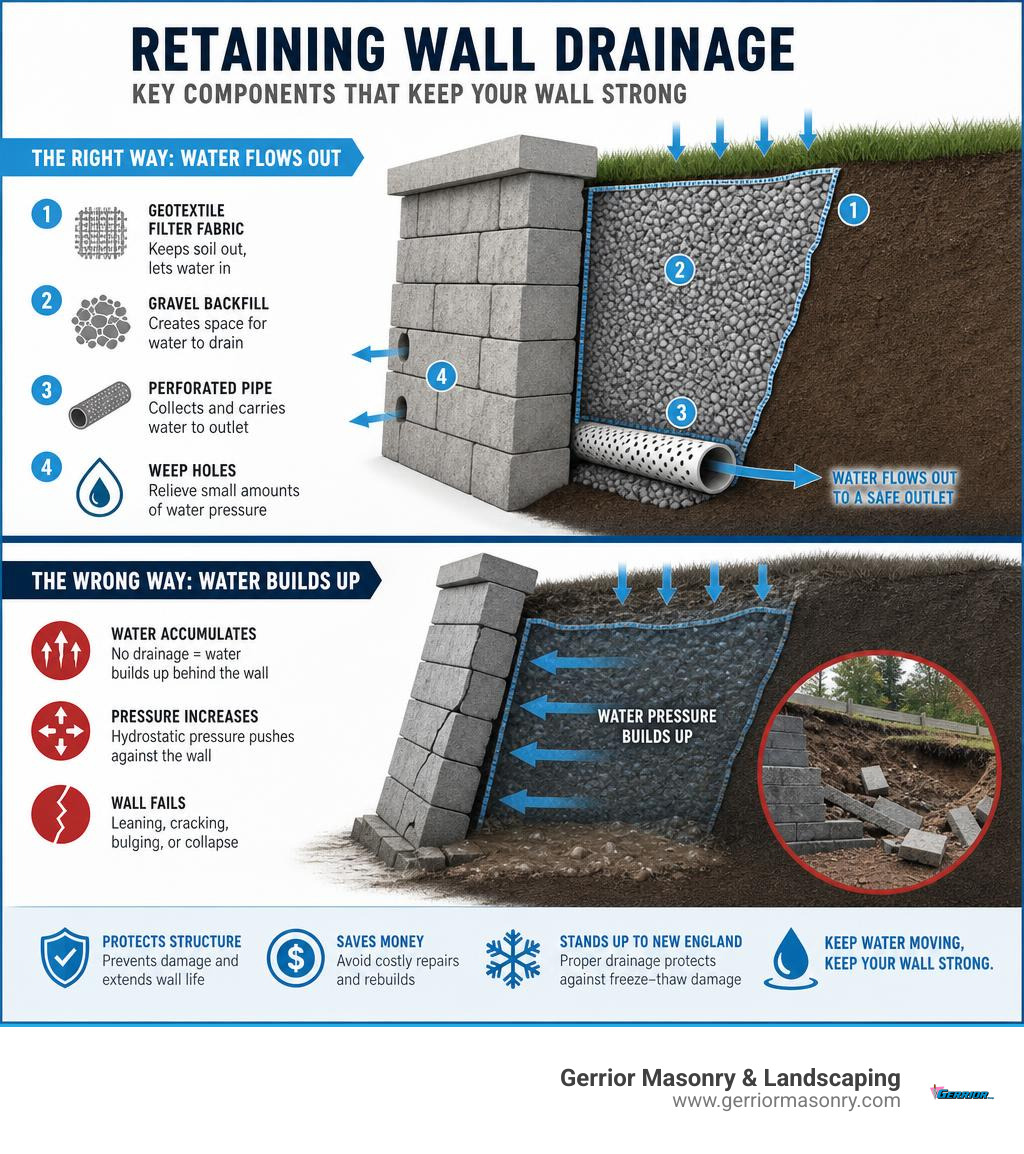
- What it is: A drainage system behind a retaining wall, made up of gravel backfill, perforated pipe, geotextile filter fabric, and weep holes
- Why it matters: Water trapped behind a wall builds hydrostatic pressure that can cause bulging, cracking, leaning, or full collapse
- Who needs it: Every retaining wall — even short 3-foot walls — benefits from proper drainage, especially in clay soils or high-rainfall areas
- Key risk in Massachusetts: Freeze-thaw cycles in Woburn, Burlington, Lexington, and Winchester accelerate wall damage when moisture is trapped behind the structure
- Bottom line: More retaining walls fail from poor drainage than from any other cause
Poor drainage is not just a minor oversight. It is the leading cause of retaining wall failure — often outpacing problems with materials, footings, or design. Water-saturated soil becomes heavier and exerts enormous lateral force. In a Massachusetts winter, that trapped water freezes, expands, and pushes even harder against the wall face.
I’m Joe Gerrior, owner of Gerrior Masonry & Landscape Construction Corp., based in Woburn, Massachusetts, with over 34 years of hands-on experience designing and building drainage solutions for retaining walls across residential and commercial properties throughout the state. Retaining wall drainage is one of the most critical — and most frequently overlooked — elements I address on every project. In this guide, I’ll walk you through exactly how it works and what it takes to get it right.
Common Retaining wall drainage vocab:
Retaining Wall Drainage: The Key to Structural Stability
When designing and constructing a landscape retaining wall for residential or commercial properties in Burlington and Winchester, we are not merely stacking stones or blocks to improve site aesthetics. We are engineering a barrier that must hold back thousands of pounds of earth.
Without a dedicated strategy to manage subsurface water, even the most heavily reinforced masonry wall will eventually succumb to the elements. Ground water, surface runoff, and seasonal storms constantly introduce water into the soil behind the wall. If that water has nowhere to go, it pools, saturates the backfill, and creates a destructive force that can easily double the physical load your wall was built to handle.
Why Retaining Wall Drainage is Essential for Structural Integrity
The fundamental purpose of retaining wall drainage is to prevent water accumulation in the “retained zone” (the soil directly behind the wall). When water saturates this soil, it triggers three main structural threats:
- Massive Weight Increase: Dry soil is heavy, but water-saturated soil is incredibly dense. Water adds massive physical weight to the soil, multiplying the active lateral pressure pushing against the back of your wall.
- The Freeze-Thaw Threat: In Massachusetts communities like Lexington and Winchester, winter temperatures drop well below freezing. When trapped water behind a wall freezes, it expands by roughly 9%. This expansion exerts a massive outward force known as frost heave, which slowly pushes blocks out of alignment.
- Loss of Soil Shear Strength: Wet soil loses its internal friction and stability. Saturated earth behaves more like a liquid than a solid, sliding forward and putting immense pressure on the masonry.
By implementing a retaining wall with French drain or another engineered drainage path, we intercept this water and guide it away safely. This ensures the soil remains stable, dry, and within the structural limits of the wall’s original engineering. For more technical background, you can review this Retaining Wall Drainage Requirements – Guide, which details the physics of hydrostatic failure.
How Hydrostatic Pressure and Soil Types Threaten Your Wall
To understand why walls fail, we have to look at the physics of hydrostatic pressure. Hydrostatic pressure is the pressure exerted by a fluid at equilibrium due to the force of gravity. For every foot of standing water behind a wall, lateral hydrostatic pressure increases significantly (approximately 9.8 kN/m² per meter of depth). Saturated soil can easily exert more force than a wall’s designed earth pressure capacity.
Your local Massachusetts soil composition plays a massive role in how fast this pressure builds up. In many areas of the state, we encounter heavy clay soils. Clay is highly cohesive and has very low permeability; it holds onto water like a sponge and drains incredibly slowly. Sandy soils, on the other hand, allow water to pass through quickly, preventing pressure buildup.
| Soil Type | Water Retention | Hydrostatic Pressure Risk | Drainage Speed |
|---|---|---|---|
| Clay / Cohesive Soil | Extremely High | Very High (Swells & holds water) | Extremely Slow |
| Sandy / Granular Soil | Low | Low (Water passes through) | Fast |
| Silt / Fine Loam | Moderate | Medium (Silt can clog systems) | Moderate |
If your property has clay soil, a highly robust drainage system is non-negotiable. The clay will trap moisture right against the back of your wall, leading to unsightly efflorescence (white salt staining), joint cracking, and eventual structural failure.
Key Components of an Effective Retaining Wall Drainage System
An effective, long-lasting drainage system relies on several components working together in harmony. If you omit even one of these layers, the entire system can fail.
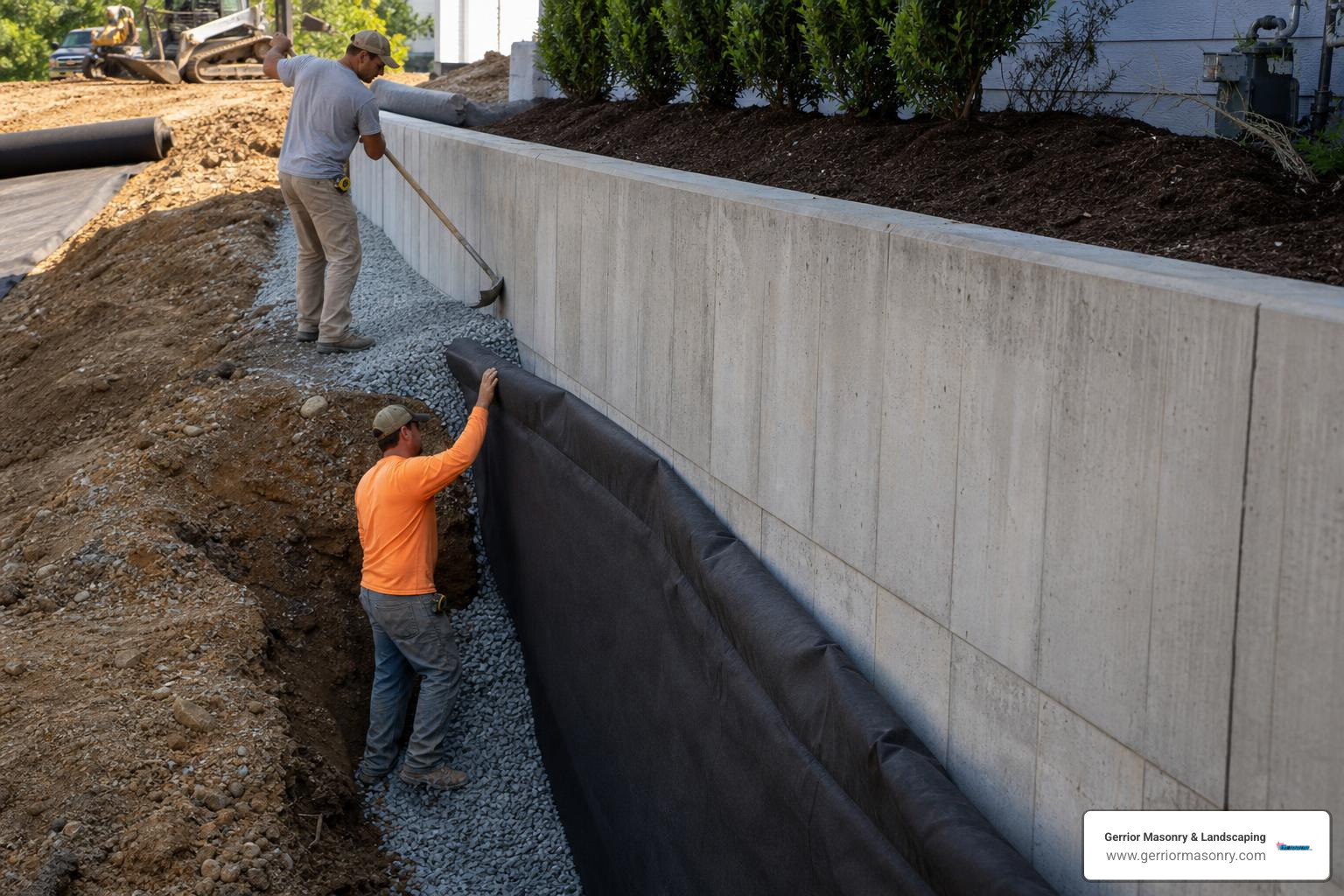
Here are the four pillars of proper retaining wall drainage:
- Drainage Aggregate (Gravel Backfill): We place a column of clean, angular crushed stone (typically 3/4-inch stone with no fine particles) directly behind the wall. This zone should be at least 12 inches wide and run from the base of the wall up to about 6 inches from the top. This aggregate provides a high-void-space path for water to fall straight down to the drain pipe.
- Perforated Drainage Pipe: Located at the very bottom of the gravel trench, a 4-inch perforated pipe (either rigid PVC or slotted corrugated pipe) collects the water. It must be installed with the perforations facing down so water rises into the pipe from below, and it must maintain a continuous downward slope (at least a 1% to 2% gradient) to carry water to a safe outlet.
- Geotextile Filter Fabric: We wrap the drainage aggregate column in a non-woven geotextile filter fabric. This fabric acts as a barrier, allowing water to pass through while keeping fine soil particles from migrating into and clogging the gravel trench.
- Weep Holes: For solid walls, weep holes are small openings built into the lowest course of the wall. Spaced every few feet, they allow water that pools at the base of the gravel trench to escape freely through the front face of the wall.
For a deeper dive into the physical layout of these systems, this Retaining Wall Drainage Guide offers helpful visual explanations of how these components connect. When we build retaining walls, we ensure every single one of these components is customized to the site’s specific water flow patterns.
Drainage Requirements for 3-Foot Walls and Different Wall Types
A common question from residential and commercial clients is: Does a short, 3-foot retaining wall really need a drainage system?
The short answer is yes. While building codes often only require a structural engineer’s stamp for walls over 4 feet tall, water does not care about height. A 3-foot wall holding back saturated clay soil on a slope can easily bow, crack, or tip over. Except in rare cases of purely decorative, dry-stacked stone walls in highly sandy, arid soils, every wall needs some form of drainage.
The installation method varies slightly based on the material used:
- Segmental Block Walls: These dry-stacked, interlocking blocks have natural joints that allow some water to seep through. However, they still require a gravel backfill column and a perforated toe drain to prevent the blocks from shifting or bulging.
- Poured Concrete & Masonry Block Walls: Because these walls are completely solid and sealed with mortar, they have zero natural permeability. They absolutely require a waterproof membrane on the back face, a full gravel backfill, a toe drain, and evenly spaced weep holes to relieve pressure.
- Natural Stone Walls: Whether dry-laid or mortared, a natural stone retaining wall benefits immensely from a gravel drainage pocket. For mortared stone, weep holes must be carefully integrated into the mortar joints at the base.
Estimated Investment for Retaining Walls in Massachusetts
If you are planning a project, it is helpful to understand broad budgeting expectations. Based on publicly available internet data and general industry averages, professionally designed retaining walls with integrated drainage may require a wide planning range of roughly $12,000 to $75,000+, depending on wall height, length, site access, engineering requirements, soil conditions, drainage complexity, and material selection.
Please note: These figures are average cost ranges sourced from publicly available internet data and industry averages only. They are not the actual prices of Gerrior Masonry & Landscape Construction Corp., and they do not represent guaranteed pricing, quoted rates, or a project-specific estimate from Gerrior Corp.
Common Installation Mistakes and How to Retrofit Existing Walls
Over our three decades in the industry, we have seen many failed walls caused by incomplete drainage planning or inexperienced installation. The most common mistakes include:
- Using the Wrong Backfill: Backfilling with native soil or pea stone instead of clean, angular crushed stone. Soil holds water, and rounded pea stone doesn’t provide the same structural lock as angular aggregate.
- Installing the Pipe Upside Down: Placing perforated pipe with the holes facing up. This allows the pipe to fill with dirt and silt before the water level even reaches the pipe’s interior.
- Skipping the Filter Fabric: Omitting the geotextile fabric. Over a few seasons, fine silt washes into the gravel, completely clogging the voids and rendering the drain useless.
- No Path to daylight: Placing a beautiful drain pipe behind the wall but failing to route it to a proper outlet (like a storm drain, dry well, or sloping yard area).
How to Retrofit an Existing Failing Wall
If you have an existing wall on a residential or commercial property in Woburn or Burlington that is starting to bulge, lean, or show heavy efflorescence, it is likely suffering from drainage failure. While the most permanent fix is excavation and rebuild, professional teams can sometimes perform targeted retrofitting to extend its service life:
- Core Drilling Weep Holes: We can use specialized diamond-core drills to cut 2-inch to 3-inch weep holes through the lower face of stone or concrete walls to let trapped water escape.
- Installing a Behind-the-Wall French Drain: If access permits, we can excavate a narrow trench directly behind the wall, line it with filter fabric, lay a new perforated pipe, and backfill with clean aggregate.
- Surface Regrading: We can reshape the yard above the wall, adding swales or catch basins to intercept surface water before it ever reaches the retaining zone.
If your wall is showing signs of distress, do not wait for a complete collapse. Check out our page on finding a retaining wall repair near me to see how professional remediation can save your landscape.
Conclusion: Partner with Massachusetts Hardscaping Experts
Mastering retaining wall design is a balancing act of physics, material selection, and water management. Whether you are building a small segmental block wall to level out a residential landscape or constructing a large natural stone wall on a sloped commercial property, getting the drainage right is the single best investment you can make.
At Gerrior Masonry & Landscaping, we have spent more than 30 years building structures designed to stand the test of time. Our highly skilled team provides direct owner oversight on every project, ensuring your masonry, hardscaping, landscaping, and drainage work is executed with the durability Massachusetts properties require.
Do not risk a costly wall failure. Let our experienced team design a robust, worry-free retaining wall system for your property.
Ready to get started?
- Request a Free Estimate: Open the quote form
- Explore Our Services: Find expert retaining wall builders near me and learn more about our complete range of masonry, hardscaping, landscaping, and drainage solutions.
