
The Truth About Installing Sod Over an Existing Lawn
Can you install sod over an existing lawn? Here’s the short answer:
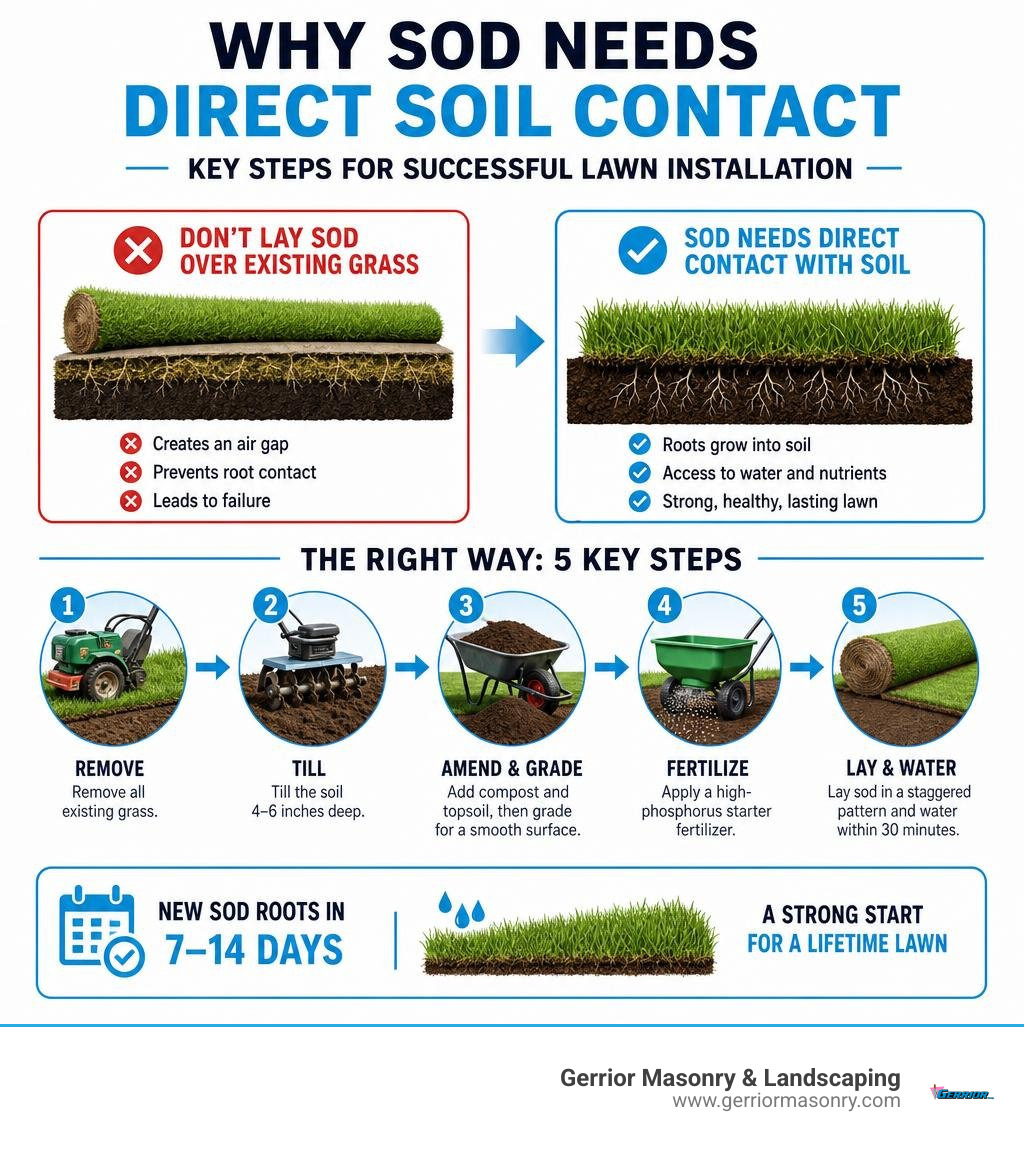
No. You should never lay sod directly over existing grass. New sod roots need direct contact with bare soil to survive. Laying sod over old turf creates an air gap that prevents rooting, causes the grass underneath to decompose, and leads to a dead lawn within weeks.
Here’s what to do instead:
- Remove all existing grass using a sod cutter or herbicide
- Till the soil 4–6 inches deep
- Amend with compost and topsoil, then grade the surface
- Apply a high-phosphorus starter fertilizer
- Lay new sod in a staggered brick pattern and water within 30 minutes
Many Massachusetts property owners — from Woburn to Burlington — consider skipping these steps to save time. It’s an understandable impulse. But that shortcut almost always leads to patchy, dying grass and the frustration of starting over.
The good news? When sod is installed correctly, it roots within 7–14 days and transforms your lawn almost overnight.
I’m Joe Gerrior, owner of Gerrior Masonry & Landscaping, and over 34 years of serving residential and commercial clients across Massachusetts, I’ve seen how often improper preparation causes costly sod failures — and how straightforward it is to install sod over an existing lawn the right way with the right team. Keep reading and I’ll walk you through exactly what proper sod installation requires.
Why You Should Never Install Sod Over Existing Lawn
It is a common myth that you can use old grass as a sort of “organic base” or fertilizer for new sod. Property owners often assume that laying a fresh layer of sod over a patchy or weed-filled lawn will simply smother the old growth, which will then decompose and feed the new roots. In reality, attempting a sod overlay is one of the primary reasons new turf installations fail within a matter of weeks.
According to the UMass Extension Turf Program – Lawn Renovation and Sodding, proper soil preparation and removing existing vegetation are non-negotiable steps for successful turf establishment in Massachusetts. Skipping this phase prevents the new root system from ever anchoring. When you attempt to bypass this step, you are essentially setting up a barrier between your new grass and the nutrients it needs to survive, as detailed in guides on whether you can lay sod over existing grass.
The Science of Root Failure When You Install Sod Over Existing Lawn
To understand why this shortcut fails, you have to look at the biology of turfgrass. Sod is harvested with a very thin layer of soil — usually only a half-inch to three-quarters of an inch thick — which means its root system has been heavily pruned and is in a state of shock. For these roots to recover and establish, they must immediately begin growing downward into loose, moist, and nutrient-rich soil.
When you install sod over existing lawn areas, the old turf creates a physical barrier. This gap is filled with air pockets rather than compacted, continuous soil. Because air is a poor conductor of moisture and prevents root elongation, the new roots cannot penetrate the old root systems and thatch layer. Instead of anchoring, the roots remain trapped in the thin sod layer, where they quickly dry out and suffocate. This dynamic is a primary reason why professional turf guides, such as this analysis of laying sod over existing grass, warn that root-to-soil contact is the single most critical factor in preventing rapid dehydration and turf death.
The Risks of Anaerobic Decomposition and Soil Layering
If the physical barrier of the old grass doesn’t kill the new sod, the chemical process of its decay will. When you cover living grass with a heavy, dense layer of sod, you cut off its supply of sunlight and oxygen. The buried turf dies and begins to rot.
Because there is no oxygen beneath the sod, this rotting occurs via anaerobic decomposition. This process releases toxic gases, including methane, which are highly harmful to young, vulnerable root systems. Instead of turning into rich nutrients, the decomposing grass turns into a slimy, sour-smelling, and matted barrier that completely blocks water drainage.
Furthermore, you run into the issue of soil layering. If the soil texture of the imported sod differs significantly from the native soil in your yard (for example, clay-heavy sod laid over sandy loam), water will not transition smoothly between the two layers. This creates a perched water table, leaving your new turf waterlogged on top while the native soil beneath remains bone-dry. This issue is thoroughly explored in the sod overlay guide on GardenerBible, which highlights how these hidden drainage failures ruin lawns from the inside out.
The Correct Way to Prepare Your Soil and Install New Sod
To achieve a golf-course-quality lawn that lasts for years, you must treat soil preparation as 90% of the project. Simply laying down turf is the easy part; prepping the ground is where the real work happens.
If you want to ensure your property’s soil is prepared to support a lifetime of healthy grass, we highly recommend working with professionals. You can learn more about our comprehensive lawn care and landscape design solutions by visiting our landscaping services page.
Step 1: Complete Turf Removal and Soil Tilling
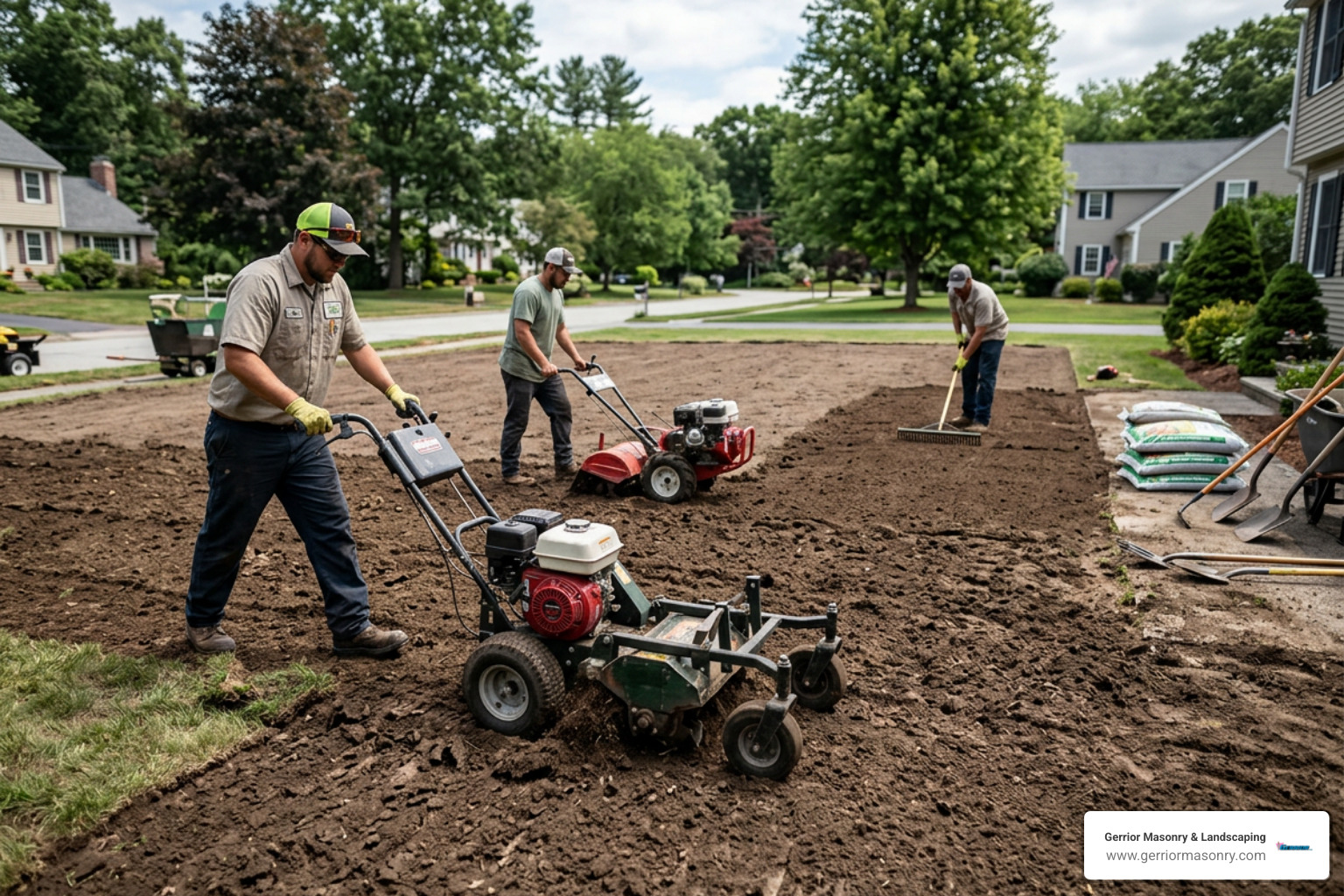
The first step in a proper installation is the complete removal of the old lawn. For properties in Lexington, MA, we use a motorized sod cutter to slice beneath the root zone of the old grass, removing the top 1 to 2 inches of turf, weeds, and compacted thatch.
Some property owners attempt to skip this by using a rototiller directly on the living grass. However, tilling live grass is a major mistake; it chops up weed roots and dormant seeds, spreading them throughout the soil and guaranteed to cause a massive weed infestation later. Once the old turf is completely stripped away, we till the bare soil to a depth of 4 to 6 inches to relieve compaction and create a loose, aerated root zone, a process recommended in the sod installation guide on usasod.com.
Step 2: Soil Amending, Grading, and Starter Fertilizer
Once the soil is loosened, it is time to enrich it. We incorporate 2 to 3 inches of organic compost and high-quality topsoil to improve nutrient retention and moisture balance. This is also the ideal window to perform a soil test to check pH levels. Turfgrass thrives in a pH range of 6.0 to 7.0; if your Massachusetts soil is too acidic, we apply agricultural lime to balance it.
Next comes grading. We carefully rake and level the area to ensure the soil sits roughly 1 inch below adjacent hardscapes, such as walkways, patios, or driveways. This prevents the sod from sitting too high once laid. We also ensure a gentle 1% to 2% slope away from your building’s foundation to prevent water pooling. For clients in Winchester, MA, coordinating this step with local turf experts is crucial for long-term success. Finally, we apply a high-phosphorus starter fertilizer to stimulate rapid, healthy root development.
Step 3: Laying, Rolling, and Watering the New Sod
With the bed fully prepared, the sod must be laid immediately. Sod is a living, perishable product that can begin to ferment and die within 24 hours of harvest in the summer heat.
We lay the sod rolls in a staggered, brick-like pattern, ensuring the seams are tightly butted against one another without overlapping or leaving gaps.
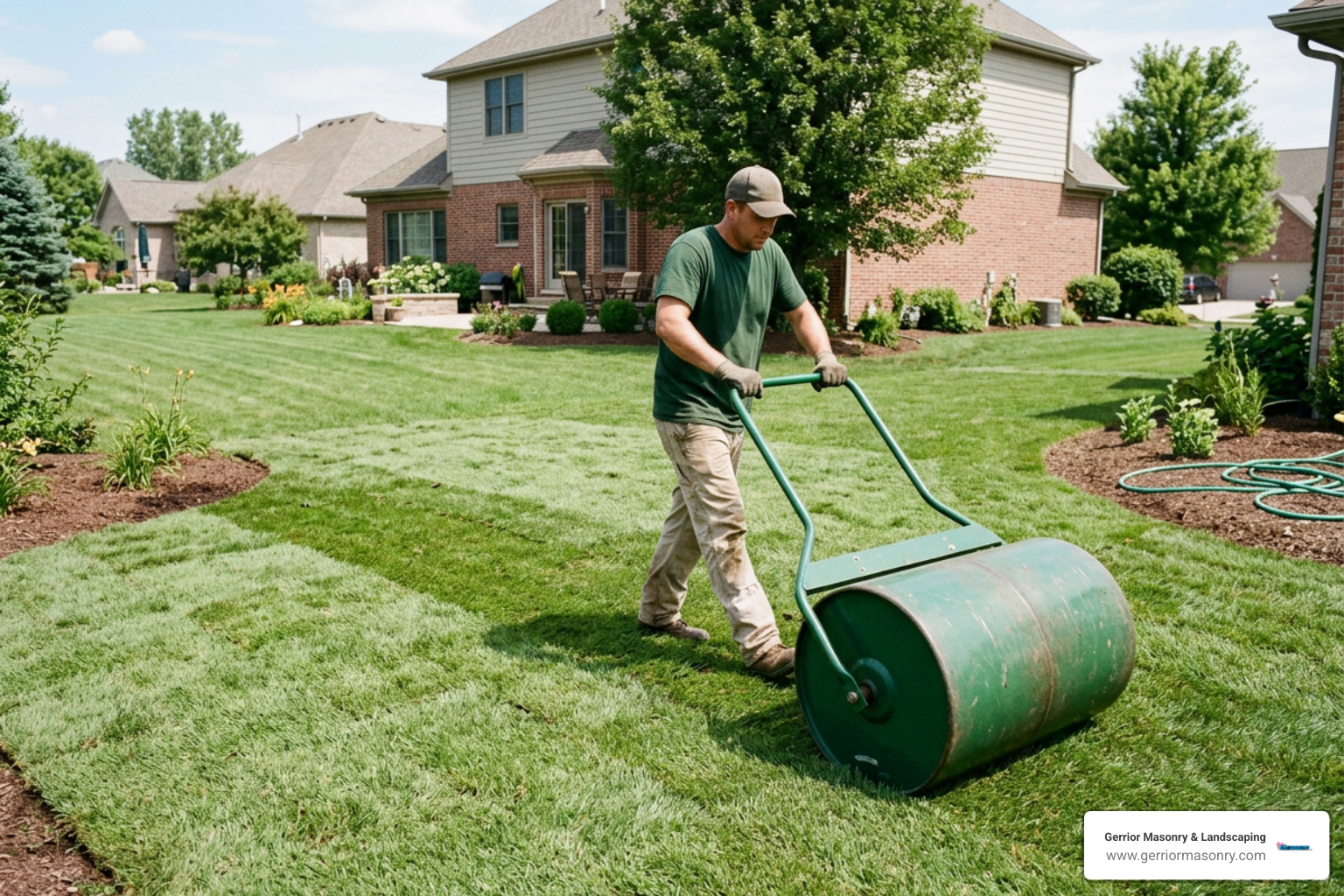
Once the sod is laid, we run a water-filled lawn roller (weighing 200 to 300 pounds) over the entire yard. This step is essential to flatten out minor bumps and press the sod roots firmly against the prepared topsoil, eliminating any lingering air pockets.
Next comes the critical “30-minute rule.” You must water your new sod within 30 minutes of laying the first piece. For the first 14 days, follow a strict watering schedule: water 2 to 3 times daily for 15 to 20 minutes to keep the soil consistently damp (but not muddy). After two weeks, you can perform a “tug test” — gently pulling on a corner of the sod. If it resists, the roots have successfully anchored, and you can gradually transition to deeper, less frequent watering to encourage deep root systems, as detailed in the DIY sod guide on Delineate Your Dwelling and this sod installation guide.
Why DIY Fails: The Cost to Install Sod Over Existing Lawn Correctly
While a DIY sod installation sounds like a fun weekend project, it is an incredibly labor-intensive process that requires specialized machinery, precise timing, and immense physical stamina. A single pallet of sod can weigh over 2,000 pounds, and a typical yard requires multiple pallets to be moved, cut, and laid rapidly before the grass begins to decay.
| Installation Factor | DIY Sod Installation | Professional Installation (Gerrior Masonry & Landscaping) |
|---|---|---|
| Labor Intensity | Extremely high; risk of back strain and physical exhaustion | Handled entirely by a trained, efficient crew |
| Equipment Needed | Costly rentals (sod cutter, rototiller, heavy lawn roller) | Fully equipped with commercial-grade machinery |
| Soil Prep & Grading | Often skipped or done incorrectly, leading to drainage issues | Precision grading and soil amending to protect your foundation |
| Risk of Failure | High; improper prep or delayed watering can kill the turf | Backed by over 30 years of experience and owner oversight |
| Root Establishment | Often patchy due to poor soil contact or uneven tilling | Fast, uniform rooting (typically within 7–14 days) |
When planning your budget, it is helpful to look at regional market data. Based on industry averages and online data for the Massachusetts area, the average cost for professional turf removal, soil preparation, grading, and high-quality sod installation typically ranges from $6.00 to $30.00 per square foot to account for project size, accessibility, and site conditions.
Please note: All prices mentioned are average costs sourced from publicly available internet data and are not the actual prices of Gerrior Corp. We do not imply that these prices reflect Gerrior Corp rates or guarantees.
If you want your new lawn installed perfectly the first time, hiring a professional team is the best way to protect your investment. At Gerrior Masonry & Landscaping, we bring more than three decades of hands-on experience to every project. Our skilled team operates under strict owner oversight to ensure your soil is prepped, amended, and graded to perfection.
Beyond our turf and lawn care expertise, we can also integrate your new lawn with stunning custom masonry. To elevate your outdoor space, explore our hardscaping services page or learn about our hydroseeding services for alternative lawn establishment options.
Ready to transform your yard in Woburn, Burlington, Lexington, or Winchester? Skip the back-breaking labor and the risk of DIY failure.
Contact Gerrior Masonry & Landscaping today at +781-713-1225 or fill out our online Estimate Request Form to schedule your consultation!
