What Are the Best Retaining Wall Materials? A Quick Answer
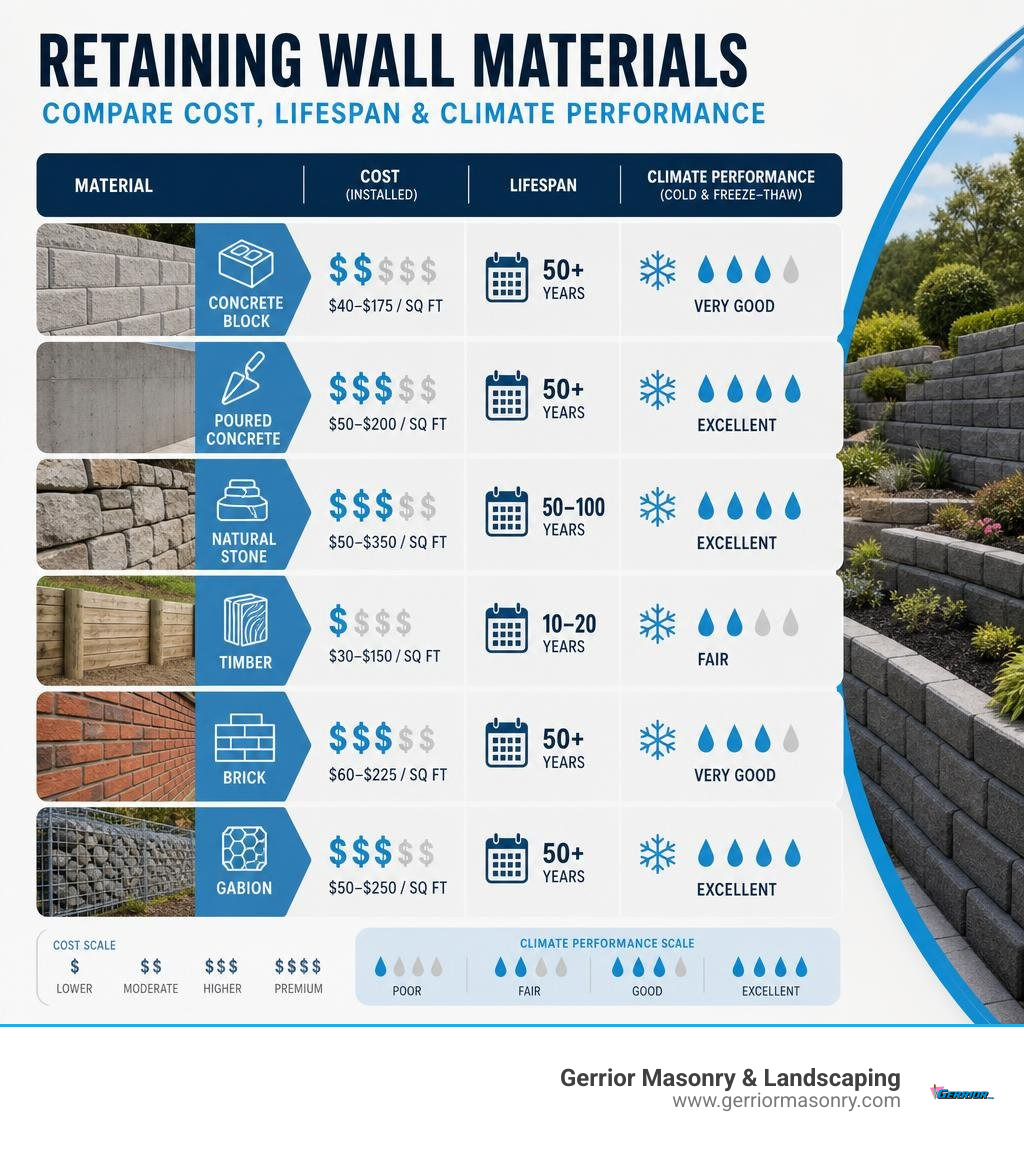
The most common retaining wall materials are compared below to help you make a fast, informed decision:
| Material | Durability | Approx. Installed Cost (MA)* | Best For |
|---|---|---|---|
| Concrete Block | 50+ years | $40–$175/sq ft | Versatility, DIY-friendly low walls |
| Poured Concrete | 50+ years | $50–$200/sq ft | Maximum strength, tall walls |
| Natural Stone | 50–100 years | $50–$350/sq ft | Aesthetics, longevity |
| Timber | 10–20 years | $30–$150/sq ft | Low-cost, short-term use |
| Brick | 50+ years | $60–$225/sq ft | Classic look, decorative walls |
| Gabion | 50+ years | $50–$250/sq ft | Drainage, erosion-prone slopes |
*Costs shown are wide industry average ranges sourced from publicly available online data and do not reflect Gerrior Masonry & Landscaping’s actual pricing.
Your yard is doing more engineering than you might think. Every slope, every raised garden bed, every uneven grade is quietly pushing soil in directions you don’t want it to go. A retaining wall stops that. But the material you build it from determines everything — how long it lasts, how it performs through brutal Massachusetts winters, and whether it still looks good a decade from now.
Most wall failures aren’t about the material itself. They come down to the wrong material for the site, poor drainage behind the wall, or footings that don’t go deep enough to beat the frost line. In a state like Massachusetts, where freeze-thaw cycles can wrench poorly built structures apart in just a few seasons, those details are not optional.
This guide breaks down each major retaining wall material honestly — what it costs, how long it lasts, where it performs well, and where it falls short — so you can make a confident choice for your property.
I’m Joe Gerrior, owner of Gerrior Masonry & Landscape Construction Corp., and over 34 years of building and repairing retaining wall materials across Massachusetts, I’ve seen what holds up and what fails. That experience shapes every recommendation in this guide.
Discover more about Retaining wall materials:
Comparing the Best Retaining Wall Materials

Selecting the right material is a balancing act between aesthetics, physical load-bearing capacity, moisture resistance, and long-term durability. In Massachusetts, our soils can range from heavy, moisture-retaining clay to rocky glacial till. When water gets trapped behind a wall and freezes, it expands with incredible force.
Because of this, your choice of retaining wall materials must factor in how well the material handles lateral pressure and moisture. A material that works beautifully in a dry, sandy climate can fail catastrophically here if it cannot handle the constant shifting of the earth. For a detailed breakdown of how different materials stack up against each other, you can read the Retaining Wall Materials: Concrete Block vs. Timber vs. Stone (2026) | YardCalc comparison guide.
Pros and Cons of Popular Retaining Wall Materials

Every material has its own personality, structural limits, and installation quirks. Here is the solid truth about the options available for your property:
- Segmental Concrete Blocks (SRWs): These are dry-stacked, interlocking blocks that rely on gravity and a pinned or lipped system to lock together.
- Pros: Extremely durable, highly resistant to freeze-thaw cycles, and they do not require mortar. They allow for flexible, curving designs.
- Cons: Can look industrial if you choose low-end utility blocks, though premium textured options mimic natural stone beautifully.
- Poured Concrete: A solid wall of steel-reinforced concrete poured directly into temporary wooden forms.
- Pros: The strongest structural option available. It can support massive lateral loads and does not require a backward lean (batter).
- Cons: Requires a flawless, deep concrete footing. If the ground shifts and a poured wall cracks, it is incredibly difficult and expensive to repair.
- Natural Stone: The gold standard of masonry, which can be dry-stacked or mortared together using granite, fieldstone, or limestone.
- Pros: Unmatched aesthetic beauty and a lifespan that easily exceeds 50 to 100 years. It naturally blends into Massachusetts landscapes.
- Cons: Labor-intensive to build, requiring highly skilled stone masons to select, cut, and place each individual stone.
- Timber: Large, pressure-treated wooden beams or railroad ties laid horizontally and pinned together with steel rebar.
- Pros: Lowest upfront material cost and a warm, rustic appearance.
- Cons: The “rot clock” starts the day it is installed. Even pressure-treated timber typically lasts only 10 to 20 years in damp Massachusetts soils before wood rot compromises its structural integrity.
- Brick: A traditional choice using clay bricks and mortar, often built with a concrete block core for structural support.
- Pros: Offers a classic, elegant look that matches historic homes in towns like Lexington and Winchester.
- Cons: Mortar joints are highly vulnerable to water penetration and frost damage, requiring routine maintenance over time.
- Gabion: Wire mesh baskets filled with durable, clean stone.
- Pros: Excellent natural drainage, highly flexible, and virtually maintenance-free.
- Cons: Has a highly industrial, modern aesthetic that does not fit every residential landscape.
For homeowners looking to elevate their property’s value and visual appeal, we often recommend custom retaining walls built from natural stone or high-end interlocking blocks.
Cost and Lifespan of Retaining Wall Materials
To help you plan your landscaping budget, the table below outlines the average cost ranges and expected lifespans for different materials in the Massachusetts region.
Please note that these pricing figures represent broad industry averages compiled from public online data and do not reflect the specific project rates of Gerrior Masonry & Landscaping.
| Material Type | Average Installed Cost Range (Per Sq. Ft.) | Expected Lifespan | Maintenance Level |
|---|---|---|---|
| Timber / Wood | $30 – $150 | 10 – 20 Years | Medium (Sealing, rot checks) |
| Concrete Block | $40 – $175 | 50+ Years | Low (Occasional cleaning) |
| Poured Concrete | $50 – $200 | 50+ Years | Low (Crack inspections) |
| Gabion Baskets | $50 – $250 | 50+ Years | Very Low |
| Natural Stone | $50 – $350 | 50 – 100+ Years | Low (Dry-stack) to Medium (Mortared) |
| Brick Masonry | $60 – $225 | 50+ Years | Medium (Repointing mortar joints) |
While timber is tempting for its lower upfront cost, it is often more expensive in the long run. Replacing a rotting timber wall twice over a 30-year period means you will end up paying for labor and excavation three times, making durable masonry a much smarter investment.
Climate Resilience and Freeze-Thaw Performance in Massachusetts
In Massachusetts towns like Woburn, Winchester, and Burlington, our winter weather is famously brutal on hardscaping. When water saturates the soil behind a wall and freezes, the soil expands outward and upward. This phenomenon, known as frost heave, is the number-one killer of poorly constructed retaining walls.
To survive these conditions, modular block systems must meet strict physical standards. According to the Specification Guidelines: Allan Block Modular Retaining Wall Systems, blocks used in northern climates should feature a higher compressive strength (often 4,000 to 5,800 PSI) and lower water absorption limits to prevent water from freezing inside the concrete itself.
Additionally, modern soil reinforcement systems, like the TensarTech® TW3® Wall System | Tensar, utilize high-strength geogrids to anchor the wall face deep into the soil mass behind it. This composite action allows the wall to flex slightly and distribute lateral loads evenly, preventing the bowing, leaning, and cracking that plague rigid walls.
The Critical Role of Engineering and Drainage
Water is the ultimate enemy of any retaining wall. When rainwater or melting snow cannot escape, it pools behind the wall, creating immense hydrostatic pressure. This water pressure, not the weight of the dry soil, is what causes most walls to bulge and eventually collapse.
A properly built wall must include a robust water management system:
- Gravel Backfill: At least 12 inches of clean, angular 3/4-inch crushed stone must be placed directly behind the wall blocks to allow water to drain quickly to the bottom.
- Filter Fabric: Geotextile fabric should separate the drainage gravel from the native soil to prevent fine silt from clogging the gravel over time.
- Perforated Drain Pipe: A perforated pipe (often connected to a French drain) must run along the base of the wall to direct water away safely.
- Weep Holes: For mortared stone or brick walls, weep holes spaced every 6 to 8 feet allow trapped water to escape through the wall face.
We specialize in designing systems like a retaining wall with French drain to ensure your investment is fully protected from water damage. For walls holding back steep slopes or heavy loads, investing in professional retaining wall engineering is essential to guarantee long-term safety and structural integrity.
DIY Feasibility vs. Professional Masonry Installation
It is easy to watch a quick online video and believe that building a retaining wall is a simple weekend project. However, the physical labor alone is staggering. A single standard concrete block can weigh anywhere from 30 to 80 pounds, and a modest 20-foot-long, 3-foot-high wall requires moving several thousand pounds of concrete and gravel by hand.
Beyond the physical toll, there are strict structural limits. In most Massachusetts municipalities, including Lexington and Arlington, any retaining wall that exceeds 4 feet in height requires a building permit and must be designed by a licensed structural engineer.
If you make a mistake during the excavation, base compaction, or drainage installation stages, the wall will likely begin to lean or bulge within a few seasons. Once a masonry wall begins to fail, it cannot be easily patched or pulled back into place—it must be completely dismantled and rebuilt from the foundation up. Hiring professional masons ensures the job is done right the first time, saving you thousands of dollars in future repairs.
For a long-lasting structure, we recommend investing in professional masonry retaining walls that are engineered to outlast your mortgage.
Conclusion
Your home’s landscape deserves a retaining wall that is as beautiful as it is structurally sound. Whether you are looking to tame a steep slope, prevent erosion, or create elegant tiered garden beds, choosing the right retaining wall materials and ensuring flawless installation is the key to a lifetime of worry-free performance.
At Gerrior Masonry & Landscaping, we bring over 30 years of local expertise to every project we touch. Serving communities across Woburn, Winchester, Burlington, Lexington, and Arlington, our highly skilled team operates under strict owner oversight to deliver unmatched craftsmanship and durability. We don’t just build walls; we build peace of mind.
Ready to transform your outdoor living space? Give us a call today at +781-713-1225 or request an estimate online. Let us help you design and build stunning, durable landscape walls that will stand strong for decades to come.