What Are Masonry Retaining Walls — and Which Material Is Right for You?
Masonry retaining walls are structures built from materials like concrete blocks, natural stone, or brick to hold back soil, prevent erosion, and create usable outdoor space on sloped or uneven ground.
Here’s a quick comparison of the three most common masonry retaining wall materials:
| Material | Strength | Aesthetics | DIY-Friendly | Best For |
|---|---|---|---|---|
| Concrete blocks | Very high (up to 5,000 PSI) | Modern, uniform | Yes | Terracing, large walls |
| Natural stone | High | Timeless, natural | No | Garden walls, focal points |
| Brick | High | Classic, traditional | Moderate | Decorative walls, raised beds |
A well-built retaining wall does more than hold dirt in place. It protects your property from erosion, creates flat usable areas on a slope, and can significantly boost your home’s value. According to the National Association of Realtors, homeowners recoup around 83% of the value of landscaping upgrades when selling.
But not all materials perform the same way — and choosing the wrong one for your soil, slope, or climate can lead to costly failure down the road.
I’m Joe Gerrior, owner of Gerrior Masonry & Landscape Construction Corp., with over 34 years of hands-on experience designing and building masonry retaining walls for homeowners across Massachusetts. In this guide, I’ll walk you through exactly how each material stacks up so you can make a confident, informed decision.
Masonry retaining walls definitions:
Comparing Materials for Masonry Retaining Walls
When we sit down with a homeowner in Andover or Lexington to plan a project, the first question is almost always: “Which material should we use?” To answer that, we have to look at the difference between a freestanding wall and a true retaining wall.
While a freestanding wall is often used as a visual divider on flat ground—think of a low wall around a patio for extra seating—masonry retaining walls are structural workhorses. They are designed to resist the literal tons of pressure exerted by shifting soil and water.
The choice of material dictates the wall’s structural integrity and how it handles our volatile Massachusetts weather. For instance, natural stone offers a “lovely aspect of permanence” and can last twice as long as wood or timber walls, which often rot within a decade in our damp climate. On the other hand, modern concrete block systems are engineered for maximum sheer capacity, using mechanical interlocks to stay put without the need for mortar.
Choosing the right material means balancing your budget with the specific needs of your landscape. Whether you are looking for hardscape retaining walls to create a grand entrance or a simple stone border, the material is the foundation of your success.
The Strength of Concrete Masonry Retaining Walls
Modern engineering has turned concrete blocks into the gold standard for many masonry retaining walls. We aren’t talking about the gray cinder blocks you might find in a basement; these are high-performance Segmental Retaining Wall (SRW) units.
Brands like Unilock, Belgard, and Allan Block manufacture units with a minimum compressive strength of 5,000 PSI. To put that in perspective, that is significantly stronger than the standard concrete used in many home foundations. These systems are often “dry-stacked,” meaning they don’t require mortar. Instead, they rely on mass and mechanical interlocks—like integral lips, pins, or clips—to stay aligned.
One of the primary advantages of SRW systems is their ability to accommodate curves and corners with ease. Unlike poured concrete, which requires complex formwork, these blocks are designed to be laid in radii, allowing for more organic, flowing designs that follow the natural contours of your property. This flexibility is particularly useful in the hilly terrain of towns like Reading or Lynnfield.
One of the coolest innovations we use is the “Ecology block.” These consist of high-strength concrete and are often used for massive soil retention projects. For residential garden block construction, the modular nature of these blocks allows us to build walls that are flexible. Because they are not a rigid monolithic slab, they can move slightly with the freeze-thaw cycles of a New England winter without cracking.
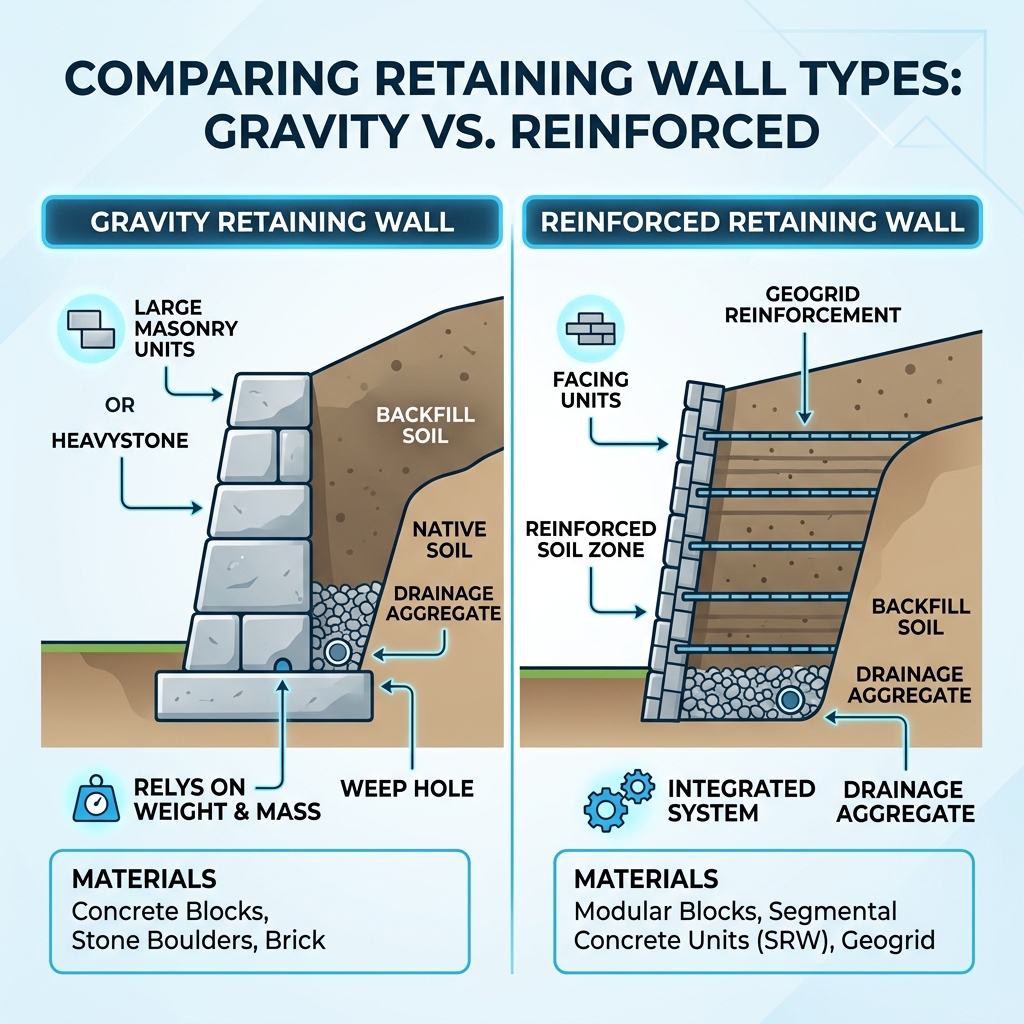
For those interested in the technical side, the Guide to Segmental Retaining Walls – CMHA explains how these gravity walls use their own weight to resist the “equivalent fluid pressure” of the soil behind them.
Timeless Appeal of Natural Stone and Brick
If you want your home to look like it has been part of the Massachusetts landscape for a century, natural stone is the way to go. There is an artistic quality to natural stone retaining that manufactured products struggle to replicate.
Over time, natural stone develops a unique patina that manufactured products simply cannot replicate. Moss may grow in the crevices of a dry-laid fieldstone wall, and the colors of the granite will deepen with exposure to the elements. This “aging” process actually enhances the beauty of the wall, making it look more integrated into the landscape as the years pass.
We work with a variety of stones, including:
- Granite: Extremely durable and iconic to New England.
- Fieldstone: Perfect for a rustic, dry stone garden wall.
- Sandstone and Limestone: Offer warmer tones and can be cut into more uniform shapes.
Natural stone walls can be built as “dry-laid” (no mortar) or “wet-laid” (with mortar joints). Dry-laid walls are excellent for drainage, as water can naturally seep through the gaps between stones. Wet-laid walls provide a cleaner, more formal look but require meticulously planned drainage systems to prevent water from cracking the mortar during a freeze.
Brick is another classic choice, often used to match the existing architecture of homes in historic areas like Concord or Salem. While brick is beautiful for raised beds and custom retaining walls, it usually requires a concrete footing below the frost line to ensure it doesn’t shift and crack.
Planning, Costs, and Professional Installation
Building a wall that will “outlast your mortgage” requires more than just stacking heavy objects. It starts with a plan. We have to calculate the surcharge loads—that is the weight of anything sitting on top of the soil being retained, like a driveway, a shed, or even a heavy lawn tractor.
Engineering and Height Limits for Masonry Retaining Walls
For many DIY systems, the safe height limit is between 24 and 36 inches. Once you go above three or four feet, the physics of soil retention change dramatically. Most local building codes in Massachusetts require a permit and a design certified by a licensed engineer for any wall over four feet tall.
When we build a retaining wall on a slope, we have to “step” the foundation. You can’t just build a wall on a slant; the base must always be level. This requires excavating a series of level trenches that follow the grade of the land.
For walls exceeding a certain height or those supporting significant weight, we often incorporate “geogrid.” This is a high-strength synthetic mesh that is laid between the layers of blocks and extended back into the soil. It acts like a “tie-back” system, anchoring the wall into the earth and creating a reinforced soil mass that is far stronger than the wall units alone. This is a critical step for structural integrity in large-scale residential projects.
Common mistakes we see when homeowners try to tackle this themselves include:
- Ignoring Utilities: Always call 811 before you dig.
- Poor Compaction: If the soil under the wall isn’t packed down with a heavy plate compactor, the wall will settle unevenly.
- Lack of Curves: Straight walls are actually harder to build on uneven terrain than slightly curved ones, which provide more natural structural strength.
If you are planning a complex project, our excavation services ensure the site is prepped correctly from day one.
Foundation and Drainage Essentials
Water is the #1 enemy of masonry retaining walls. It’s not usually the weight of the dirt that knocks a wall down; it’s the “hydrostatic pressure” of water trapped behind it. When soil gets saturated, it becomes exponentially heavier and expands. In the winter, that water turns to ice and pushes against the wall with incredible force.
To prevent this, every wall we build includes:
- A Solid Base: A footing should be 4 to 6 inches deep and at least 12 inches wide (or twice the width of the block). We use a proper base for retaining walls made of compacted crushed stone.
- Drainage Stone: We place at least 12 inches of free-draining gravel directly behind the wall units.
- Filter Fabric: This prevents fine soil particles from clogging the drainage stone.
- Perforated Pipe: Often called a French drain, this pipe sits at the base of the drainage stone and vents water away from the wall.
- Weep Holes: For mortared walls, these small openings allow water to escape from behind the masonry.
The backfilling process is just as important as the wall itself. We don’t just dump gravel behind the wall; we install it in “lifts” of 6 to 8 inches, compacting each layer with professional-grade machinery. This ensures there are no air pockets or loose soil that could settle later, which is the leading cause of wall tilting or “bowing” over time. Proper compaction is what separates a professional installation from a DIY project that fails after the first heavy rain.
For more details, check out our guide on retaining wall drain pipe installation.
Estimating Costs and ROI
Let’s talk numbers. Based on general internet data, the average cost for a retaining wall typically falls between $3,000 and $8,500. However, for large-scale structural projects or high-end natural stone work, the range can easily extend from $3,000 to $30,000 or more. It is important to note that these are average internet estimates and not a direct quote for services from us.
Factors that influence the price include:
- Material Choice: Concrete blocks are generally more budget-friendly than imported natural stone.
- Height and Length: Pricing is often calculated by the square foot, ranging from $20 to $60 per square foot.
- Site Accessibility: Can we get a bobcat into your backyard, or does everything need to be moved by hand?
- Excavation and Drainage: The “hidden” work under the ground often costs as much as the blocks themselves.
While the upfront cost can be significant, the Return on Investment (ROI) is one of the highest in the home improvement world. Beyond the 83% value recoupment, a wall can turn a “dead” sloped backyard into a functional space for a patio installation or an outdoor kitchen. If you have an existing wall that is leaning or crumbling, you might look into retaining wall repair before starting from scratch.
Conclusion: Professional Installation in Massachusetts
Building masonry retaining walls is a blend of heavy labor and high-stakes engineering. At Gerrior Masonry & Landscaping, we’ve spent over 30 years perfecting this craft across Middlesex and Essex Counties. Whether we are building a simple landscape wall to frame a flower bed or a massive structural system to save a driveway from erosion, our team brings a level of skill and owner oversight that ensures the job is done right the first time.
We understand the unique challenges of Massachusetts soil—from the rocky earth of Winchester to the sandy patches near the coast. We don’t just stack blocks; we build permanent solutions that enhance your property’s beauty and safety.
If you’re ready to transform your landscape with a wall that will truly stand the test of time, we’re here to help.
Gerrior Masonry & Landscape Construction is based in Woburn, MA, and services Middlesex and Essex County, Massachusetts, including Andover, Bedford, Burlington, Concord, Lexington, Lynnfield, Reading, and the surrounding towns.