What Does Artificial Turf Cost per Square Metre in Massachusetts?
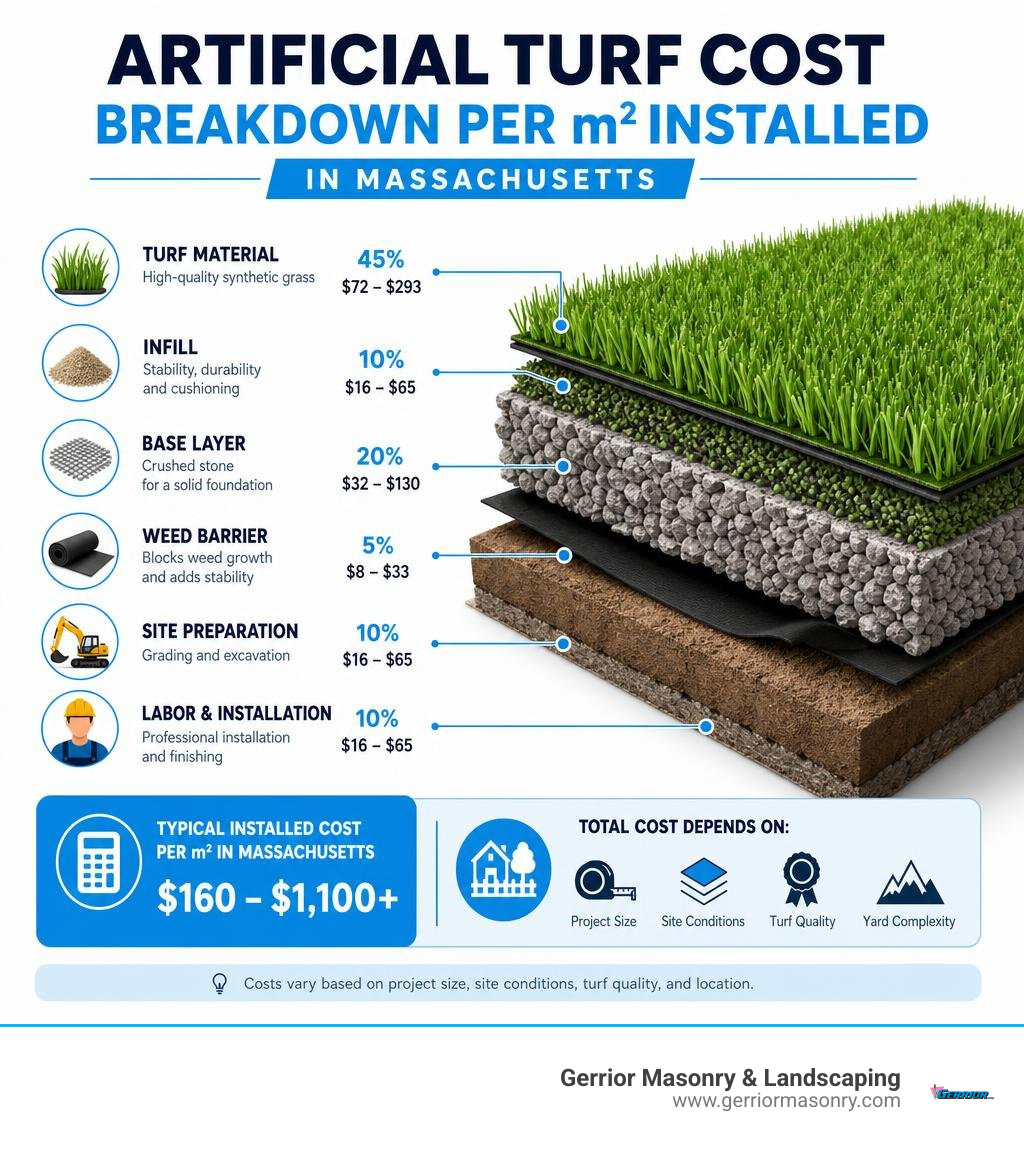
If you want a quick planning answer, here are the estimated installed cost ranges for artificial turf per square metre in Massachusetts. These figures are intentionally wide industry-average ranges sourced from publicly available online data and are not Gerrior Corp rates, estimates, guarantees, or price commitments:
Project Type
Estimated Installed Cost (per m²)
Entry-level residential turf
$160 – $500
Mid-range residential turf
$300 – $950
Premium/pet-friendly turf
$500 – $1,900
Putting green or sports surface
$900 – $4,000+
Note: These are broad industry-average planning ranges sourced from publicly available internet data. Actual costs vary based on project size, site conditions, turf quality, drainage requirements, access, and Massachusetts location. They do not reflect Gerrior Corp pricing.
For residential and commercial properties across Massachusetts — including Woburn, Burlington, and Winchester — the first budgeting question is often straightforward: “What is the installed cost of artificial turf per square metre?”
The professional answer depends on several site-specific factors. Material quality, excavation, drainage, base preparation, labor, access, and the complexity of the surrounding landscape all influence the final investment. What appears to be a simple surface replacement is usually a multi-step lawn installation process, and understanding each cost driver helps property owners and managers plan more accurately.
This guide breaks it down clearly so you can evaluate synthetic lawn installation with a practical budget in mind.
I’m Joe Gerrior, owner of Gerrior Masonry & Landscape Construction Corp., a family-owned business based in Woburn, Massachusetts, with over 34 years of experience in landscape installation and hardscaping. Our team helps clients evaluate the true cost of artificial turf per square metre, including the site preparation, drainage, and finishing work that many general price guides leave out. For direct guidance, call +781-713-1225 or use our Request a Free Estimate form.
Understanding the Cost of Artificial Turf per Square Metre
When you begin researching synthetic lawn installation, you will quickly find that pricing depends on several variables. Because artificial turf is a premium, long-term landscaping upgrade, the initial investment is higher than traditional sod. According to broad online data and industry averages, a complete synthetic lawn installation in Massachusetts can range widely depending on project size, site complexity, drainage requirements, and finish level.
For a typical residential or light commercial installation, broad planning ranges may start around $18,000 and can exceed $120,000 on more complex sites. These are average cost ranges sourced from publicly available internet data only and are not Gerrior Corp prices or guarantees. Let’s look at the primary cost factors that influence the final price of your project.
Material Quality and Artificial Turf per Square Metre Pricing
The synthetic grass material itself is the first major component of your budget. Not all artificial grass is created equal, and the manufacturing technology directly affects how realistic the blades look, how the surface feels underfoot, and how long it will withstand Massachusetts weather.
The three primary materials used in manufacturing synthetic turf include:
Polypropylene: Typically used for lower-traffic decorative areas or specialty applications. It has a fine, soft texture, but it is generally less durable than other turf materials.
Polyethylene: A common choice for residential lawns and many commercial landscape areas. It offers a strong balance of realistic appearance, soft feel, and durability.
Nylon: The strongest and most durable material available. It can withstand heavy foot traffic and heat exposure, but it is stiffer to the touch and typically carries a premium cost.
Beyond the raw material, other technical specifications drive the cost of your artificial turf per square metre. Pile height, blade shape, face weight, density, and stitch rate all affect the finished appearance, performance, and price. A thicker, denser turf uses more raw material and generally costs more.
The backing system is also critical because it holds the blades in place and supports drainage. Premium polyurethane backing systems can cost roughly 30% to 100% more than standard backing options in broad online planning data because they offer stronger moisture resistance and dimensional stability during freeze-thaw conditions. For additional public background on how yarn technology and manufacturing standards affect pricing, you can read this artificial grass price per square metre guide.
Professional Installation vs. DIY Costs
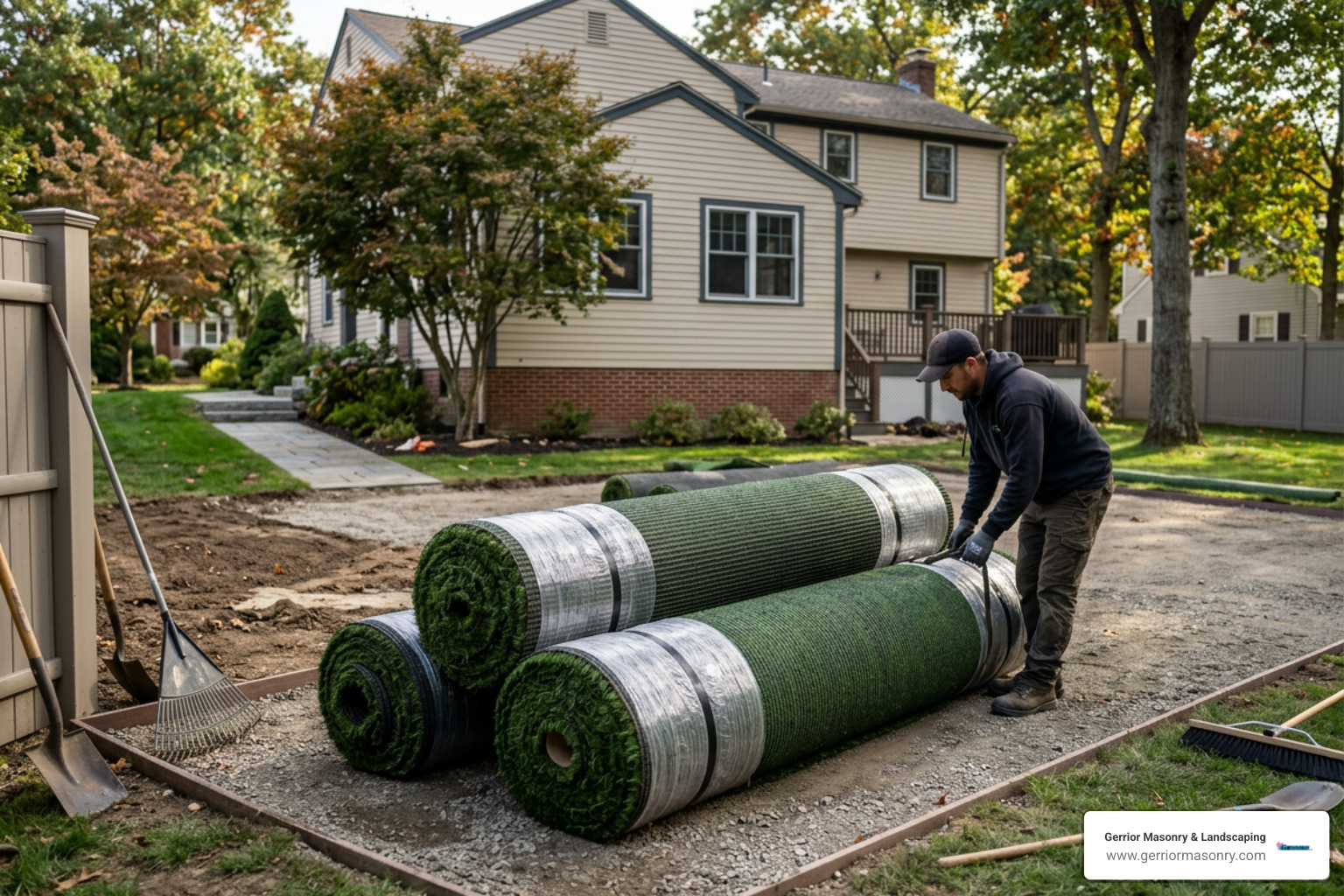
Artificial turf installation is best treated as a professional landscape construction project rather than a basic DIY surface covering. A durable installation requires excavation, grading, base compaction, drainage planning, clean seam work, secure edging, and proper infill placement.
Labor costs typically make up a significant portion of the total installed price. Professional crews account for soil removal, hauling, aggregate base installation, compaction, turf layout, trimming, and finishing. Site complexity is another major pricing driver for projects in Burlington and Winchester:
Sloped or uneven areas: Installing turf on a slope or irregular grade can significantly increase labor because the base must be stabilized and shaped correctly.
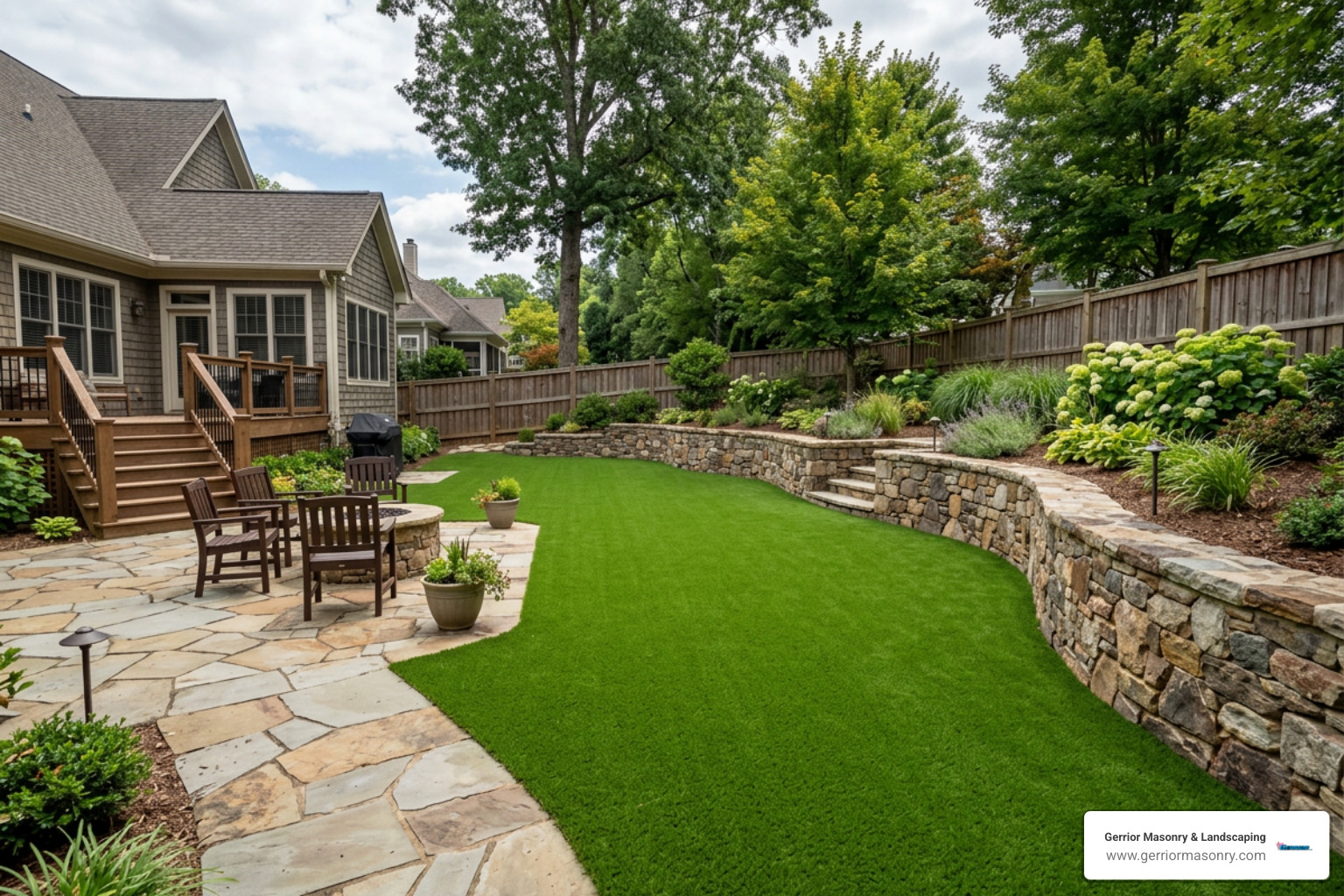
Curved boundaries and transitions: Landscape beds, walkways, patios, trees, and stonework require precise cutting and seaming, which adds installation time.
DIY information can be useful for understanding the process at a high level, but synthetic turf installations that must drain properly and perform long-term should be handled by an experienced professional. Without proper compaction, grading, and seam construction, turf can settle unevenly, wrinkle, separate, or hold water. To learn more about how professional crews manage these installations as part of complete site work, visit our landscaping services page.
Essential Base Preparation and Additional Materials
The long-term performance of a synthetic lawn depends heavily on what is installed beneath the turf. Proper base preparation generally includes excavating existing soil, grading the sub-base for water movement, and installing a weed barrier where appropriate.
Once excavation is complete, a sub-base of crushed stone, processed gravel, or granite dust is imported, spread, and compacted. This aggregate layer supports drainage and helps protect the installation during Massachusetts freeze-thaw cycles.
Other essential installation materials include:
Landscape Edging: Based on broad publicly available online data, edging may be planned in a wide range of roughly $4 to $57.50 per linear foot depending on material, access, and installation conditions. These are not Gerrior Corp prices.
Infill: Infill is placed between turf blades to add ballast, help protect the backing, and keep the blades standing upright. Standard silica sand is common, while antimicrobial infill is often specified for pet-friendly and high-use areas.
To compare these pre-installation considerations with traditional lawn preparation at a general planning level, you can review this real grass vs. artificial turf cost guide.
Long-Term Value: Artificial Turf per Square Metre vs. Real Grass
While the upfront cost of synthetic turf is higher than natural sod, a longer planning horizon can show a different financial picture. A professional synthetic lawn can reduce recurring costs for watering, fertilizing, aerating, weeding, mowing, and seasonal lawn restoration.
Comparing the Lifespan and Maintenance of Artificial Turf per Square Metre
A premium synthetic lawn may have an expected lifespan of 10 to 20 years depending on product quality, installation standards, drainage, use level, and maintenance. High-quality products often feature UV-stabilized yarn designed to help preserve color under summer sun. For pet-friendly or high-use areas, appropriate drainage and antimicrobial infill can help maintain a cleaner, more serviceable surface.
Artificial lawns are low-maintenance, but they are not completely maintenance-free. To keep the surface performing well, periodic care may include:
Rinsing pet or high-use areas as needed.
Brushing high-traffic areas to help turf blades stand upright.
Removing leaves and organic debris before they decompose in the turf.
The following 10-year comparison uses broad planning ranges for a 100-square-metre Massachusetts lawn. All figures are expanded from publicly available online industry averages to account for variability and are not Gerrior Corp prices, estimates, or guarantees:
Expense Category
Real Grass (10-Year Planning Range)
Artificial Turf (10-Year Planning Range)
Initial Installation
$3,000 – $15,000
$44,000 – $190,000
Watering & Irrigation
$8,000 – $40,000
$400 – $2,500
Fertilizer & Weed Control
$5,000 – $25,000
$0
Mowing & Spring/Fall Cleanups
$20,000 – $100,000
$0
Aeration & Reseeding
$3,000 – $15,000
$0
Estimated 10-Year Total
$39,000 – $195,000
$44,400 – $192,500
These planning ranges show why the long-term value of synthetic turf should be evaluated alongside maintenance reduction, usable space, drainage performance, and appearance consistency.
Enhancing Your Massachusetts Property with Professional Hardscaping
At Gerrior Masonry & Landscaping, we believe that a durable lawn surface is only one part of a complete exterior plan. Synthetic turf should be integrated with high-quality hardscaping and masonry details so the finished space drains correctly, transitions cleanly, and supports the property’s overall use.
For residential and commercial properties in Burlington and Winchester, our team designs and installs patios, walkways, retaining walls, lawn areas, and landscape features that work together as one system. With over 30 years of experience, we bring professional oversight and field-tested installation practices to each project.
Why Choosing the Right Retaining Wall Companies Can Make or Break Your Property
Retaining wall companies are not all created equal — and in Massachusetts, where freeze-thaw cycles, heavy rainfall, and sloped terrain are common, the difference between a qualified contractor and the wrong one can mean the difference between a wall that lasts decades and one that fails within a few years.
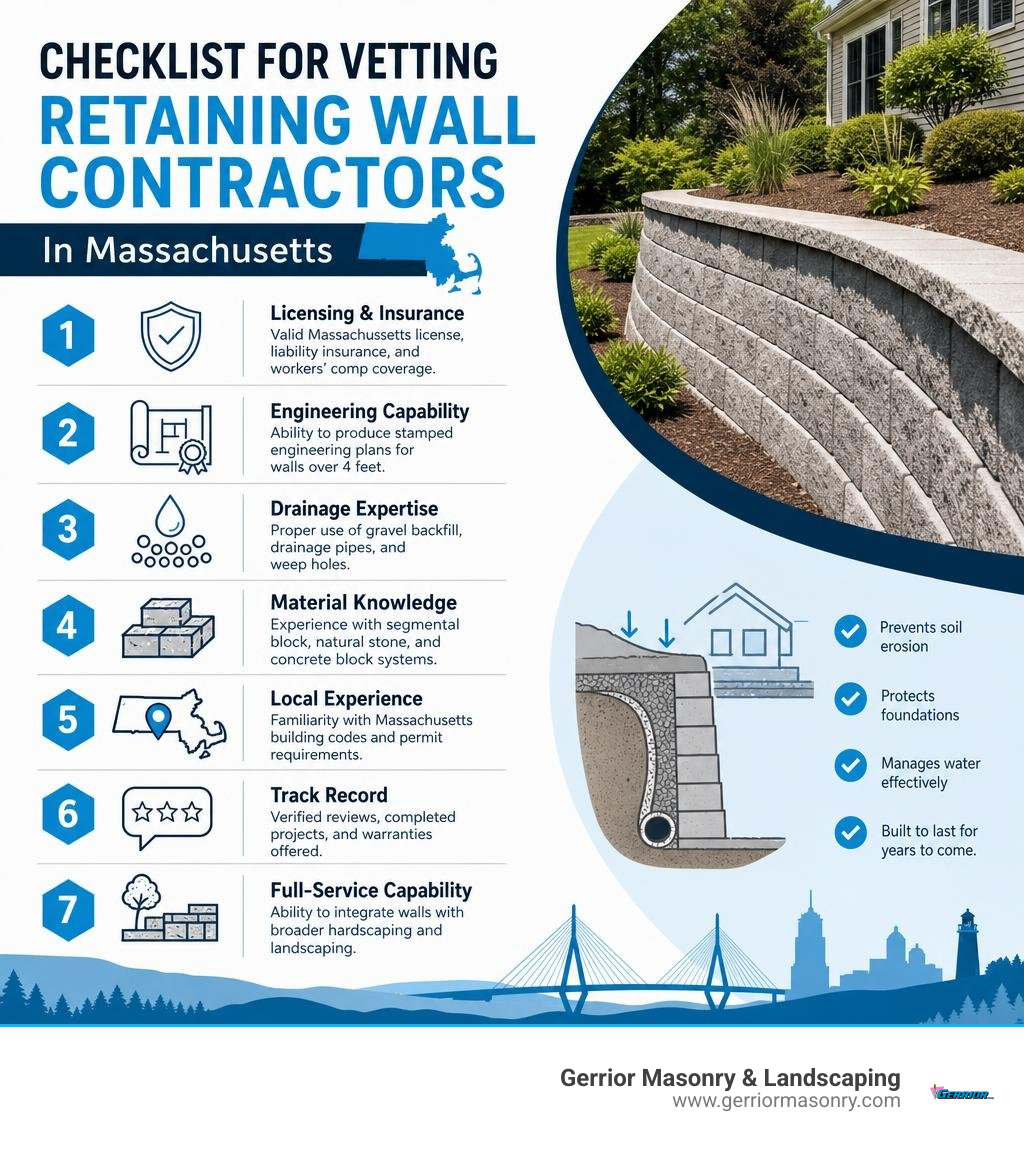
Here’s what to look for when vetting retaining wall companies:
Licensing and insurance — Valid Massachusetts contractor license, liability insurance, and workers’ comp coverage
Engineering capability — Ability to produce stamped engineering plans for walls over 4 feet
Drainage expertise — Proper use of gravel backfill, drainage pipes, and weep holes
Material knowledge — Experience with segmental block, natural stone, and concrete block systems
Local experience — Familiarity with Massachusetts building codes and permit requirements
Track record — Verified reviews, completed projects, and warranties offered
Full-service capability — Ability to integrate walls with broader hardscaping and landscaping
A poorly built retaining wall doesn’t just look bad — it can destabilize slopes, flood foundations, and create costly structural damage to your property. In towns like Woburn and Andover, where many residential lots feature significant grade changes, getting this decision right matters.
I’m Joe Gerrior, owner of Gerrior Masonry & Landscape Construction Corp., a family-owned business based in Woburn with over 34 years of experience working with retaining wall companies and building walls ourselves for residential and commercial clients across Massachusetts. In this guide, I’ll walk you through exactly what to check before you hire anyone.
Key Standards for Evaluating Retaining Wall Companies
When searching for the best retaining wall companies, it is easy to get overwhelmed by the sheer volume of options. A quick search for retaining wall companies near me or retaining wall builders near me will yield dozens of results in Eastern Massachusetts. However, separating true craftsmen from unqualified operators requires a systematic vetting process.
In our region, a retaining wall is rarely just a decorative border. It is a critical structural element engineered to hold back thousands of pounds of saturated soil. When we evaluate projects in Winchester, we look at soil density, water runoff patterns, and the specific surcharge loads the wall will bear. High-quality contractors will always prioritize structural stability over quick aesthetics.
Licensing and Insurance Requirements for Retaining Wall Companies
Never hire a contractor who cannot immediately produce up-to-date proof of licensing and insurance. In Massachusetts, any reputable business operating as one of the local retaining wall companies must carry a valid Home Improvement Contractor (HIC) registration and, where structural work is involved, a Construction Supervisor License (CSL).
When we handle Winchester projects, we make sure our clients have complete peace of mind. Your chosen contractor must carry:
General Liability Insurance: This protects your property and neighboring structures in the event of an accident.
Workers’ Compensation: This ensures that if a crew member is injured on your property, you are not held liable.
Always ask for proof of these documents directly from the insurance agency before any excavation begins. If a contractor hesitates or makes excuses, cross them off your list immediately.
How Professional Retaining Wall Companies Prevent Structural Failures
The leading cause of retaining wall failure is not the material itself, but rather a failure to manage water and soil pressure. Saturated soil is incredibly heavy. When water cannot escape from behind a wall, it creates immense hydrostatic pressure. Over time, this pressure causes walls to bow, crack, lean, and eventually collapse.
To ensure long-term structural integrity on every Lexington project, we follow strict engineering principles. First, proper soil compaction is essential. We compact the soil in thin lifts behind the wall to prevent settling. Second, the wall must be built with a slight backward lean (known as setback or batter) to naturally resist the forward pressure of the earth. You can learn more about these critical calculations in our guide on how to master retaining wall design and stability. When vetting retaining wall builders near me, ask them exactly how they calculate setback and manage soil compaction.
Selecting the Right Materials for Massachusetts Landscapes
The materials selected for your wall must be able to withstand the brutal Massachusetts winters. Saturated soils freeze and expand, putting intense pressure on the back of the structure.
Here are the most common and reliable materials we recommend for Andover masonry and Burlington hardscapes:
Segmental Block Systems: These interlocking concrete units are highly popular because they are engineered to flex slightly with freeze-thaw cycles without cracking.
Natural Stone: From dry-stacked fieldstone to mortared granite, natural stone offers unmatched, timeless beauty for Massachusetts properties, especially where a wall needs to blend with existing stonework, steps, patios, or historic landscape features.
High-Quality Precast Concrete Systems: For heavy-duty commercial or large-scale residential needs, precast systems provide incredible structural strength. You can explore options like Shea Concrete – Amesbury, MA – Recon Wall Systems to see how these massive blocks are utilized.
For Massachusetts properties, material selection should be based on wall height, soil conditions, drainage needs, access for equipment, and the finished appearance you want to achieve. A qualified contractor should be able to explain why a specific system is appropriate for your Andover, Burlington, Lexington, or Winchester site rather than recommending one material for every project.
Essential Technical and Structural Considerations
When you are investing in your property, you need to know that your contractor understands the technical side of the job.
A beautiful wall that sinks or falls apart after three winters is a financial nightmare. A professional installation of hardscape retaining walls requires careful planning, adherence to local building codes, and flawless execution of drainage systems.
Understanding Engineering, Permits, and Drainage Systems
In Massachusetts, building codes generally dictate that any retaining wall over 4 feet in height must be designed by a registered professional engineer and requires a local building permit. Whether you are dealing with Lexington building permits or Winchester drainage systems, a professional contractor will handle the entire permitting and engineering process for you.
The anatomy of a durable wall relies on three invisible but crucial elements:
The Base: Every wall needs a solid foundation. We excavate a trench and compact a thick base for retaining wall installations, usually consisting of crushed angular stone.
The Drain Pipe: A perforated pipe must be installed at the base behind the wall to collect and channel water away. Learn more about this process in our article on retaining wall drain pipe installation.
Gravel Backfill and Weep Holes: We fill the space directly behind the wall with clean gravel to allow water to filter down to the drain pipe, and we include weep holes to let any trapped water escape safely through the face of the wall.
Average Costs and Project Timelines in Massachusetts
Understanding the financial and time commitment of your project is essential for proper planning. To help you budget for your upcoming hardscaping upgrades, we have compiled a comparison of common materials and their estimated costs.
Retaining Wall Material
Average Estimated Cost Per Square Foot
Typical Longevity
Best Suited For
Segmental Concrete Block
$100 – $180
50 – 100 Years
Engineered slopes, terraced yards, clean modern lines
Please note: The average costs listed above are sourced from publicly available internet data and are not the actual prices of Gerrior Corp. We provide this wide price range from $100 to $250 per square foot to account for industry variability, site accessibility, and regional material costs in 2026.
Andover project timelines and Woburn site conditions can vary wildly depending on soil type, slope, and weather. A standard residential wall (under 4 feet tall and 50 feet long) typically takes our crew 3 to 5 days to complete, from initial excavation to final backfilling and site cleanup.
Integrating Retaining Walls with Broader Hardscaping Services
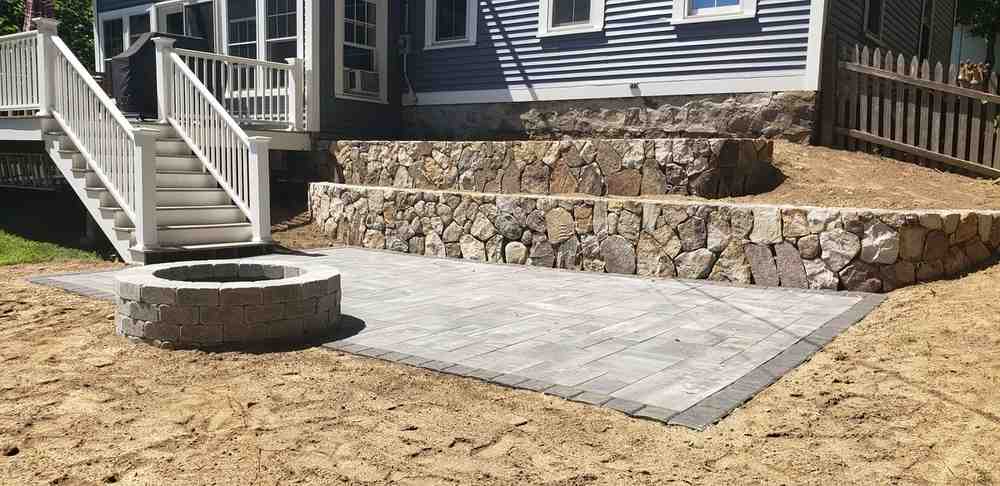
A retaining wall should never look like an afterthought. When designed correctly, it integrates seamlessly with your entire outdoor living area. At Gerrior Masonry & Landscaping, we specialize in comprehensive Woburn masonry services and Burlington patio installation. Whether you want to transition your sloped yard into a functional tiered lawn, build beautiful stone steps, or install durable walkways, we can design a cohesive plan that elevates your entire property.
Additionally, our expertise extends to commercial snow removal, foundation repairs, and custom masonry. We understand how to protect your outdoor investments year-round while coordinating walls, patios, steps, walkways, drainage, and other hardscape elements into one durable plan.
If you are ready to work with a team that brings over three decades of hands-on experience, owner oversight, and unmatched local expertise, we are here to help. Visit our website to request a quote online and take the first step toward transforming your landscape with beautiful, durable landscape walls.
Why Low Maintenance Landscape Design Is Worth It in 2026
Low maintenance landscape design means creating an outdoor space that stays beautiful year-round — with far less mowing, watering, weeding, and pruning than a traditional yard.
Here’s what it typically involves:
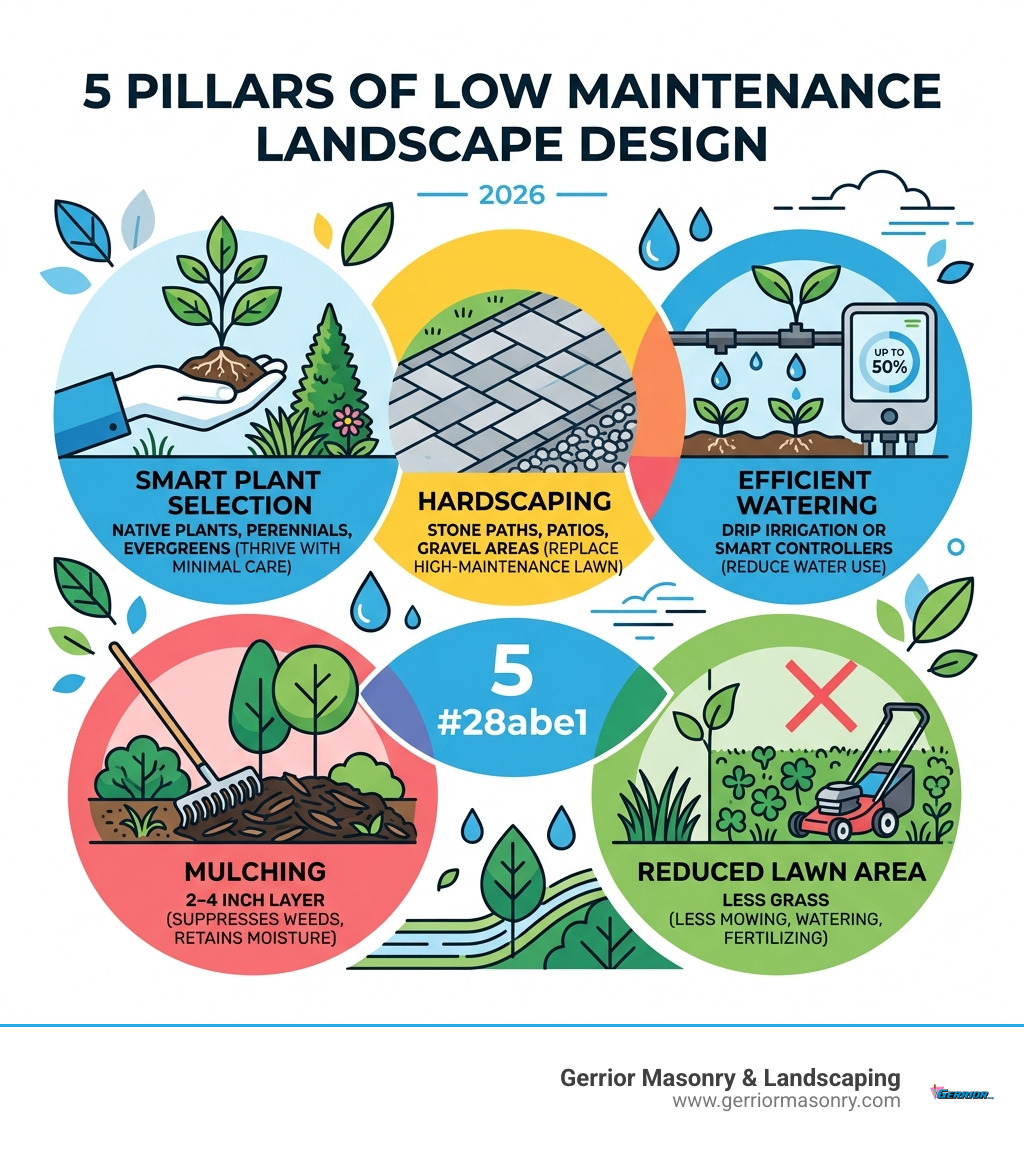
Pillar
What It Means
Smart plant selection
Native plants, perennials, and evergreens that thrive with minimal care
Hardscaping
Stone paths, patios, and gravel areas that replace high-maintenance lawn
Efficient watering
Drip irrigation or smart controllers that reduce water use up to 50%
Mulching
A 2–4 inch layer that suppresses weeds and retains moisture
Reduced lawn area
Less grass means less mowing, fertilizing, and watering
The benefits are real. Homeowners who switch to low-maintenance options can reduce their water bills by 30–50%, and reclaim hours of weekend time they’d otherwise spend on yard work.
Most Massachusetts homeowners aren’t short on ambition — they’re short on time. A well-designed yard shouldn’t feel like a second job. Whether your current landscape demands constant mowing, endless weeding, or a sprinkler system that never quite cooperates, there’s a smarter way to approach your outdoor space.
In April 2026, the shift toward sustainable, low-effort landscaping is accelerating. Homeowners and design professionals alike are moving away from resource-heavy lawns and high-maintenance plantings — and toward designs that work with nature rather than against it.
I’m Joe Gerrior, owner of Gerrior Masonry & Landscape Construction Corp., and over the past 34 years I’ve helped Massachusetts homeowners transform demanding yards into beautiful, easy-care outdoor spaces through thoughtful low maintenance landscape design. In this guide, I’ll walk you through everything you need to know — from plant selection and hardscaping to irrigation and budgeting — so you can build a yard that looks great without consuming your weekends.
Core Principles of Low Maintenance Landscape Design
Creating a yard that looks like a million bucks but only takes a few minutes of care starts with a change in philosophy. We often tell our clients in Woburn and Burlington that a low-maintenance yard isn’t about neglect; it’s about making smarter choices during the landscape planning phase.
One of the most effective strategies is xeriscaping. While people often associate this with desert climates, the core principles apply perfectly to Massachusetts. Xeriscaping focuses on water-efficient design and using plants that are naturally adapted to our local rainfall levels. By grouping plants with similar water needs — a technique known as “hydrozoning” — you ensure that you aren’t overwatering the drought-tolerant species just to keep a thirsty neighbor alive.
Scientific research on low-care ideas highlights that the most successful easy-care yards work with the existing site conditions. If you have a damp spot near your downspouts, don’t fight it with a plant that hates “wet feet.” Instead, use a native species that loves moisture. This “right plant, right place” mentality is the bedrock of our landscaping services.
Soil health is another critical,, factor. Before we start any landscape design installation, we recommend a soil test. Amending your soil with organic matter once can save you years of struggling with underperforming plants. Healthy soil leads to deeper root systems, which makes your plants more resilient to our New England weather swings.
Finally, simplicity is your best friend. A complex garden with fifty different types of flowers requires fifty different care schedules. A simple, repeated palette of 10–15 hardy plants creates a unified look that is much easier to manage.
Selecting Plants for a Low Maintenance Landscape Design
When we sit down for backyard garden design sessions, we look for “workhorse” plants. These are species that provide maximum visual impact with minimum intervention.
Perennials: These are the gift that keeps on giving. Unlike annuals, which you have to replant every spring, perennials return year after year. In our region, plants like Catmint (Nepeta), Coneflowers (Echinacea), and Black-eyed Susans (Rudbeckia) are incredibly hardy. They are drought-tolerant once established and generally resist local pests.
Evergreens: For year-round structure and color, evergreens are essential. They don’t drop leaves that need raking, and many varieties require very little pruning. We often suggest Boxwoods, Hollies, or Junipers to provide a consistent green backdrop for your modern landscape design.
Ground Covers: If you’re tired of mowing, ground covers like Creeping Phlox, Creeping Thyme, or Mondo Grass are fantastic alternatives. They suppress weeds naturally by “shading out” the soil and provide a lush, textured look. Creeping Juniper is another excellent choice for steep slopes where mowing is dangerous or difficult.
Self-Seeding Plants: If you want a “cottage garden” feel without the work, choose plants that self-seed, like Cosmos or California Poppies. They’ll fill in the gaps on their own, making your garden look full and vibrant without you lifting a finger.
Hardscaping as a Foundation for Low Maintenance Landscape Design
If you really want to slash your yard work time, the secret is to trade grass for stone. Hardscaping is the “bones” of your yard, providing structure that never needs to be watered, fertilized, or mowed.
A well-placed patio backyard design can instantly eliminate hundreds of square feet of high-maintenance lawn. Whether you prefer the classic look of a landscape pavers or the natural feel of flagstone, a patio creates a functional outdoor room.
Landscape walkway ideas are another great way to add beauty while reducing maintenance. A path made of pavers or gravel provides a clear route through your yard, preventing “cow paths” from forming in the grass. Gravel, in particular, is a low-cost, high-impact material. It provides excellent drainage and a modern aesthetic when paired with metal edging.
For those dealing with the hilly terrain often found in areas like Winchester or Lexington, a landscape retaining wall is a game-changer. These walls prevent erosion and create level planting beds that are much easier to access. Plus, there is something timeless about a landscaping brick wall that adds value to any Massachusetts property.
Even the most drought-tolerant plants need a little help to get established. However, you don’t need to spend your summer evenings standing in the yard with a hose.
Low-Maintenance Landscaping from MU Extension emphasizes that automated systems are key to efficiency. Smart irrigation controllers, like those from Rachio or Rain Bird, can reduce water use by up to 50% by adjusting schedules based on real-time local weather data. If it rained in Medford yesterday, your system won’t turn on today.
Drip irrigation is another favorite of ours. By delivering water directly to the base of the plants, you minimize evaporation and keep the foliage dry, which helps prevent fungal diseases. It’s a much more efficient way to water than traditional overhead sprinklers.
Then, there is the magic of mulch. A 2-to-4-inch layer of organic mulch (like shredded bark or compost) does three vital jobs:
Weed Suppression: It can block up to 90% of weed growth by preventing sunlight from reaching weed seeds.
Moisture Retention: It keeps the soil cool and damp, meaning you have to water less often.
Soil Health: As organic mulch breaks down, it adds nutrients back into the soil.
For high-traffic areas or rock gardens, inorganic mulches like gravel or river stones offer a truly permanent solution that never needs to be replenished. Just make sure to use a high-quality landscape fabric underneath to keep the weeds at bay. If you’re worried about drainage, we can help design drainage systems and dry wells to keep your yard functional even during our heavy New England rainstorms.
Implementing and Sustaining Your Easy-Care Yard
Once you have your low maintenance landscape design on paper, it’s time to bring it to life. For many of our clients in places like Andover or North Reading, the first step is often “lawn reduction.”
You don’t have to get rid of all your grass, but consider replacing the parts that don’t grow well — like those shady patches under the oaks or the steep slope in the back. Artificial turf has come a long way since the 1970s; today’s options look incredibly realistic and are perfect for dog runs or small play areas where real grass just gets trampled into mud.
Sustainability is a huge part of the 2026 landscape. By choosing native plants and reducing chemical inputs, you aren’t just saving yourself work; you’re creating a habitat for local pollinators. It’s a win-win for you and the Massachusetts environment.
Front Yard and Backyard Design Ideas
Your front yard is your home’s “handshake” with the neighborhood. A low-maintenance entryway can actually improve your curb appeal more than a high-maintenance one, simply because it always looks tidy.
Consider replacing a large, thirsty front lawn with a combination of front stairs and steps and wide, sweeping planting beds filled with evergreens and ornamental grasses. These “mass plantings” read well from the street and require almost no upkeep once the plants fill in.
In the backyard, focus on creating “outdoor rooms.” A backyard landscape that features a central patio design surrounded by a rock garden or a meadow of native wildflowers is much more inviting (and easier to care for) than a giant square of grass.
If you have a pool, you know that grass clippings and pool filters are a match made in hell. Using pool decks and patios made of pavers or natural stone eliminates this problem entirely. Surround the area with salt-tolerant, non-messy plants like ornamental grasses to create a private oasis that doesn’t require a daily skim.
Budgeting and Professional Installation in Massachusetts
One of the most common questions we get is: “How much does this cost?” While every yard is unique, we can provide some general ranges based on internet data for the Massachusetts area.
It is important to remember that while a low-maintenance yard might have a higher upfront cost (especially for hardscaping), the long-term ROI is significant. You’ll save thousands on water bills, fertilizers, and professional lawn care services over the life of your home.
Project Type
Average MA Cost Range*
High-End / Complex*
Basic Lawn Replacement (Mulch/Plants)
$5,000 – $10,000
$30,000+
Standard Paver Patio & Walkway
$12,000 – $25,000
$75,000+
Full Low-Maintenance Overhaul
$20,000 – $45,000
$135,000+
*Average costs for Massachusetts based on internet data and not actual costs for Gerrior Masonry services. High-end estimates reflect premium materials and complex site conditions.
When looking for a landscape contractor, you have two main paths: DIY or professional.
DIY: Great for small projects like adding a mulch bed or planting a few perennials. We have plenty of tips for diy landscape design to help you get started.
At Gerrior Masonry & Landscaping, we bring over 30 years of experience to every project. Whether you need a hardscape company to install a new landscape walkway or a hardscape designer to reimagine your entire property, our owner oversight ensures that the job is done right the first time. We also handle the “un-glamorous” but essential work like foundation repair and bulkhead replacement, which are often discovered during landscape renovations.
Conclusion and Next Steps with Gerrior Masonry & Landscaping
Designing a low-maintenance yard is one of the best gifts you can give yourself as a homeowner. By shifting your focus toward native plants, durable hardscaping, and smart technology, you can create an outdoor space that enhances your life rather than adding to your “to-do” list.
From the historic streets of Salem to the growing neighborhoods of Woburn, we’ve seen how a well-executed low maintenance landscape design can transform a property. You don’t have to do it all at once — start by replacing a small patch of struggling grass with a stone walkway, or swap out your high-maintenance annuals for a few hardy evergreens.
If you’re ready to reclaim your weekends and boost your home’s value, we’re here to help. Our skilled team provides everything from landscape design near me to specialized masonry work like chimney repairs. And when the Massachusetts winter hits, we also offer reliable commercial snow removal to keep local businesses running safely.
Ready to get started? Whether you live in Billerica, Melrose, or any of our other service areas, reach out to us today. Let’s build something beautiful together that you can actually enjoy.
Gerrior Masonry & Landscape Construction is based in Woburn, MA, and services Middlesex and Essex County, Massachusetts. Note: Service prices listed are average costs for Massachusetts based on internet data and not actual costs for Gerrior Masonry services.
Why Backyard Patio Construction Is One of the Best Home Investments You Can Make
Backyard patio construction is a project that can transform an unused yard into a functional outdoor living space — and return 80% or more of its cost in added home value.
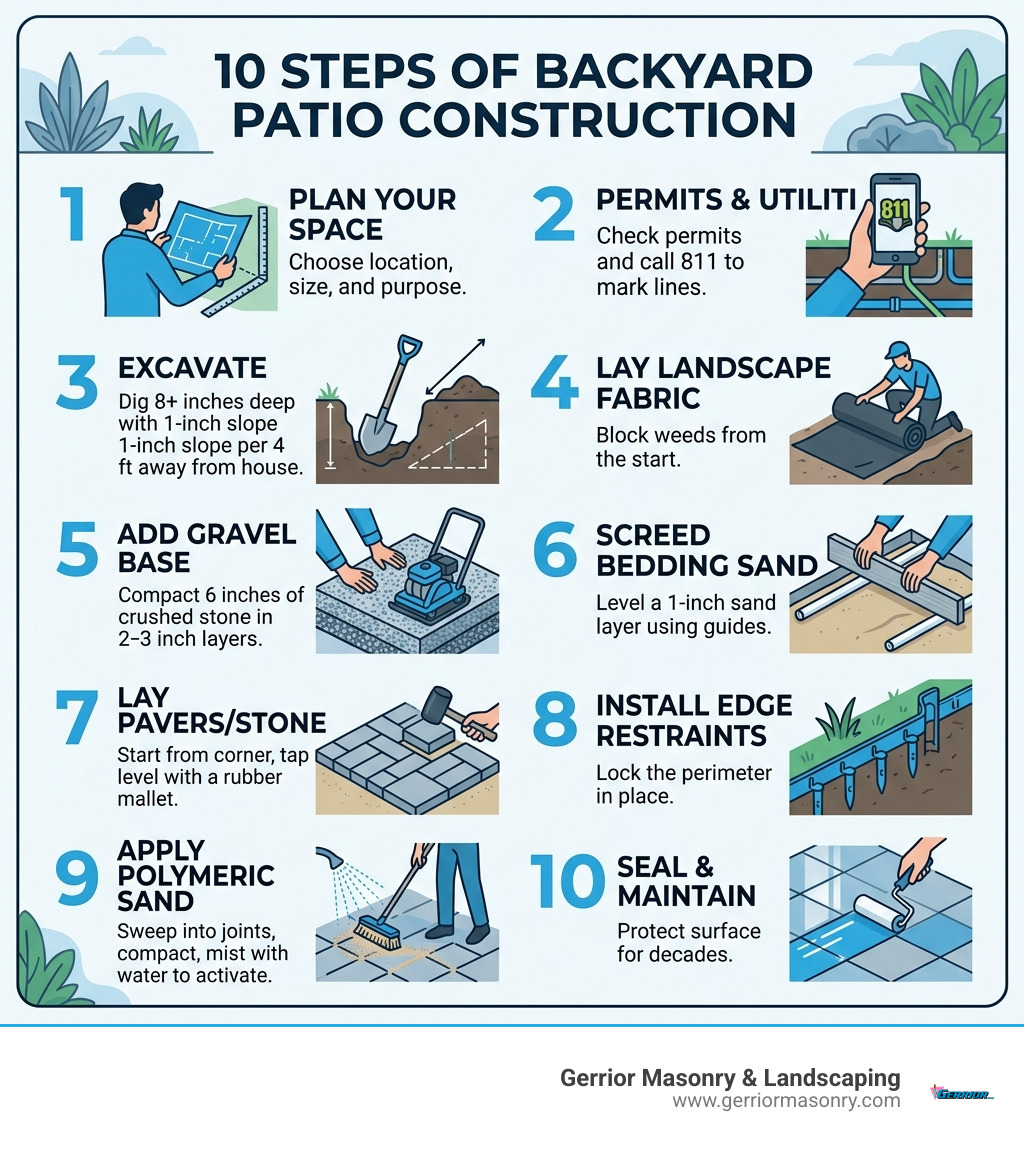
Here are the core steps to build a backyard patio:
Plan your space — Choose location, size, and purpose
Check permits and call 811 — Mark underground utilities before digging
Excavate — Dig 8+ inches deep with a 1-inch slope per 4 feet away from the house
Lay landscape fabric — Block weeds from the start
Add gravel base — Compact 6 inches of crushed stone in 2-3 inch layers
Screed bedding sand — Level a 1-inch sand layer using PVC pipes as guides
Lay your pavers or stone — Start from a corner, tap level with a rubber mallet
Install edge restraints — Lock the perimeter in place
Apply polymeric sand — Sweep into joints, compact, then mist with water to activate
Seal and maintain — Protect your surface and keep it looking sharp for decades
Whether you’re a confident DIYer or planning to hire a pro, understanding the full process helps you make smarter decisions — and avoid costly mistakes.
I’m Joe Gerrior, owner of Gerrior Masonry & Landscape Construction Corp., with over 30 years of hands-on experience in backyard patio construction for homeowners across Massachusetts. In this guide, I’ll walk you through everything you need to know — from picking the right materials to getting a patio that lasts 50+ years.
Planning and Executing Your Backyard Patio Construction
Before you ever pick up a shovel, you need a blueprint. Many homeowners jump into a project because they saw a beautiful image online, only to realize halfway through that they didn’t account for the slope of their yard or the size of their furniture. Planning is the most critical phase of backyard patio construction.
Site Selection and Purpose
The first question we ask our clients in towns like Lexington or Winchester is: “What is the primary purpose of this space?”
Dining Zone: If you plan to host dinners, you’ll need a minimum of 10×10 feet for a table of four, but 14×14 feet is much more comfortable for circulation.
Relaxation Nook: For a simple fire pit and a few chairs, a circular design or a smaller 10×10 square often works perfectly.
Proximity to the House: Most patios are built directly off the back door for convenience, but you must ensure the foundation is protected from water runoff.
Drainage and Slope: The “Silent Killer” of Patios
Water is the enemy of any masonry project. If your patio is perfectly level, water will pool, leading to algae, mold, and shifting stones. Even worse, if it slopes toward your house, you’re looking at a flooded basement.
The industry standard for backyard patio construction is a slope of 1 inch for every 4 feet of distance. We use string levels and stakes to ensure the ground drops away from the foundation. If you’re building in a particularly wet area of Middlesex County, you might even consider installing a drainage system or dry well to manage runoff effectively.
Essential Steps for Backyard Patio Construction Success
Success in backyard patio construction isn’t about how pretty the stones look on top; it’s about the 8 to 12 inches of material hidden underneath them.
1. The 811 Call and Permits
Never dig without calling 811. It’s free and prevents you from hitting a gas line or fiber optic cable. Additionally, while many ground-level patios don’t require a building permit, some municipalities have strict “impervious surface” laws. Always check with your local building department in cities like Newton or Medford before starting.
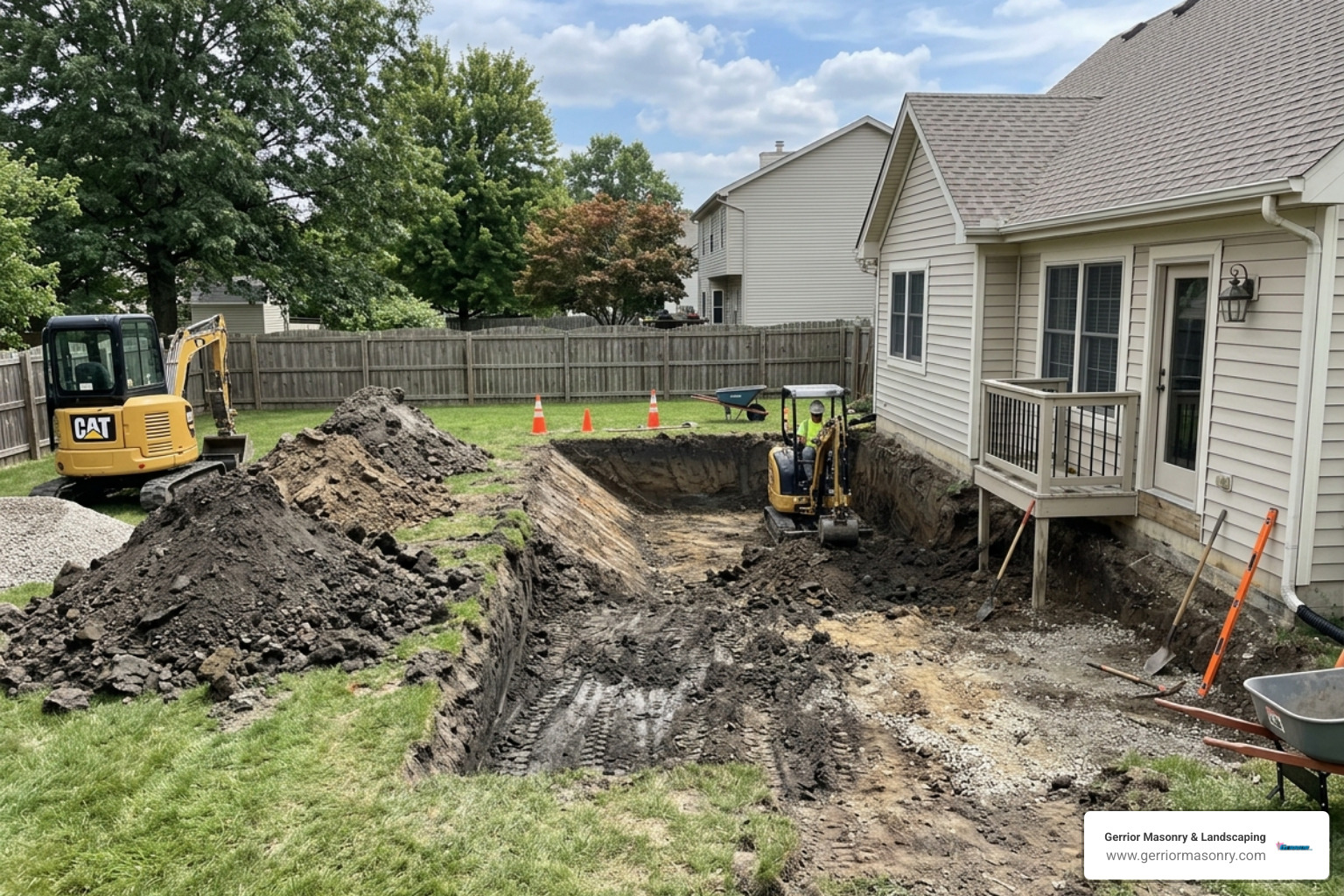
2. Excavation Depth
In Massachusetts, we deal with “frost heave”—the ground expanding and contracting as it freezes.
Standard Depth: 4 inches of gravel base + 1 inch of sand + the thickness of your paver (usually 2–3 inches). This totals about 8 inches.
New England Best Practice: For maximum durability, we often recommend 6–8 inches of gravel base, bringing your total excavation depth to 10–12 inches.
3. Landscape Fabric: Don’t Skip It
We always lay a high-quality geotextile landscape fabric at the bottom of the excavated hole. This prevents the native soil from mixing with your clean gravel base and acts as a secondary barrier against weeds.
4. The “Layered Cake” Base
A patio is only as stable as its base. We use angular crushed stone because the jagged edges lock together when compacted. Add the gravel in 2-inch “lifts” and compact each layer with a plate compactor until it’s rock hard. A plate compactor builds a patio that stays flat for 50 years.
5. Bedding Sand and Screeding
On top of the gravel goes a 1-inch layer of coarse sand. To get this perfectly level, we use 1-inch PVC pipes as “rails” and drag a straight 2×4 board across them. This is called “screeding.” Once this layer is set, do not walk on it!
Choosing Materials for Your Backyard Patio Construction
The materials you choose will define the aesthetic and maintenance requirements of your space. Whether you prefer the clean lines of concrete pavers or the rugged beauty of natural flagstone, each has its pros and cons.
Material
Average Cost (per sq ft)*
Lifespan
Pros
Cons
Concrete Slabs
$2 – $15
30–50 Years
Affordable, versatile
Prone to cracking in cold climates
Concrete Pavers
$2.25 – $11
50+ Years
Durable, easy to repair
Can fade over decades if not sealed
Brick
$4 – $10
25–30 Years
Classic look
Can be slippery when wet
Natural Stone
$3 – $18
50+ Years
High-end look
More difficult to install
Gravel
$1 – $3
10–20 Years
Very affordable
Messy with kids/pets
*Note: These are average costs based on internet data and not actual costs for Gerrior Masonry services.
Pavers vs. Poured Concrete
In Massachusetts, we almost always recommend pavers over solid concrete slabs. With our extreme temperature swings, a solid slab is under immense pressure and prone to cracking. Pavers, however, are a “flexible” pavement system that can move slightly with the earth and are easily replaced if one stone gets damaged.
DIY backyard patio construction typically saves you about 45% in labor costs. However, you have to weigh that against the cost of renting heavy equipment and the physical toll of moving tons of rock.
DIY Costs: For a 200 sq ft paver patio, DIYers usually spend between $1,800 and $4,400.
Professional Costs: For that same 200 sq ft patio, professional installation usually ranges from $3,000 to $7,600, though high-end custom stone work can easily exceed $15,000 depending on complexity.
When you hire a professional team like ours, you aren’t just paying for labor; you’re paying for the 30+ years of experience that ensures your backyard patio cost is a one-time investment.
Finishing Touches and Long-Term Maintenance
You’ve laid the stones, and the patio looks great, but the “finishing” steps are what separate an amateur project from a professional one.
The Magic of Polymeric Sand
Today, we use polymeric sand, a mix of fine sand and special additives that turn into a powerful “glue” when wetted.
Sweep: Fill the joints completely while the pavers are bone-dry.
Vibrate: Run the plate compactor over the pavers to settle the sand.
Clean: Blow off every speck of sand from the surface to prevent a white haze.
Activate: Lightly mist the joints with water to trigger the chemical bond.
Edge Restraints: Keeping It All Together
Without edge restraints, your patio will eventually “creep” outward. We use heavy-duty plastic or aluminum edging secured with 10-inch steel spikes every 12 inches. For those interested in a more permanent look, a complete guide to concrete patios can offer insights into mortared edges.
Enhancing Your Space with Design Add-ons
Outdoor Fire Pits: Whether it’s a stone ring or a gas-powered feature, a fire pit is the #1 requested add-on in Massachusetts. Learn more about outdoor fire pits.
Seating Walls: These provide extra places for guests to sit without cluttering the patio with furniture and help define the “zones” of your yard.
Outdoor Lighting: Low-voltage LED lights can be integrated directly into the pavers or seating walls, creating a stunning ambiance for evening gatherings.
Maintenance is the key to ensuring your backyard patio construction lasts for decades.
Cleaning and Sealing
We recommend power washing your patio every spring to remove winter grime. Applying a high-quality sealer every 3 to 5 years will protect the color of your pavers and prevent oil or food stains from sinking in.
Permeable Paving: The Eco-Friendly Choice
If you live in an area with strict runoff regulations, consider permeable pavers. These allow rainwater to filter directly into the ground, reducing the load on local storm drains and keeping your yard from becoming a swamp after heavy rain.
Expert Hardscaping and Professional Installation
While we love the spirit of DIY, backyard patio construction is a massive undertaking. Moving 2.5 tons of base rock and 0.75 tons of sand for a small patio is a grueling task.
At Gerrior Masonry & Landscaping, we take the stress out of the process. Our skilled team handles everything from the initial excavation to the final misting of the polymeric sand. With owner oversight on every project, we ensure that the quality of work meets the high standards our clients in Woburn, Andover, and beyond expect. Explore our patio installation services to see how we can transform your yard.
Gerrior Masonry & Landscape Construction is based in Woburn, MA, and services Middlesex and Essex County, Massachusetts.
What You Need to Know Before You Start Landscaping
How to landscape your yard from scratch can feel overwhelming — but it doesn’t have to be.
Here’s a quick overview of the core steps:
Assess your space — note sun exposure, drainage, soil type, and existing features
Define your style — decide between formal or informal, modern or traditional
Create a plan — draw your property to scale and map out beds, paths, and hardscaping
Prepare your beds — remove existing vegetation, amend soil, and add compost
Select and plant — choose plants suited to your hardiness zone, sun, and water conditions
Add hardscaping — install patios, walkways, walls, and focal points
Mulch and maintain — protect plants, retain moisture, and keep things tidy long-term
A well-designed landscape does more than look good. According to industry data, 92% of realtors advise homeowners to improve curb appeal before listing — and a thoughtfully planted yard can reduce heating and cooling costs by as much as 25%. Trees, native plants, and healthy lawns also deliver real environmental benefits, from absorbing carbon dioxide to reducing soil erosion.
Yet most homeowners hit the same wall: they know they want a better yard, but they don’t know where to begin. That’s exactly what this guide is for.
I’m Joe Gerrior, owner of Gerrior Masonry & Landscape Construction Corp., with over 34 years of hands-on experience helping Massachusetts homeowners master how to landscape their properties beautifully and practically. In the sections ahead, I’ll walk you through every step — from reading your site to choosing plants to avoiding the costly mistakes I’ve seen derail too many projects.
Fundamental Principles and Design Elements of How to Landscape
Before you pick up a shovel, you need to understand the “visual language” of a great yard. When we talk about how to landscape, we aren’t just talking about where the hostas go. We are talking about creating a cohesive environment using eight fundamental design elements that work together to create a professional-grade result.
Line: Lines control how the eye moves through the space. Straight lines feel formal, architectural, and modern, while curved lines feel natural, organic, and relaxed. Vertical lines, like those found in tall arborvitae or upright stone pillars, draw the eye upward and create a sense of height. Horizontal lines, often established by low stone walls or sprawling groundcovers, tend to make a space feel wider and more grounded.
Form: This refers to the shapes of your plants and hardscaping. A rounded boxwood feels different than a spiky ornamental grass. Consider the silhouette of your plants; a weeping cherry tree provides a soft, cascading form that contrasts beautifully with the rigid, upright form of a cedar. Mixing these shapes prevents visual monotony.
Color: Warm colors (reds, oranges) create excitement and make objects feel closer, perfect for a focal point near a patio. Cool colors (blues, purples) are tranquil and make a space feel larger and more distant.
Texture: Mixing fine-textured plants (like ferns or dill) with coarse-textured ones (like hostas or oakleaf hydrangeas) adds depth and prevents the yard from looking “flat” or one-dimensional.
Scale: Your landscape should match the size of your house. A tiny flower bed looks lost against a two-story colonial in Andover, while a massive oak might overwhelm a small cottage in Reading. Always consider the mature size of everything you plant.
Balance: This can be symmetrical (identical on both sides of a central axis) or asymmetrical (different elements that carry equal “visual weight”). Symmetrical balance is common in formal entries, while asymmetrical balance feels more naturalistic.
Unity: This is achieved through repetition. Instead of buying one of every plant at the nursery, buy in groups of three, five, or seven to create a unified look that feels intentional rather than cluttered.
Rhythm: Repeating a specific plant, color, or material at regular intervals creates a sense of movement, guiding visitors toward your front door or a hidden garden bench.
Choosing Your Style: Modern vs. Traditional
Determining your landscaping style is often the hardest part for homeowners in Middlesex County. I like to use the “Style Spectrum” framework to help clients narrow down their preferences. Imagine an X-axis ranging from Modern to Traditional, and a Y-axis ranging from Formal to Informal.
Formal Traditional: Think of the classic estates in Winchester or Lexington. These use strict symmetry, clipped hedges (like boxwoods or yews), and a limited palette of greens and whites. Everything has a designated place.
Informal Traditional (Cottage Garden): These date back to the 1400s and are characterized by dense, overflowing beds of perennials like peonies, foxgloves, and roses. They feel “wild” but are actually carefully managed to ensure year-round interest.
Modern Landscape Design: This style emphasizes clean, straight lines, geometric shapes, and industrial materials like concrete, steel, and large-format pavers. It often features “Modern Minimal” or “Modern Farmhouse” aesthetics, which are very popular in towns like Concord and Bedford.
Transitional: Most of our clients fall here. It’s the sweet spot that blends traditional warmth with modern functionality—for example, a tiered stone fountain at the end of a crisp, modern paver path, or using traditional fieldstone for a wall with a very clean, modern cap.
Planning Your Layout and How to Landscape with Hardscaping
You wouldn’t build a house without a blueprint, and you shouldn’t landscape without a scale map. Start by measuring your property and drawing it on graph paper (where one square equals one square foot). This allows you to experiment with shapes before you ever break ground.
Site Analysis: Before you draw a single bed, observe your yard. Where does the water pool after a heavy rain? Which side gets the southern sun (usually the warmest spot for a patio)? Where does the wind whip through in the winter? Identify your “assets” (a beautiful mature oak or a nice view) and your “liabilities” (an ugly utility box or a neighbor’s noisy AC unit).
Integrating Hardscape: In Massachusetts, we have to think about functionality year-round, including snow removal and drainage. Hardscaping Design is the “skeleton” of your yard. It includes the non-living elements: patios, Landscape Walkway Ideas, retaining walls, and fire pits.
When planning, think about “Outdoor Rooms.” A patio isn’t just a slab of stone; it’s your outdoor dining room. A fire pit area is your lounge. Use Hardscape and Landscape elements together to define these spaces. For instance, a low stone wall can provide extra seating for guests while also acting as a structural boundary for a lush garden bed.
Sustainable Plant Selection and Bed Preparation
Choosing the right plants is like a blind date between Mother Nature and your backyard—you want them to get along long-term without constant intervention.
Hardiness Zones: In the Woburn and North Shore area, we are generally in USDA Hardiness Zone 5b to 6a. This means your plants need to survive winter temperatures that can dip below zero. Always check the tag before you buy! A plant that thrives in Virginia may not survive a February in Massachusetts.
The Power of Trees: Never underestimate a tree. Scientific research on tree benefits and carbon sequestration shows that a single tree can remove 10 to 40 kg of carbon dioxide annually. Strategically placing deciduous trees on the south side of your home can shade your house in the summer and let the sun warm it in the winter, potentially reducing energy costs by 25%.
Sustainable Choices:
Native Plants: These are adapted to our local soil and climate. In Massachusetts, choosing species like the Eastern Redbud, New England Aster, or Highbush Blueberry ensures your garden thrives with minimal intervention. They require less water and provide vital habitats for local pollinators.
Xeriscaping: This is a practice that requires little to no irrigation. While we get plenty of rain in MA, using drought-tolerant plants in sandy soils (like in some coastal Essex County areas) saves time and money during our increasingly dry summers.
Edible Elements: Over 50% of homeowners now want edible elements. Think about tucking blueberry bushes into your shrub borders or building raised beds for herbs and vegetables near the kitchen door.
Bed Preparation: Don’t just dig a hole in the grass and drop a plant in. You need to kill the weeds and prepare the soil first.
Mark your beds: Use flour or a garden hose to outline the shape. Step back and look at it from your windows to ensure the scale is right.
Sod Inversion or Removal: You can flip the sod over to let it decompose, or use the Newspaper Method. Layer 8-10 sheets of newspaper over the grass, wet it down, and cover it with 10-12 inches of topsoil and compost. This smothers the grass and adds nutrients back into the soil.
Mulching: Apply 2-3 inches of mulch to retain moisture and suppress weeds. Just remember the “no-volcano” rule: don’t pile mulch against the trunk of a tree or the stems of shrubs, as it causes rot and invites pests.
Executing Your Vision: Budgeting and Common Mistakes
Once you have a plan, the real work begins. I always suggest a phased approach for DIYers. You don’t have to do everything in one weekend. In fact, starting small—maybe with a 25-square-foot bed near the front door—is the best way to learn the rhythm of your soil without burning out.
Setting a Realistic Budget for How to Landscape
One of the biggest shocks for homeowners is the actual cost of materials. TV shows make it look like you can transform a yard for $500. In reality, a realistic budget for a DIY starter project is usually closer to $1,000 once you factor in quality plants, soil, mulch, and tools. Don’t forget the “hidden” costs: tool rentals (like sod cutters or plate compactors), debris disposal fees for old concrete or brush, and the cost of high-quality organic compost.
For larger projects, internet averages suggest a wide range of costs based on the scope:
Project Type
Average DIY Cost
Average Professional Cost
Small Flower Bed (50 sq ft)
$300 – $600
$800 – $1,500
Paver Walkway (30 linear ft)
$800 – $1,500
$2,500 – $5,000
Full Backyard Transformation
$5,000 – $15,000
$15,000 – $45,000+
Note: These are average costs based on internet data and not actual costs for Gerrior Masonry services. High-end custom masonry can exceed $50,000 depending on materials like natural bluestone or granite.
The good news? Landscape Planning has a high ROI. The National Association of Realtors reports that a well-executed landscape upgrade can provide a 100% return on investment when you sell your home. If you’re looking for Landscaping Design Near Me, always look for a contractor who understands the local geology and climate of Middlesex County.
Avoiding Common Landscaping Pitfalls
Even with the best intentions, I see the same mistakes over and over. Here’s how to avoid them:
The “Mustache” Hedge: This is when homeowners plant a single, straight row of identical shrubs right against the foundation. It looks rigid and dated. Instead, stagger your plants and mix heights for a more natural, layered look.
Improper Tree Placement: Never plant a tree without knowing its mature size. That cute 6-foot sapling could grow into a 60-foot giant that tangles in power lines or cracks your foundation. Always plant at least 15-20 feet away from the house for large species.
Undersized Beds: Most people make their garden beds too narrow. A good rule of thumb is that the depth of the bed should be at least 30-50% of the height of the adjacent wall. If your house is 20 feet tall, a 2-foot bed will look like a tiny, insignificant ribbon.
Ignoring Drainage: If you build a Landscape Retaining Wall without proper drainage pipes and crushed stone behind it, the pressure of wet soil will eventually cause it to lean or fail. Always address water flow before you build.
Ignoring the View from Inside: We spend a significant amount of time looking at our yards through windows. Ensure your focal points—like a beautiful Japanese Maple or a stone fountain—are aligned with your kitchen or living room windows.
Neglecting Outdoor Lighting: This is a missed opportunity. Simple low-voltage LED path lights or uplighting on a specimen tree can extend the usability and beauty of your landscape well into the evening hours, providing safety and ambiance.
Overplanting: It’s tempting to pack plants in for an “instant” look, but they will eventually crowd each other out, leading to disease and stunted growth. Give them room to breathe based on their mature spread.
Conclusion and Professional Support
Learning how to landscape is a journey of trial and error, but the results—a beautiful, functional outdoor space that increases your home’s value and supports the environment—are well worth the effort. Whether you are tackling a small garden bed in Billerica or planning a major stone patio in Lynnfield, the key is starting with a solid plan and a clear understanding of your site’s unique characteristics.
At Gerrior Masonry & Landscaping, we’ve spent over 30 years perfecting the art of Hardscaping and Landscaping. We know that every property in Middlesex and Essex County has unique challenges, from the rocky soil of the North Shore to the sloped yards of the Merrimack Valley. Our team provides expert Hardscaping Services with direct owner oversight on every project to ensure that your “scratch” project becomes a masterpiece.
Note on Pricing: Please note that all listed service prices are average costs based on general internet data and do not represent actual costs for Gerrior Masonry services. Project costs can vary significantly based on materials and scope, typically ranging from $5,000 to over $45,000 for comprehensive projects.
Gerrior Masonry & Landscape Construction is based in Woburn, MA, and services Middlesex and Essex County, Massachusetts, including communities like Burlington, Wilmington, Winchester, Stoneham, and Wakefield.
Why Commercial Properties Need Stormwater Drainage Solutions
Stormwater drainage solutions are essential systems designed to manage rainwater and snowmelt runoff on commercial properties. In the unique climate of Massachusetts, where heavy spring rains follow significant winter snow accumulation, these systems are the first line of defense for your business infrastructure. Here are the most effective options for your business:
Catch Basins & Trench Drains – Collect surface water from parking lots and walkways.
Permeable Pavement Systems – Allow water to filter through surfaces into underground storage.
Bioretention Basins & Rain Gardens – Use native plants and soil to naturally filter stormwater.
Dry Wells & Underground Infiltration – Store water underground for gradual absorption.
French Drains – Redirect water away from foundations and structures.
Green Infrastructure – Combine multiple natural systems for comprehensive management.
Without proper stormwater management, commercial properties face serious risks. Runoff carrying oils, chemicals, and debris from impervious surfaces like parking lots can cause flooding, foundation damage, and eroded landscapes. In urban and suburban environments, the sheer volume of water generated by a single storm can overwhelm local municipal systems if not managed on-site. Stormwater is a leading source of pollution for local estuaries and rivers, making proper drainage both an environmental responsibility and a regulatory requirement for modern businesses.
The primary goals of commercial stormwater drainage systems include:
Preventing flooding of buildings and parking areas: Ensuring that customers and employees have safe access to your facility regardless of weather conditions.
Protecting infrastructure from water damage: Preventing the costly degradation of asphalt, concrete, and building foundations caused by standing water and freeze-thaw cycles.
Managing runoff volume and velocity: Slowing down water to prevent soil erosion and downstream flooding.
Filtering pollutants before water reaches natural waterways: Removing hydrocarbons, heavy metals, and sediment through natural or mechanical filtration.
Complying with local and EPA stormwater regulations: Avoiding fines and legal complications by adhering to the Clean Water Act and local Massachusetts bylaws.
Reducing liability from slip hazards: Eliminating ice patches in winter and deep puddles in summer that can lead to accidents.
I’m Joe Gerrior, owner of Gerrior Masonry & Landscape Construction Corp. Over our 34 years serving Massachusetts commercial properties, I’ve seen how proper stormwater drainage solutions protect investments. From simple catch basin installations to complex bioretention systems, choosing the right approach requires understanding your property’s unique challenges, including soil composition and topography.
Top Commercial Stormwater Drainage Solutions for Modern Properties
Effective stormwater management is critical for commercial properties in Middlesex and Essex County, Massachusetts. The goal is to manage water responsibly to prevent flooding and protect infrastructure through a combination of “gray” and “green” infrastructure. Gray infrastructure refers to engineered systems like pipes and concrete channels, while green infrastructure (GI) mimics natural processes using vegetation and permeable surfaces to capture and filter stormwater. This dual approach protects properties from heavy rainfall and snowmelt, which are increasingly common in the Northeast. These systems are vital for preventing the flooding of streets and parking lots, which can otherwise disrupt business operations and cause significant property damage.
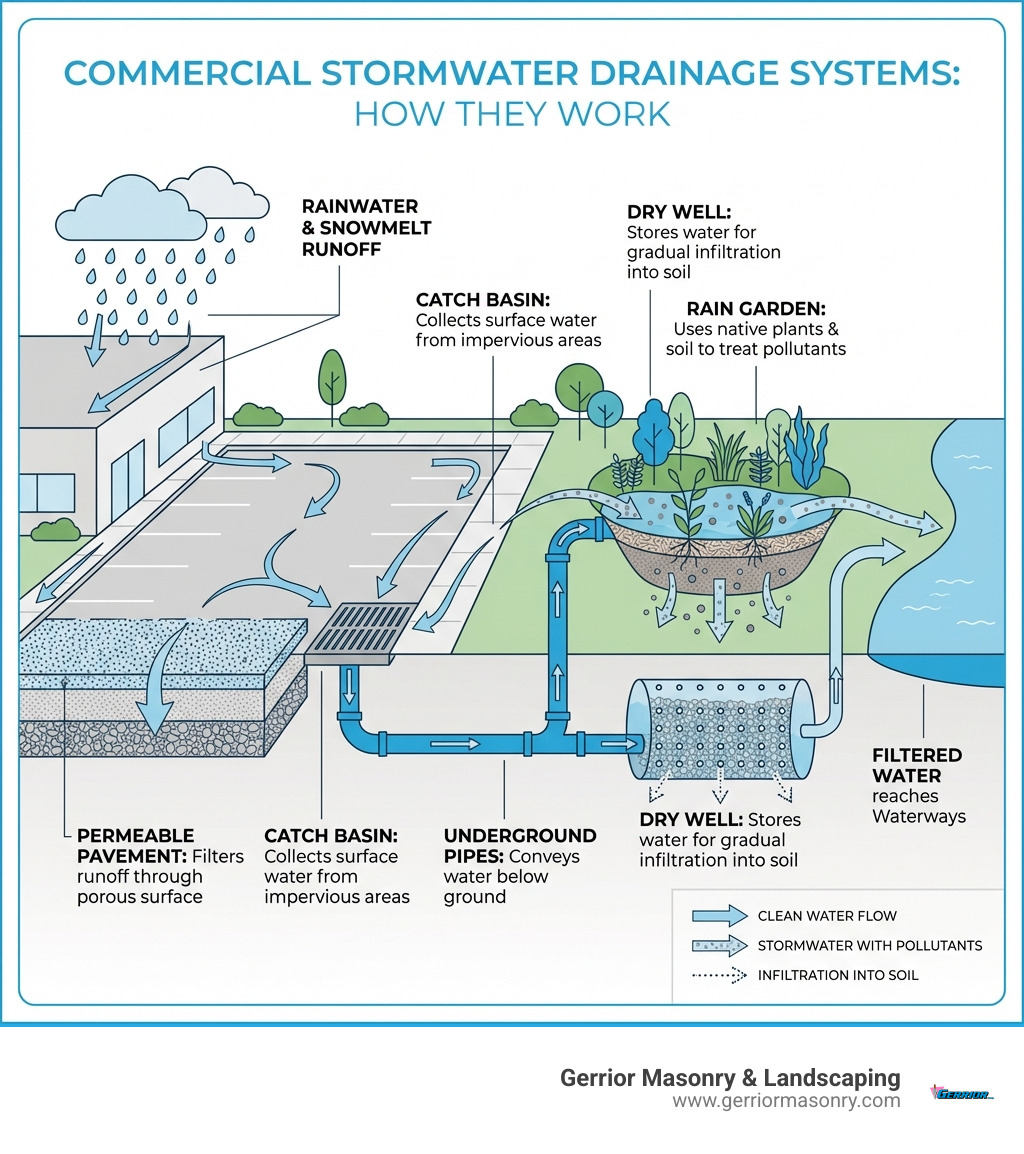
The “Lifecycle of a Raindrop” approach involves four critical stages: Capture, Convey, Store, and Treat.
Capture: This is the initial collection of water from roofs, parking lots, and sidewalks.
Convey: Moving the water safely through pipes or swales to a management area.
Store: Holding the water temporarily in basins or underground tanks to prevent overwhelming the system.
Treat: Removing pollutants through filtration or biological processes before the water is released.
This holistic view ensures stormwater is managed for both quality and quantity. For more information, you can explore options for treating stormwater.
Efficient Catch Basins and Trench Drain Stormwater Drainage Solutions
Traditional gray infrastructure like catch basins and trench drains remains highly effective for managing surface runoff. These systems are the workhorses of commercial drainage, specifically designed to collect water from large impervious areas like parking lots, loading docks, and driveways.
A catch basin is a grated opening that directs surface water into underground pipes. The grates block large debris like leaves, branches, and trash from clogging the system. Below the grate, a sump area allows sediment to settle before the water flows to a designated outlet. We provide various drainage systems for commercial needs. Trench drains, or channel drains, are linear systems used in large paved areas or along building foundations to intercept sheet flow. By capturing water across a wide path, they are exceptionally effective at reducing slip hazards and preventing erosion on sloped landscapes.
These systems require regular maintenance to remain functional. Accumulated debris can block inlets, leading to localized flooding. We recommend regular clearing of grates and periodic vacuuming of the sumps. For stubborn blockages within the piping, a high-pressure washer is an effective tool. Keeping these elements free of obstructions is a key best practice for commercial property managers looking to avoid emergency repairs.
Permeable Pavement and Green Infrastructure Stormwater Drainage Solutions
Green infrastructure offers environmentally friendly solutions like permeable pavement and bioretention systems. Unlike traditional asphalt, permeable pavement allows water to pass through its surface into an underlying stone reservoir. From there, it is slowly absorbed into the ground, which recharges groundwater and filters out pollutants naturally. We offer various hardscaping services including grass pavers, porous concrete, and open-joint bricks that provide structural integrity while maintaining permeability.
Rain gardens and bioswales are functional green components that add aesthetic value to a property. Rain gardens are shallow depressions planted with native vegetation that capture and filter runoff from roofs or small paved areas. Bioswales are larger, linear vegetated channels often integrated into parking lot islands or along roadways. You can find more details on planted stormwater management practices. These practices improve air quality, increase biodiversity, and enhance property aesthetics while managing runoff volume effectively.
Dry Wells and Subsurface Infiltration Systems
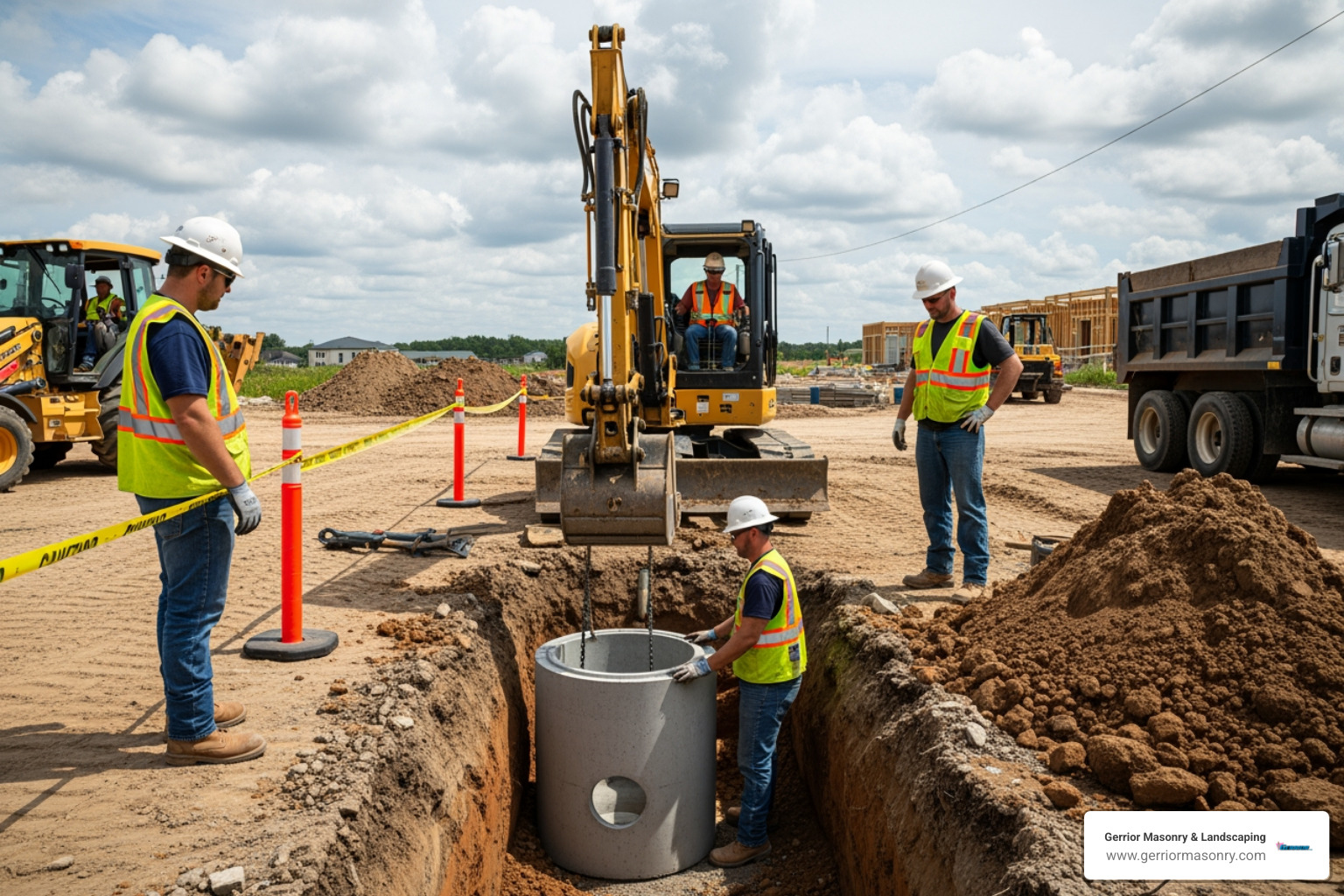
Dry wells and subsurface infiltration systems work underground to manage excess water, making them ideal for sites with limited surface space. A dry well is essentially an underground chamber that collects and slowly releases stormwater into the surrounding soil. We are experts in installing dry wells to handle standing water issues in areas where surface basins are not feasible.
Larger underground systems, often consisting of perforated pipes or modular plastic crates, can be engineered beneath parking lots to store massive volumes of water. However, these systems must comply with strict regulations, such as the EPA’s Class V injection well guidelines. Challenges include ensuring proper groundwater separation and maintaining access for periodic inspections. When properly designed and installed, these systems provide significant runoff reduction and contribute to long-term groundwater sustainability.
Implementing and Maintaining Your Stormwater Strategy
Developing effective stormwater drainage solutions in Massachusetts requires site-specific planning and strict adherence to state and local regulations. Proper design considers soil type (determined through perc tests), slopes, and the total impervious surface area to handle both current weather patterns and future extreme weather events. In Massachusetts, the Department of Environmental Protection (DEP) provides a Stormwater Handbook that serves as the gold standard for these installations.
Maintenance is essential for system longevity and performance. Requirements vary significantly by system type:
Feature
Permeable Pavement
Traditional Pavement (with Drains)
Water Management
Infiltrates water into ground
Directs water to drains
Pollutant Treatment
Filters through soil layers
Minimal treatment
Maintenance
Regular vacuuming/sweeping
Debris removal from grates
Environmental Impact
Positive, supports ecosystems
Can contribute to pollution
Ditches and Swales: Require regular mowing to maintain flow and debris removal to prevent blockages.
Catch Basins and Trench Drains: Need regular clearing of inlets; pressure washing for clogs and vacuuming of sumps every 1-2 years.
Rain Gardens: Involve weeding, mulching, and plant care, similar to traditional landscaping but with a focus on sediment removal.
Permeable Pavements: Should be vacuumed 1-2 times annually with a regenerative air sweeper to prevent fine sediments from clogging the pores.
Compliance with local ordinances and the EPA’s National Pollutant Discharge Elimination System (NPDES) permits is mandatory for many commercial sites. Frameworks like the Unified Stormwater Rule (USWR) provide guidelines that mirror many Massachusetts requirements regarding runoff rates and water quality. Our approach ensures all solutions meet or exceed these environmental standards, protecting you from potential litigation or municipal fines.
Design Best Practices and Cost Considerations
Effective design requires a thorough site assessment by experienced professionals. Bioretention systems need specific engineered soil mixes to ensure proper drainage and plant health, while infiltration systems require flat bottoms to ensure uniform absorption into the subsoil. Consulting with professionals prevents unintended consequences like flooded basements, overwhelmed public systems, or “piping” where water carves dangerous channels underground.
Costs vary based on complexity, scale, and the specific needs of the site. Based on industry data, the average cost for commercial stormwater drainage solutions is approximately $12,000. However, prices can range widely from $4,000 for simple catch basin repairs or small French drain installations to upwards of $45,000 for large-scale green infrastructure projects involving extensive excavation and specialized materials. Please note these are average industry costs and not actual quotes for Gerrior Masonry services. We provide customized, detailed quotes after a comprehensive site evaluation.
Professional Installation and Maintenance Services
Professional installation ensures your system performs as intended for decades. At Gerrior Masonry & Landscaping, we have over 30 years of experience handling the unique commercial drainage challenges found in Middlesex and Essex County. Our team manages everything from precise grading for trench drains to the complex layering of permeable pavements. We provide owner oversight on every project to ensure the highest quality of workmanship.
Proper installation prevents standing water and foundation damage, which are the leading causes of commercial property depreciation. For example, a French drain must be installed at the correct depth and slope with the right aggregate to be effective over the long term. You can learn more about our drainage systems services. We also offer maintenance and commercial snow removal to ensure melting snow does not overwhelm your systems during the volatile New England winters. We only provide commercial snow services and do not offer residential snow removal.
Partnering with experienced professionals is an investment in your property’s future and its environmental footprint. Gerrior Masonry & Landscape Construction is based in Woburn, MA, and proudly services Middlesex and Essex County, Massachusetts.