
Why Paver Retaining Wall Installation Can Transform Your Yard
Paver retaining wall installation is a premier landscaping project that controls erosion, levels sloped ground, and creates usable outdoor space. A well-built wall can turn an awkward hillside into a functional patio edge, planting terrace, or safer walkway transition. It also adds definition to the landscape, helping separate lawn, garden, and hardscape areas in a clean and durable way. Beyond the immediate visual upgrade, these structures serve as the backbone of a property’s drainage and stability system, preventing soil loss and protecting the foundation of your home from water-related issues.
Core steps include:
- Plan and mark the layout using stakes and string lines.
- Dig a trench 4-6 inches deep, plus the height of the buried block.
- Compact a gravel base 4-6 inches thick using a plate compactor.
- Lay the first course perfectly level to ensure the entire wall stays straight.
- Stack courses with staggered joints to maximize structural integrity.
- Install drainage using perforated pipe and clean drainage gravel.
- Cap the wall with heavy-duty masonry adhesive for a finished look.
According to the National Association of Realtors, landscape redesigns like retaining walls can recover 105% of their value upon home sale. This makes it one of the few home improvement projects that can actually pay for itself. Beyond resale, homeowners often appreciate the everyday benefits right away: reduced washout after storms, better use of uneven ground, and a more finished appearance that complements patios, stairs, and walkways. However, poor installation leads to collapse, which can be a costly and dangerous liability. Success depends on meticulous preparation and advanced drainage planning.
I’m Joe Gerrior, owner of Gerrior Masonry & Landscape Construction Corp. With over 34 years of experience in Massachusetts, I’ve led hundreds of paver retaining wall installation projects. This guide ensures your wall stands the test of time. In New England, that means building for drainage, frost movement, and seasonal weather swings rather than focusing only on appearance. Our local climate is particularly harsh on masonry; the constant freeze-thaw cycles can heave a poorly built wall out of the ground in just one or two seasons. We focus on deep bases and flexible drainage systems to counteract these natural forces.
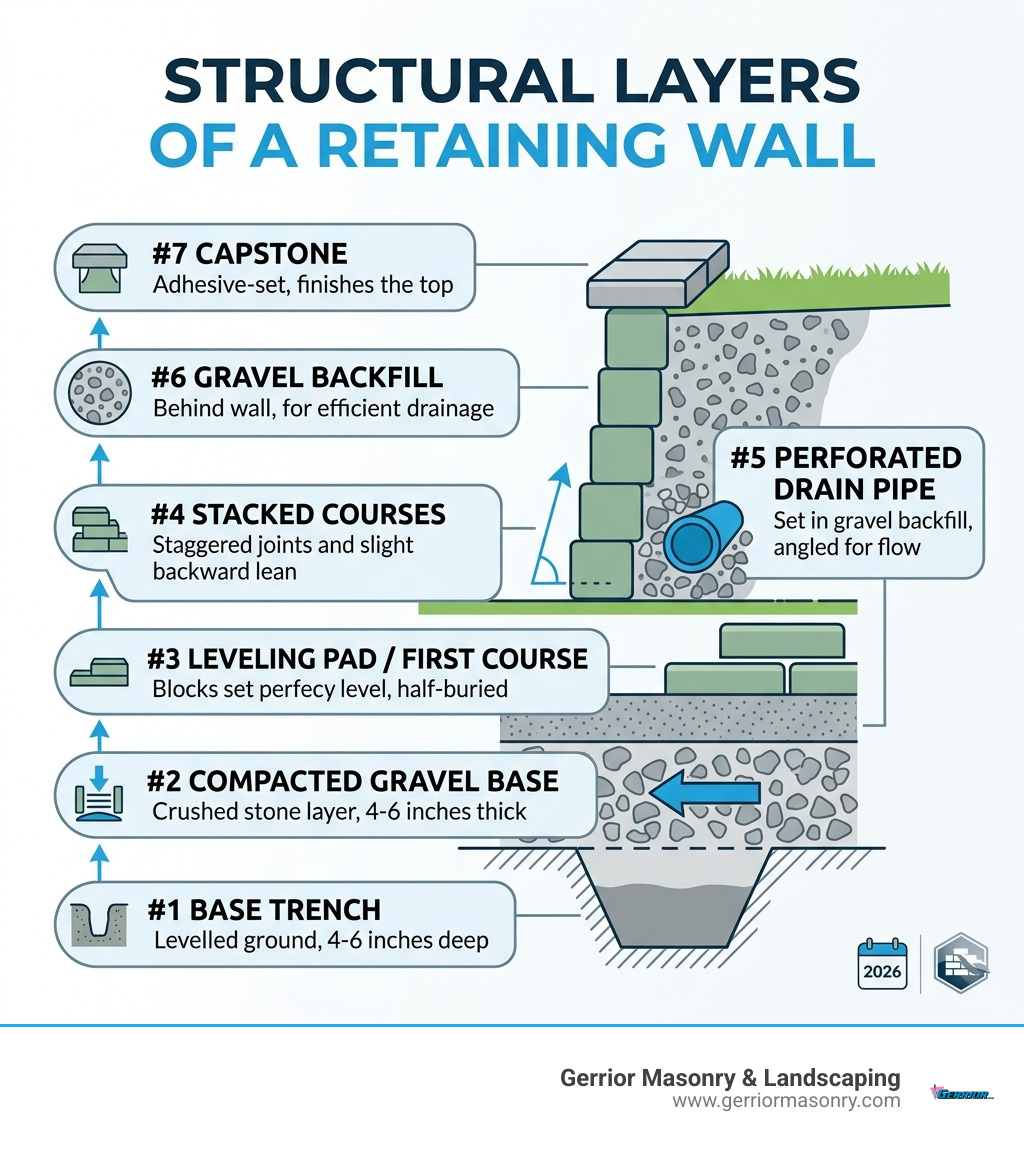
A retaining wall is only as strong as the layers behind it. The visible block face matters far less than the buried base, compacted stone, and drainage components that relieve pressure. When those hidden elements are installed correctly, the finished wall stays straighter, lasts longer, and requires less maintenance over time. Think of the wall as a filter: it must allow water to pass through the drainage zone while holding back the weight of the earth.
Key terms:
Step-by-Step Guide to Paver Retaining Wall Installation
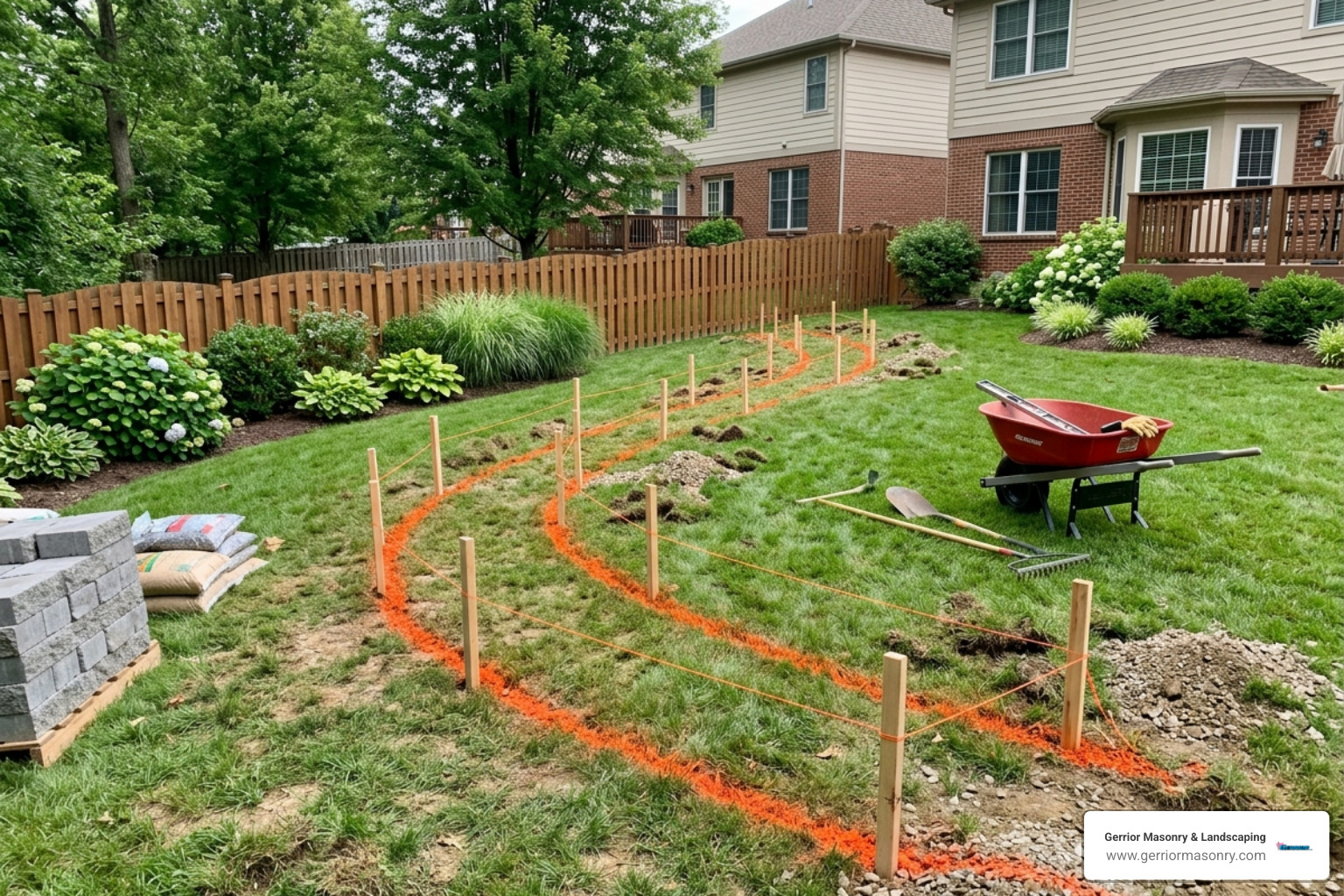
Most DIY-friendly walls under 3 feet are segmental retaining walls using interlocking blocks. Water is the primary cause of failure; saturated soil creates immense pressure, making gravel and drainage pipe essential. Before any digging starts, take time to evaluate where runoff currently travels, whether nearby downspouts discharge toward the wall area, and how the finished grade will move water away from the structure. Understanding the soil type is also vital; clay soils retain more water and expand, requiring more robust drainage than sandy soils.
The Installation Process
- Choose Wall Type: Decorative walls are shorter; true retaining walls hold back slopes. Walls over 36 inches usually require permits and potentially an engineer’s stamp.
- Pick Block System: Interlocking lip blocks are easiest for DIYers to maintain consistent setback and ensure the wall leans slightly into the hill for stability.
- Plan Layout: Use strings for straight walls and garden hoses for curves. Always start at the lowest elevation point to ensure the base remains level as you move uphill.
- Excavate: Remove organic soil (grass and roots) and dig a trench for the compacted crushed-stone leveling pad. The trench should be twice as wide as the block.
- First Course: This must be perfectly level to prevent structural issues later. If the first row is off by even a fraction of an inch, that error will be magnified by the time you reach the top.
- Stacking: Use a running bond pattern to stagger joints. This ensures that no vertical seam runs through the wall, which would create a weak point.
- Drainage: Install a gravel zone, landscape fabric, and perforated pipe behind the wall. The fabric prevents soil from clogging the gaps between the drainage stones.
- Finish: Secure capstones with high-quality masonry adhesive and grade the soil to direct water away from the top of the wall.
Each step supports the next one. If layout is off, the excavation will be inconsistent. If the trench is uneven, the first course will rock. If drainage is skipped, even a good-looking wall can lean or bulge after heavy rain or winter freeze-thaw cycles. That is why experienced installers spend so much time on the parts of the project that disappear once backfilled. The “invisible” work is what determines if the wall lasts 5 years or 50 years.
Essential Tools and Materials
- Blocks: Use specific retaining wall pavers designed for weight-bearing. These are denser and more durable than standard garden edging.
- Base Material: 3/4-inch crushed stone (angular, not round) for the pad. See our guide on base for retaining wall.
- Drainage: 4-inch perforated pipe and non-woven landscape fabric.
- Tools: Shovel, pickaxe, wheelbarrow, 4-foot level, torpedo level, hand tamper or plate compactor, rubber mallet, and a masonry saw with a diamond blade.
You may also need stakes, string line, marking paint, a transit or laser level for larger jobs, and personal protective equipment such as gloves, eye protection, and hearing protection when cutting block. Having the right compaction equipment is especially important because loose base stone will settle later and telegraph problems through the entire wall. A plate compactor is highly recommended over a hand tamper for any wall over 10 feet long.
Foundation and First Course
The base is the most critical element. For walls under 4 feet, a trench 18 inches wide and 4-6 inches deep (plus block burial depth) is standard. Burying at least one full block (or 10% of the wall height) provides necessary stability against “toe kick,” where the bottom of the wall slides outward. Level the base side-to-side and front-to-back meticulously using a screed pipe or a long straightedge. For more on methods, see Build Retaining Walls.
Take extra time with this course. Check each block individually, then check across multiple blocks as the row grows. Small errors compound quickly, especially on curved walls or long runs. If one section is high, resist the urge to fix it by adding loose material underneath; remove the block, correct the base, recompact, and reset it properly. The first course is the only one that needs to be perfectly level; subsequent courses will follow its lead.
Managing Drainage and Backfill
Hydrostatic pressure—the weight of water trapped in the soil—causes walls to bulge and eventually fail. To prevent this:
- Gravel Chimney: Maintain a 12-inch wide gravel zone of clean, 3/4-inch crushed stone directly behind the blocks.
- Drain Pipe: Place perforated pipe at the base, sloped 1 inch per 4 feet toward an outlet. Details: Retaining Wall Drain Pipe Installation.
- Compaction: Backfill with gravel in 6-inch lifts and compact thoroughly. Avoid using heavy machinery directly against the wall, as the lateral pressure can push the blocks out of alignment.
Landscape fabric helps separate soil from the gravel zone so fines do not clog drainage over time. The top of the wall should also be considered part of the drainage plan. If topsoil is pitched toward the wall, runoff can still saturate the backfill, so final grading should always move water outward and away. In areas with heavy rainfall, consider a “swale” or a shallow trench behind the wall to catch surface water before it reaches the structure.
Safety and Reinforcement
Call 811 before digging to locate utilities. For walls exceeding 3-4 feet, geogrid reinforcement and professional engineering are typically required to handle the load. Geogrid is a high-strength synthetic mesh that is sandwiched between layers of block and extended back into the soil to create a larger, unified mass. Learn more at Build Retaining Walls.
Additional caution is needed if the wall supports a driveway, sits near a foundation, or carries surcharge loads such as parked vehicles, sheds, or steep slopes above. In these cases, professional design is often the safest path because soil conditions and loading can change the wall requirements significantly. A wall holding back a flat lawn is under much less stress than a wall holding back a slope that continues to rise behind it.
Planning Your Project: Costs, Materials, and Professional Help
Calculating Materials
To find the number of blocks: (Wall Length x Height) / Square-foot coverage per block. Always add 10% extra for cuts, breakage, and future repairs. Also account for cap units, which are often sold separately, as well as base stone, drainage gravel, and pipe. Don’t forget the masonry adhesive; you’ll typically need one tube for every 10-15 linear feet of capping.
Common Mistakes
- Skipping compaction: This is the #1 cause of settling and wavy walls.
- Using soil for backfill: Soil holds water; gravel allows it to drain. Never use dirt behind the blocks.
- Using pea gravel: Round stones like pea gravel act like ball bearings and do not lock together for stability.
- Ignoring Surcharge: Failing to account for the weight of a car or a shed near the top of the wall.
- Failing to bury the first course: A wall sitting on top of the ground has no resistance to sliding.
Finishing Touches
Clean the top course thoroughly with a brush before applying construction adhesive to caps. A 1 to 1.5-inch overhang helps shed water away from the face of the wall, preventing staining and erosion. Grade the final topsoil so water runs away from the wall structure, and consider planting low-maintenance groundcover to further stabilize the soil.
Estimating Costs for Your Paver Retaining Wall Installation
Note: These are average costs based on internet data and not actual costs for Gerrior Masonry services.
| Material type | Pros | Cons | Best for |
|---|---|---|---|
| Interlocking Block | DIY-friendly, consistent | Manufactured look | Most residential walls |
| Poured Concrete | Extremely strong | Cracking risk, not DIY | Structural engineering |
| Natural Stone | Timeless, high value | Labor intensive, high cost | Premium landscapes |
Typical Installed Price Ranges (Internet Averages):
- Professional installation: $30 to $110 per square foot.
- Premium or complex builds: $120 to $400 per square foot.
- DIY budget (3ft x 30ft wall): $1,000 to $2,500 depending on materials.
For high-end aesthetics, see Natural Stone Retaining or Brick Retaining Wall Ideas.
When to Hire a Professional Mason
DIY is suitable for low, dry-site walls. Hire a professional if the wall is over 3 feet, supports a driveway, or involves complex drainage. Professional masons have access to heavy compaction equipment and laser levels that ensure a level of precision difficult to achieve with hand tools. Gerrior Masonry & Landscaping provides expert oversight to ensure walls survive New England’s freeze-thaw cycles.
Resources for finding help:
Gerrior Masonry & Landscape Construction is based in Woburn, MA, and services Middlesex and Essex County, Massachusetts. We specialize in creating durable, beautiful structures that enhance both the utility and the value of your property.
