Why Building a Dry Well for Drainage Could Save Your Yard (and Your Foundation)
Building a dry well for drainage is one of the most effective ways to stop standing water from damaging your yard, foundation, and landscaping. Here’s a quick overview of how it works:
How to build a dry well for drainage — quick summary:
- Test your soil — Dig a 12-inch hole, fill it with water, and measure how fast it drains. You need at least 0.5 inches per hour.
- Pick your location — At least 10 feet from your foundation, away from septic systems and utility lines.
- Dig the pit — Typically 3–4 feet deep and 3–4 feet wide, depending on your drainage area.
- Line with filter fabric — Wrap the hole in non-woven geotextile fabric to keep soil out.
- Fill with washed stone or install a prefab unit — Gravel or a perforated plastic barrel collects and slowly releases water into the soil.
- Connect your inlet pipe — Slope it at least 1/4 inch per foot from the water source (downspout, sump pump, etc.).
- Backfill and restore — Cover with soil, sod, or plants.
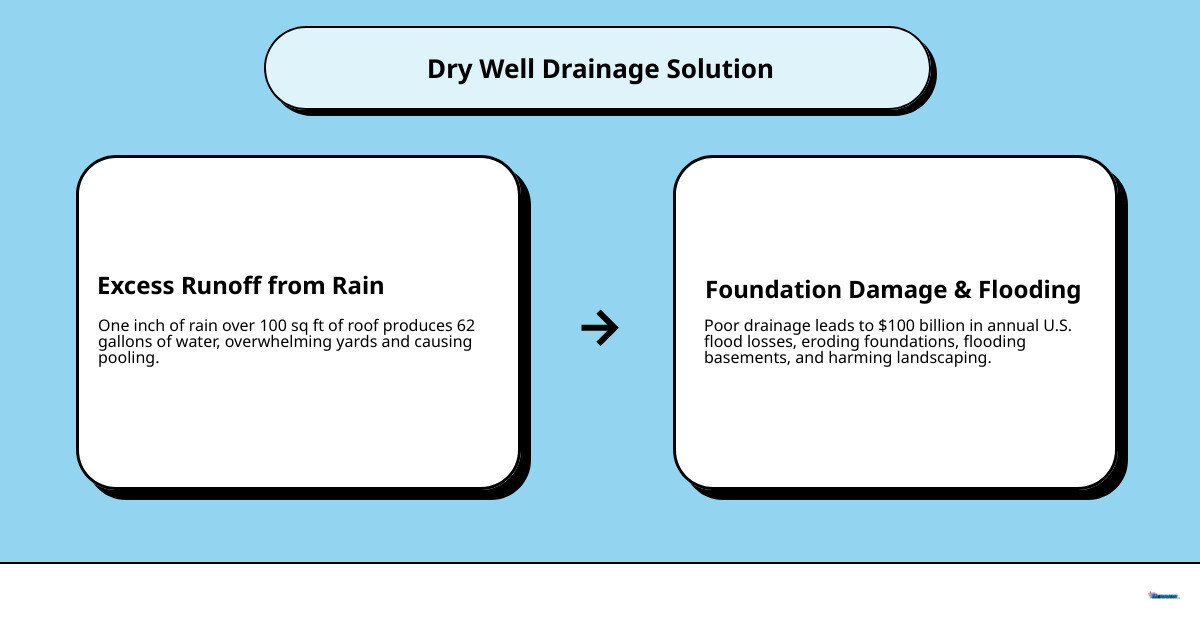
Every year, poor drainage causes billions of dollars in property damage across the United States. In fact, flood-related losses run an estimated $100 billion annually — and a waterlogged backyard is often the first warning sign. What most homeowners don’t realize is that just one inch of rain produces roughly 62 gallons of runoff for every 100 square feet of roof or hard surface. That water has to go somewhere — and if your yard can’t handle it, your foundation, landscaping, and even your basement will pay the price.
In suburban environments like those found in Woburn or Burlington, the prevalence of impermeable surfaces—driveways, patios, and roofs—means that rainwater has nowhere to go. This leads to “sheet flow,” where water moves across the surface, picking up pollutants and eroding topsoil. By building a dry well, you are essentially creating a localized groundwater recharge station, which is a cornerstone of modern Low Impact Development (LID) practices. Instead of pooling on the surface or seeping toward your home, it gets directed underground, where it slowly infiltrates the soil and recharges the groundwater below.
I’m Joe Gerrior, owner of Gerrior Masonry & Landscape Construction Corp., and after 34 years of solving drainage problems for Massachusetts homeowners, building a dry well for drainage is one of the most practical and cost-effective solutions I recommend. In this guide, I’ll walk you through everything you need to know — from soil testing to final installation.
Common building a dry well for drainage vocab:
The Essentials of Building a Dry Well for Drainage
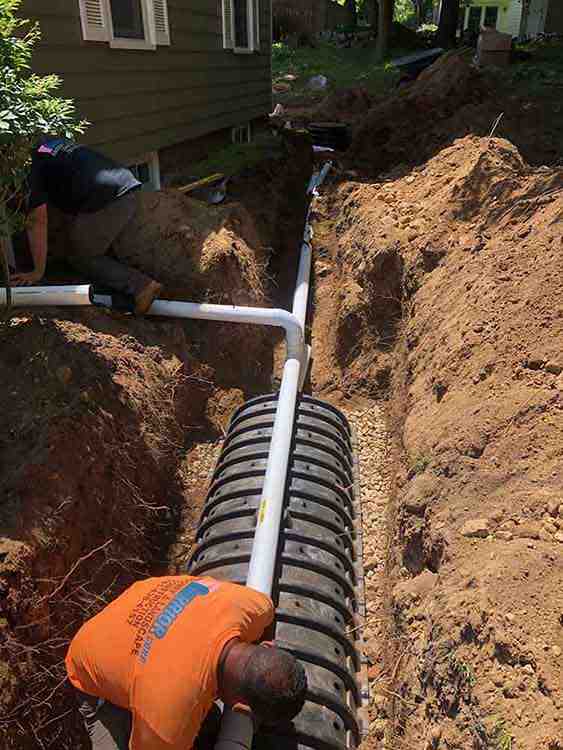
When we talk about building a dry well for drainage, we are essentially talking about creating an underground storage tank for rainwater. Think of it as a “waiting room” for runoff. During a heavy Middlesex County thunderstorm, the ground often can’t absorb water as fast as it falls. The dry well catches that surge, holds it safely away from your home, and lets it “wait” until the surrounding soil is ready to soak it up.
There are two primary ways to construct these systems: traditional gravel-filled pits and modern prefabricated systems.
| Feature | Traditional Gravel Well | Prefabricated (Plastic) Well |
|---|---|---|
| Storage Capacity | Lower (~40% void space) | Higher (Empty hollow chamber) |
| Installation Effort | High (Moving tons of stone) | Moderate (Lightweight barrel) |
| Longevity | Moderate (Prone to silting) | High (Easier to protect/clean) |
| Best For | Small runoff areas | Large roofs or sump pumps |
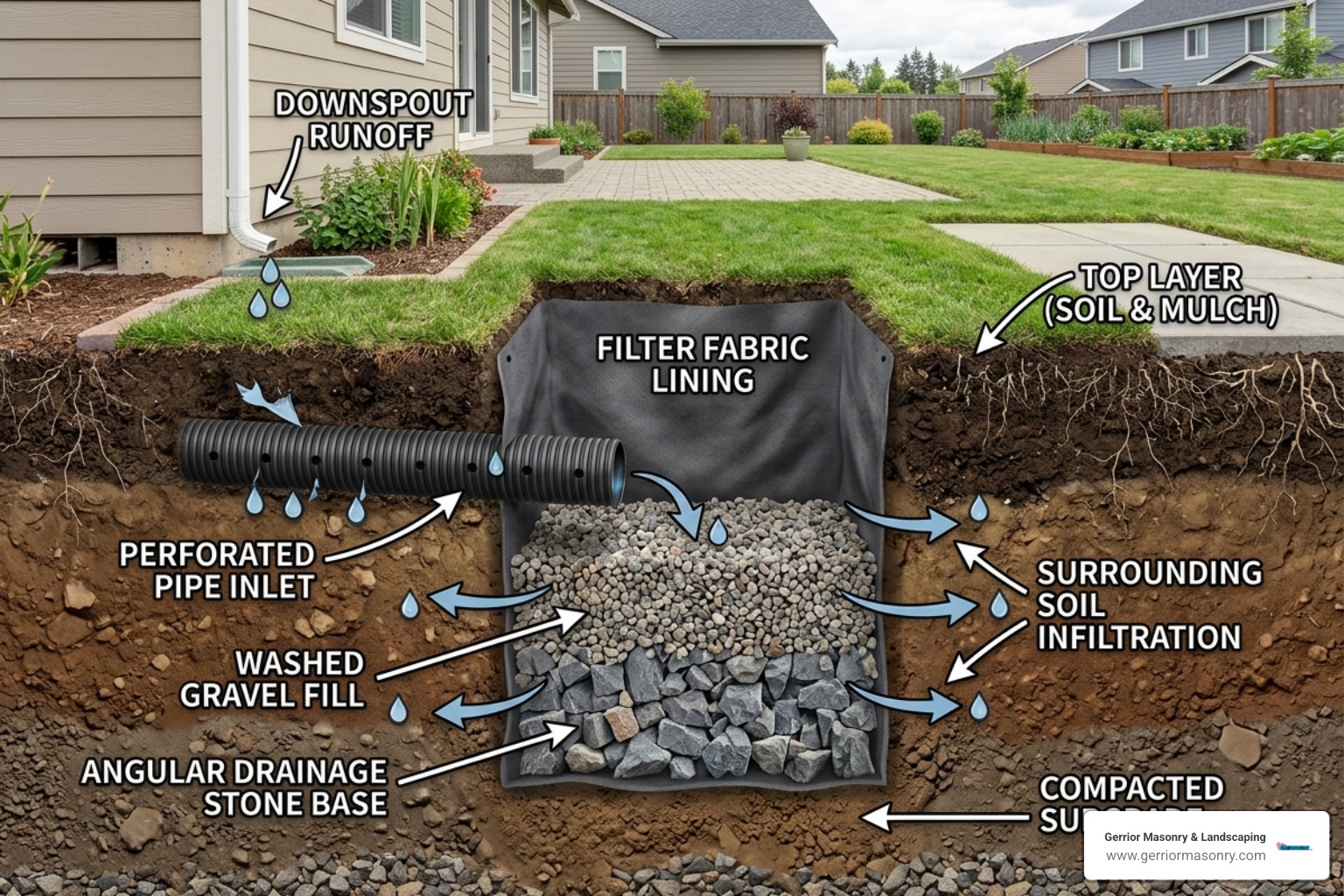
Traditional wells rely on the “void space” between rocks. If you fill a hole with washed stone, about 40% of that hole is still empty air where water can sit. A typical 3’x3’x3’ traditional well provides about 11 cubic feet of actual water storage. Modern prefabricated systems, like perforated plastic barrels, offer nearly 100% void space inside the unit, meaning you get much more storage in a smaller footprint.
To size your well correctly, you need to estimate the volume of water it will receive. A common rule of thumb is to design for a 1-inch rain event. If you are draining 500 square feet of roof, that’s about 310 gallons of water. Since one cubic foot holds about 7.48 gallons, you would need roughly 41 cubic feet of storage. If using a prefab unit like an NDS Flo-Well, which holds about 50 gallons, you might need multiple units connected in a series to handle a large roof section.
Determining Soil Suitability and Percolation Rates
Before you start swinging a pickaxe, we need to make sure your soil can actually handle the water. If you have heavy clay—common in parts of Essex County—a dry well might just turn into an underground pond that never empties.
To check this, you must perform a percolation test (or “perc test”):
- Dig a hole about 12 inches deep in the area where you want the well.
- Fill it with water and let it drain completely to saturate the area.
- Refill it and measure how far the water level drops in one hour.
For a dry well to be effective, the soil must infiltrate at a rate of at least 0.5 inches per hour. Sandy soils are the “gold standard,” typically draining within 24–48 hours. If you’re dealing with heavy clay, it could take 3–7 days to empty, which might lead to overflow during back-to-back storms. For a deep dive into the physics of this, you can check out this Scientific research on dry well design.
Site Planning and Setbacks for Building a Dry Well for Drainage
Location is everything. We’ve seen DIY projects where the homeowner installed a dry well too close to the house, effectively injecting water directly into their own basement. To avoid this, follow these strict setbacks:
- Foundation: At least 10 feet away (12-15 feet is even better). You can find More info about drainage around house foundation here to see why this distance matters.
- Septic Systems: Keep at least 50 feet away from any septic tanks or leach fields to prevent interference.
- Property Lines: Usually at least 3–5 feet away to avoid dumping your water onto the neighbor’s lawn.
- Water Table: The bottom of your well should be at least 4 feet above the seasonal high water table.
Crucial Step: Before you dig, call 811 (DigSafe). In Massachusetts, hitting a gas or power line isn’t just dangerous; it’s an expensive mistake that will ruin your weekend faster than a flooded basement.
Step-by-Step Guide to Installation and Maintenance
Is building a dry well for drainage a feasible DIY project? For a healthy homeowner with a strong back and a few weekends to spare, yes. However, it is labor-intensive. You’ll be moving hundreds of pounds of soil and stone. If the thought of digging a 4-foot deep pit makes your joints ache, you might want to consider professional help.
Safety is paramount. Ensure the sides of your excavation are stable so they don’t cave in while you’re working. If you’re digging a trench for the inlet pipe, remember the “golden rule” of drainage: water doesn’t flow uphill. You need a consistent slope of 1/4 inch per foot leading toward the well.
For a visual look at the process, How to install a dry well offers great supplementary photos.
Materials and Tools for Building a Dry Well for Drainage
To do the job right, we recommend gathering all your materials beforehand. You don’t want to be stuck with an open pit in your yard when a surprise rainstorm hits.
Essential Tool List:
- Shovel and pickaxe (or rent a small power excavator).
- Level (to check pipe pitch).
- Hacksaw (for cutting PVC).
- Landscape fabric staples.
- Wheelbarrow.
Required Materials:
- Landscape Fabric: Use non-woven geotextile fabric. This is the “skin” of your dry well; it lets water through but keeps soil from clogging your stones. Never use woven weed barrier; it will clog instantly.
- PVC Piping: 4-inch diameter is standard. Use solid pipe near the house and perforated pipe once you’re at least 10 feet away.
- Catch Basins: These act as a “pre-filter” to catch leaves and sediment before they enter the well. Check out More info about dry well catch basins for details.
- Washed Stone: 3/4-inch to 1.5-inch rounded stones are best. Avoid “crusher run” or stone with “fines” (dust), as these will clog the system.
The 5-Step Installation Process
Here is how we typically handle a dry well project at Gerrior Masonry:
- Excavation: Dig your pit. For a standard residential prefab unit, a hole 4 feet wide and 4 feet deep is common. Dig your connecting trench from the downspout or soggy area.
- Lining: Line the entire pit with landscape fabric. Leave enough extra at the top to fold over like a present once the well is full.
- Assembly: If using a prefab unit, knock out the drainage ports and place it in the center. If building a traditional gravel well, fill the bottom 6 inches with stone. Connect your inlet pipe, ensuring the 1/4-inch-per-foot pitch. Pro Tip: Prefab units need to breathe. If air can’t escape, water can’t get in, so ensure you install an air vent.
- Backfilling: Fill the space around the prefab unit with washed stone. If it’s a gravel well, fill the entire pit with stone to within 6–12 inches of the surface. Fold the landscape fabric over the top of the stone.
- Restoration: Top the fabric with a final layer of stone or cover with soil and sod. We often recommend adding an overflow emitter—a pop-up valve that lets water escape safely to the surface if the well ever completely fills up during a “once-in-a-century” storm. For more on managing roof water, see More info about gutter runoff solutions.
Estimating Costs and Professional Considerations
When planning your budget, keep in mind that these are average costs based on internet data and not actual costs for Gerrior Masonry services. Prices can vary wildly based on your soil type and how much manual labor is involved.
- DIY Installation: Generally ranges from $950 to $3,500. This covers the prefab unit ($150–$500), gravel, pipe, fabric, and tool rentals.
- Professional Installation: For a small residential system, you might see quotes between $1,200 and $5,000. For large-scale residential drainage or commercial-grade systems, costs can range from $6,000 to over $20,000.
Why the wide range? If we hit a ledge (solid rock) or have to navigate complex underground utilities, the price goes up. You can find More info about dry well installation costs to help you plan your project.
Long-Term Maintenance and Troubleshooting
A dry well is mostly “set it and forget it,” but it isn’t immortal. Over time, fine silt and sediment can build up.
- Annual Check: Every autumn, clean your gutters and check the catch basins. If the catch basin is full of gunk, that’s gunk that didn’t go into your dry well—which is a good thing!
- Slow Drainage: If you notice water pooling over the well days after a rain, the fabric or the soil may be clogged. Sometimes a high-pressure flush with a garden hose can help, but eventually, the stone may need to be replaced.
- Winter Concerns: In Massachusetts, the ground freezes. If your inlet pipe is too shallow, water can freeze inside it and back up. We ensure pipes are buried deep enough and sloped perfectly to prevent standing water from turning into an ice plug.
The environmental benefits of building a dry well for drainage are significant. By keeping water on your property, you’re reducing the load on municipal storm sewers and preventing local stream erosion. It’s a sustainable choice that pays dividends in property value and peace of mind.
If you’re unsure about the soil or the scale of the project, it’s always wise to consult with More info about professional dry well installers. We can help ensure the system is sized correctly for your roof area and local rainfall patterns.
Gerrior Masonry & Landscape Construction is based in Woburn, MA, and services Middlesex and Essex County, Massachusetts.