Understanding the True Investment in Chimney Mortar Repair
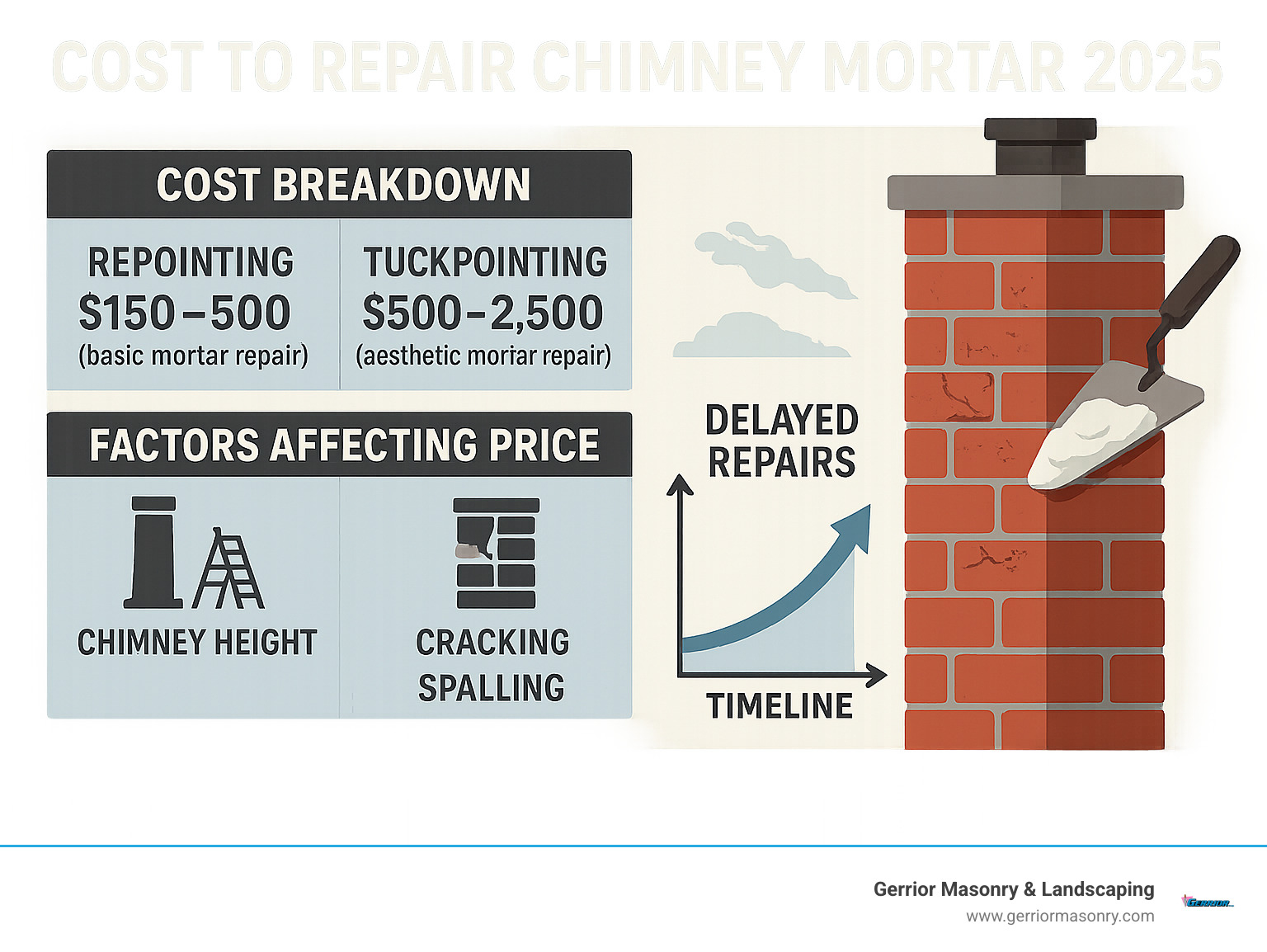
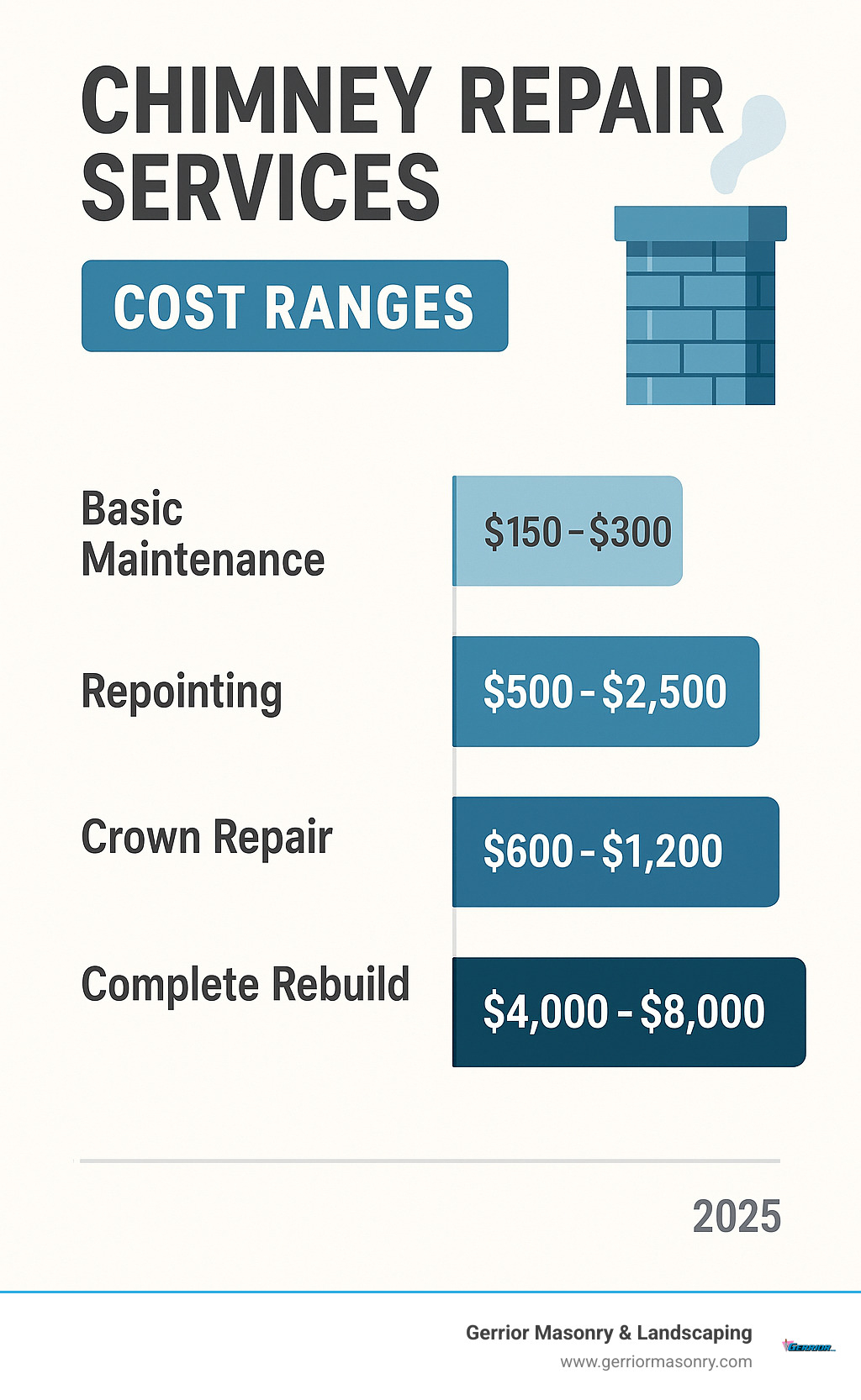
The cost to repair chimney mortar typically ranges from $150 to $2,500, but this depends heavily on the extent of the damage and the repair method required.
These are average costs based on internet data and not actual costs for Gerrior Masonry services.
When you spot crumbling mortar on your chimney, the first question is usually about cost. But the real answer depends on timing. A small crack that costs $200 to fix today can escalate into a $15,000 chimney rebuild if water damage spreads to the structure.
Mortar typically lasts 25-30 years, but harsh Massachusetts weather accelerates this timeline. Freeze-thaw cycles are brutal on mortar joints, causing them to crack and crumble much faster than in warmer climates.
Several key factors influence your final bill: the height of your chimney, its accessibility, whether scaffolding is needed, and most importantly, the extent of the damage.
I’m Joe Gerrior, owner of Gerrior Masonry & Landscape Construction Corp. With over 34 years of experience, my team has seen how early intervention saves homeowners thousands compared to waiting for structural damage.
Understanding Chimney Mortar Repair Costs and Processes
Your chimney works hard year-round against New England’s weather. Understanding what to look for and what drives repair costs can save you thousands and prevent serious safety hazards.
What Are the Signs Your Chimney Mortar Needs Repair?
Chimneys send clear distress signals. The trick is to read them before small problems become expensive ones.
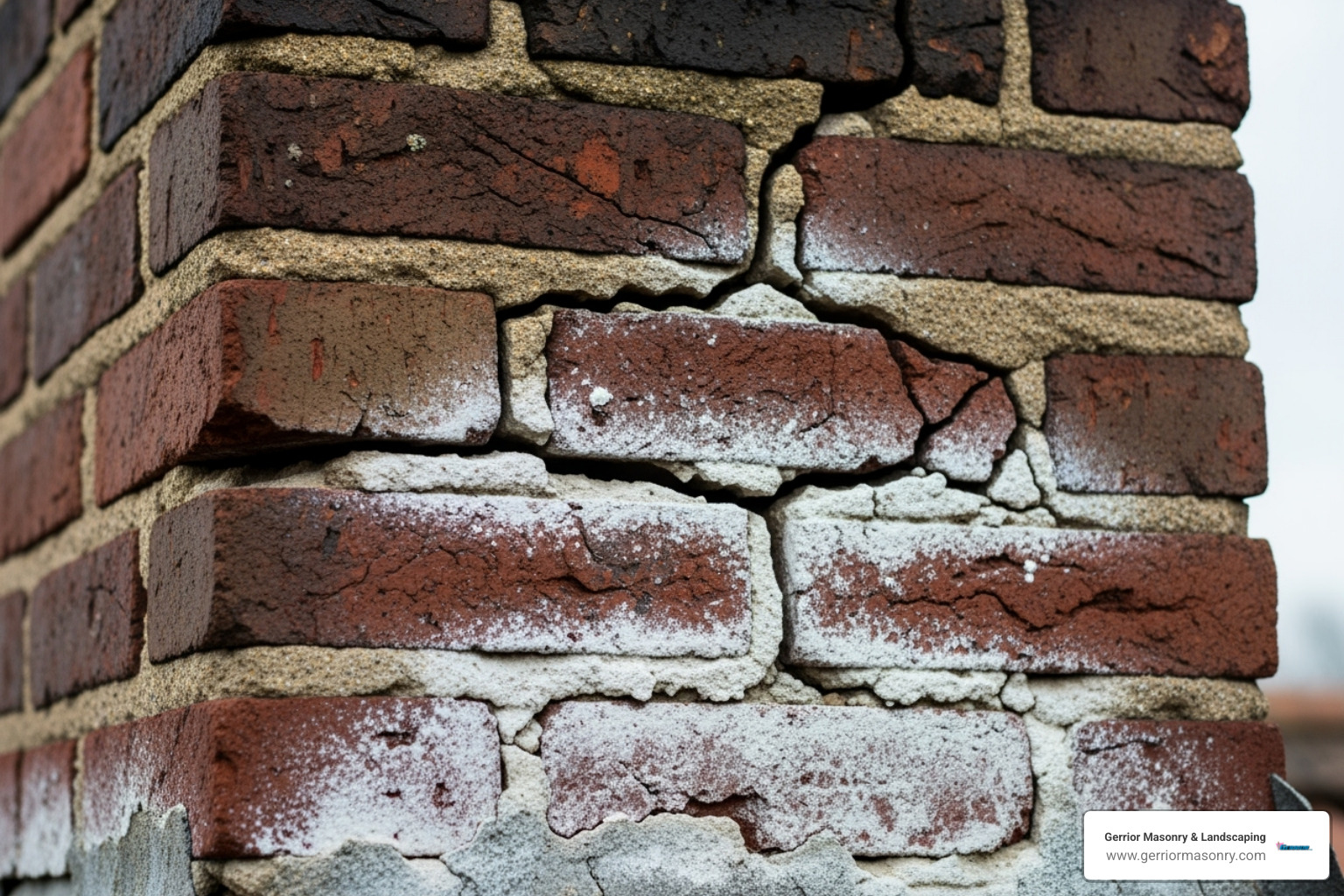
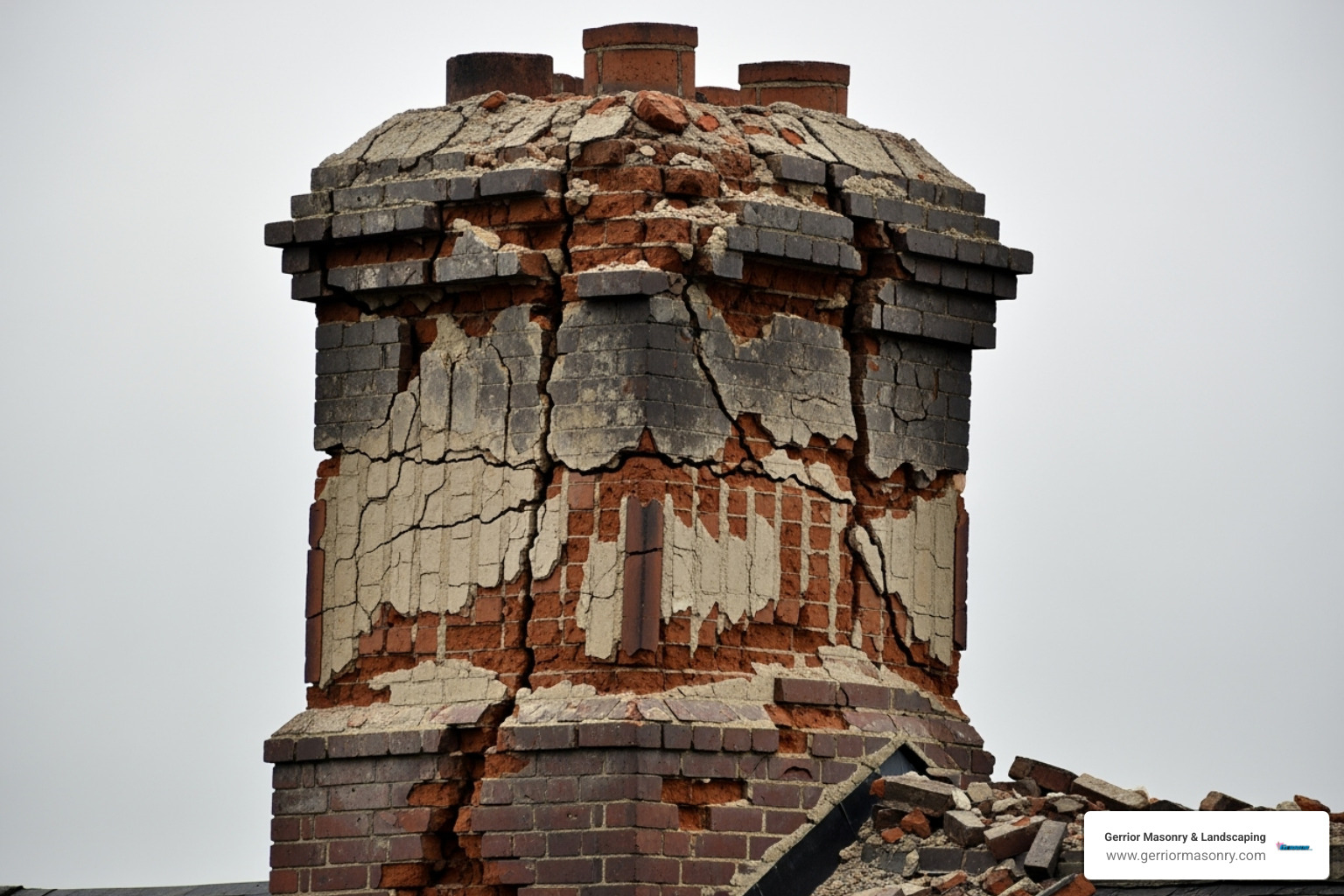
Visible cracks are the first red flag. Water enters these cracks, freezes, and expands, worsening the damage each winter.
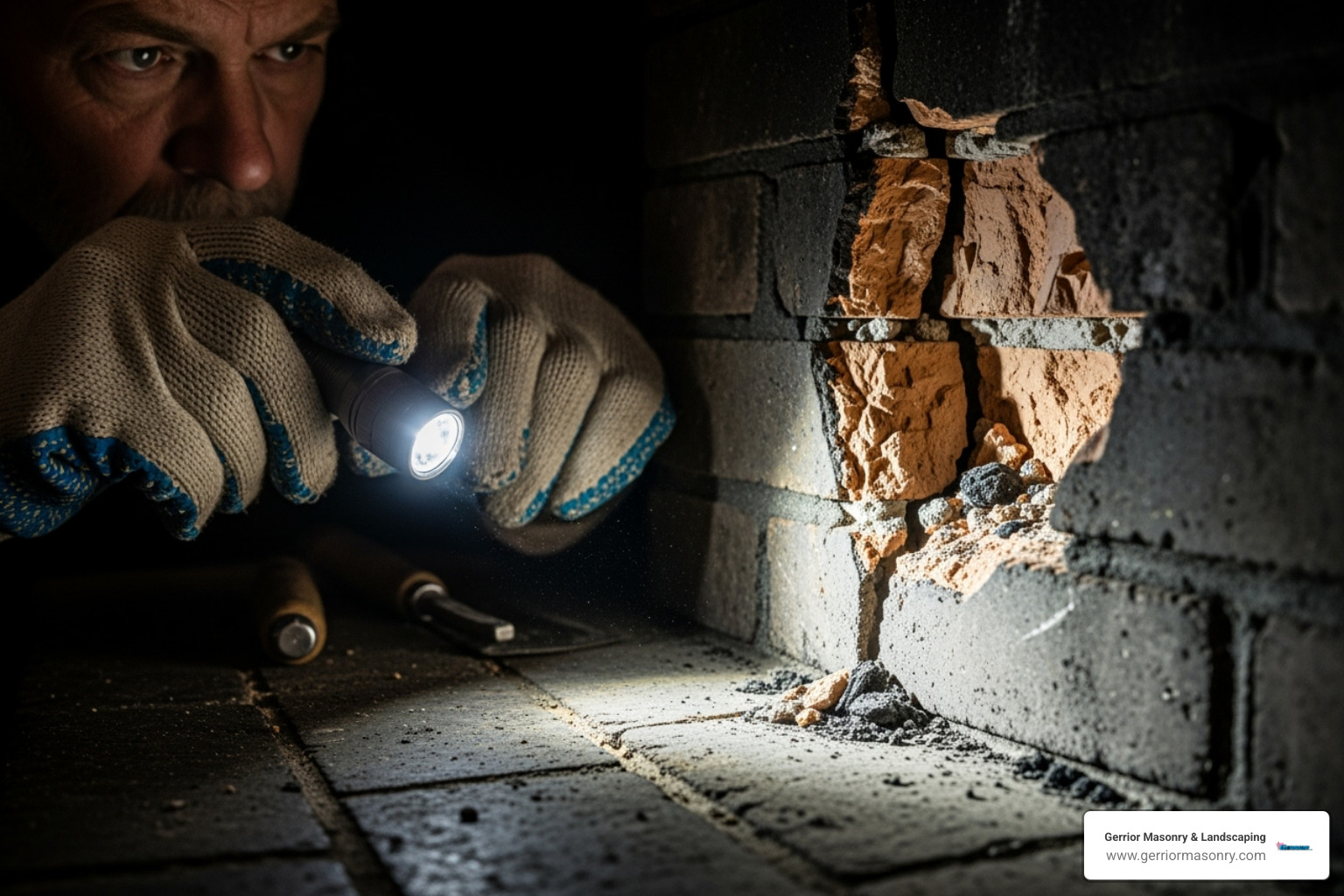
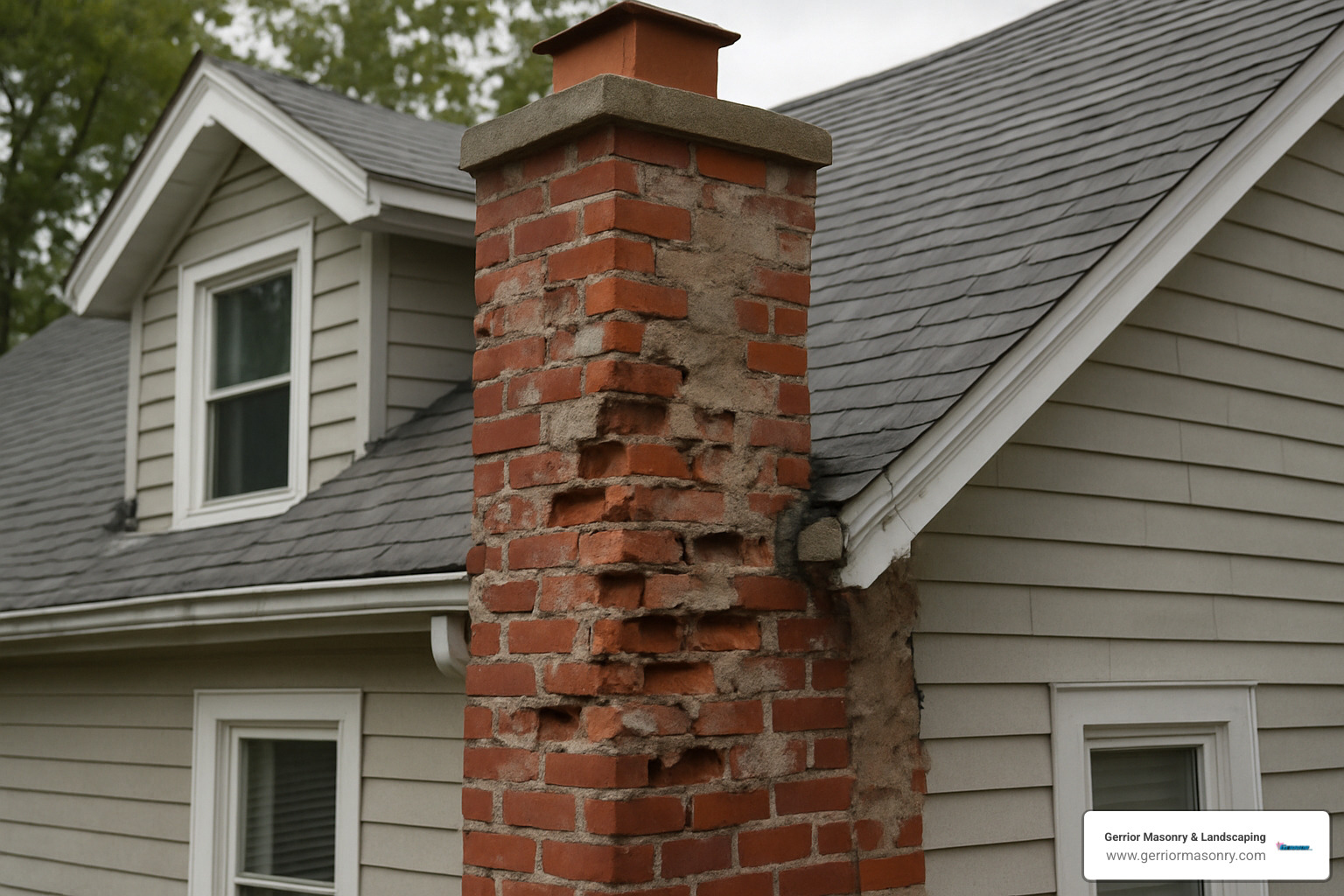
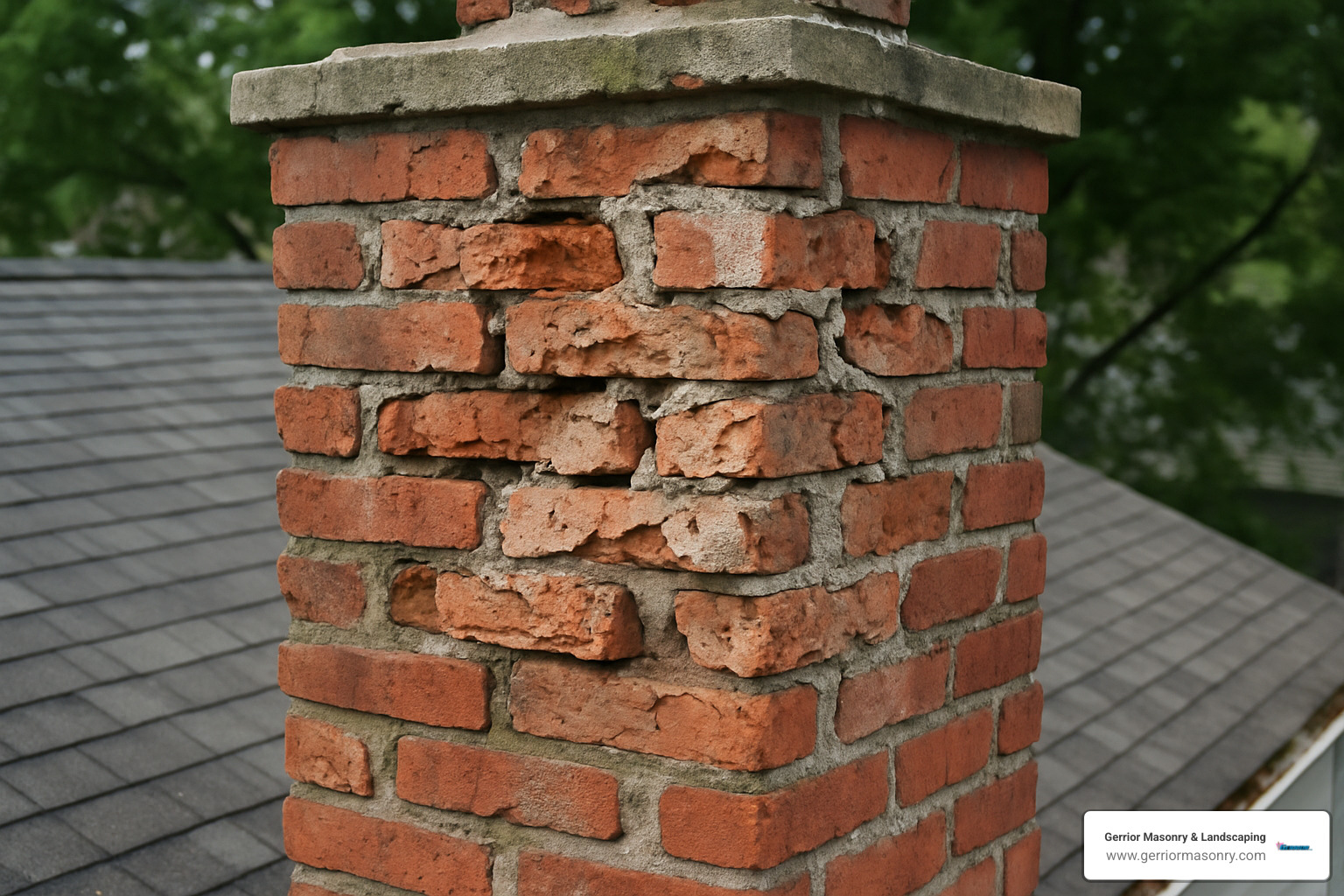
Crumbling or missing mortar directly compromises your chimney’s structural integrity. If you can scrape it away easily, it’s time for a repair.
Spalling bricks (flaking or peeling surfaces) occur when trapped moisture freezes and pops off the brick face, signaling a water intrusion problem.
White, chalky stains (efflorescence) indicate water is moving through the masonry and leaving salt deposits as it evaporates.
Water leaks in your attic or near the fireplace are a serious sign your chimney is failing to keep moisture out.
Subtler signs include a rusted damper or odd smells. A leaning chimney is an emergency requiring immediate professional attention.
Key Factors That Influence the Cost to Repair Chimney Mortar
The cost to repair chimney mortar is not a one-size-fits-all answer. Several factors determine your final bill.
Extent of damage is the biggest cost driver. Minor cracks might cost $150-$500, but widespread failure can reach $5,000. A full rebuild can exceed $20,000.
Chimney height and accessibility affect labor costs. Taller chimneys or steep roofs may require scaffolding, adding several hundred to a few thousand dollars to the project.
Brick and mortar type matters. Historic homes often need softer, lime-based mortars to prevent damage to the original bricks, which requires specialized knowledge.
Labor is about 90% of the cost, with skilled masons charging $50-$150 per hour. Emergency rates can be as high as $300 per hour.
Additional costs can include permits ($150-$2,000), detailed inspections ($100-$1,000), and debris removal.
If you’re dealing with foundation issues that might be affecting your chimney, our foundation repair services can help address structural problems at their source.
Average Cost to Repair Chimney Mortar: Repointing vs. Tuckpointing
Two common repair terms are repointing and tuckpointing. They serve different purposes and have different costs to repair chimney mortar.
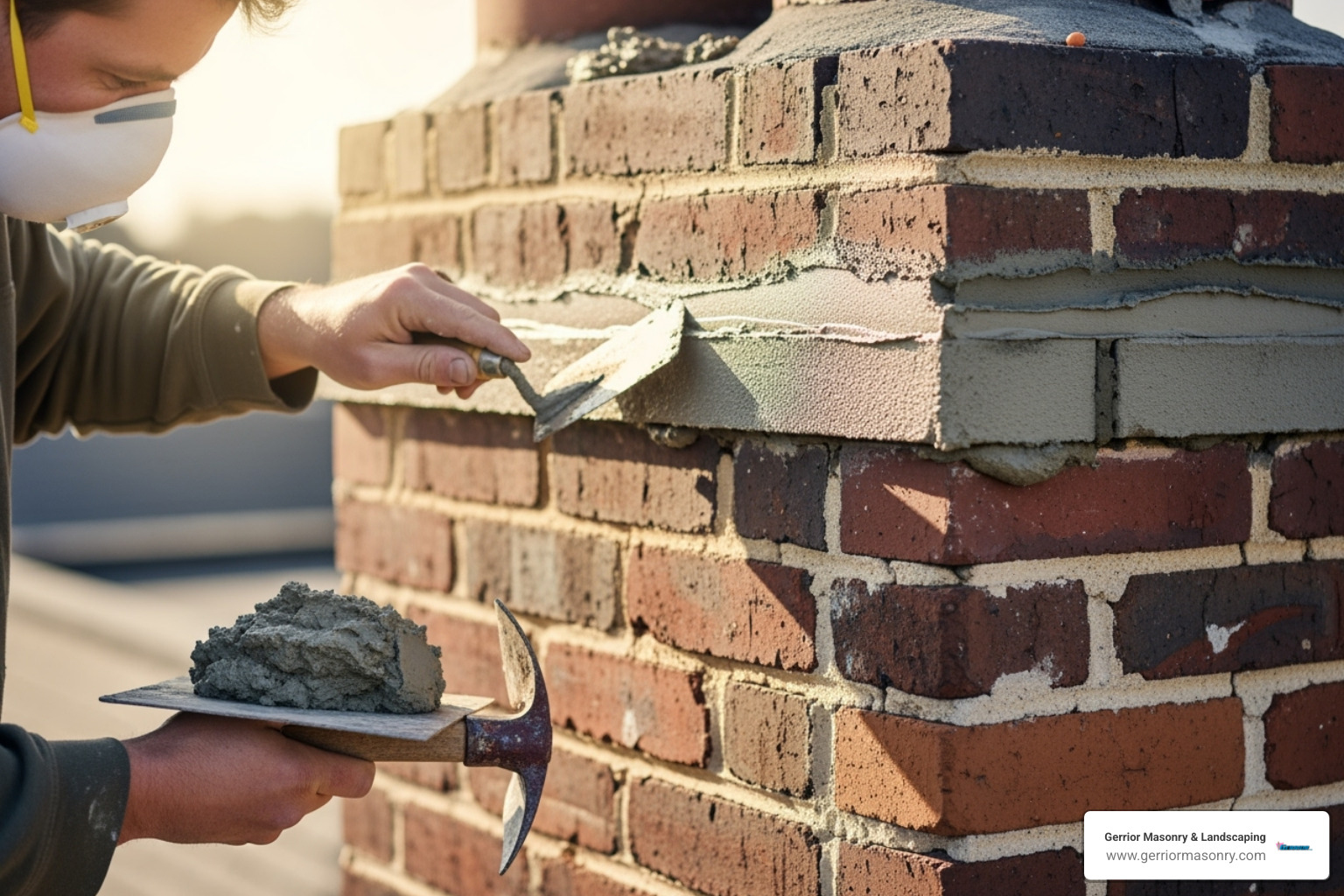
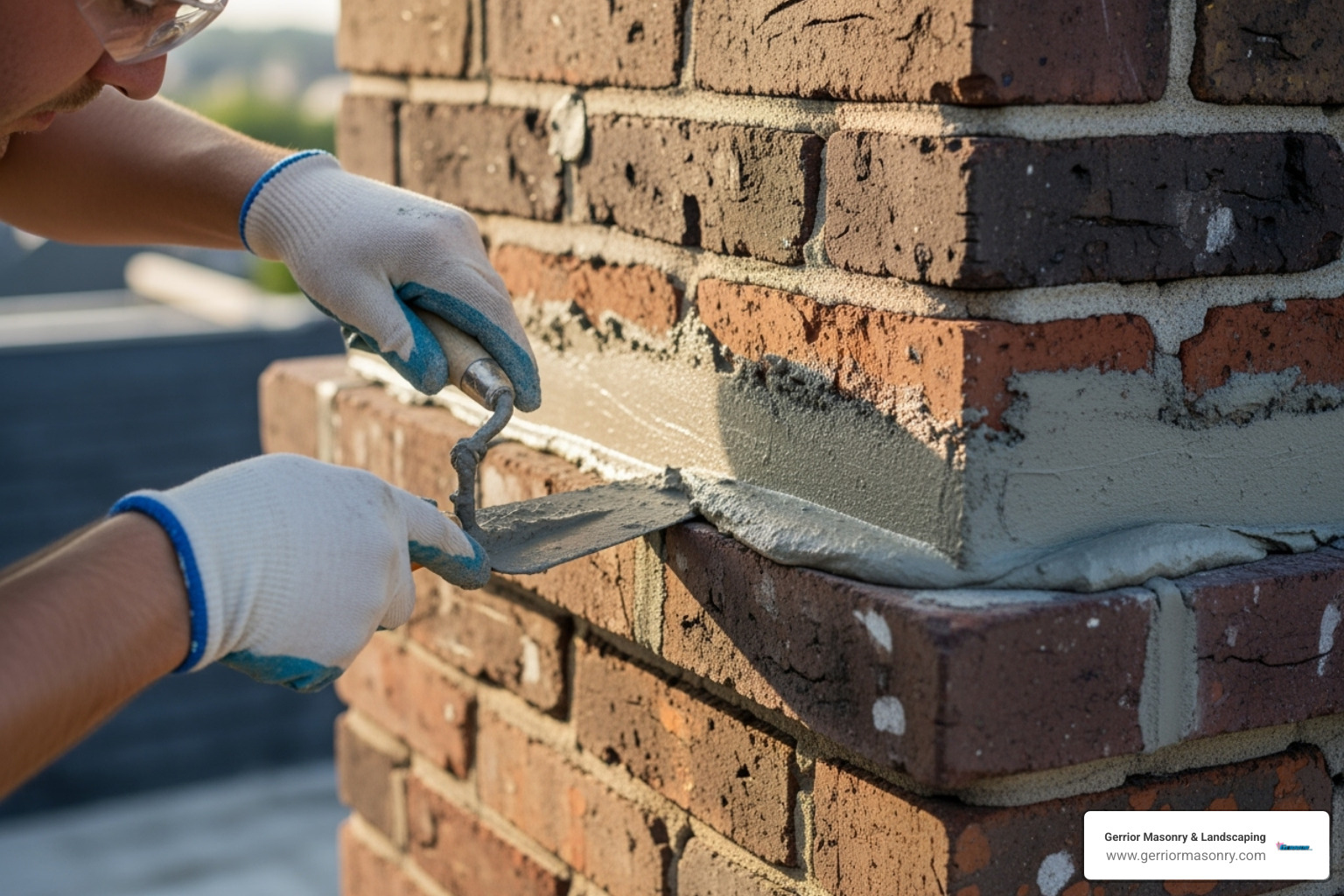
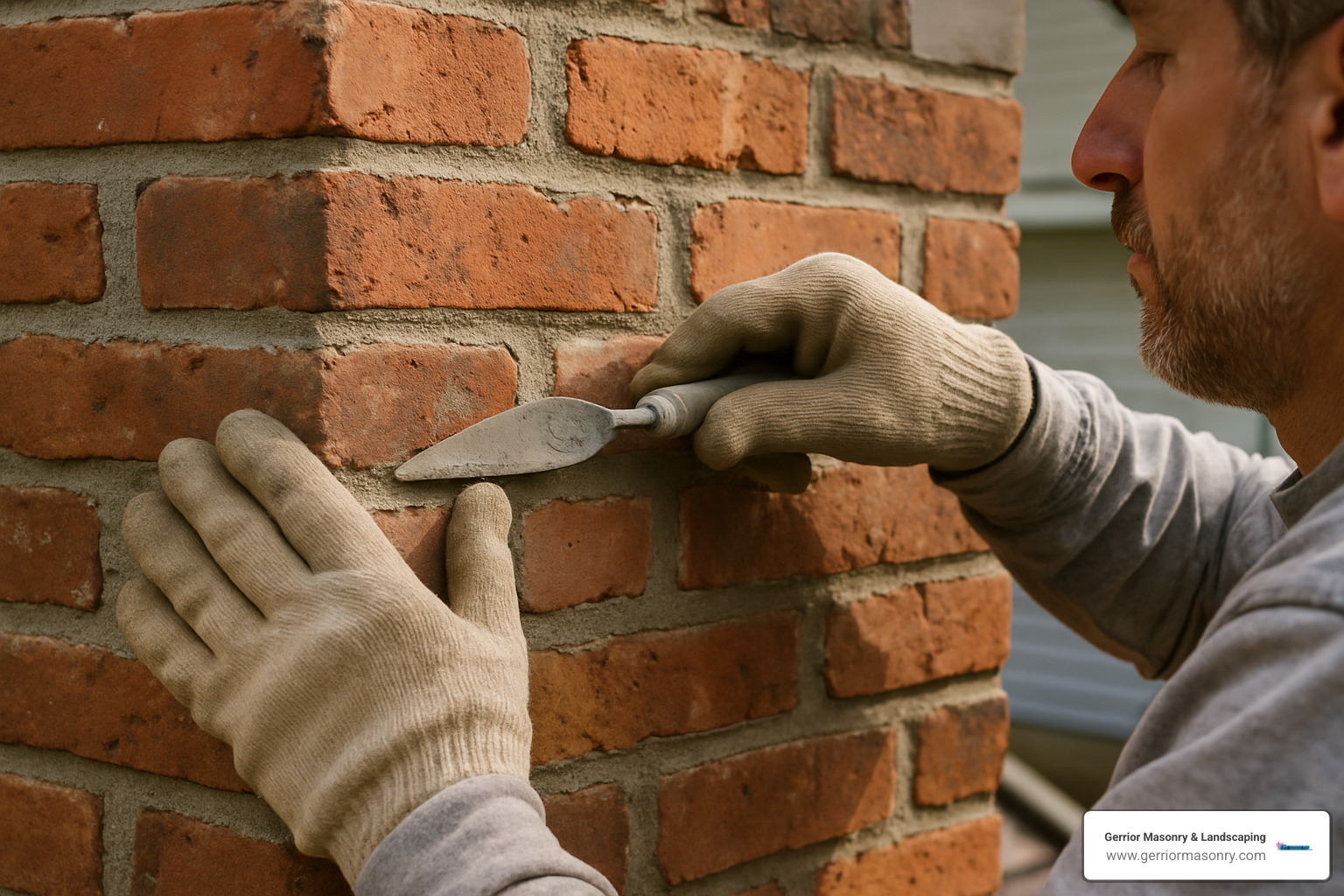
Repointing is a structural repair. We remove old, failing mortar and replace it to restore the chimney’s integrity and weather resistance.
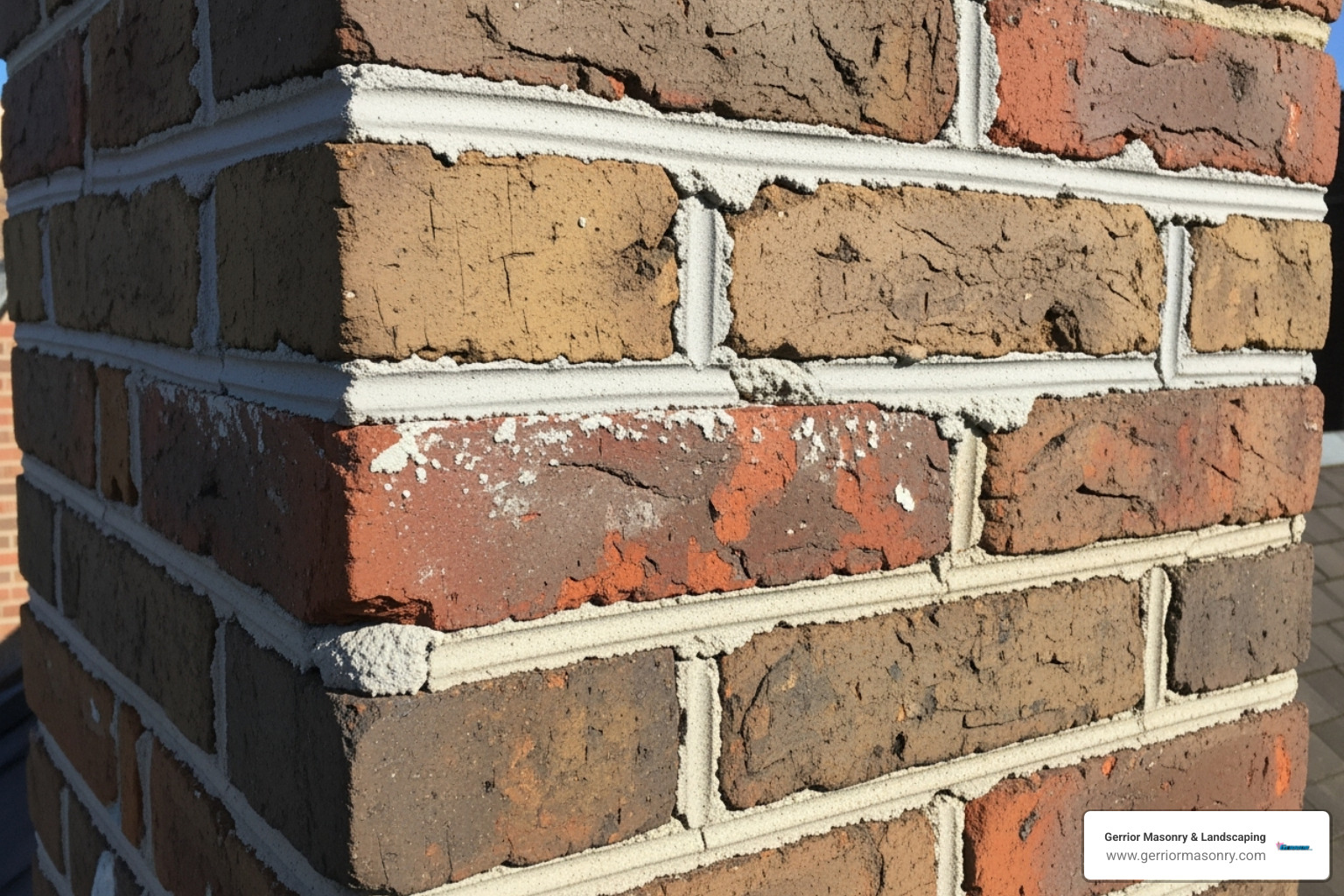
Tuckpointing is a cosmetic improvement performed after repointing. We apply thin, contrasting lines over the new mortar to create a sharp, clean look.
These are average costs based on internet data and not actual costs for Gerrior Masonry services.
Repointing typically costs $150-$500 for basic repairs, though extensive work can reach $2,200. Per square foot, expect $4-$25 plus labor.
Tuckpointing runs higher, from $500-$2,500 for most projects, with costs around $10 per square foot being common.
Feature
Repointing
Tuckpointing
Primary Goal
Structural integrity, weatherproofing
Structural integrity + improved aesthetics
Mortar Used
Single color matched to existing
Two colors: structural + contrasting accent line
Appearance
Clean, restored joints
Sharp, precise lines with visual contrast
Complexity
Standard skilled masonry
Highly precise artistic masonry
Typical Cost
$150-$500 (basic repairs)
$500-$2,500
Lifespan
25-30 years
25-30 years
Both methods provide the same structural benefits. The choice comes down to budget and your desired curb appeal. For more information, visit our repointing services page.
The Mortar Repair Process and Timeline
Our mortar repair process is systematic to ensure quality results. The steps include:
Inspection: We thoroughly assess the chimney to identify all damage upfront.
Preparation: We set up safe access equipment and protect your property from debris.
Mortar Removal: We carefully grind out old mortar to the proper depth without damaging bricks.
Cleaning: We clean the joints to ensure a strong bond for the new mortar.
Mortar Mixing: We mix the appropriate mortar type and color, using specialized formulas for fireboxes or historic homes.
Application: Our masons skillfully pack new mortar into the joints. For tuckpointing, we add the fine aesthetic lines.
Curing: We protect the new mortar as it cures, which is critical for long-term durability.
Project timelines depend on the scope of work. Minor patching may take 1-2 days, while full chimney repointing can take 5-7 business days. Extensive repairs requiring partial rebuilds might extend to 1-2 weeks.
Why Timely, Professional Repair is a Smart Investment
It’s tempting to ignore a few cracks in your chimney mortar, but delaying repairs is a costly mistake. What starts as a $300 mortar repair can quickly become a $15,000 chimney rebuild if you wait too long.
Think of your chimney mortar like the grout in your shower. When it fails, water gets in. In Massachusetts, that water freezes, expands, and creates exponentially more damage with each winter cycle. The cost to repair chimney mortar today is always less than the cost of dealing with the consequences tomorrow.
The Serious Risks of Neglecting Damaged Mortar
We’ve seen it happen: a homeowner ignored “a few loose bricks” for years, only to face an $18,000 emergency rebuild when the chimney started to collapse. Here’s what happens when mortar damage goes unchecked:
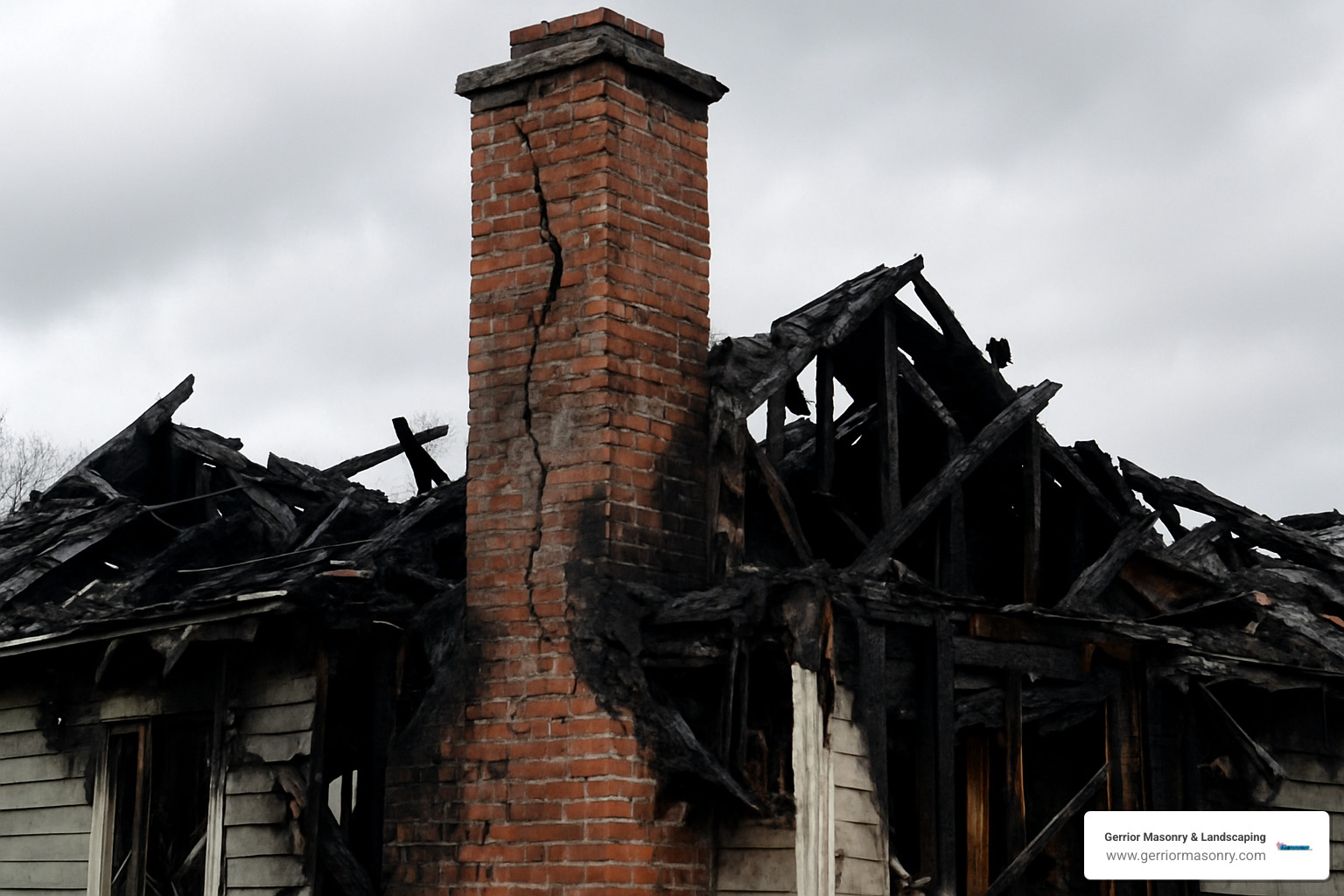
Structural Collapse: Failing mortar can lead to a chimney leaning or collapsing, causing catastrophic damage to your roof and home.
Widespread Water Damage: Water entering through bad mortar joints can rot wood framing, stain ceilings, and lead to expensive mold remediation.
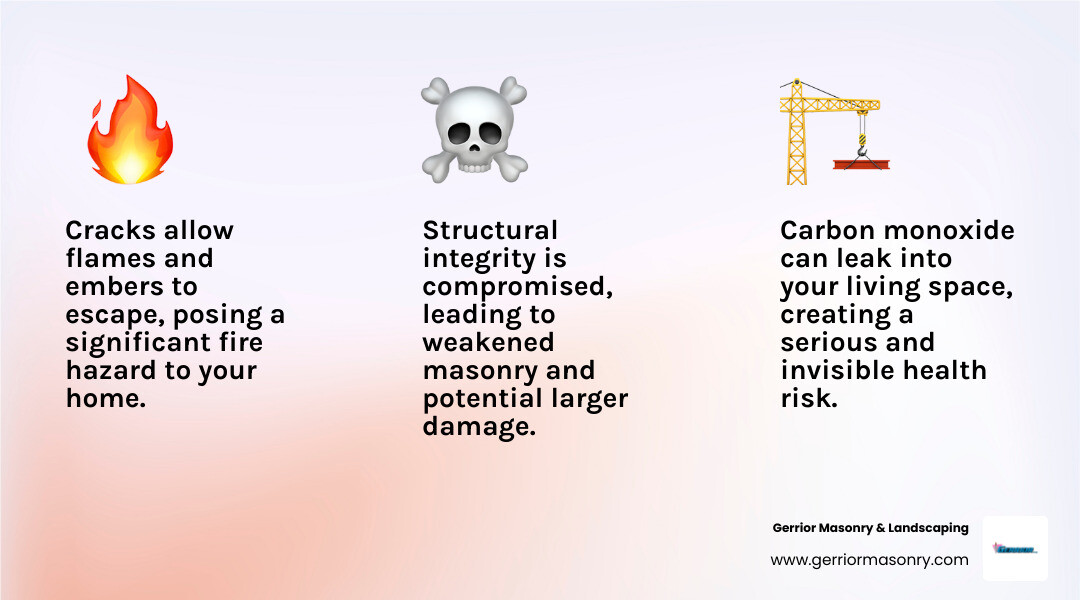
Fire Hazards: Cracks can allow intense heat or sparks to reach your home’s wooden frame, a risk highlighted by the National Fire Protection Association.
Carbon Monoxide Leaks: Gaps in the mortar can allow this deadly, odorless gas to leak into your home instead of venting safely outside.
Pest Infestations: Damaged chimneys are an open invitation for birds and raccoons to nest, causing blockages and further damage.
Decreased Home Value: A deteriorating chimney is a major red flag for potential buyers, often leading to lower offers or failed sales.
Early intervention isn’t just smart—it’s essential for your safety and your wallet.
How to Find a Qualified Chimney Masonry Professional in Your Area
Hiring a chimney mason requires more diligence than other contractors due to the specialized knowledge of structures, fire safety, and building codes. Choosing the wrong person can lead to failed repairs or new safety hazards.
Verify Reputation: Read online reviews on Google and the BBB. Ask for local references to gauge long-term quality and service.
Confirm Insurance: Always get proof of current liability insurance and workers’ compensation. This protects you from liability for on-site accidents.
Get Detailed Estimates: Obtain multiple written estimates that break down costs. Be wary of bids that are unusually low, as they may signal cut corners.
Prioritize Experience: With chimney work, experience is more important than the lowest price. The cost to repair chimney mortar properly the first time is always less than paying for the same job twice.
At Gerrior Masonry & Landscaping, we’ve built our reputation over 30+ years by treating every chimney repair like it’s our own home. Our owner oversight on every project ensures you get the expertise and attention your home deserves.
Ready to protect your home with professional chimney repair? Contact us for a professional estimate and let us show you why quality masonry work makes all the difference.
Gerrior Masonry & Landscape Construction Corp is based in Woburn, MA, and proudly services Middlesex and Essex County, Massachusetts, including towns like Acton, Andover, Arlington, Bedford, Belmont, Beverly, Billerica, Burlington, Carlisle, Chelmsford, Concord, Danvers, Georgetown, Hamilton, Hudson, Ipswich, Lexington, Lincoln, Lowell, Lynnfield, Malden, Manchester-by-the-Sea, Medford, Melrose, Middleton, Natick, Newton, North Andover, North Reading, Peabody, Reading, Salem, Saugus, Stoneham, Sudbury, Swampscott, Tewksbury, Topsfield, Wakefield, Waltham, Watertown, Wayland, Wenham, West Newbury, Westford, Weston, Wilmington, and Winchester.
When you notice cracks in your fireplace, it’s a serious matter. Fireplace cement crack repair is crucial for your home’s safety. Ignoring these cracks can be dangerous. Flames can get through the fire-resistant layers. Burning embers can even blow into your walls. This creates a big fire risk. Also, carbon monoxide could escape into your home.
Here’s a quick overview of how to fix fireplace cement cracks:
Clean the crack: Make sure the area is free of ash and loose debris.
Apply the repair material: Use a high-heat refractory caulk or cement designed for fireplaces.
Smooth the surface: Ensure the repair is even and fills the crack completely.
Allow to dry and cure: Follow the product’s instructions for air drying and heat curing.
Cracks in your fireplace also weaken its structure. Over time, this can lead to bigger problems. Fixing them early keeps your fireplace safe and working well. It protects your home and family.
I’m Joe Gerrior, owner of Gerrior Masonry & Landscape Construction Corp. With over 34 years in the business, my team and I have experience in ensuring the safety and longevity of masonry structures, including expert fireplace cement crack repair. We understand the importance of a properly maintained fireplace for your home’s value and your family’s peace of mind.
A Step-by-Step Guide to Fireplace Cement Crack Repair
Now that you understand why those cracks need attention, let’s roll up our sleeves and get to work. Don’t worry – fireplace cement crack repair isn’t rocket science, but it does require the right approach. Think of it like baking a cake: follow the recipe, use quality ingredients, and be patient with the process.
Choosing the Right Materials for the Job
Here’s where many DIY enthusiasts go wrong – they grab whatever’s handy at the hardware store. But your fireplace isn’t messing around when it comes to heat. We’re talking temperatures that can reach over 2000°F, so that regular caulk from your junk drawer just won’t cut it.
For those hairline cracks (less than 1/8 inch wide), a high-temperature refractory caulk is your best friend. These come in convenient tubes and work just like regular caulk, but they’re built tough. Look for products rated to handle at least 2000°F – some can even withstand temperatures up to 2550°F. That’s hot enough to melt copper!
For wider gaps or when you’re dealing with crumbling firebricks, you’ll need refractory mortar or cement. These usually come as dry mixes that you blend with water, or as ready-to-use pastes. The key difference? These products are specifically designed to expand and contract with your fireplace’s heating cycles without cracking.
Whatever you do, don’t use regular Portland cement. I’ve seen too many DIY repairs fail because someone thought cement was cement. Regular mortar will crack and fall out faster than you can say “fire hazard.” The specialized refractory materials contain ingredients that help them bond and flex with the intense heat cycles your fireplace experiences.
Before you start mixing anything, take a moment to read through the manufacturer’s safety data sheet. It might seem boring, but understanding how to handle these materials safely is crucial. Here’s a helpful resource: Understanding product safety data sheets.
Prepping the Crack for a Lasting Repair
You know how your mom always said “cleanliness is next to godliness”? Well, when it comes to fireplace cement crack repair, cleanliness is next to success. A dirty surface is like trying to put a bandage on muddy skin – it’s just not going to stick.
Start by cleaning out your firebox completely. Remove all the ash, soot, and any leftover wood pieces. If you’ve been putting off that annual cleaning, now’s the perfect time to tackle it. A clean fireplace isn’t just safer – it makes repairs much more effective.
Next, grab a wire brush and get to work on the crack itself. You want to scrub away any loose or crumbling material around the damaged area. This might seem aggressive, but you’re creating a solid foundation for your repair. Think of it as removing the weak spots so the new material has something strong to grip onto.
Once you’ve brushed everything loose, use a shop vacuum to suck up all that debris. Don’t skip this step – even tiny particles can prevent your repair material from bonding properly. For ceramic fireboxes, a gentle wash with soap and water followed by complete drying works wonders.
Here’s a pro tip: lightly dampen the crack area before applying your repair material. This helps the new cement bond better and prevents it from drying too quickly. Just moist, not soaking – we’re not trying to flood the thing.
Safety first, always. Make sure you’re wearing protective goggles, a dust mask, and gloves. Trust me, getting refractory dust in your eyes or lungs isn’t fun, and these materials can be tough on your skin.
The Proper Technique for Fireplace Cement Crack Repair
Now comes the satisfying part – actually fixing that crack. Take your time here because rushing this step is like hurrying through frosting a cake. You’ll just end up with a mess.
If you’re using refractory caulk in a tube, cut the nozzle tip at an angle to match your crack width. Load it into your caulking gun and apply steady, even pressure. The goal is to force the material deep into the crack, not just smear it on the surface. Think of it like filling a pothole – you want to pack it full.
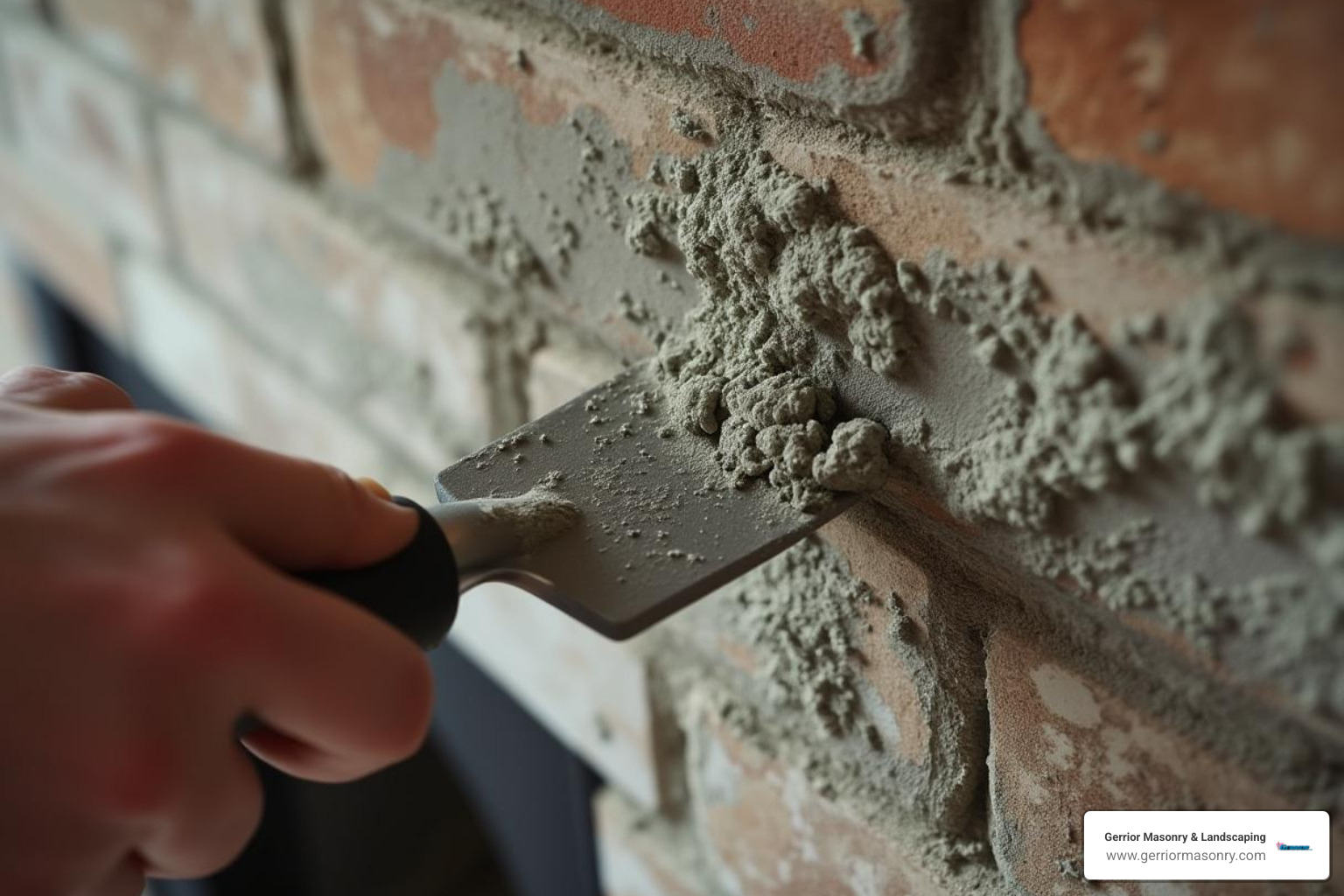
For wider cracks or when using cement from a tub, a putty knife or small trowel becomes your tool of choice. Scoop up some material and really pack it into the crack. Don’t be gentle – push it all the way to the back of the void. If your crack is deeper than 1/8 inch, work in layers, letting each one air dry for 24 hours before adding the next.
Once the crack is filled, smooth the surface with your tool. A little trick I’ve learned over the years – dip your smoothing tool in water occasionally. This creates a clean, professional-looking finish that blends seamlessly with the surrounding masonry. Wipe away any excess with a damp cloth before it starts to set.
Getting the consistency right is crucial. If you’re mixing dry powder, aim for something between peanut butter and thick frosting. Too thin and it’ll run out; too thick and you won’t be able to work it into the crack properly.
Curing the Repair and Preventing Future Cracks
Here’s where patience becomes your best friend. Proper curing is what separates a lasting repair from one that’ll fail next winter. Most people want to light a roaring fire immediately, but that’s like putting a cake in a 500-degree oven – you’ll just ruin all your hard work.
Start with air drying for at least 24 hours. Some products specify a maximum air-dry time (usually 30 days), so check your manufacturer’s instructions. This initial period lets the material begin its chemical change.
The heat curing process is where the magic happens. Begin with a small, low-temperature fire (under 210°F). This gentle heat drives out any remaining moisture without shocking the repair. Keep this gentle fire going until the repair looks completely dry.
Next comes the final cure with a hotter fire (around 500°F) for 1-2 hours. This higher temperature activates the chemical bonds that make your repair as strong as the original firebrick. It’s like tempering steel – the heat treatment gives it strength.
To prevent future cracks, think prevention, not just repair. Annual inspections are your first line of defense. Keep your fireplace clean of ash and soot buildup, which can be corrosive over time. Avoid building oversized fires that stress your masonry beyond its limits.
Water damage is often the hidden culprit behind fireplace cracks. Make sure your chimney cap and flashing are in good shape. Even small leaks can cause big problems when water freezes and expands in tiny cracks.
DIY vs. Professional Repair: Making the Right Call
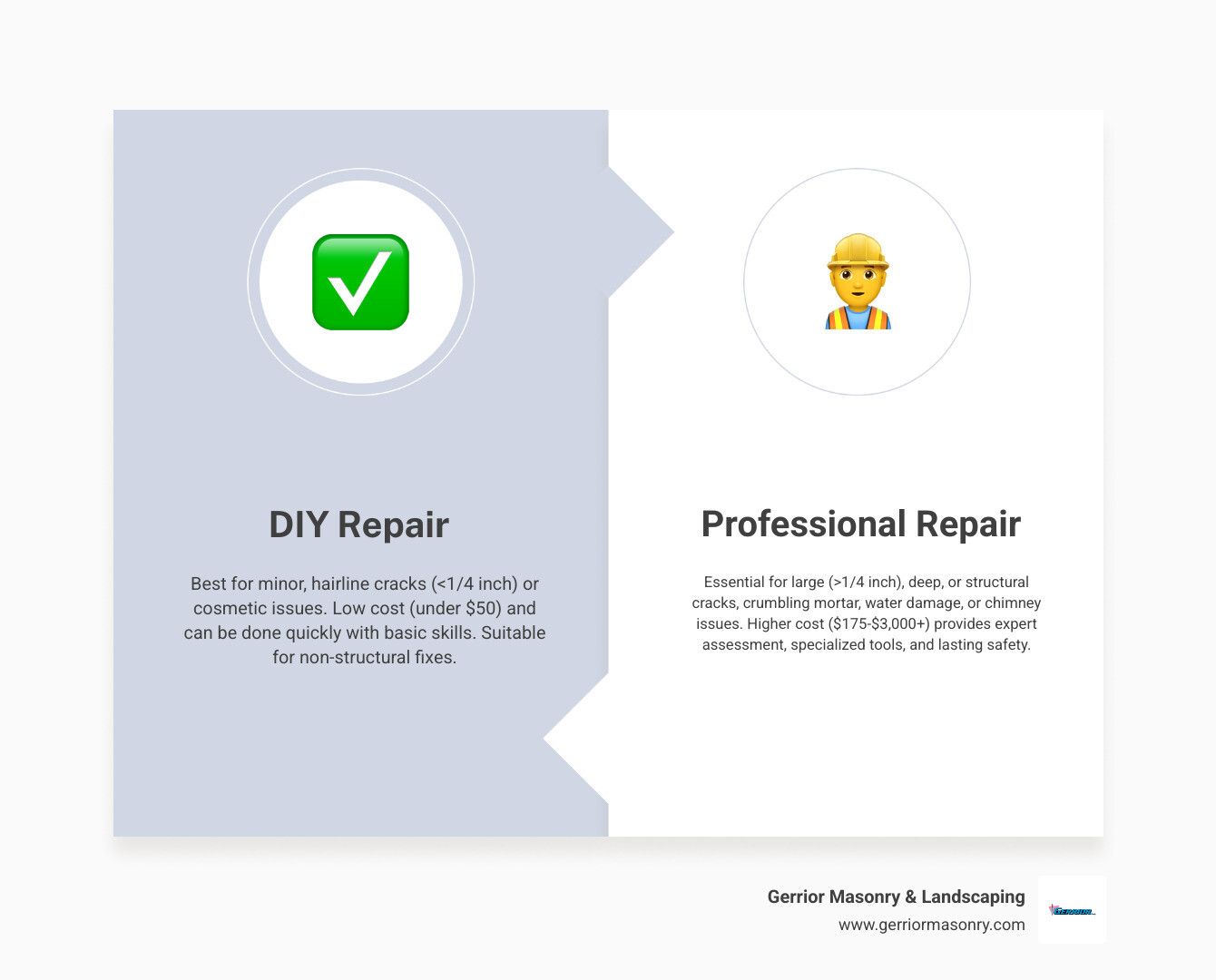
When you’re staring at a crack in your fireplace, the big question isn’t just “Can I fix this?” but “Should I fix this myself?” It’s a fair question, and honestly, the answer depends on what you’re dealing with. While a DIY fix works great for minor issues, significant damage needs a professional touch to keep your family safe and your home sound.
Think of it this way: patching a small hairline crack is like putting a band-aid on a paper cut. But trying to DIY a major structural crack? That’s like performing surgery with a butter knife. Not a great idea.
Understanding the Costs: DIY vs. Hiring a Pro
Let’s talk money, because we know that’s often the first thing on your mind when you spot a crack. The good news? For small, hairline cracks, fireplace cement crack repair doesn’t have to break the bank.
A tube of high-temperature refractory caulk runs about $15. Throw in a caulking gun, putty knife, and some basic cleaning supplies, and you’re looking at under $50 total. That’s pretty appealing when you’re dealing with minor cosmetic issues or small, non-structural cracks.
But here’s where things get interesting. Professional repairs? Well, that’s a whole different ballgame. You’re looking at anywhere from $175 to $3,000 or more, depending on what’s actually wrong. That wide range covers everything from simple mortar joint repairs to complete firebox rebuilds.
Please note: the professional repair cost range mentioned here is an average based on national internet data and is not a quote from Gerrior Masonry & Landscaping. Costs can vary significantly based on the extent of the damage, regional pricing, and the specific services required.
The cost difference really comes down to what you’re fixing and how complex the job is. A simple crack might take you an hour and cost $15. But if that crack is actually a symptom of a bigger structural problem, you could be looking at days of professional work.
The time factor is worth considering too. A DIY repair might seem quick, but if you factor in research time, multiple trips to the hardware store, and potential do-overs, it adds up. Professionals come prepared and get it right the first time.
When to Leave Fireplace Cement Crack Repair to the Experts
Here’s where we get serious about safety. While we love a good DIY project, some situations absolutely require professional expertise. Knowing when to step back isn’t admitting defeat – it’s being smart about protecting your home and family.
Large or deep cracks are our first red flag. If you’re looking at a crack wider than about 1/4 inch, or one that seems to go way back into the masonry, you’re dealing with a structural issue. This isn’t a patch job – it needs proper assessment and a robust repair solution.
Crumbling bricks or mortar around the crack tell a different story entirely. When masonry starts turning to powder or easily crumbles in your hand, you’re not just looking at a crack anymore. You’re seeing widespread material failure that needs professional attention.
Water damage signs are another major concern. If you notice bricks flaking (we call this spalling), white powdery residue, or persistent dampness around your fireplace or chimney, water is getting where it shouldn’t. Simply patching cracks won’t solve the root problem – you need to find and fix the leak.
Structural concerns are the most serious issue. Cracks extending from the fireplace into surrounding walls, or a fireplace that seems to be leaning or shifting, indicate foundation problems or chimney settlement. These can lead to catastrophic failure if ignored.
And honestly? If you’re lacking experience or confidence with any step of the process, that’s perfectly valid reason to call in the pros. An improper DIY repair can create a false sense of security and potentially make things worse.
Here’s something important: your average handyman typically isn’t equipped to handle complex fireplace cement crack repair. You need someone who specializes in refractory materials and fireplace construction. Our team has over 30 years of experience in masonry work, and we can tell you whether a firebox is worth saving or needs a complete rebuild.
For expert assessment and lasting repairs, trust a certified professional. Gerrior Masonry & Landscaping provides expert fireplace mortar repair services. Our team is based in Woburn, MA, and proudly serves the communities of Middlesex and Essex County, Massachusetts, including towns like Acton, Andover, Arlington, Bedford, Burlington, Chelmsford, Concord, Danvers, Lexington, Lowell, Lynnfield, Malden, Medford, Melrose, Newton, North Andover, Peabody, Reading, Salem, Stoneham, Sudbury, Tewksbury, Wakefield, Waltham, Watertown, Wayland, Westford, Wilmington, and Winchester.
Why Your Chimney’s Mortar is Your First Line of Defense
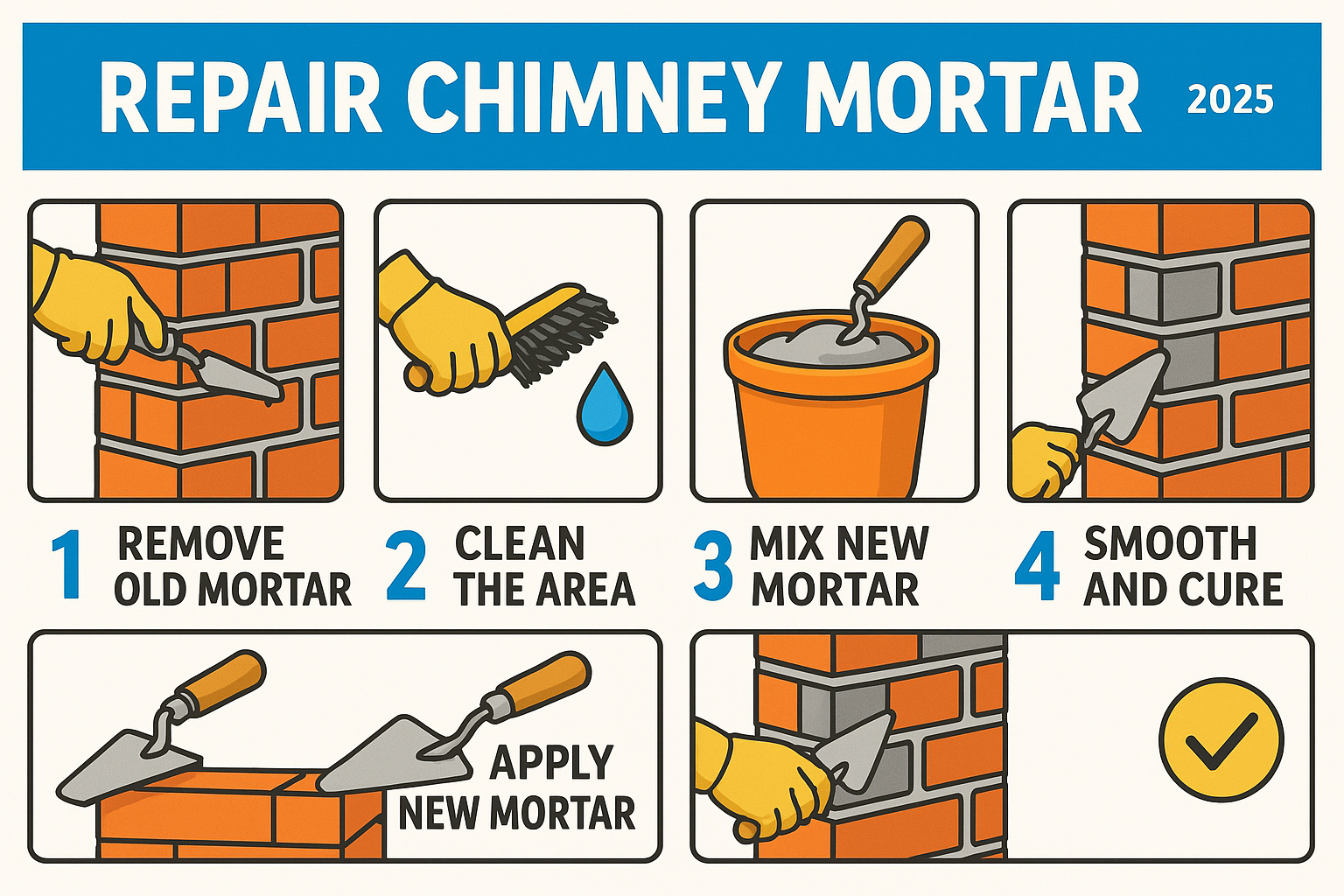
To repair chimney mortar, the general process is:
Remove old mortar: Use a grinder or chisel to clear out crumbling material.
Clean the area: Brush away debris and wet the bricks.
Mix new mortar: Prepare it to a thick, workable consistency.
Apply new mortar: Fill joints carefully with a pointing trowel.
Smooth and cure: Finish the joints and let the mortar dry properly.
Your chimney’s mortar is a critical defense against the elements, but constant weather exposure causes it to break down. This isn’t just a cosmetic issue; crumbling mortar can lead to water leaks, structural damage, and fire hazards. Unsafe chimneys cause over $200 million in property damage annually, making mortar maintenance vital for your home’s safety.
I’m Joe Gerrior, owner of Gerrior Masonry & Landscape Construction Corp. For over 34 years, our family business has provided expert repair chimney mortar services. We’re here to help you understand and address chimney issues.
The mortar holding your chimney together is under constant assault from weather, especially the freeze-thaw cycles in Massachusetts. When it deteriorates, it creates openings for water to seep in, leading to brick damage (spalling) and white stains (efflorescence). More seriously, it can weaken the chimney’s structure, risking collapse or allowing carbon monoxide to leak into your home. Recognizing these signs of decay is the first step to protecting your property.
A Homeowner’s Guide to Diagnosing and Preparing for Chimney Mortar Repair
Before you repair chimney mortar, a thorough inspection is crucial to identify issues early and prevent costly future repairs. Closely examine your chimney’s mortar joints and bricks for any signs of water penetration, which is often exacerbated by New England’s freeze-thaw cycles. You can find More info about masonry services here.
Common Signs of Mortar Damage and What They Mean
Spotting problems early can save you from major expenses. Here are common signs that your chimney mortar needs attention:
Cracked Mortar Joints: Even hairline cracks are an early warning sign, as they can widen and allow water to enter.
Gaps Between Bricks: Missing mortar creates voids that weaken the chimney’s structure and provide a direct path for water intrusion.
Spalling Bricks: This is when the face of the brick flakes or crumbles off, usually caused by water freezing and expanding inside the brick. It indicates a significant moisture problem, often stemming from failed mortar joints.
Efflorescence: These white, powdery stains are left behind when water-soluble salts evaporate from the masonry surface. While not directly harmful, efflorescence is a clear sign that water is penetrating your chimney.
Leaning Chimney: A visible tilt or shift in the chimney is a major structural issue that requires immediate professional assessment, as it may indicate foundation failure.
Water Stains on Interior Walls or Ceilings: Stains near your fireplace are a sure sign of a leak, which could be caused by failing mortar, a damaged crown, or faulty flashing.
Minor issues can sometimes be addressed with crack fillers, but widespread damage requires repointing. For more on similar repairs, see our info about foundation repointing.
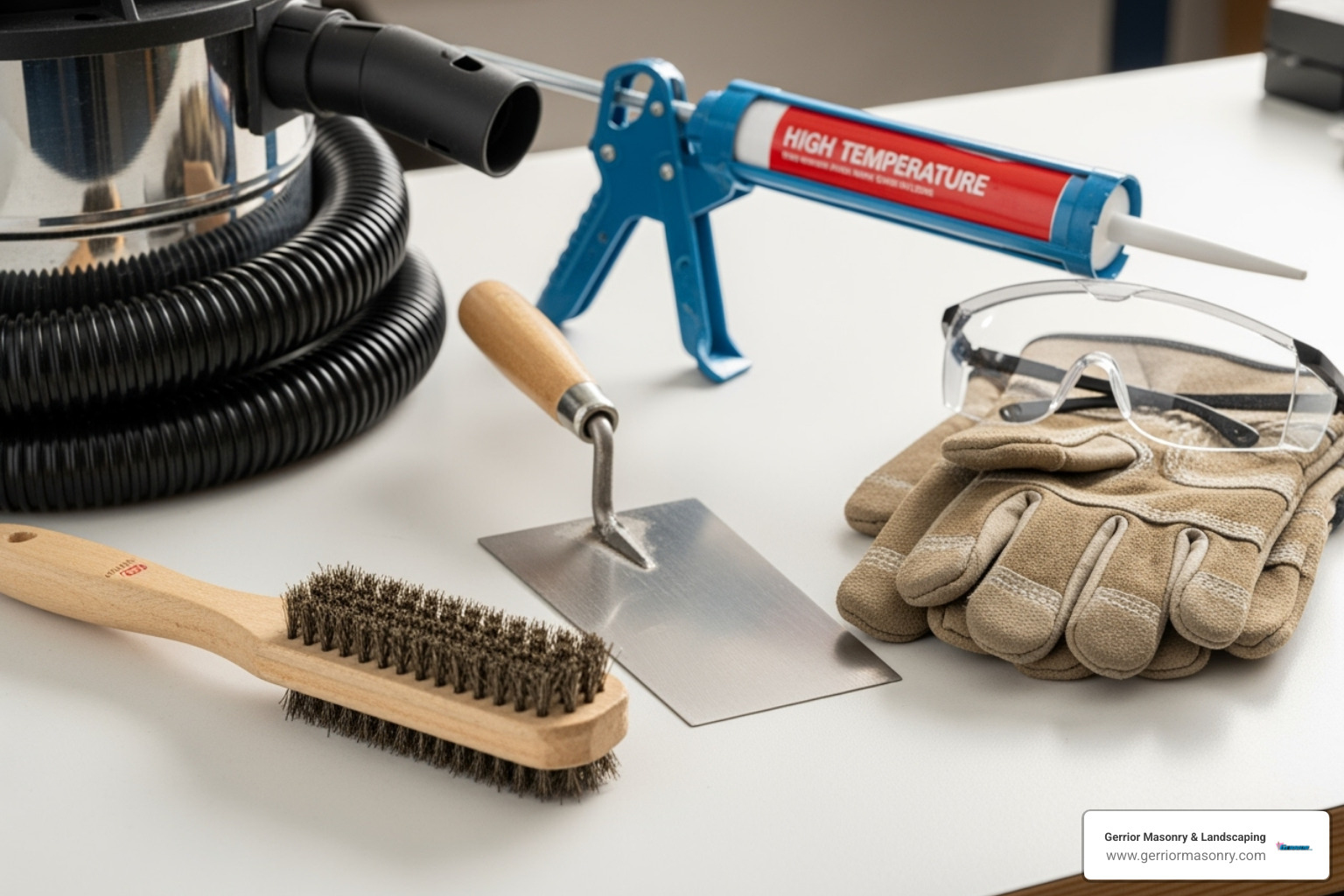
Gearing Up: Essential Tools and Materials for Chimney Mortar Repair
Gathering the right supplies will make your repair chimney mortar project go smoothly.
Essential Tools:
Mortar Removal: Mortar raking tool, grinder with a HEPA filter, or a chisel and hammer.
Cleaning: Stiff-bristled and soft-bristled brushes, or an air compressor.
Application: Spray bottle, mixing bucket, pointing trowel, bricklayer’s trowel, and a mortar hawk or board. A tuckpointing or grout bag can help with precision.
Finishing: Mortar striker or jointing tool, sponge, and water for cleanup.
Safety Gear: Safety glasses, dust mask or respirator, gloves, and a sturdy ladder or scaffolding.
Essential Materials:
Mortar Mix: Type N mortar is generally recommended for above-ground exterior work. For high-heat areas like the firebox, use specialized refractory cement.
Additives: Use builder’s sand that matches your existing mortar color if mixing from scratch.
Sealants: After repairs, apply a breathable waterproofing sealant to protect against future moisture. For minor cracks, use a brush-applied crack filler or elastomeric flashing sealant as needed.
When choosing new mortar, matching the strength, color, and texture of the existing mortar is crucial for both appearance and structural integrity. Using a mortar that is too hard can damage the surrounding bricks. For Technical details on mortar types, this resource is helpful.
The Step-by-Step Process of Repointing a Chimney
Repointing is the process of removing deteriorated mortar and replacing it with new mortar to restore your chimney’s strength and water resistance.
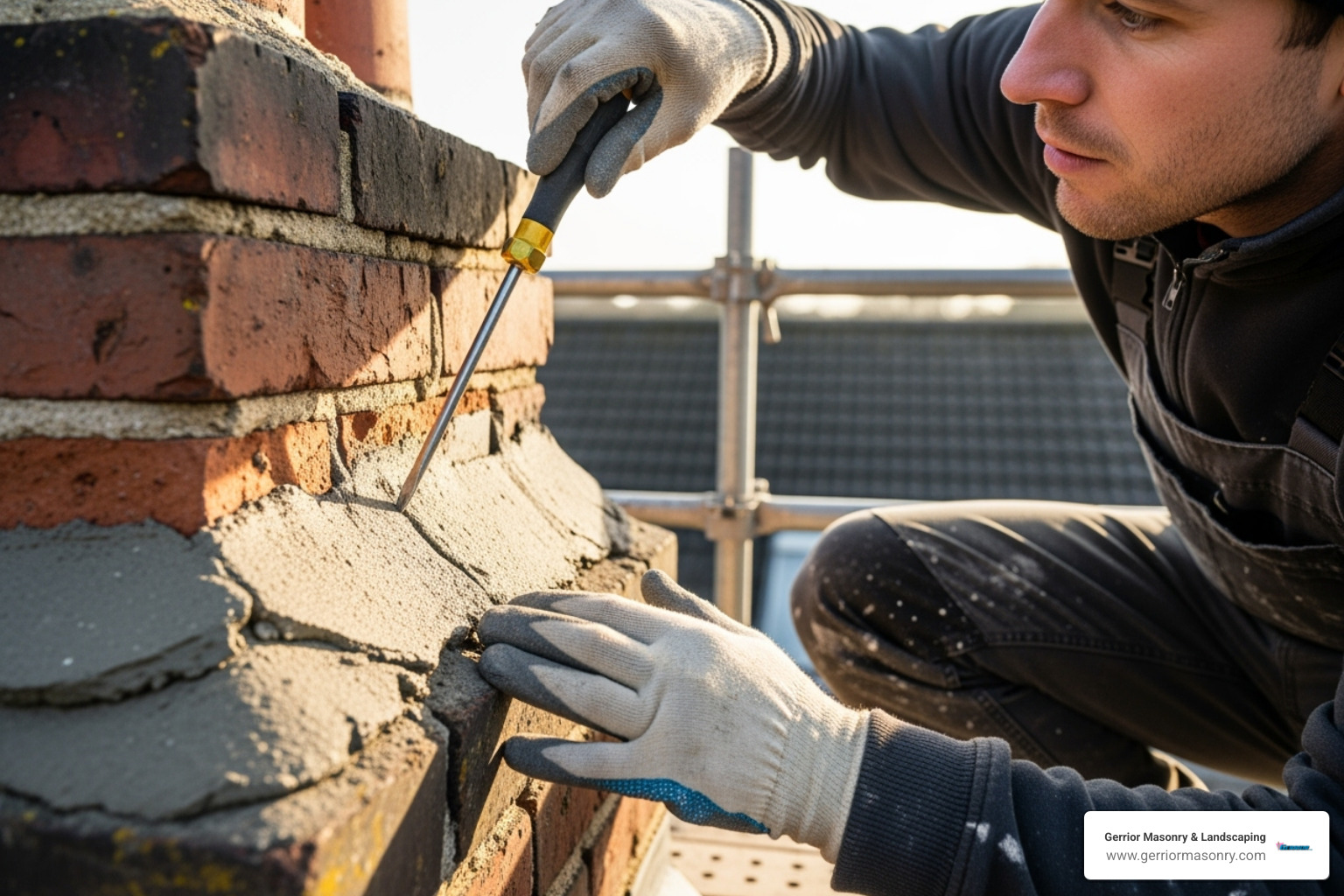
Remove Old Mortar: Use a grinder or chisel to remove old mortar to a depth of at least half an inch to one inch, or until you reach solid material. Work carefully to avoid damaging the bricks.
Clean the Joints: Thoroughly brush out all loose debris and dust from the joints with a stiff brush, followed by a soft brush or compressed air. A clean surface is essential for proper adhesion.
Mist the Area: Lightly spray the joints with water. This prevents the dry bricks from absorbing moisture from the new mortar too quickly, ensuring a stronger bond.
Mix New Mortar: Prepare your mortar mix according to the manufacturer’s instructions to a thick, workable consistency. Mix only what you can use within about an hour.
Fill the Joints: Using a pointing trowel or tuckpointing bag, press the new mortar firmly into the joints, ensuring there are no air pockets. Pack the joints so the mortar slightly bulges out.
Tool the Joints: After the mortar has set slightly (5-10 minutes), use a jointing tool to compress and shape the mortar. This creates a dense, water-resistant finish. Clean any excess mortar off the brick faces immediately.
Cure the Mortar: Keep the new mortar damp for 24 to 72 hours by misting it periodically. This slow curing process is critical for achieving maximum strength. Avoid using the chimney for at least 24 hours.
Advanced Chimney Care and When to Call the Experts
You’ve learned how to spot and tackle some basic repair chimney mortar tasks, but serious issues like major structural damage, a crumbling crown, or a leaning stack require a professional. At Gerrior Masonry & Landscape Construction, we have over 30 years of experience diagnosing and fixing complex chimney problems to keep your home safe.
Protecting Your Investment: Flashing, Caps, and Weatherproofing
Beyond mortar, a complete protection system includes flashing, caps, and weatherproofing—all crucial for defending against water, the number one enemy of chimneys.
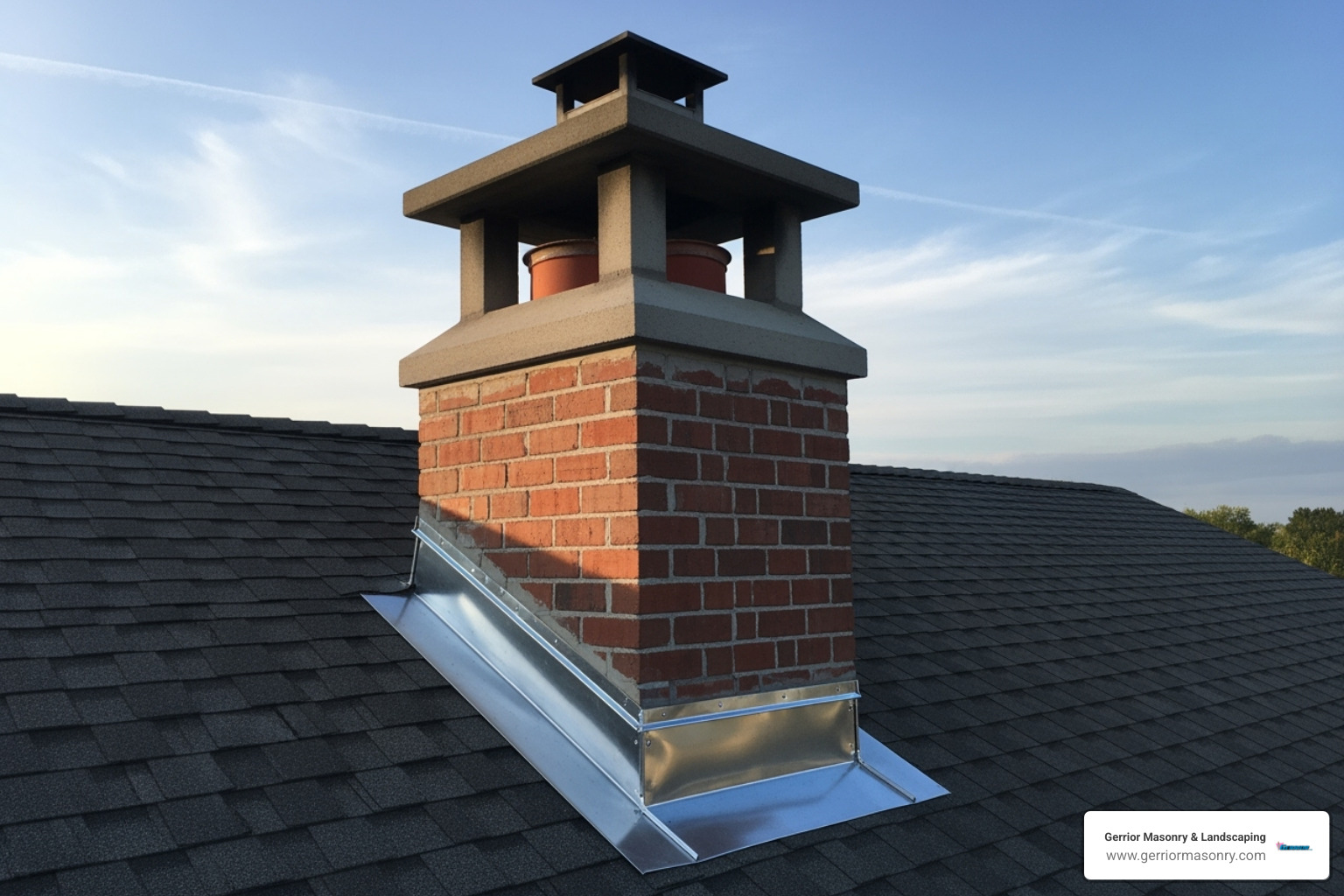
Chimney Flashing: This metal seal where the chimney meets the roof prevents leaks. If you see rust, gaps, or interior water stains, the flashing may need repair or replacement.
Chimney Cap: A cap acts as a protective hat, keeping rain, debris, and animals out of your flue. Without one, water can pour directly inside, causing significant damage.
Waterproofing Sealants: After masonry work, applying a breathable, non-film-forming waterproofing agent is recommended. It acts as an invisible shield, blocking liquid water while allowing internal moisture vapor to escape.
Preventative maintenance is essential, especially with the harsh freeze-thaw cycles in Middlesex and Essex County, Massachusetts. Annual inspections can catch small issues before they become expensive problems. More info about chimney repairs.
The Risks of Neglect and Why Professional Help is Key
Ignoring chimney problems can lead to dangerous and costly consequences for your home and family.
Structural Collapse: Severely deteriorated mortar can destabilize the entire chimney, creating a risk of collapse.
House Fires: Cracks in the mortar or flue liner can allow heat and embers to escape, potentially igniting parts of your home.
Carbon Monoxide Poisoning: A damaged flue can leak this invisible, odorless gas into your living space, which can be fatal.
Extensive Water Damage: Unrepaired leaks lead to stained walls, rotted wood, mold growth, and accelerated decay of the chimney structure.
Decreased Home Value: A neglected chimney is a major red flag for potential buyers and can significantly lower your property’s value.
While DIY is great for some tasks, you should call a professional for:
Extensive water damage or widespread spalling bricks.
Complex flashing repairs or replacement.
Any damage to the flue liner.
Structural issues like a leaning stack or large cracks in the chimney itself.
Understanding Repair Costs and Long-Term Maintenance
Chimney repair costs vary widely. The figures below are average costs based on general internet data, not actual prices from Gerrior Masonry. The final cost depends on the extent of damage, chimney height, accessibility, and location, and the high end could be three times the average or more.
Minor Mortar Repair (Spot Pointing): Professional: $200 – $800.
Full Chimney Repointing: Professional: $1,000 – $6,000+.
Chimney Cap Installation: Professional: $150 – $800 (including cap).
While DIY saves on labor, complex repairs risk safety and can lead to costlier mistakes. Professionals have the experience, tools, and insurance to do the job correctly and safely.
The best way to control costs is through consistent preventative maintenance:
Annual Inspections: Have a certified professional inspect your chimney yearly to catch problems early.
Regular Cleaning: Remove creosote buildup to prevent chimney fires.
Waterproofing: Reapply a breathable sealant every few years to protect the masonry.
Prompt Minor Repairs: Fix small cracks and loose mortar immediately.
At Gerrior Masonry & Landscape Construction, we believe in proactive care. With over 30 years of experience and owner oversight on every project, we deliver quality and peace of mind. We’re here to protect your investment and ensure your chimney is safe and functional for years to come. Get a professional consultation.
Gerrior Masonry & Landscape Construction is based in Woburn, MA, and proudly services the surrounding communities in Middlesex and Essex County, Massachusetts.
Your chimney does more than vent smoke—it protects your roof, walls, and your family’s safety from Massachusetts’ famous freeze-thaw cycles. While the bricks themselves can last a century, the mortar between them typically weathers away in 20–30 years. Once small cracks appear, rainwater seeps in, freezes, and expands, forcing the joints apart. What starts as a hairline gap can quickly become loose bricks, interior leaks, and expensive structural repairs. A little preventive maintenance today keeps your chimney’s structure—and your entire home—dry, secure, and looking sharp in every New England season. That is why Gerrior Masonry & Landscaping always recommends an annual inspection for homeowners in Woburn, Burlington, Lexington, and the rest of Middlesex and Essex Counties.
Understanding the Lingo: Tuckpointing vs. Repointing
Homeowners often mix up tuckpointing and repointing because both involve adding fresh mortar, yet their goals differ.
Repointing is purely structural—masons remove failed mortar, insert fresh mortar of the same color, and seal water out.
Tuckpointing adds a cosmetic twist. After repointing, masons carve a narrow groove and “tuck” in a thin, contrasting fillet so the joints look razor-fine. This 18th-century technique was developed to mimic high-end stonework without the price tag.
Both approaches can spare you from a full chimney rebuild when damage is still limited and the bricks remain sound. In a historic town such as Concord or Marblehead, matching the original façade is often just as important as restoring strength.
Spalling bricks (faces popping off) or efflorescence.
Cracked chimney crown or missing cap.
Interior stains near the fireplace after rain.
Why Mortar Fails
Water is enemy number one in New England. Freeze-thaw cycles expand trapped moisture by about 10%, prying mortar apart. Age, acidic flue gases, and minor house settling speed up the process. Because bricks usually outlast mortar, timely repairs focus on the joints—not the whole chimney.
Tuckpointing or Rebuild?
Choose tuckpointing when damage is isolated and bricks remain solid. Opt for a rebuild if mortar is failing everywhere, the chimney leans, or bricks are crumbling below the roofline. Unsure? Schedule an expert inspection.
Grind out deteriorated mortar 3–10 times the joint width.
Press in fresh, compatible mortar matched for strength, color, and texture.
For tuckpointing, carve a groove and insert a thin fillet of lighter mortar for that crisp look.
Tool and cure the joints so they shed water.
DIY or Hire a Pro?
Working three stories up with power grinders is not a weekend hobby. Using the wrong mortar—often a hard Portland mix on old, soft brick—can accelerate spalling. Add the time, safety gear, and aesthetic match, and most homeowners quickly see the value of a qualified mason.
For historic homes, the NYC Landmarks Preservation Commission guide reminds us that matching original lime mortar is critical. Gerrior’s masons are trained to identify and blend these mixes so the repair disappears into the existing wall.
Understanding the Cost of Chimney Repair Tuckpointing
One of the first questions homeowners often ask us is, “How much will chimney repair tuckpointing cost?” And it’s a completely fair question! While we’d love to give you a single, straightforward answer, the truth is, like many things in home repair, “it depends.” The cost can vary quite a bit based on several important factors, which is why getting a professional assessment is always the best way to get an accurate quote for your specific chimney.
Think of it this way: repairing a small crack in your driveway is very different from repaving the entire thing, right? The same goes for your chimney. The biggest factor influencing the cost of chimney repair tuckpointing is often the extent of the damage. Is it just a few crumbling joints near the very top of your chimney that need a little love, or does the entire structure, from the roofline all the way up, need a full overhaul? Naturally, the more mortar that needs to be carefully removed and expertly replaced, the more time, labor, and materials will be involved, which directly impacts the price.
Then there’s your chimney’s unique position. Its height and accessibility play a big role. Taller chimneys mean more time and specialized equipment, like extensive scaffolding, to ensure our team can work safely and effectively. If your chimney is tricky to reach due to a steep roof pitch, surrounding trees, or other structures, that can also add to the complexity and time needed for the job.
We also consider the type of brick and mortar your chimney is made of. Matching the existing brick and mortar isn’t just about aesthetics; it’s crucial for a repair that lasts. If your home is older or historic, it might require a specific, softer lime-based mortar that’s different from modern mixes. Sourcing these specific materials or ensuring the perfect color and consistency match takes expertise and sometimes specialized materials, which can subtly affect the cost.
Finally, like most services, geographic location and labor rates come into play. Here in Middlesex and Essex County, Massachusetts, our pricing reflects the local market conditions and the high level of skill and experience our masons bring to every job. We pride ourselves on the expertise our team offers for intricate masonry work like chimney repair tuckpointing.
What Do Real-World Numbers Look Like?
To give homeowners a general idea, the following figures represent average cost ranges based on publicly available internet data, not actual quotes from Gerrior Masonry & Landscaping. Your final cost will depend on the specific factors discussed above.
Spot-tuckpointing of 10–20 linear feet of joints near the crown: $600–$1,800.
Mid-level repair of the top third of a two-story chimney with safe roof access: $1,500–$5,000.
Full tuckpointing from roofline to crown on a 30-foot stack that requires staging or a lift: $3,500–$11,000.
Add-ons you may need — such as crown replacement, rain cap installation, or a waterproofing sealer — typically range from $150–$750 each, depending on materials and size.
These figures typically include labor, mortar, cleanup, and disposal, but they do not include major brick replacement or structural rebuilds. Permitting fees, if required by your town, are generally modest, yet they can add another $50–$150 to the total.
Remember: the lowest bid isn’t always the best value. A mason who skips grinding depths or uses an incompatible mortar can leave you with costly spalling down the road. At Gerrior Masonry & Landscaping, every proposal details the exact mortar mix, color matching process, joint depth, and curing method so you can compare apples to apples.
Curious where your chimney falls on the price spectrum? Schedule a no-pressure inspection, and we’ll walk you through a customized line-item estimate along with photos of any trouble spots. Transparency now prevents surprises later.
How to Ensure Your Chimney’s Longevity After Repair
Your new joints will last decades if you:
Schedule yearly inspections to catch tiny cracks early and budget for spot repairs before winter.
Install or maintain a concrete cap with proper overhang so water cannot dribble down the sides.
Apply a breathable masonry sealer every 5–7 years. Modern silane/siloxane formulas keep water out while letting trapped moisture escape.
Keep gutters clear so runoff is not dumping on the stack and eroding the mortar that was just replaced.
Glance up after big storms and call for spot repairs fast. A single missing brick or cap can invite thousands of dollars in damage if ignored.
Burn seasoned wood only to minimize acidic creosote that can attack mortar from the inside.
Taking these simple steps helps homeowners from Acton to Amesbury squeeze every possible year out of their investment.
Deteriorated mortar may look small now, but it becomes expensive later. Professional tuckpointing fortifies your chimney, blocks moisture, and preserves your home’s character—all at a fraction of replacement cost.
Because every property is different, Gerrior Masonry & Landscaping approaches each project with the meticulous eye of craftsmen who live and work right here in Middlesex and Essex Counties. Whether you have a 1720 Colonial in Ipswich or a mid-century Cape in Burlington, our owner-supervised crew protects the original architecture while bringing the structure up to modern durability standards.
Still on the fence? Consider this:
A minor tuckpointing job today often prevents a full tear-down tomorrow.
Properly matched mortar keeps freeze-thaw damage from spreading into adjacent walls and the roof deck.
A sharp-looking chimney boosts curb appeal, a key advantage if you plan to sell in competitive markets like Arlington or Winchester.
With more than 30 years of hands-on experience, state-of-the-art dust control, and a safety record we’re proud of, our team is ready to help you protect your investment. For an expert assessment and a detailed quote for your chimney repair needs, contact us today. Gerrior Masonry & Landscape Construction is based in Woburn, MA, and services Middlesex and Essex County, Massachusetts.
Why Professional Chimney Repair Contractors Are Essential for Your Home
Your chimney is a hardworking safety system, not just a decorative stack of bricks. It must stand up to fire, drastic temperature swings, and harsh New England weather—all while venting dangerous gases like carbon monoxide away from your living space. Because its role is so critical, hiring the right chimney repair contractor is one of the most important decisions you can make for your home’s safety and structural integrity.
Quick Answer: What to Look for in a Chimney Repair Contractor:
Licensed & insured professionals only. This is non-negotiable. A license proves they meet state standards, while insurance protects you from liability in case of accidents on your property.
Experience with the exact materials and design of your chimney. Whether you have a historic brick chimney or a modern prefab system, your contractor needs hands-on experience with that specific type.
Detailed written estimate. A professional quote breaks down all anticipated costs (labor, materials, permits, timeline) to prevent surprise charges later.
Local references & reviews you can verify. Ask for a list of recent, local projects and check online reviews to gauge their reputation in communities like Woburn, Andover, or Lexington.
Workmanship and material warranties in writing. A confident contractor stands behind their work with a solid warranty, giving you long-term peace of mind.
Knowledge of local codes and permit requirements. Building codes vary across Middlesex and Essex County. A knowledgeable contractor ensures all work is compliant, safe, and won’t cause issues during a future home sale.
Cost is always a concern, but safety should come first. Based on internet research, minor chimney repairs often start around $200–$700, larger masonry or crown repairs run $1,000–$3,500, and full replacements can range $4,000–$15,000+. These are average figures, not actual Gerrior Masonry pricing.
Ignoring early warning signs can multiply those numbers—or worse, lead to devastating house fires or carbon-monoxide exposure. Common red flags include:
Cracked or crumbling mortar joints, which can allow water and dangerous gases to escape.
White staining (efflorescence) on brick faces, a clear sign that water is penetrating the masonry.
Rusted dampers or firebox parts, indicating a moisture problem inside the system.
Water stains on walls or ceilings near the fireplace.
Smoke backing up into rooms instead of rising properly up the flue.
I’m Joe Gerrior, owner of Gerrior Masonry & Landscape Construction Corp., and for 34+ years I’ve seen how prompt, professional repairs save homeowners from expensive disasters and keep their families safe.
Quick look at chimney repair contractor resources:
Recognizing the Red Flags: When to Call a Chimney Professional
Your chimney rarely fails overnight—it usually whispers warnings first. Learning to spot those whispers is key to proactive maintenance. By addressing issues early, you can call a chimney repair contractor for a minor fix before it evolves into a major, costly reconstruction project.
Incomplete wood combustion leaves a flammable, tar-like residue. It can build up in stages, from a light soot to a thick, glazed coating that is extremely difficult to remove and poses a serious fire hazard.
Water damage
Rain and melting snow are a chimney’s worst enemy. Water enters through cracked crowns, failed flashing at the roofline, or porous mortar, leading to decay from the inside out.
Flue blockages
Debris such as leaves, twigs, and animal nests (especially from birds and squirrels) can clog the flue, restricting airflow. This prevents smoke from exiting and can trap deadly carbon monoxide (CO) in your home.
Age-related mortar & brick decay
The constant exposure to freeze–thaw cycles in New England, combined with decades of heat and acidic flue gases, inevitably weakens masonry. Mortar erodes and bricks can begin to flake or crack.
Foundation settlement
If the ground beneath your home shifts, the heavy chimney structure can crack, separate from the house, or begin to lean. This is a serious structural problem that requires immediate professional assessment.
Missing or crumbling mortar between bricks: These gaps are entry points for water and can compromise the chimney’s stability.
Spalling (flaking) bricks: This indicates that moisture has penetrated the brick itself, and the surface is popping off during freeze-thaw cycles.
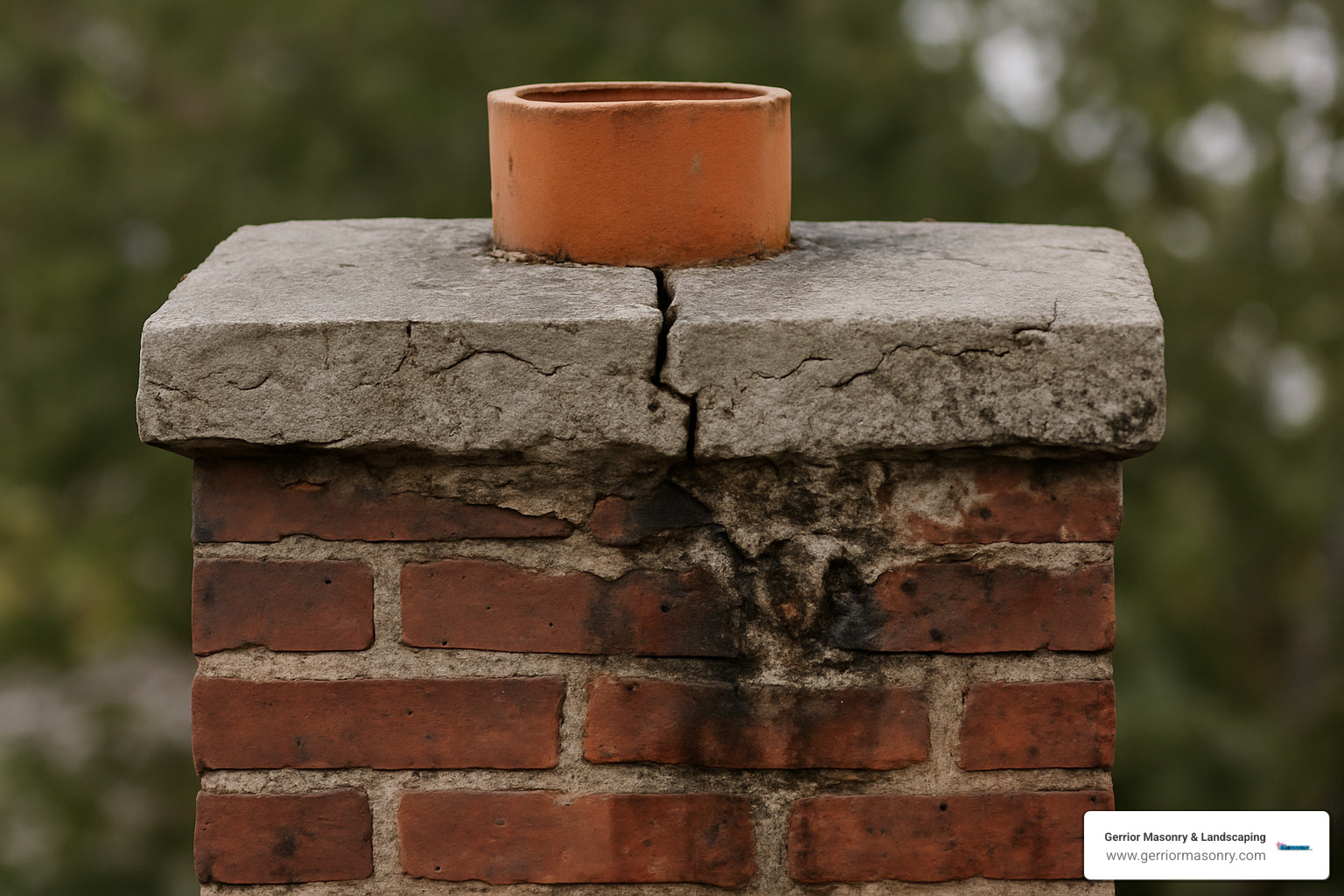
Cracked chimney crown or damaged cap: The crown is the cement slab on top of your chimney. Cracks here allow water to pour directly into the chimney structure.
Rust on the damper or in the firebox: Rust is a definitive sign of excess moisture getting into the chimney system, often from above.
White, chalky efflorescence on the exterior: These salt deposits are left behind as water evaporates from the brick, signaling a moisture intrusion problem.
Water stains on nearby walls or ceiling: This is a late-stage warning that a leak has progressed from the chimney into your home’s structure.
Leaning chimney structure: Any noticeable tilt is a major structural red flag that needs immediate attention from a qualified mason.
Smoke or strong odors inside the room: A poor draft could be caused by creosote buildup, a blockage, or an improperly sized flue, all of which are safety hazards.
Notice any of these? Our Chimney Mortar Repair team can help before problems escalate.
The Professional Process: Inspections, Estimates, and Costs
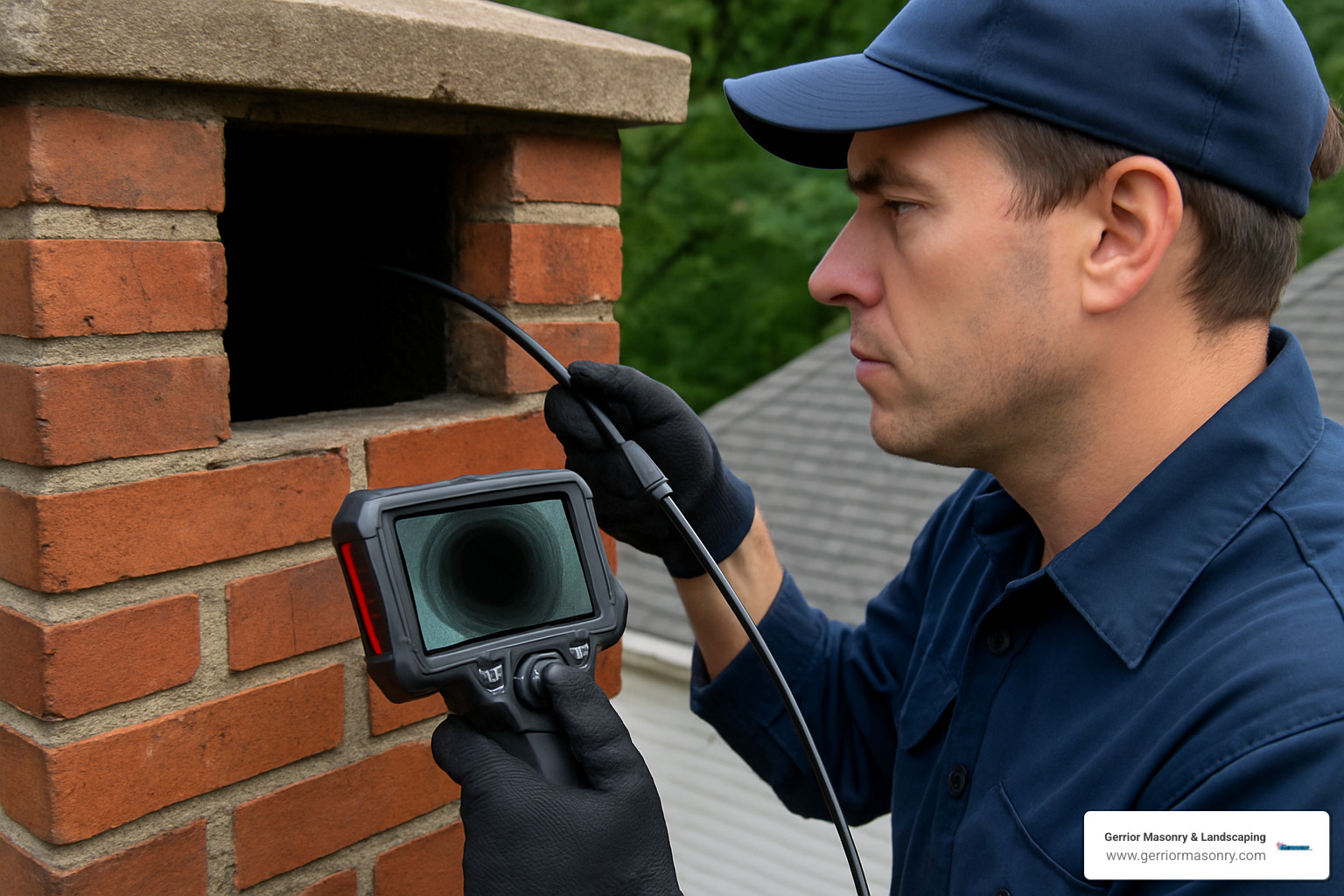
Guesswork has no place in chimney safety. Modern chimney repair contractors use a combination of advanced diagnostic tools, like internal video cameras and moisture meters, and decades of hands-on knowledge to accurately assess your chimney’s condition.
The Chimney Safety Institute of America (CSIA) defines three levels of inspection:
Level 1 – This is the standard annual inspection. A professional will perform a visual check of the readily accessible areas of your chimney’s interior and exterior, ensuring the basic system is sound and free of blockages.
Level 2 – This more in-depth inspection is required when you buy or sell a home, change your heating appliance, or after a malfunction like a chimney fire. It includes a video scan of the entire flue interior, plus a review of the chimney in the attic, crawlspace, or basement.
Level 3 – This is the most intensive level, reserved for when a Level 1 or 2 inspection suggests a hidden hazard that can’t be seen without intrusive measures. It may involve targeted demolition of parts of the chimney or surrounding walls to expose and investigate the problem.
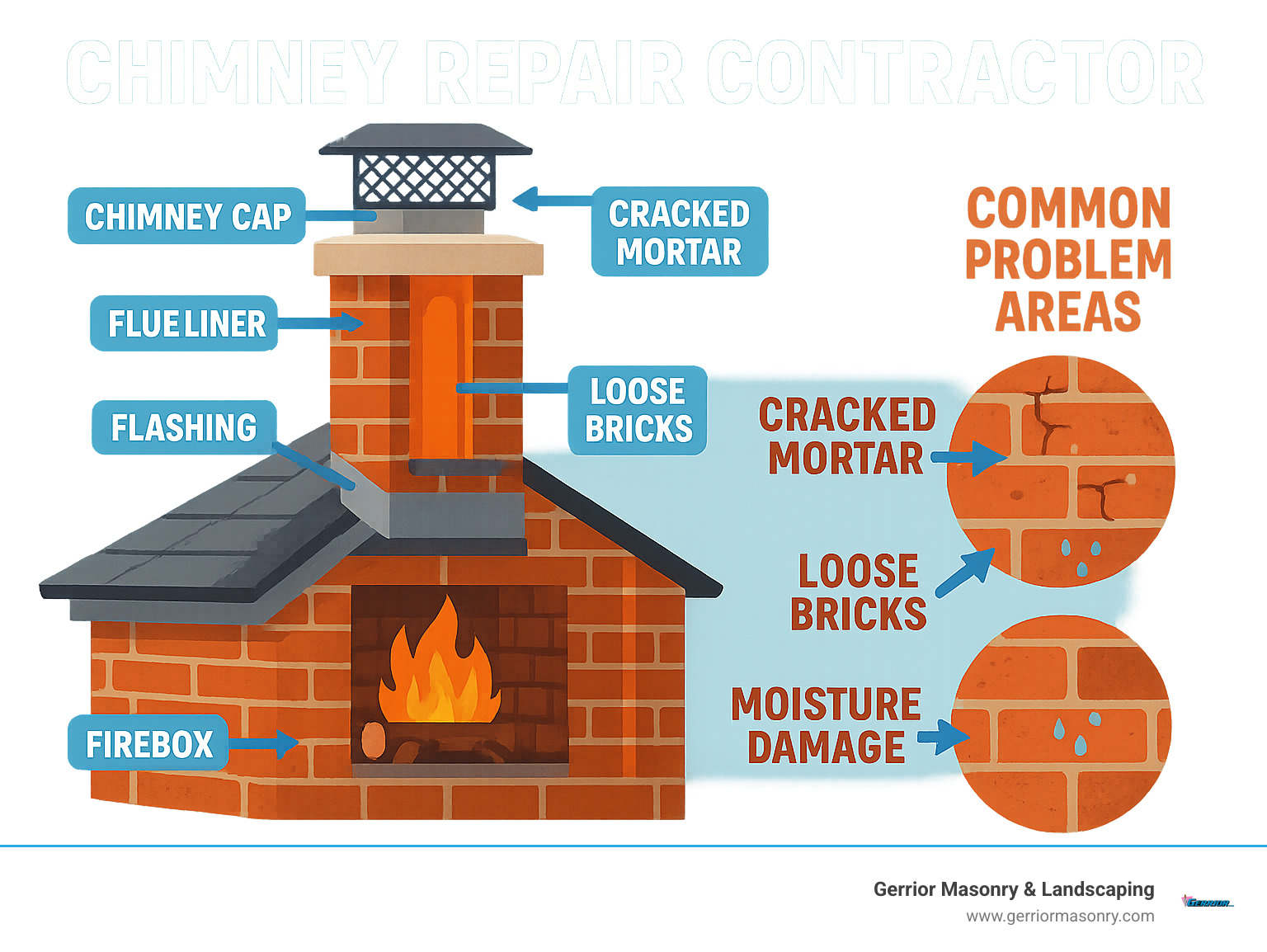
Each inspection level will always include a thorough check of the crown, cap, flashing, mortar joints, firebox, smoke chamber, and overall structural stability.
Decoding Your Chimney Repair Estimate
A trustworthy, professional estimate is your roadmap for the project. It should be provided in writing and clearly list:
A detailed description of the work to be performed and why it’s necessary.
A clear breakdown of labor and material costs.
The type and quality of materials to be used (e.g., specific mortar type, stainless steel liner gauge).
A projected timeline with start and completion dates.
Details on any required permits and who is responsible for obtaining them.
Written warranties covering both workmanship and materials.
Understanding Chimney Repair Costs
These are average internet figures for general guidance, not official Gerrior Masonry pricing.
Scope
Typical Range
Minor fixes (new cap, small crack repair, flashing patch)
$200–$900+
Major masonry or crown work (repointing, partial rebuild)
$1,000–$5,000+
Full chimney rebuild/replacement
$4,000–$15,000+
Prices are influenced by factors like chimney height and accessibility (requiring scaffolding), the complexity of the roofline, the specific choice of brick or stone, and local permit fees in your Massachusetts town. See Chimney Repair Cost Near Me for regional insights.
Core Services of a Qualified Chimney Repair Contractor
A full-service chimney contractor offers a wide range of solutions, from routine upkeep to complete structural overhauls. Understanding these services helps you know what to ask for.
Chimney sweeping – The foundational service. This annual task removes flammable creosote and any debris blocking the flue, ensuring a safe and efficient draft.
Tuckpointing & repointing – These terms involve repairing mortar joints. Repointing replaces decayed mortar, while tuckpointing is a more refined method to create clean, crisp lines. Using the correct mortar that matches the hardness of the original brick is crucial to prevent damage.
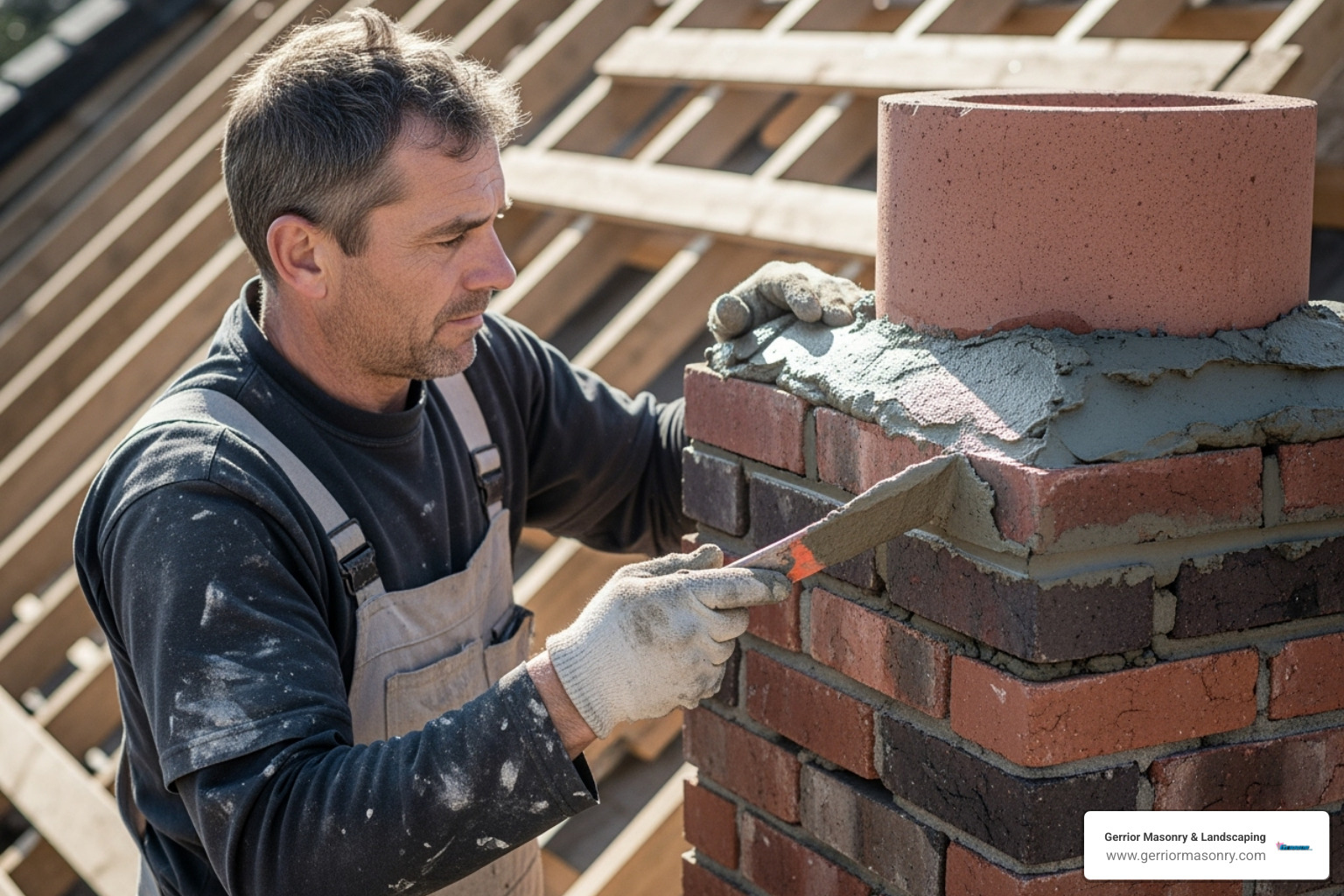
Crown repair/replacement – The chimney crown is the first line of defense against water. Sealing cracks or completely recasting a new, properly angled crown stops water from getting inside the masonry.
Flashing repair – The metal sheets that seal the roof–chimney junction are a common leak source. Proper repair or replacement is critical to prevent roof and attic damage.
Waterproofing – After repairs are made, a professional-grade, vapor-permeable sealer can be applied. This blocks water from soaking into the bricks but allows the chimney to breathe out any internal moisture, preventing freeze–thaw damage.
Chimney cap installation – A simple but vital device that keeps out rain, snow, debris, and animals, while also acting as a spark arrestor.
Major Restorations: When to Repair vs. Rebuild
Deciding between a major repair and a full rebuild depends on the extent of the damage. A skilled mason will help you make the most cost-effective and safe decision.
Situation
Repair
Rebuild
Minor mortar loss
✓
A few spalled bricks
✓
Leaning stack
✓
Extensive cracking/spalling
✓
Foundation issues
✓
As a general rule, if the structural integrity is compromised (leaning, severe cracking) or if the cost of extensive repairs exceeds about 50% of the rebuild cost, a full rebuild is the smarter, safer long-term investment. See our Chimney Rebuild page for examples.
Liner and Flue Services
The flue liner is the hidden workhorse of your chimney system.
Video liner inspections to find hidden cracks, gaps, or deterioration in clay tile liners.
Spot-repair of minor clay-tile damage when feasible.
Installation of stainless-steel liners, the modern standard for safety and durability. They are often required when installing a new furnace or fireplace insert and typically come with a lifetime warranty. (Internet average $900–$3,800, not Gerrior pricing)
Smoke-chamber resurfacing to create a smooth, insulated surface for better draft and improved safety.
Hiring the Right Pro: Vetting Your Chimney Repair Contractor
Choosing your contractor is as important as the repair itself. A qualified professional ensures the job is done right, while a poor choice can lead to bigger problems and wasted money.
Code-compliant, safe workmanship: Professionals are up-to-date on national and local building codes, ensuring your chimney is not just functional but truly safe.
Specialized tools and materials: Pros have access to commercial-grade materials and equipment, from video scanners to specialized scaffolding, for a superior and safer job.
Proper insurance & liability coverage: This protects you and your property. If an accident happens, their insurance covers it, not your homeowner’s policy.
Written warranties and owner oversight: Reputable companies stand by their work. At Gerrior Masonry, every project benefits from owner supervision, a hallmark of our commitment to quality.
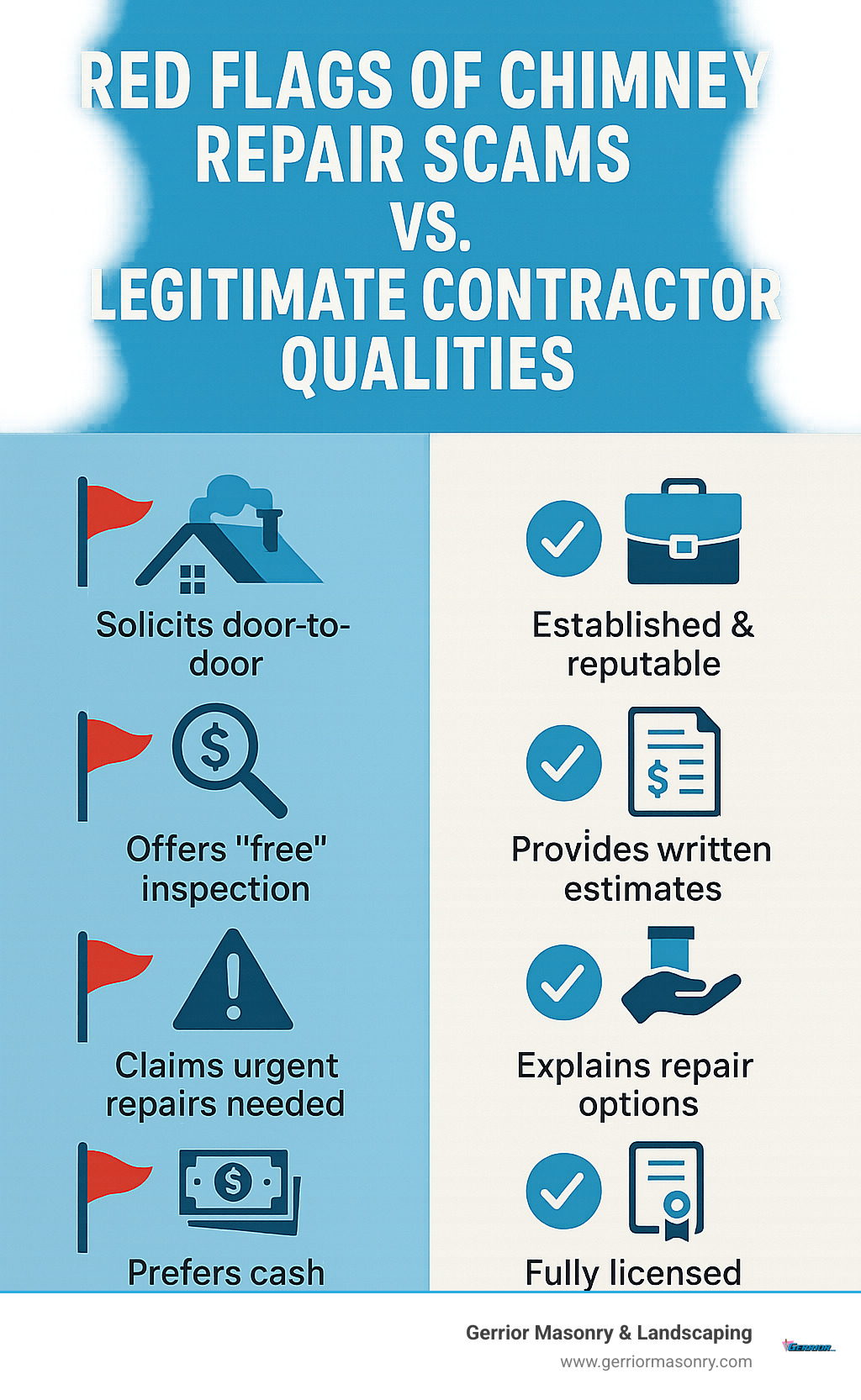
Spotting Chimney Scams
Be wary of these common red flags:
Door-to-door solicitations: Unsolicited offers from someone who just “happened to be in the neighborhood and saw damage” are a classic scam tactic.
High-pressure, “today only” pricing: A legitimate contractor will provide a detailed quote and give you time to consider it. Scare tactics and pressure to sign immediately are unprofessional.
Huge upfront cash demands: While a deposit for materials is standard, demanding a large percentage of the job cost in cash upfront is a major warning sign.
Vague or missing credentials: If a contractor can’t provide a physical business address, proof of insurance, or a license number, walk away.
Always take your time, verify credentials, and get more than one quote for any major project.
Key Questions to Ask
Are you licensed and insured in Massachusetts? Can I see the documentation?
How many years of dedicated chimney repair experience do you have?
Can I see a portfolio of recent Chimney Projects and speak with local references?
What written warranty do you provide on both materials and labor?
Who supervises the crew on-site? Will the owner be involved?
How will you protect my roof, gutters, and landscaping during the work?
Frequently Asked Questions about Chimney Repairs
Here are answers to some common questions homeowners have about chimney maintenance and repair.
Do chimney repairs require a permit?
It depends on the scope of work. Minor upkeep like applying a water repellent or replacing a chimney cap seldom requires a permit. However, structural work—such as a partial or full rebuild, major masonry repairs, or installing a new flue liner—almost always requires a permit from your local building department. A reputable contractor will be knowledgeable about local requirements and handle the entire permitting process for you.
Are chimney repairs covered by homeowner’s insurance?
Coverage varies by policy, but generally, insurance covers sudden and accidental damage. For example, if your chimney is struck by lightning or damaged in a severe storm or a documented chimney fire, it is often covered. However, damage that occurs gradually over time due to neglect or lack of maintenance (like crumbling mortar from age) is typically not covered. Always document any damage with photos and check your specific policy before authorizing work.
How often should I have my chimney inspected?
The National Fire Protection Association (NFPA) recommends annual inspections for every chimney and vent system in use. This routine check can catch small problems before they become large, expensive hazards. You should also schedule an inspection after any unusual event, like a chimney fire or severe weather, or before purchasing a new home.
What is the difference between tuckpointing and repointing?
Though often used interchangeably, they are slightly different. Repointing is the process of grinding out and replacing old, deteriorated mortar from the joints of a masonry wall. Tuckpointing is a more specialized, two-step process that involves filling the joints with mortar that matches the brick color, then applying a thin line of a contrasting color (the “tuck”) to create the appearance of fine, perfect joints. Both restore the integrity of the chimney, but repointing is the more common structural repair.
Can I use my fireplace if the chimney is damaged?
It is strongly advised not to. Using a fireplace with a damaged chimney is a serious safety risk. Cracks in the flue liner can allow intense heat to reach the combustible framework of your house, potentially starting a fire. Blockages or structural issues can also cause smoke and deadly carbon monoxide to vent back into your home. Always have the chimney professionally inspected and repaired before using it.
Conclusion: Protect Your Home with Expert Chimney Care
Your chimney is a critical component of your home’s safety system. A small crack or minor leak today can quickly escalate into a costly rebuild—or worse, a devastating safety hazard like a house fire or carbon monoxide leak—tomorrow. The key to preventing this is proactive care: conducting annual inspections, learning to recognize the early warning signs of decay, and partnering with a trustworthy, skilled chimney repair contractor for all maintenance and repairs.
Gerrior Masonry & Landscape Construction has delivered owner-supervised, high-quality chimney work across Massachusetts for more than 30 years. We understand the unique challenges that New England weather poses to masonry structures. From routine sweeps and minor repointing to complex, full-scale rebuilds, we bring the specialized skill, modern tools, and unwavering integrity your home deserves.
Gerrior Masonry & Landscape Construction is based in Woburn, MA, and proudly serves homeowners throughout Middlesex and Essex County, Massachusetts.
Why Your Chimney is More Than Just a Stack of Bricks
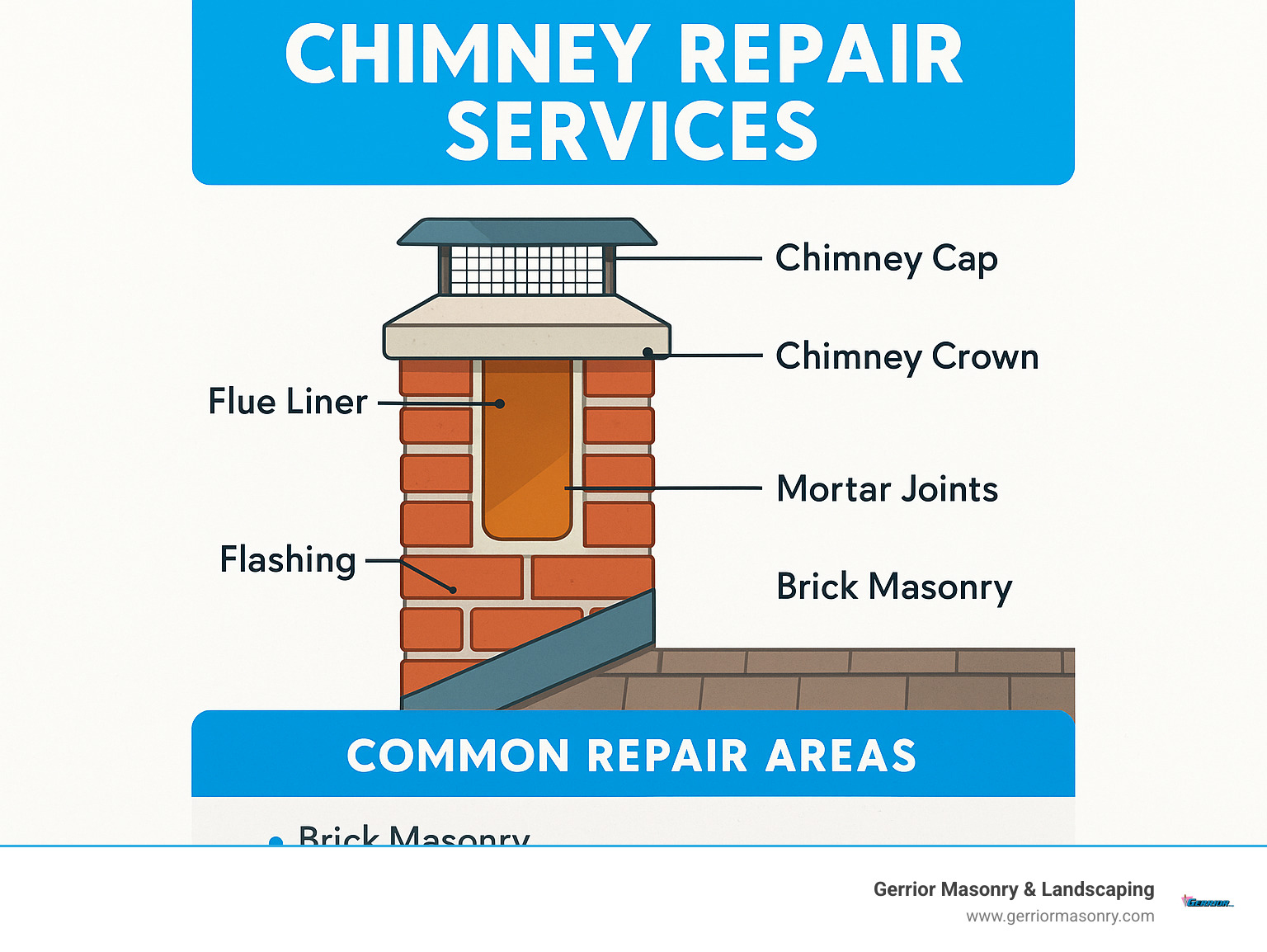
Chimney repair services are essential for maintaining one of your home’s most critical safety systems. While your chimney may look like a simple stack of bricks, it’s actually a complex system that protects your family from dangerous gases, prevents fires, and shields your home from water damage.
Flue and liner services – repairing or replacing damaged flue liners
Crown and cap repair – sealing cracks and replacing damaged chimney crowns and caps
Flashing repair – fixing leaks where the chimney meets your roof
Waterproofing – applying breathable sealants to prevent water damage
Repointing – removing old mortar and replacing with fresh, properly matched mortar
Your chimney faces unique challenges that most home structures don’t. As noted in industry research, chimneys are exposed to weather on five surfaces – the four sides plus the top – making them particularly vulnerable to wind, snow, ice, and rain. This constant exposure, combined with the extreme temperature changes from heating and cooling cycles, causes rapid deterioration of mortar joints and masonry.
The National Fire Protection Association requires annual chimney inspections for safety, and any creosote buildup thicker than 1/8 inch becomes a serious fire hazard. Swift action on repairs like cap replacement or repointing can save you thousands in future reconstruction costs.
I’m Joe Gerrior, owner of Gerrior Masonry & Landscape Construction Corp, and I’ve been providing professional chimney repair services to Massachusetts homeowners for over 34 years. My team and I have seen how proper chimney maintenance protects families and preserves home value.
Telltale Signs Your Chimney Needs Professional Attention
Your chimney has a way of telling you when something’s wrong – you just need to know what to look for. After three decades of providing chimney repair services throughout Massachusetts, I’ve learned that catching problems early can save homeowners thousands of dollars and prevent dangerous situations.
The most obvious red flags show up on the outside of your chimney. Visible cracks in the masonry might seem minor, but they’re actually doorways for water to enter your chimney system. Spalling bricks – where the brick faces start flaking or crumbling away – tell you that freeze-thaw cycles are doing serious damage.
Deteriorating mortar joints are another clear sign that your chimney needs attention. When mortar starts cracking or falling out, the structural integrity of your entire chimney is at risk. You might also notice white staining called efflorescence on your bricks – this chalky residue appears when water carries minerals to the surface, proving that moisture is penetrating your masonry.
Inside your home, watch for rusted dampers or fireboxes, water leaks in your attic near the chimney, or damaged wallpaper around the chimney area. These problems often trace back to a faulty chimney cap – what industry experts call “the cornerstone of chimney preservation.”
Your home’s interior offers some of the clearest warnings that your chimney needs professional help. Dampness around your fireplace is a dead giveaway that water is getting through damaged masonry or flashing. This moisture doesn’t just stay put – it can spread to walls, floors, and furniture.
Unpleasant odors coming from your fireplace, especially musty or animal-like smells, signal moisture problems or unwanted guests in your chimney. These odors often get worse during humid weather when moisture amplifies the smell.
If smoke backs up into your room instead of going up the chimney, you’re dealing with a serious blockage or structural issue that needs immediate attention. This isn’t just annoying – it’s dangerous because it can expose your family to carbon monoxide.
Finding debris in your firebox like leaves, animal nests, or chunks of masonry tells you that your chimney cap or crown has failed. Animals love warm, protected spaces, and a damaged chimney provides the perfect home for birds, squirrels, or raccoons.
These interior problems often require specialized fireplace repairs to restore proper function and keep your family safe.
Exterior Warning Signs
Some exterior warning signs demand immediate action. A leaning chimney structure is a serious safety concern that can indicate foundation problems or severe structural damage. If you notice your chimney isn’t perfectly vertical, call a professional right away.
Look up at your chimney crown – the concrete or masonry surface at the very top. Cracks or missing sections in this crown allow water to pour directly into your chimney system, accelerating damage to everything below.
A missing or damaged chimney cap leaves your flue completely exposed to rain, snow, and animals. I’ve seen cases where homeowners ignored a missing cap for just one winter, only to find extensive water damage that required partial chimney rebuilds.
Damaged flashing around the base of your chimney where it meets your roof is another critical issue. This thin metal barrier is your first line of defense against water infiltration. When flashing fails, water finds its way into your attic, walls, and ceiling.
Mortar joint decay between bricks is especially common in New England’s harsh climate. When mortar starts crumbling or falling out, your chimney loses its structural strength and weather resistance. The sooner you address these issues, the less expensive the repairs will be.
Comprehensive Chimney Repair Services Explained
When it comes to chimney repair services, every defect is usually part of a bigger story. In New England, freeze-thaw cycles, driving rain, and constant heating swings attack masonry from all sides. That is why we never look at a crack or stain in isolation—chimney systems work (or fail) as a whole.
After 30+ years in the field we group most repairs into four categories: 1) structural fixes, 2) water-damage prevention, 3) performance upgrades, and 4) aesthetic restoration. Our chimney projects gallery shows how these often overlap on a single job.
Masonry Repair: Cracked Bricks and Deteriorating Mortar
Spalling brick replacement starts with carefully removing damaged units, sourcing matching brick, then resetting with the right mortar. A key step is asking why the bricks failed—usually water intrusion. Ignoring the root cause just guarantees another service call.
Repointing means removing crumbling mortar and packing fresh, compatible material into the joint. Done correctly, it restores structural strength and weather resistance. Our chimney repointing services in Woburn, MA follow strict depth, mix, and curing guidelines.
Tuckpointing is optional, decorative work that lays a thin, contrasting bead for sharp visual lines once structural repointing is complete.
A cracked flue liner allows heat and gases to attack the chimney shell—and sometimes your living space. Our chimney flue replacement service sizes and installs modern liners that match today’s high-efficiency appliances.
At the roofline, failed flashing is the number-one source of chimney leaks. We use code-approved aluminum, copper, or galvanized steel and integrate it under the shingles—not on top of them—so water is forced out, not in.
Inside the firebox, we replace split fire bricks and repair stuck dampers to restore safe, efficient operation.
The First Line of Defense: Chimney Crown and Cap Services
Your concrete or masonry crown should shed water and include a drip edge. We repair minor cracks, rebuild failed sections, and apply flexible sealants so small defects don’t balloon into costly rebuilds.
A quality chimney cap—installed by our chimney cap installation team—keeps out rain, animals, and sparks. We recommend single-piece metal caps with screen and integrated drip edges for maximum durability.
Chimney Rebuilding and Waterproofing
When damage is too advanced, partial (roofline-up) or full rebuilds become the safest, most economical choice. Our chimney rebuild service includes structural assessment and, when needed, foundation work.
Finally, we protect new or repaired masonry with breathable water repellents. Our chimney waterproofing services use sealants that block bulk water while allowing interior moisture vapor to escape—preventing the very freeze-thaw damage they are meant to solve.
The Dangers of Delaying Chimney Repairs
Small chimney issues rarely stay small. A hairline crack lets in water, freeze-thaw forces it wider, and before long the chimney—and sometimes your attic framing—needs major work.
Fire hazards are the most immediate worry. Creosote thicker than 1/8 inch can ignite, and gaps in the structure allow flames to reach wood framing. Carbon monoxide sneaks in through the same defects when flues are blocked or cracked.
Neglect also leads to structural collapse. Water-soaked masonry loses strength; we have seen chimneys start leaning after just a few winters of ignored damage. Repairs that could have cost a few hundred dollars grow into multi-thousand-dollar rebuilds.
Add in energy loss—damaged dampers and liners waste heat—and the price of procrastination becomes obvious.
The Chimney Safety Institute of America explains more about creosote dangers in their resource center.
How to Choose the Best Local Chimney Repair Company
Hiring the right pro saves time, money, and headaches. Focus on three essentials:
Specialized experience – Masonry and chimney work demand different skills than general roof or siding jobs. Browse portfolios and ask about similar projects.
Licensing & insurance – Reputable contractors gladly show current documents. No paperwork, no hire.
Reputation – Read reviews for communication, cleanliness, and long-term results. How a company responds to a bad review often tells you more than the review itself.
Itemized repairs – e.g., 50 ft repointing, crown rebuild, cap install.
Named materials – “Type N mortar” or “copper step flashing,” not vague terms.
Realistic schedule – accounting for weather-dependent cure times.
Warranty terms – solid coverage on materials and workmanship.
For cost ranges on typical fixes, see our breakdown of chimney repair cost near me. Remember: a rock-bottom bid often means shortcuts that cost more later.
Frequently Asked Questions about Chimney Repair Services
When homeowners start researching chimney repair services, they naturally have questions about maintenance schedules, repair techniques, and costs. After three decades in the masonry business, I’ve heard these questions countless times, and I’m happy to share what I’ve learned.
How often should I have my chimney inspected?
The National Fire Protection Association requires annual chimney inspections for good reason – your chimney faces challenges that most home structures don’t encounter. Think about it: your chimney deals with extreme temperature swings, constant weather exposure, and corrosive combustion gases. A lot can change in a year.
We recommend scheduling your inspection before each heating season, ideally in late summer or early fall. This timing gives you enough time to complete any necessary repairs before you need your fireplace or heating system.
Don’t wait for your regular inspection if severe weather hits your area. Ice storms, hurricanes, high winds, and even earthquakes can damage chimney structures in ways that aren’t immediately visible. A quick post-storm inspection can catch problems before they become dangerous.
If you’re buying a home, always include the chimney in your inspection checklist. Previous owners might have delayed maintenance, and you don’t want to inherit expensive repair bills or safety hazards.
What is the difference between repointing and tuckpointing?
This question comes up frequently because the terms sound similar, but they serve different purposes in chimney repair services.
Repointing is functional repair work. When mortar joints deteriorate from weather exposure and age, we remove the old, crumbling mortar and replace it with fresh material. This process restores your chimney’s structural integrity and weather resistance. Without proper repointing, water penetrates the masonry and causes accelerating damage through freeze-thaw cycles.
Tuckpointing is primarily about appearance. After repointing is complete, we can apply thin lines of contrasting mortar to create the visual effect of fine, precise joints. This technique was historically used to make ordinary brickwork look like expensive, perfectly cut stone.
Both processes require skilled craftsmanship to ensure proper mortar bonding and weather resistance. The mortar must be mixed to the right consistency, applied at the correct depth, and properly cured. Poor workmanship in either technique can actually accelerate deterioration rather than prevent it.
Most chimney repairs involve repointing for structural reasons, with tuckpointing added when homeowners want to improve their chimney’s appearance. Learn more about our chimney tuckpointing services.
How much do chimney repairs cost?
Please note: These are average costs based on internet data and not actual costs for Gerrior Masonry services.
Chimney repair costs vary significantly based on the extent of damage, accessibility, and materials required. Here’s what homeowners typically spend on common repairs:
Repair Type
Average Cost Range
Repointing
$500 – $2,500+
Crown Repair
$200 – $1,000+
Flashing Repair
$300 – $1,500+
Cap Installation
$150 – $800+
Flue Liner Replacement
$1,000 – $5,000+
Partial Rebuild
$3,000 – $15,000+
Complete Rebuild
$5,000 – $20,000+
Several factors influence the final cost of your chimney repair services. Height and accessibility play a major role – taller chimneys require specialized equipment and additional safety measures. Extent of damage obviously affects pricing, as minor mortar touch-ups cost far less than major structural repairs.
Materials required can significantly impact costs. If we need to match unusual brick colors or use specialty mortar formulations, expenses increase. Local building codes sometimes require specific materials or techniques that affect pricing.
Seasonal demand also influences costs. Spring and fall are our busiest seasons as homeowners prepare for temperature changes, which can affect scheduling and pricing.
The most cost-effective approach is preventive maintenance. Regular inspections and prompt minor repairs prevent the need for expensive major reconstruction. A $200 crown repair completed promptly can prevent thousands in water damage and structural problems.
The cheapest estimate isn’t always the best value. Quality materials and skilled workmanship cost more upfront but provide better long-term results and fewer callbacks.
Your Trusted Partner for Chimney Repair in Massachusetts
When it comes to protecting your home and family, chimney repair services aren’t just another home maintenance task – they’re a critical investment in your safety and peace of mind. Throughout this guide, we’ve covered the essential aspects of chimney care that every homeowner should understand.
The most important lesson? Proactive maintenance saves money and lives. Annual inspections catch small problems before they become expensive disasters. That $200 crown repair today prevents the $10,000 water damage repair next year. More importantly, properly maintained chimneys protect your family from fire hazards and carbon monoxide poisoning.
Safety must always come first. Never ignore warning signs like white staining on your bricks, smoke backing up into your room, or dampness around your fireplace. These aren’t minor inconveniences – they’re your chimney’s way of telling you something’s wrong.
Professional expertise matters more than you might think. Chimney systems are complex, and DIY repairs often create more problems than they solve. The wrong mortar mix can accelerate deterioration. Improper flashing installation can cause extensive water damage. These aren’t risks worth taking to save a few dollars.
At Gerrior Masonry & Landscaping, we’ve spent over 30 years perfecting our craft and building trust with Massachusetts homeowners. We’ve seen how proper chimney maintenance protects families and preserves home values. More importantly, we’ve helped countless homeowners avoid the devastating consequences of neglected chimney problems.
What sets us apart is our commitment to quality craftsmanship and owner oversight on every project. When you work with us, you’re not just getting experienced masons – you’re getting a team that treats your home like our own. We use high-quality materials, follow proper techniques, and stand behind our work with meaningful warranties.
Whether you need simple repointing, complex flue liner replacement, or complete chimney rebuilding, we have the expertise to handle any challenge. From minor maintenance to major reconstruction, we approach every project with the same attention to detail and commitment to excellence.
For expert chimney repairs in Woburn, MA, and throughout Middlesex and Essex County, contact our team today. We’re here to help you maintain a safe, efficient, and beautiful chimney system that protects your family for years to come.
Gerrior Masonry & Landscape Construction is based in Woburn, MA, and services Middlesex and Essex County, Massachusetts.