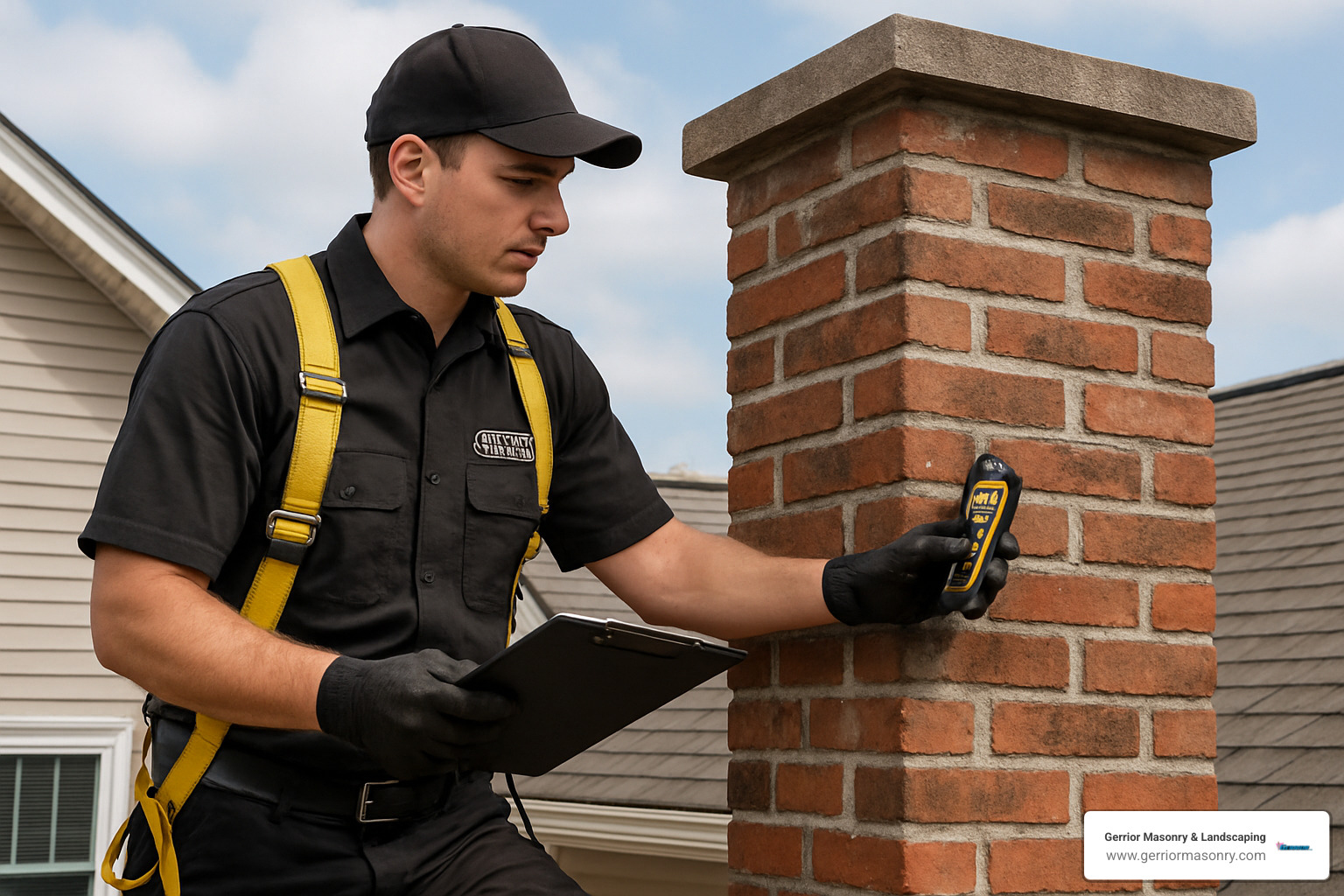
Chimney Brick: 10 Best Picks & Proven Tips for 2025 Success
Why Choosing the Right Chimney Brick Matters for Your Home
Chimney brick selection is crucial for both safety and longevity of your fireplace system. The right bricks protect your home from fire hazards, withstand extreme temperatures, and resist Massachusetts’ harsh freeze-thaw cycles that can cause costly damage.
Quick Answer for Chimney Brick Buyers:
– Fire bricks (refractory bricks) – Best for fireboxes and high-heat areas
– Clay modular bricks – Standard choice for chimney exteriors
– Reclaimed bricks – Perfect for historic home restoration
– Brick veneer – Lightweight, cost-effective option for chases
– Premium glazed bricks – Weather-resistant with improved durability
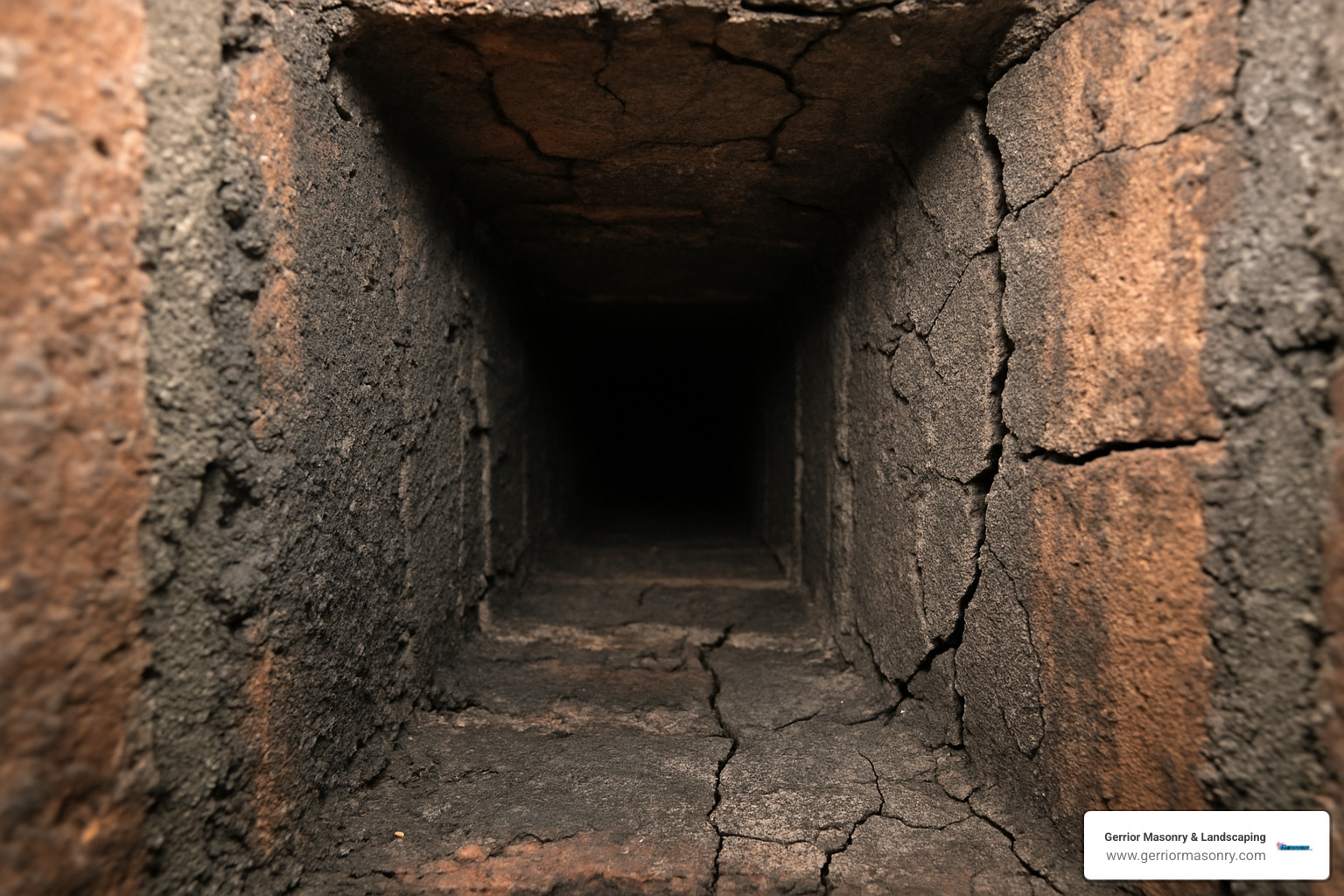
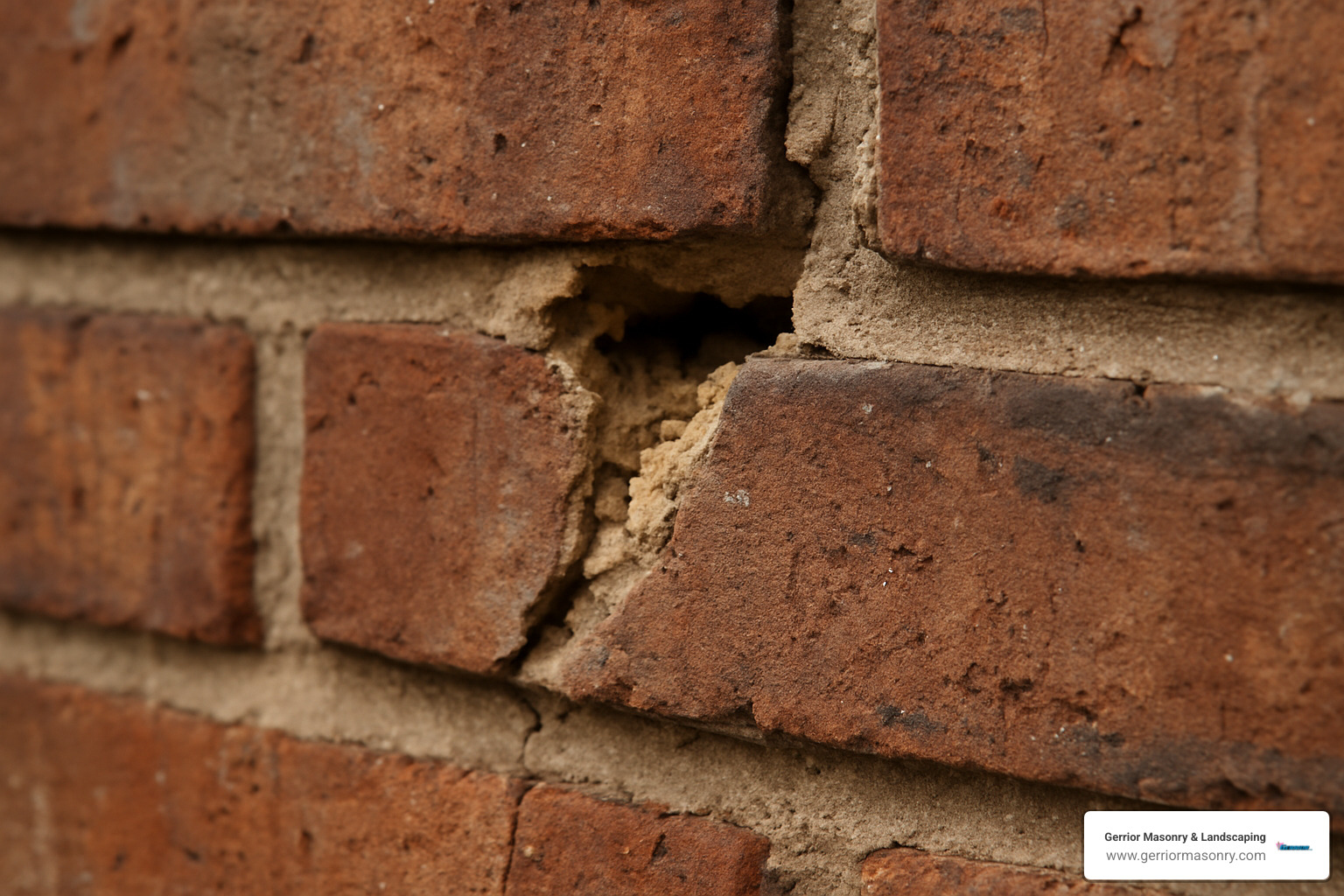
According to industry research, chimney brick spalling is one of the most common masonry issues found during inspections, especially in regions with frequent freeze-thaw cycles like New England. Small cracks in chimney brickwork can become significantly larger by the next spring if left unattended.
Rebuilding a brick chimney due to severe spalling can cost tens of thousands of dollars, making the right initial brick choice crucial for homeowners.
I’m Joe Gerrior, owner of Gerrior Masonry & Landscape Construction Corp., and I’ve been helping Massachusetts homeowners select and install the perfect chimney brick solutions for over 34 years.
What Makes a Great Chimney Brick?
After three decades of chimney work in Massachusetts, I can tell you that choosing the right chimney brick isn’t just about looks – it’s about keeping your family safe and your wallet happy. We’ve seen too many homeowners learn this lesson the hard way when their “bargain” bricks start crumbling after just one brutal New England winter.
Durability is absolutely everything when it comes to chimney bricks. Here in Massachusetts, your bricks face a real beating – scorching summer heat followed by bone-chilling winters with freeze-thaw cycles that happen dozens of times each season. Poor quality bricks literally explode under these conditions.
The fire rating of your bricks could literally save your home. Quality fire bricks handle temperatures over 2,000°F without breaking a sweat, while regular bricks start failing around 1,200°F. When you’re dealing with chimney fires or intense heat from a roaring fireplace, this difference matters.
Absorption rate is where many homeowners get tripped up. Bricks that soak up too much water become ticking time bombs once winter hits. We always recommend bricks with absorption rates below 17% for exterior chimney work. Water gets in, freezes, expands, and boom – you’ve got spalling bricks and a hefty repair bill.
Compressive strength determines whether your chimney can handle its own weight plus wind loads and settling. Quality chimney brick should have at least 3,000 PSI compressive strength.
According to scientific research on brick safety, proper brick selection is one of the most important factors in chimney safety and longevity.
Chimney Brick vs. Standard Masonry Brick
Here’s where I see homeowners make expensive mistakes all the time. Not all bricks are created equal, and using the wrong type for your chimney is like using a butter knife for brain surgery – technically it’s a tool, but it’s definitely not the right one.
Chimney brick and firebrick are specially engineered to handle what chimneys throw at them. These refractory bricks contain high alumina content and are fired at much higher temperatures during manufacturing. This creates a dense, heat-resistant material that laughs at thermal shock – those rapid temperature changes that make regular bricks crack and fail.
Regular masonry bricks work great for your garden wall or front steps, but they have no business being near your chimney’s high-heat areas.
Property
Fire Brick
Standard Brick
Heat Resistance
Up to 3,000°F+
Up to 1,200°F
Thermal Shock Resistance
Excellent
Poor
Density
High
Medium
Cost
$0.50-$2.00 each
$0.25-$0.75 each
Typical Use
Fireboxes, flue liners
Exterior walls, patios
Yes, fire bricks cost more upfront, but they’ll outlast standard bricks by decades in chimney applications.
Key Components of a Brick Chimney
Understanding how all the pieces fit together helps you make smart decisions about brick selection for each part of your chimney system.
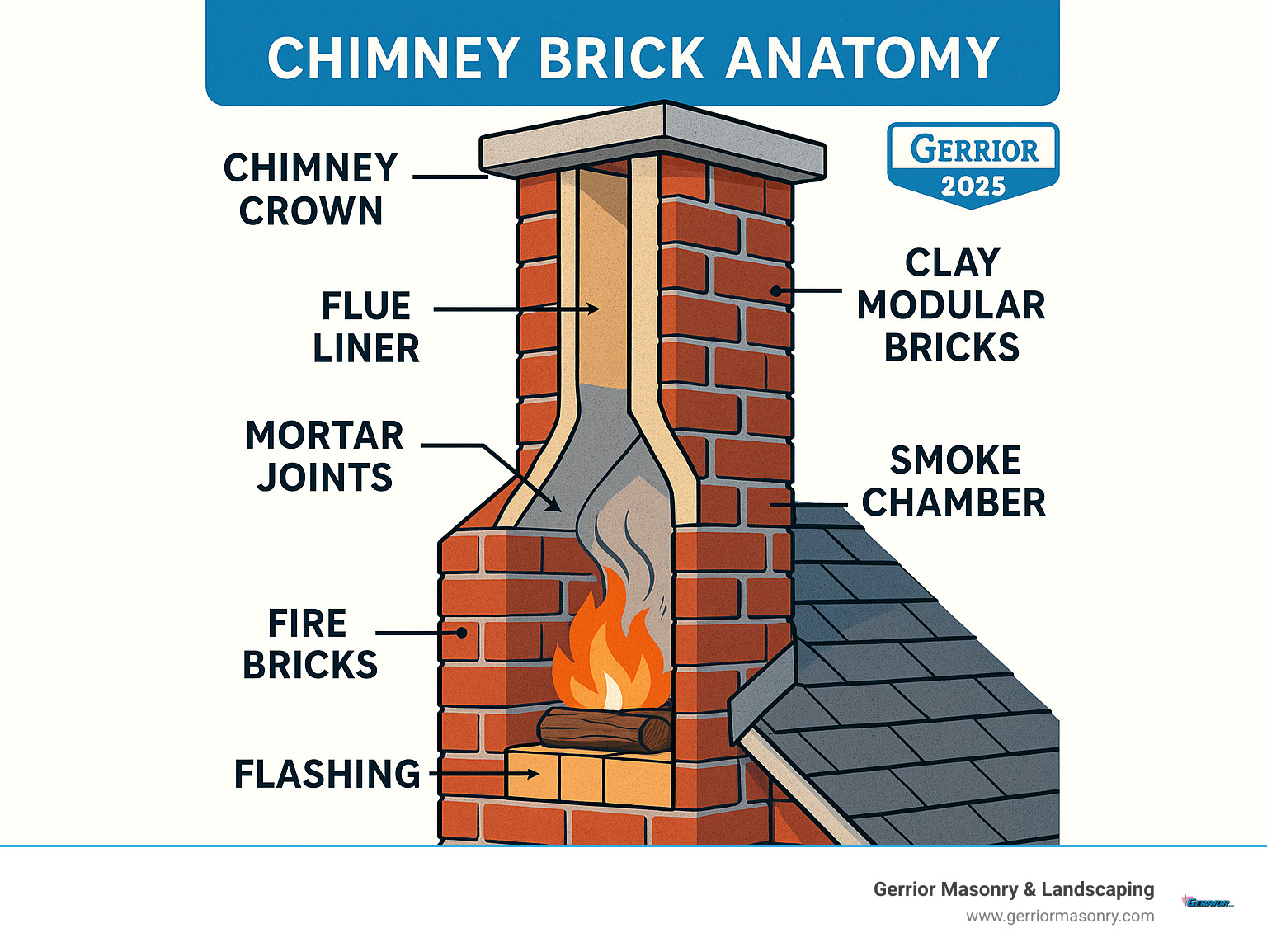
The crown sits at the very top of your chimney and takes a beating from weather year-round. We build crowns with a proper slope to shed water quickly because standing water is brick’s worst enemy.
Your cap might not be made of brick, but it’s your chimney’s best friend. A quality cap keeps rain, snow, and critters out of your flue, protecting all that expensive brickwork below.
The flue liner protects your chimney structure from heat and corrosive gases. Whether you choose clay, stainless steel, or concrete liner, the surrounding bricks still need to handle serious thermal stress.
Mortar joints between your bricks are often the first thing to fail, and that’s actually by design. Mortar is intentionally softer than brick, so it takes the abuse first and can be repaired more easily.
Flashing creates that crucial watertight seal where your chimney meets the roof. Poor flashing installation can destroy even premium bricks from the inside out by allowing water infiltration.
The smoke chamber area requires your highest-grade fire bricks because this is where temperatures peak and thermal stress is most severe.
Top Chimney Brick Options for Every Fireplace
After three decades of working with chimneys across Massachusetts, I’ve learned that choosing the right chimney brick isn’t just about looks – it’s about finding the perfect match for your specific fireplace needs and budget.
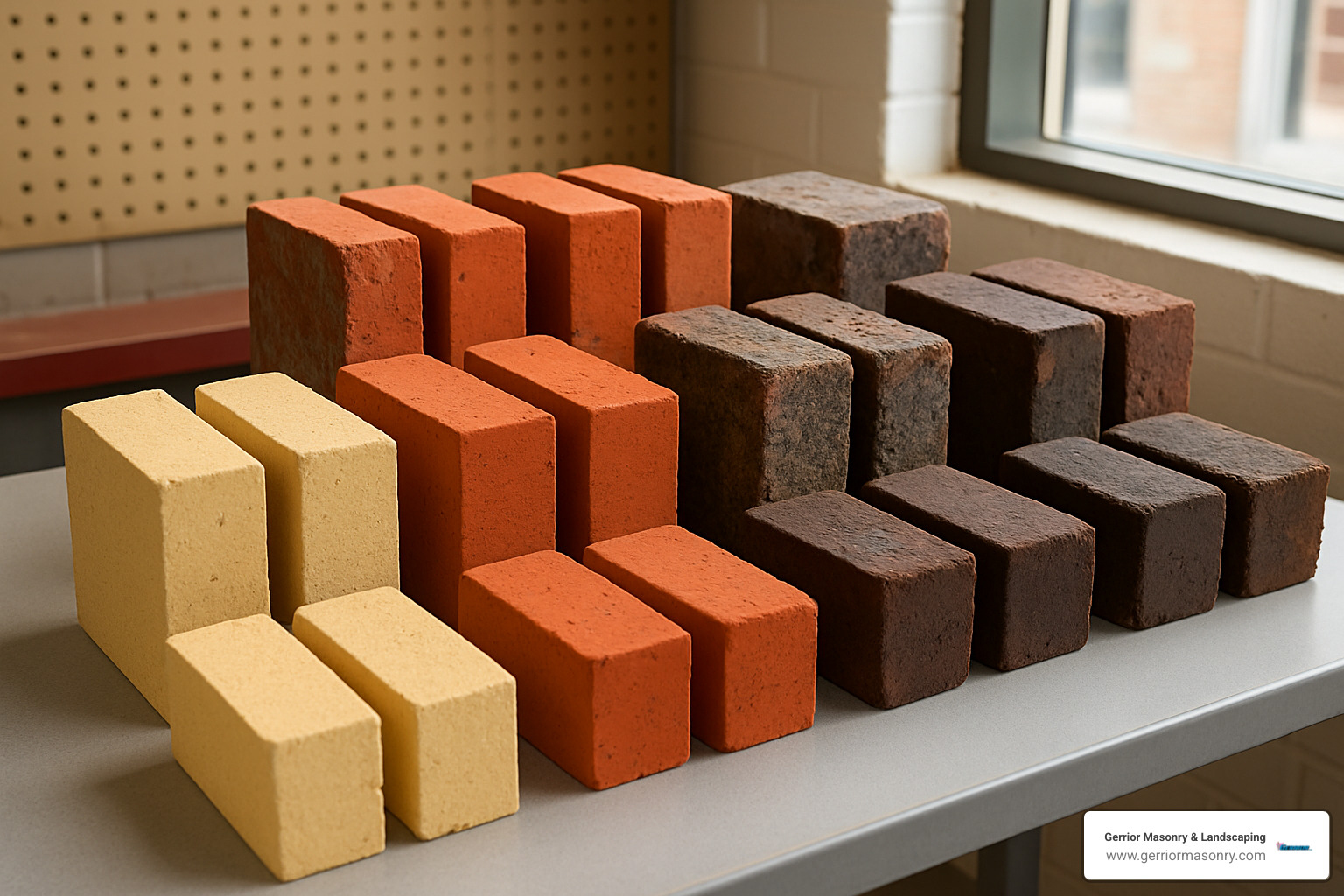
Fire bricks are the champions of high-heat areas, especially your firebox. These tough little workhorses can handle temperatures that would crack regular bricks faster than you can say “chimney fire.” They come in standard sizes and classic buff or red colors.
For the exterior chimney structure, clay modular bricks are our go-to recommendation. They’re like the reliable friend who never lets you down – offering excellent weather resistance, consistent sizing, and a price that won’t make you wince.
Handmade bricks bring personality to your chimney that machine-made versions simply can’t match. Each brick tells its own little story with slight variations in color and texture.
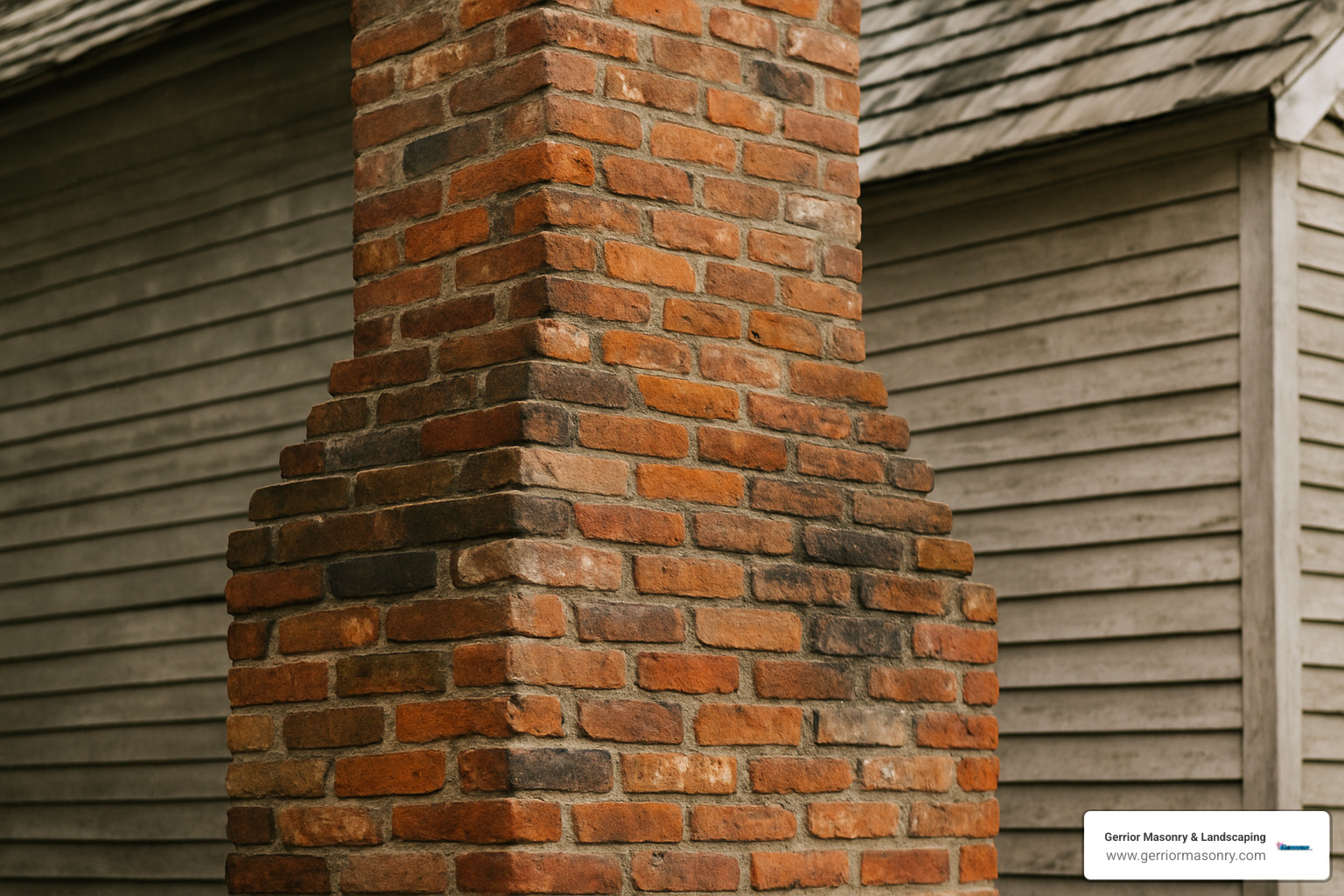
Reclaimed bricks offer a chance to give old materials new life while adding instant character to your chimney. These salvaged beauties carry decades of history in their weathered surfaces. Just remember – we always inspect reclaimed bricks carefully since their past life might have left them more vulnerable to harsh New England winters.
For homeowners looking for the brick look without the full brick investment, brick veneer delivers impressive results. These thin bricks give you all the visual appeal of traditional masonry while being lighter on both your structure and your wallet.
Budget-Friendly Chimney Brick Picks
You don’t need to empty your savings account to get quality chimney brick that’ll protect your home for decades.
Economy clay bricks are the practical choice that gets the job done right. They might not win any beauty contests, but these machine-made bricks offer consistent sizing and reliable weather resistance.
Local sourcing is one of my favorite money-saving strategies. New England has some excellent brick manufacturers right in our backyard, and buying local cuts out those hefty shipping costs. Plus, local bricks are designed to handle our specific climate challenges.
When it comes to fire bricks for your firebox, standard fire bricks provide essential safety protection without breaking the bank. While premium versions offer some improved features, standard fire bricks still give you the heat resistance you absolutely need.
Premium Chimney Brick Choices for Historic Homes
Working on historic homes is like being a detective and an artist rolled into one. You need chimney brick options that respect the past while providing modern performance.
Antique-look bricks are masters of disguise – they’re brand new but look like they’ve been weathering New England storms for generations. Manufacturers use special techniques to create the irregular sizing and weathered appearance that makes these bricks blend seamlessly with centuries-old masonry.
Glazed bricks are particularly smart for coastal areas or homes that face harsh weather exposure. The glazed surface acts like a protective shield against moisture and salt, while still maintaining that classic brick appearance.
Tumbled bricks go through a special process that softens their edges and creates natural-looking wear patterns. It’s like giving new bricks a time machine treatment.
Sometimes historic restoration calls for custom sizes to match the unique dimensions of old brickwork. Yes, they’re expensive, but when you’re working on a home that’s been standing since before the Revolutionary War, authenticity matters.
How to Maintain & Repair Brick Chimneys
Taking care of your chimney brick doesn’t have to be overwhelming, but it does require consistent attention. After 34 years in the masonry business, I’ve seen how a little preventive care can save homeowners thousands of dollars in major repairs.
The key is catching problems while they’re still small. A tiny crack in your mortar joint might seem insignificant in spring, but after a Massachusetts winter of freeze-thaw cycles, that same crack can become a major structural issue.
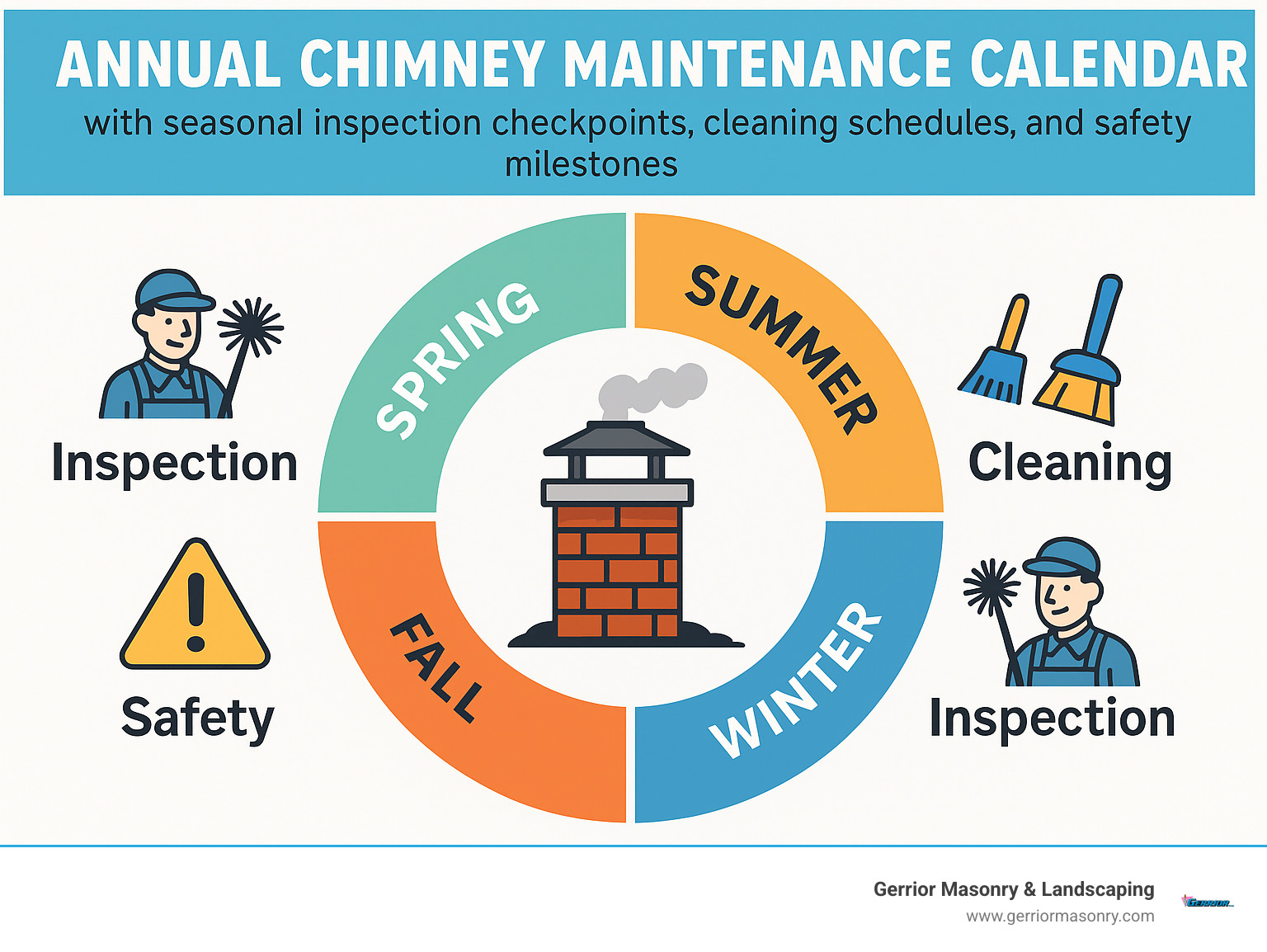
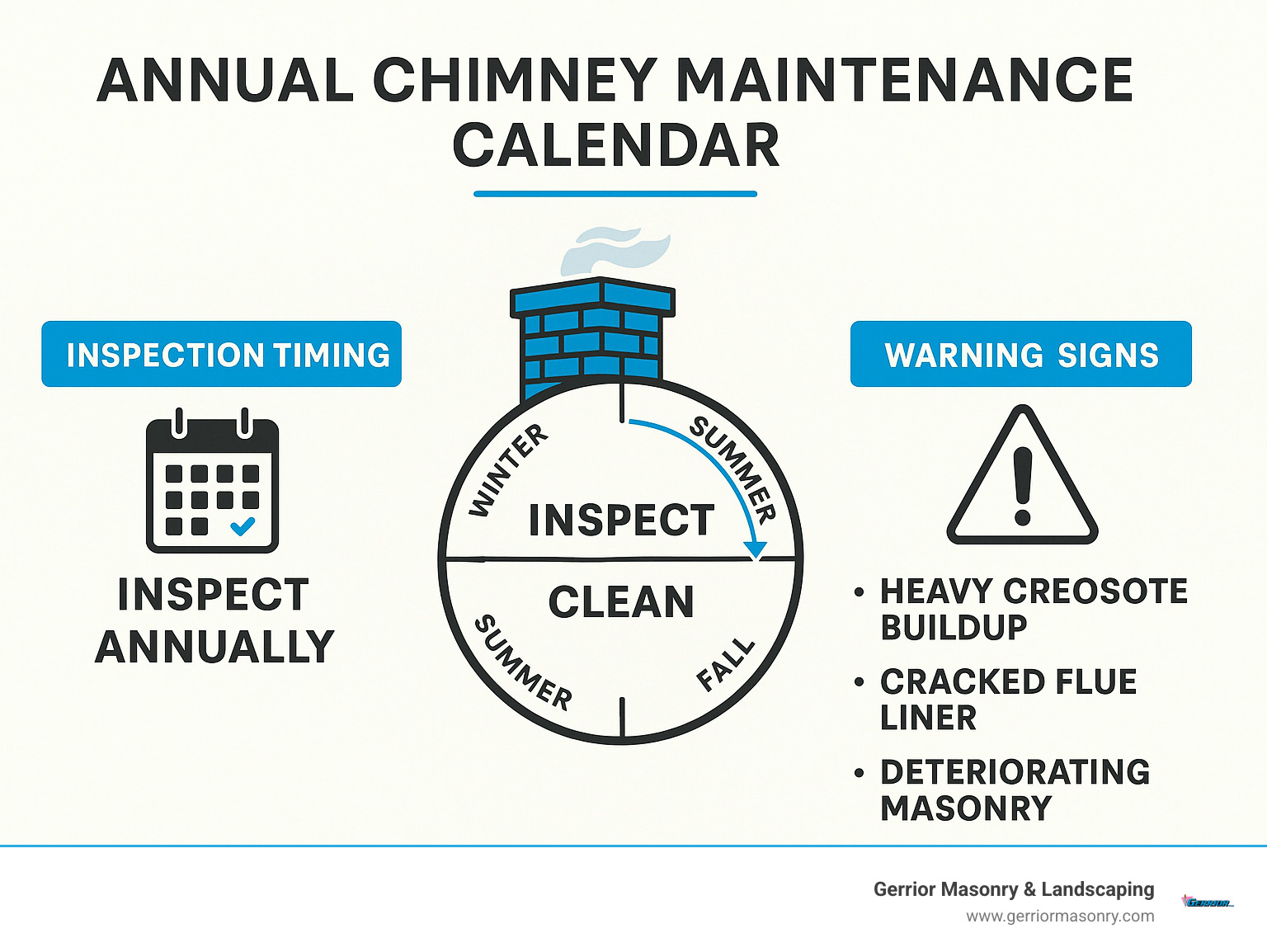
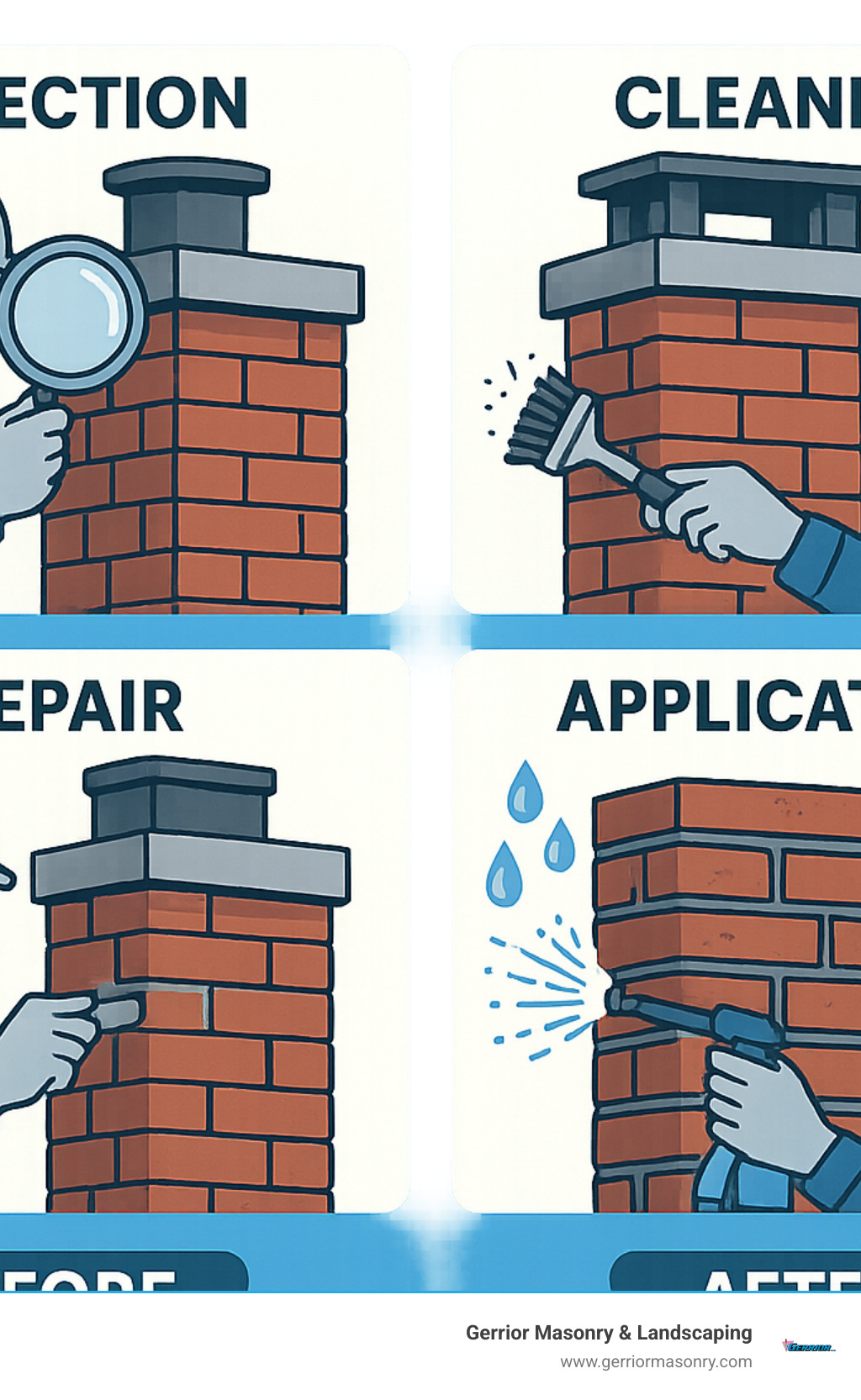
Regular inspections should happen at least once a year, preferably in late summer before the heating season begins. Look for loose or missing mortar, cracked bricks, white staining (efflorescence), or any signs of water damage around the chimney base.
Tuckpointing is probably the most common repair we perform on brick chimneys. This process involves carefully removing old, deteriorated mortar and replacing it with fresh material. When done properly, tuckpointing restores both the structural integrity and weather resistance of your chimney.
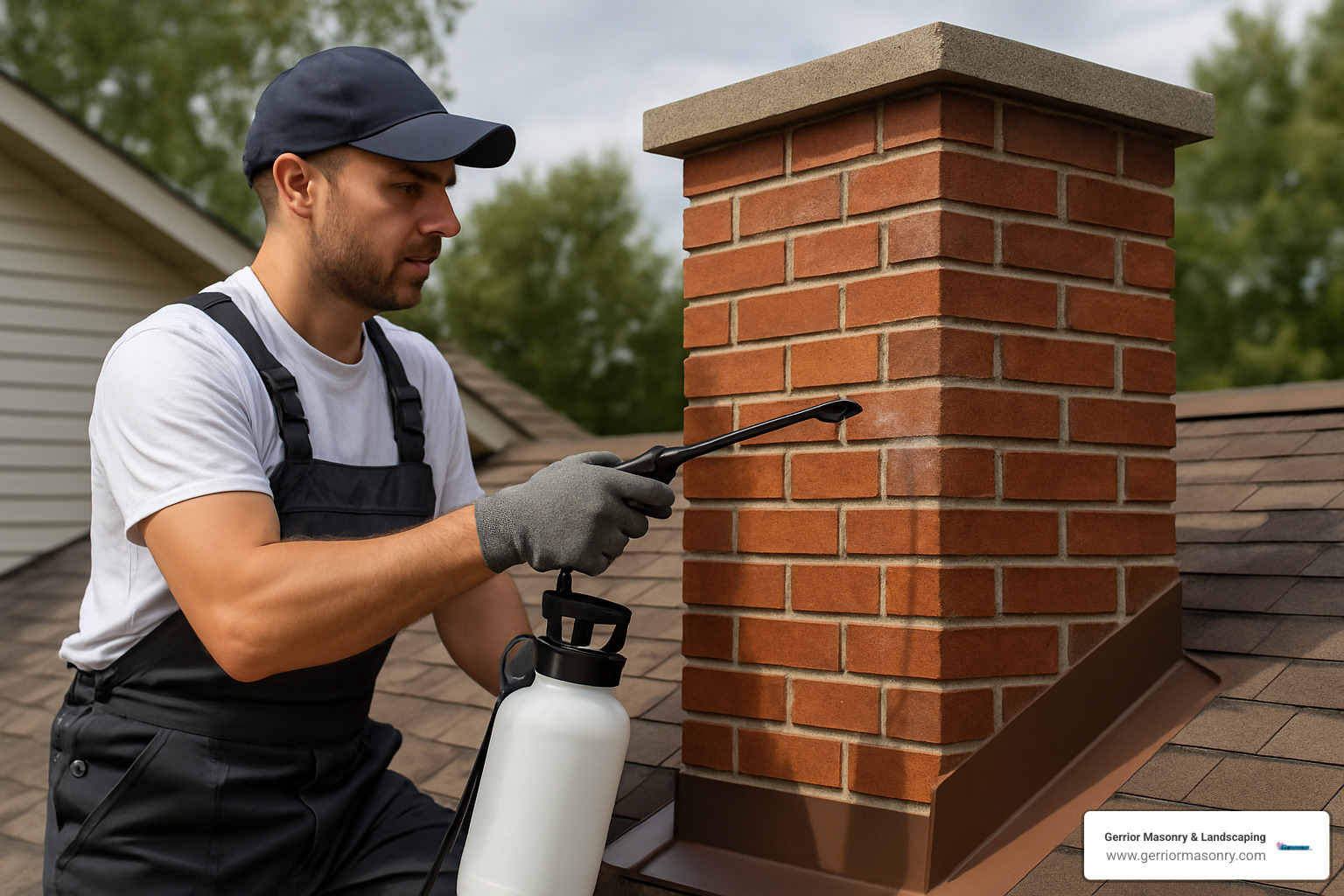
Sealing your chimney brick creates an invisible barrier against moisture while still allowing the masonry to breathe. Quality masonry sealants don’t change the appearance of your bricks but significantly improve their ability to shed water.
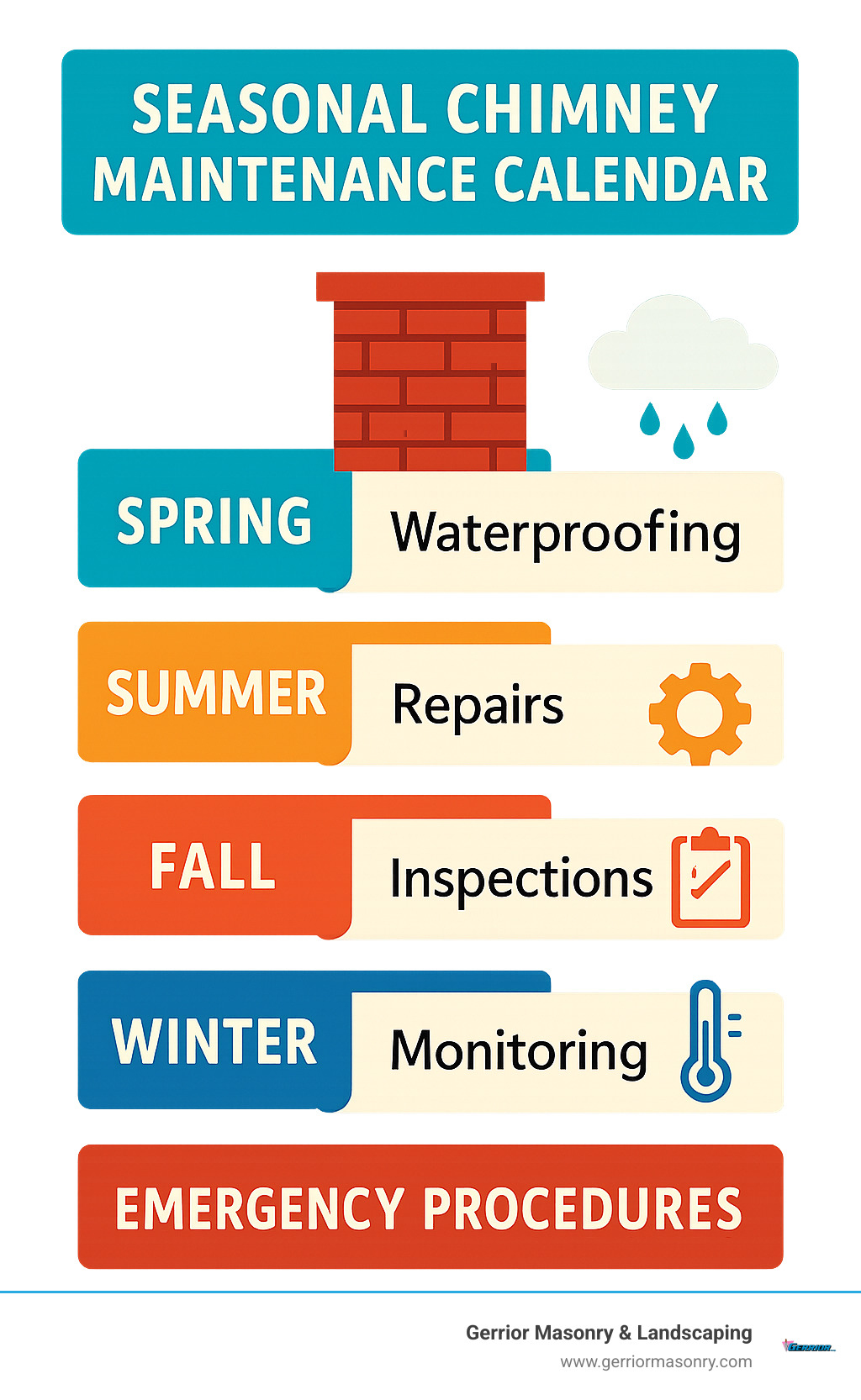
Waterproofing goes beyond simple sealing to address the entire chimney system. This includes repairing the chimney crown, maintaining flashing where the chimney meets the roof, and ensuring proper drainage.
For more detailed information about professional chimney services, visit our Chimney Masonry Repair page.
DIY Chimney Brick Repair Basics
Some chimney brick repairs are well within the reach of handy homeowners, but knowing your limits is crucial for both safety and success.
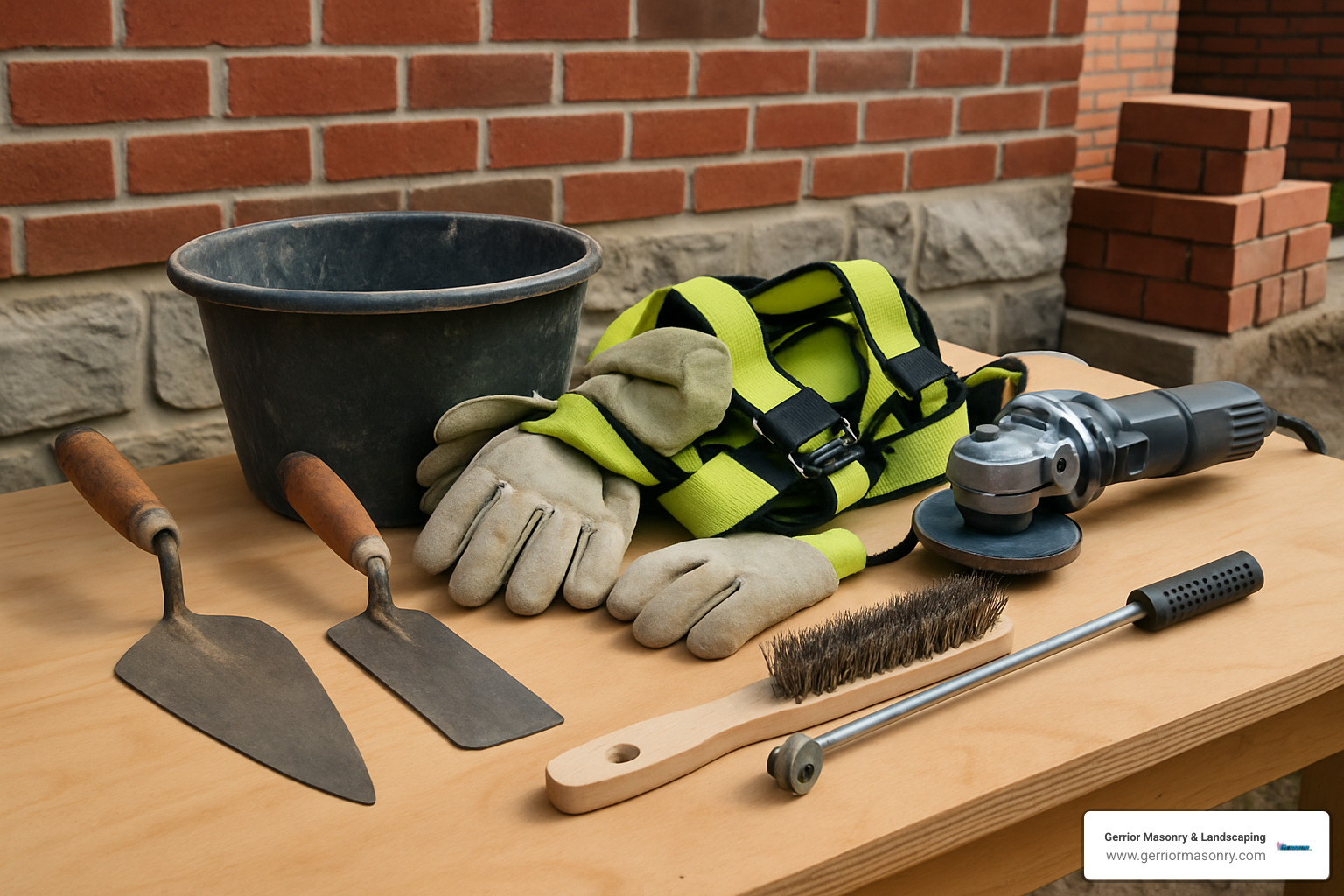
Tuckpointing tools don’t have to break the bank, but quality makes a real difference. A good joint raker removes old mortar cleanly without damaging surrounding bricks. Pointing trowels should feel comfortable in your hand and hold their edge well.
Mortar mix selection is where many DIY projects go wrong. The new mortar must be compatible with your existing masonry – too hard, and it can actually damage your bricks. For most New England chimneys, we recommend a Type N mortar mix, but older homes might need a softer lime-based mortar.
The proper technique starts with completely removing failed mortar to a depth of at least twice the joint width. Clean out all loose debris and dampen the joint before applying fresh mortar.
Weather timing can make or break your tuckpointing project. Avoid working when temperatures drop below 40°F or rise above 90°F. Protect fresh mortar from rain for at least 24 hours.
DIY work should stay at ground level where it’s safe. Anything requiring ladders or roof access is better left to professionals.
When Chimney Brick Damage Requires a Pro
Some chimney brick problems are definitely beyond DIY repair territory. Recognizing these situations early can prevent dangerous conditions and save money in the long run.
Leaning stacks are an immediate red flag that requires professional attention. Any visible lean or movement in your chimney indicates serious structural problems that could threaten your entire home.
Major cracking that extends through multiple brick courses or shows up in a stair-step pattern suggests foundation settlement or structural failure. These cracks often indicate problems that go far deeper than the visible damage.
Fire risk situations demand immediate professional intervention. Damaged flue liners, missing mortar joints near combustible materials, or any condition that could allow heat or flames to escape the chimney system puts your family’s safety at stake.
When water infiltration starts causing interior damage, mold growth, or structural deterioration, the problem has moved beyond simple surface repairs.
For detailed information about professional repair costs and what to expect, check our Chimney Repair Cost Near Me page.
Costs & Climate Considerations
When you’re planning chimney brick work, understanding both the financial investment and how New England weather affects your chimney helps you make smart decisions that protect your home and wallet.
Chimney brick work isn’t cheap, but it’s a lot less expensive than dealing with water damage in your living room or, worse, a house fire. After 34 years in this business, I’ve seen homeowners spend twice as much on emergency repairs because they waited too long to address small problems.
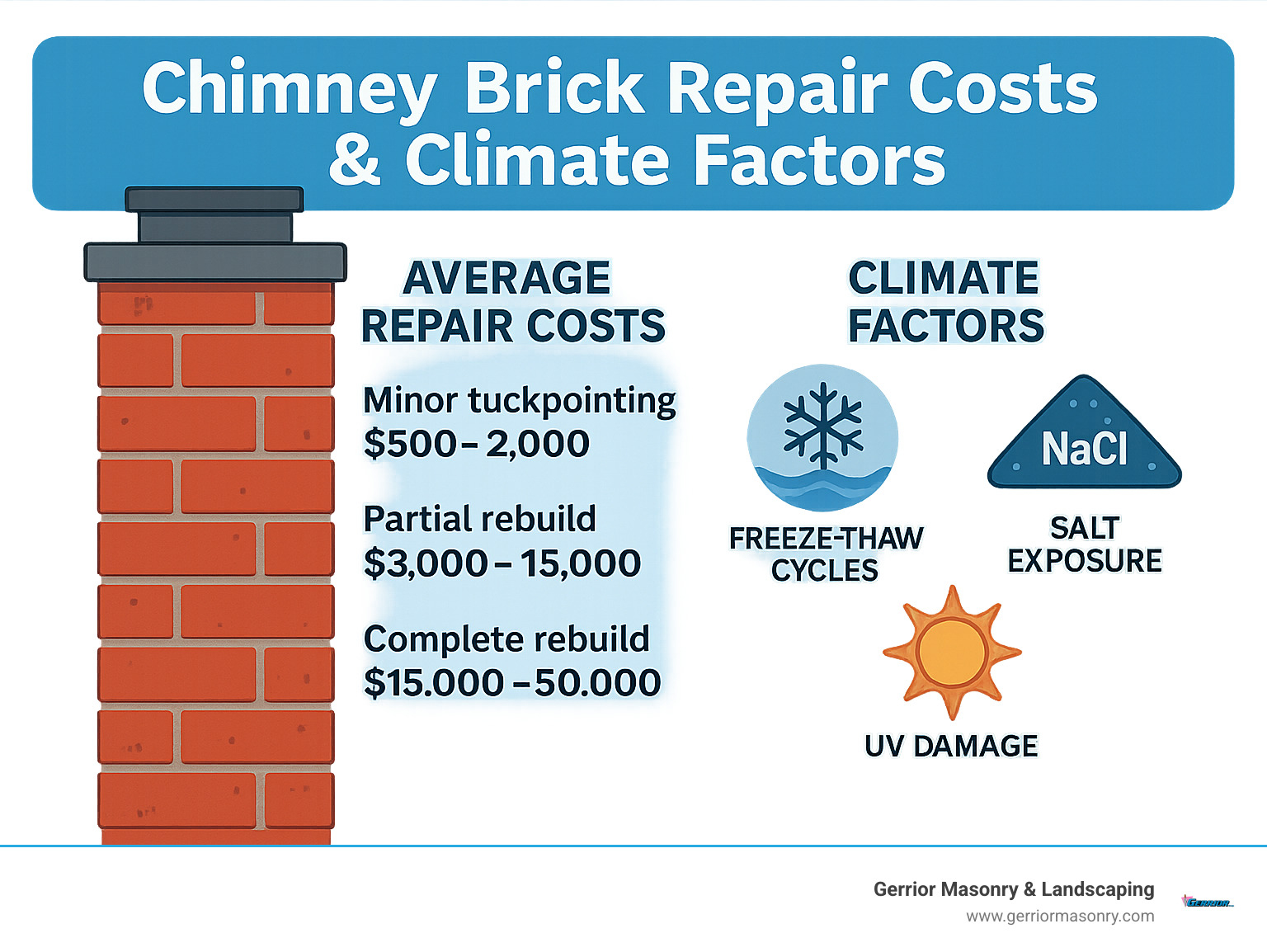
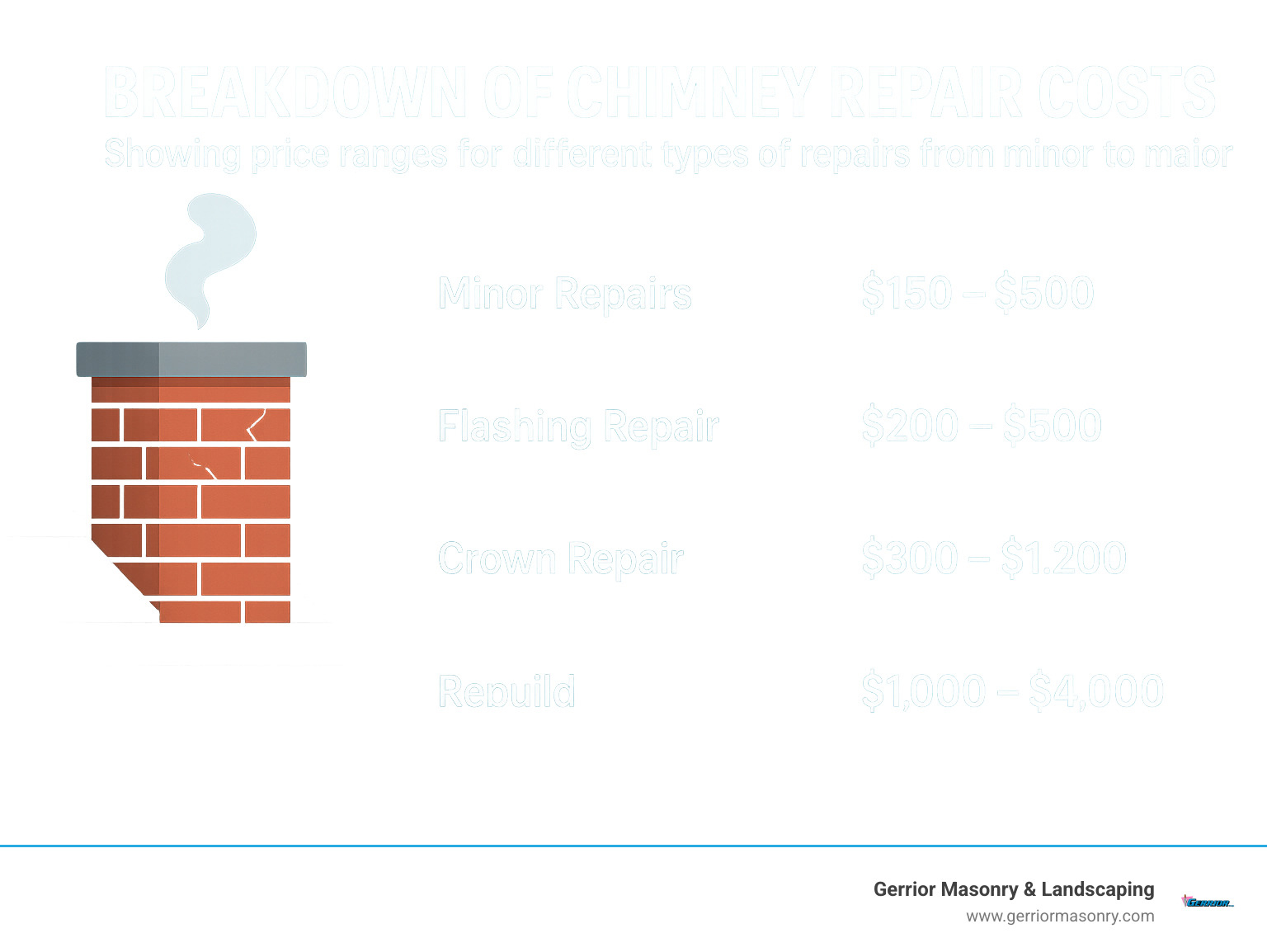
Average cost ranges for chimney work vary widely based on what needs fixing. These costs reflect internet research averages and not specific Gerrior Masonry pricing: minor tuckpointing runs $500-$2,000, partial chimney rebuilds cost $3,000-$15,000, and complete chimney reconstruction ranges from $8,000-$25,000. Emergency repairs can hit anywhere from $1,000-$8,000.
The rebuild versus repair decision often comes down to math and timing. Sometimes extensive repairs cost almost as much as starting fresh, but only give you a few more years of service.
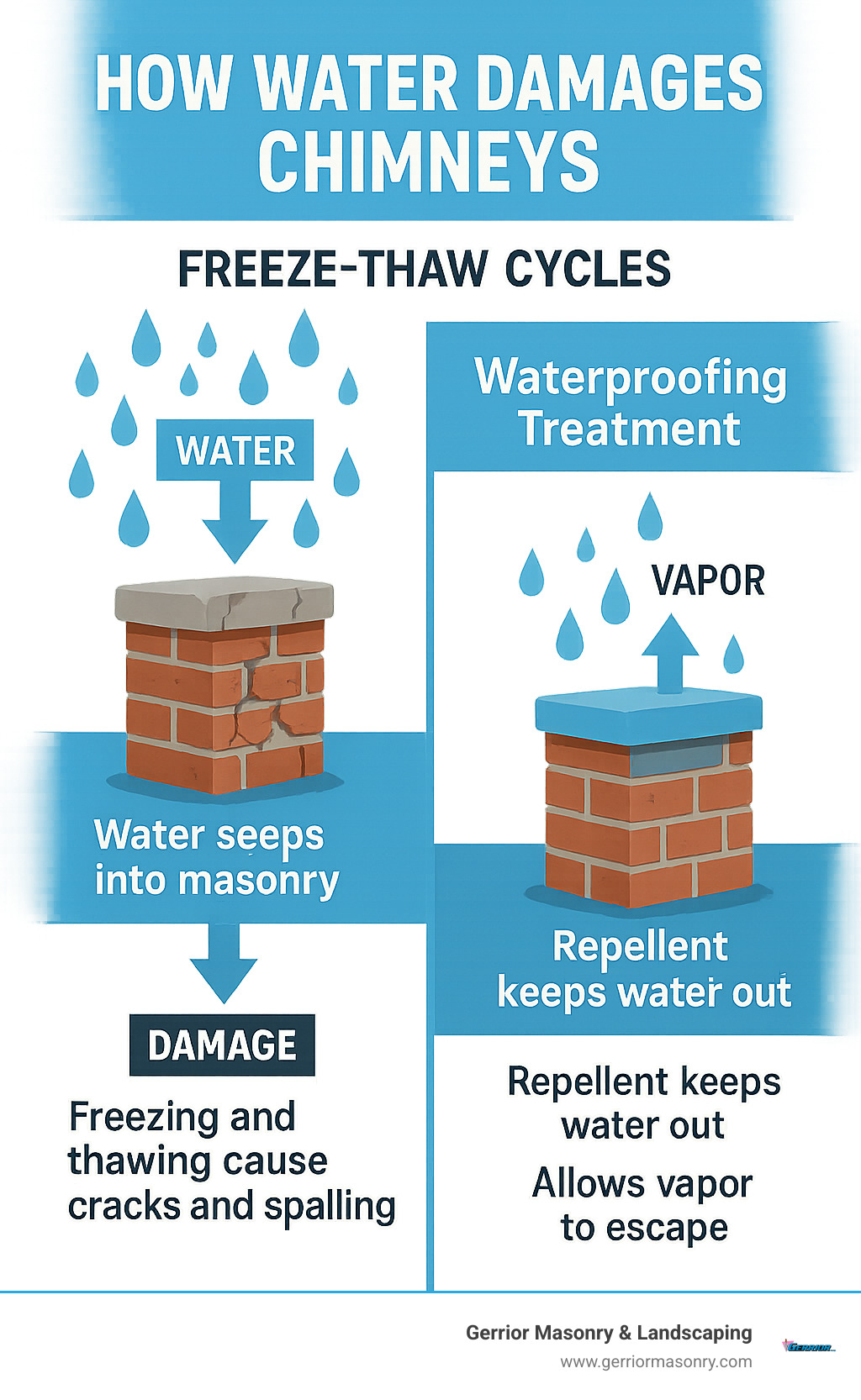
Freeze-thaw cycles are the biggest enemy of chimney bricks in Massachusetts. Water gets into tiny cracks, freezes overnight, expands, and makes those cracks bigger. Salt exposure near the coast makes this worse by attracting more moisture and causing chemical damage to the brick surface.
Understanding current chimney brick repair pricing helps you budget appropriately and avoid sticker shock. These average costs are based on internet data and not actual Gerrior Masonry pricing, which varies based on your specific project needs.
Labor costs make up the biggest chunk of your bill – usually 60-70% of the total project cost. Skilled masons earn good wages because this work requires specialized knowledge and involves real safety risks.
Material costs depend heavily on what type of brick you choose and how much you need. Premium bricks run $1-$3 each, while standard bricks cost $0.50-$1.50 per piece. Don’t forget about specialty mortars and sealants, which add another $200-$800 to most projects.
Scaffolding rental is often unavoidable for chimney work, adding $500-$2,000 to your project cost. Safety regulations require proper scaffolding for work above certain heights.
Demolition costs for carefully removing damaged brickwork typically run $15-$25 per square foot.
How Weather Affects Chimney Brick Lifespan
Massachusetts weather puts chimney brick through the wringer year after year. Understanding how our climate affects your chimney helps you plan maintenance and catch problems early.
Rain infiltration causes more long-term damage than any other weather factor. Water finds its way into the smallest cracks and starts a cycle of freeze-thaw damage, mortar deterioration, and structural problems.
Snow load puts extra stress on your chimney structure, especially during those heavy February storms we’re famous for. Heavy snow sitting on your chimney crown increases freeze-thaw cycles.
Wind exposure drives rain horizontally into brick surfaces and speeds up normal weathering. Chimneys stick up above everything else on your roof, so they take the full force of our coastal winds and nor’easters.
After three decades of working with homeowners across Massachusetts, we hear the same chimney brick questions repeatedly. Here are the answers to the most common concerns that come up during our consultations.
What causes chimney brick spalling?
Chimney brick spalling happens when water gets trapped inside your bricks and then freezes during our harsh New England winters. As that water expands into ice, it creates tremendous pressure that literally pushes the brick surface apart, causing those telltale flakes and chips you see falling around your chimney base.
The most common culprit is weak mortar that allows water infiltration while simultaneously putting pressure on the bricks during freeze-thaw cycles. We’ve seen this countless times – the mortar acts like a vise, squeezing the bricks until they can’t take the stress anymore.
Moisture infiltration from missing chimney caps, cracked crowns, or failed flashing accelerates the problem. Once water finds its way into your chimney system, it’s only a matter of time before freeze-thaw damage begins.
Other factors include using salvaged bricks that may already be weakened, poor original construction techniques, and normal aging of materials. House settling can also create stress points that make bricks more vulnerable to spalling.
How often should chimney bricks be inspected?
The NFPA guidelines recommend professional chimney inspections annually, and we strongly agree with this schedule. One year can bring significant changes, especially after a harsh winter or severe storm season.
However, don’t wait for your annual inspection to keep an eye on your chimney brick condition. We encourage homeowners to do quick visual checks every few months, particularly after major weather events.
Look for obvious warning signs like loose or missing mortar, white staining on the brick surface, water stains inside your fireplace, or small piles of brick chips around your chimney base. These early indicators can save you thousands in repair costs if addressed promptly.
During your quarterly checks, also notice any musty odors from your fireplace or dampness on walls near the chimney. These symptoms often indicate water infiltration that threatens your brick investment.
Can I use veneer instead of full chimney bricks?
Brick veneer offers an attractive middle ground between full brick construction and other chimney materials, but it’s important to understand where it works and where it doesn’t.
Veneer excels for chimney chases and exterior cladding applications where you want the classic brick appearance without the weight and expense of full brick construction. It’s significantly lighter, easier to install, and costs substantially less than traditional masonry.
However, veneer has important limitations. You still need fire bricks for your firebox and any areas exposed to extreme heat – veneer simply cannot handle those temperatures safely. Think of veneer as the attractive exterior clothing for your chimney, not the structural foundation.
The weight advantage makes veneer particularly useful for retrofitting older homes where structural capacity might be limited. The cost savings can be substantial too, often running 40-60% less than full brick construction while delivering similar visual appeal.
For most homeowners, a combination approach works best – fire bricks where heat resistance is critical, and veneer where appearance and cost-effectiveness matter most.
Conclusion
Choosing the right chimney brick isn’t just about aesthetics—it’s about protecting your family and your biggest investment. After helping Massachusetts homeowners for over three decades, I’ve seen how quality brick selection makes the difference between decades of worry-free fireplace enjoyment and costly emergency repairs.
Preventive care truly is your best friend when it comes to chimney maintenance. Those quarterly visual inspections we mentioned might seem like a hassle, but they’re nothing compared to dealing with water damage in your living room or, worse, a chimney fire. Regular maintenance catches small issues while they’re still small—and affordable to fix.
The truth about early repairs is simple: a $500 tuckpointing job today prevents a $15,000 rebuild tomorrow. We’ve seen too many homeowners postpone minor repairs only to face major reconstruction projects later. Those little cracks and loose mortar joints don’t fix themselves, and Massachusetts weather doesn’t give them a break.
When it comes to smart purchasing decisions, the cheapest option upfront often costs the most in the long run. Fire bricks for your firebox aren’t optional—they’re essential safety equipment. Quality clay bricks for your exterior chimney construction will outlast bargain alternatives by decades. And proper sealants and protective measures pay for themselves many times over through prevented water damage.
Think of your chimney brick investment like buying a good winter coat in New England—you might pay more initially, but you’ll be grateful for that protection when the weather gets rough. Quality materials and professional installation aren’t expenses; they’re insurance policies for your home’s safety and value.
For comprehensive masonry services including chimney repair, visit our Brick and Masonry Repair page.
At Gerrior Masonry & Landscape Construction, we bring over 30 years of experience to every chimney project. Our skilled team and owner oversight ensure quality results that protect your home and family. Based in Woburn, MA, we proudly serve homeowners throughout Middlesex and Essex County, Massachusetts, providing expert chimney brick selection, installation, and repair services.
Chimney Cleaning and Inspection Near Me: Top 5 Trusted 2025
Why Professional Chimney Care Protects Your Home and Family
Chimney cleaning and inspection near me services are essential for preventing house fires and carbon monoxide poisoning. Research shows that annual chimney cleaning prevents the buildup of creosote, a flammable compound that causes thousands of chimney fires each year.
Quick Answer for Local Chimney Services:
Annual cleaning frequency – Remove creosote buildup and prevent fires
WETT certified inspectors – Required by many insurance companies
Average cost range – $100-$700+ (varies by service level and location)
Key certifications to look for – CSIA, WETT, National Chimney Sweep Guild membership
The dangers of neglected chimneys are real. As one Calgary homeowner finded, “We all cherish the moments around our fireplace(s) for a variety reasons; it’s imperative to know the condition and hazards revealed through professional chimney cleaning and/or inspection.” This sentiment reflects what fire safety experts have been warning about for decades – regular maintenance is the only way to prevent tragic accidents.
I’m Joe Gerrior, owner of Gerrior Masonry & Landscape Construction Corp., serving Massachusetts homeowners for over 34 years with comprehensive masonry and chimney services. Our team has seen how proper chimney cleaning and inspection near me searches lead homeowners to certified professionals who prevent costly damage and keep families safe.
Here’s the truth that keeps me up at night: creosote buildup kills. This sticky, flammable compound clings to your chimney walls every single time you light a fire. What starts as a thin layer becomes a deadly fire hazard that grows thicker with each cozy evening by the fireplace.
The Chimney Safety Institute of America doesn’t mince words about this danger. Their guidelines are crystal clear – chimney cleaning and inspection near me services become essential when soot reaches just 1/8 inch thick. If you see any shiny glaze on your chimney walls, that’s creosote in its most dangerous form, and you need professional help immediately.
The numbers don’t lie. The National Fire Protection Association reports that dirty chimneys cause thousands of house fires every year. But here’s what really gets to me – many of these tragedies could have been prevented with simple annual maintenance.
Carbon monoxide poisoning presents an equally terrifying threat. This silent killer has no smell, no color, and no warning signs until it’s too late. A cracked flue liner or blocked vent can turn your cozy fireplace into a death trap, allowing deadly gases to seep into your home while your family sleeps.
Your insurance company knows these risks too. That’s why many require WETT (Wood Energy Technology Transfer) inspections for homes with wood-burning appliances. These certified inspections aren’t just paperwork – they’re your proof that your chimney meets safety standards and your coverage stays intact.
The latest research on fireplace emissions reinforces what we’ve seen in the field for over 30 years. Even gas fireplaces need regular attention because they produce exhaust gases that must vent properly. Skip the maintenance, and you’re gambling with your family’s health and your home’s air quality.
I’ve walked into too many homes where “routine” inspections revealed serious problems – cracked flue liners that could have caused carbon monoxide leaks, damaged crowns letting water destroy the chimney structure, or animal nests blocking proper ventilation. Each situation could have turned tragic if the homeowner had waited another year.
Annual chimney care isn’t just recommended – it’s the only way to sleep soundly knowing your family is safe.
Professional Chimney Cleaning and Inspection Near Me: Step-By-Step
When you search for chimney cleaning and inspection near me, you’re looking for certified professionals who follow proven safety protocols. The process starts before they even arrive – reputable companies will ask about your chimney type, last cleaning date, and any concerns you’ve noticed.
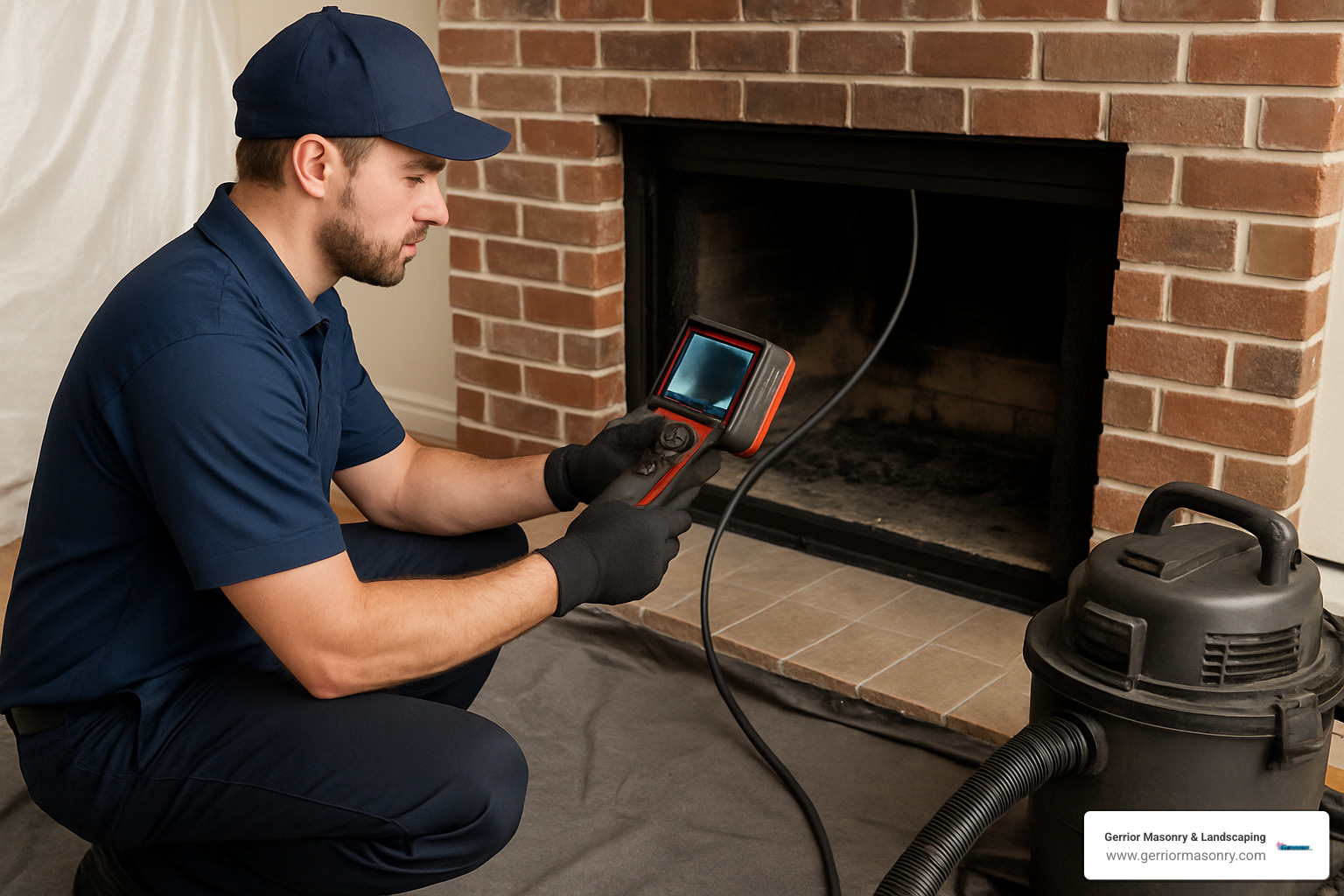
Once our team arrives, we begin with a comprehensive visual assessment of your entire chimney system. This isn’t just a quick peek up the flue – we examine everything from the foundation level through your attic and up to the roof. Modern chimney cleaning and inspection near me services use specialized equipment that makes all the difference in both safety and results.
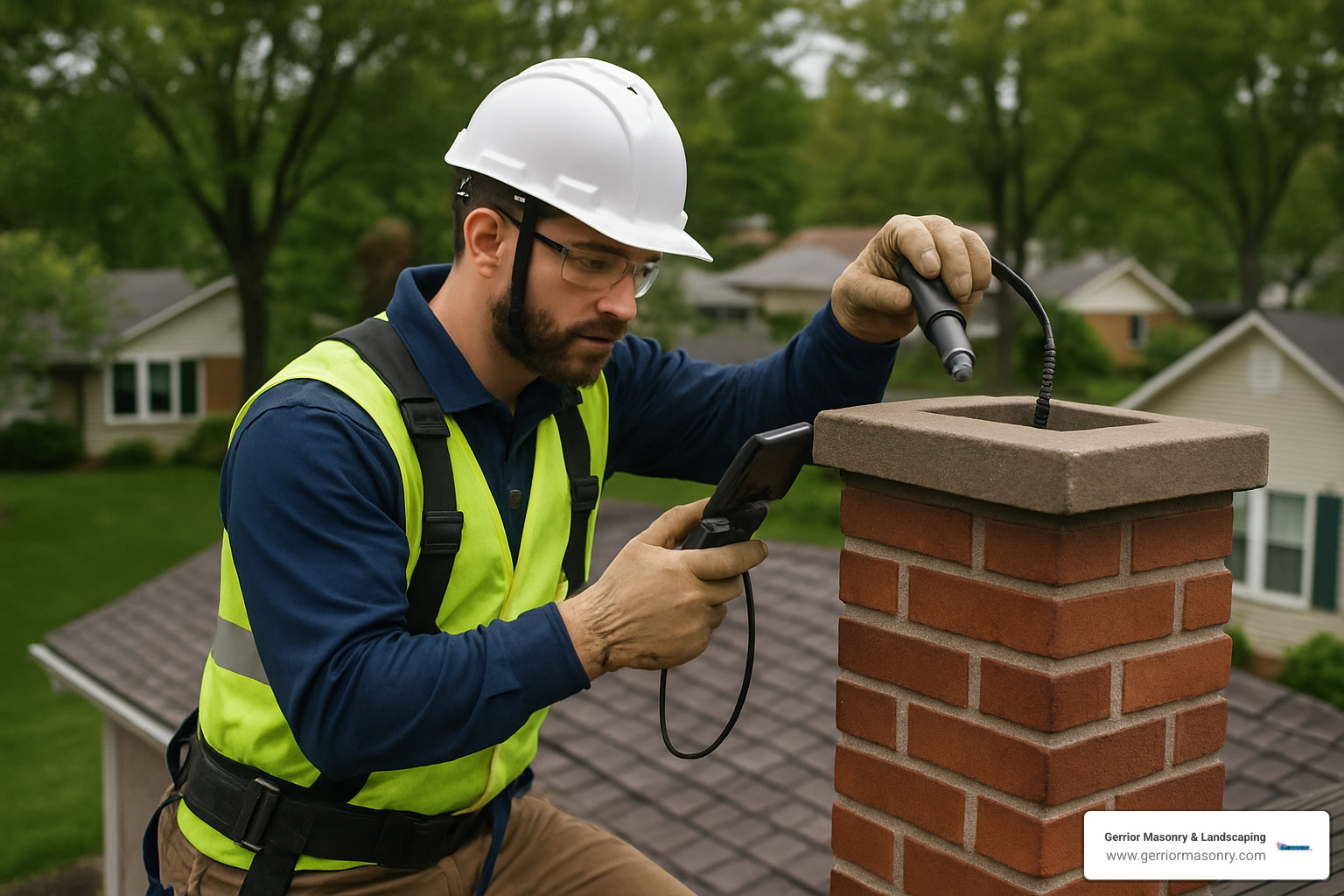
Professional-grade rotating brushes remove stubborn creosote buildup, while industrial HEPA vacuum systems contain every speck of dust and debris. No more worrying about soot covering your furniture or tracking through your home. Video scoping technology lets us see exactly what’s happening inside your flue – areas that would otherwise remain hidden until problems become dangerous.
The cleaning process removes years of accumulated soot, creosote, and debris while we inspect for structural damage, proper ventilation, and code compliance. We document everything with detailed reports and photographs, giving you a complete picture of your chimney’s condition and any recommended repairs.
Inspection Level
Scope
When Required
Average Cost Range*
Level 1
Visual inspection of accessible areas
Annual maintenance
$100-$250
Level 2
Level 1 plus video scanning, attic/crawl space check
Real estate transactions, insurance claims
$200-$500
Level 3
Levels 1 & 2 plus removal of components for hidden area access
After chimney fires or major damage
$400-$700+
*These are average costs based on internet data and not actual costs for Gerrior Masonry services.
What sets professional service apart is the attention to detail. We’re not just cleaning – we’re conducting a thorough safety evaluation that could prevent house fires or carbon monoxide poisoning. For more complex structural issues, our Chimney Masonry Repair services address everything from minor mortar repairs to complete rebuilds.
Level 1, 2 & 3 Chimney Inspection Near Me Standards
Level 1 inspections cover all the areas you can readily see – the firebox, damper, smoke chamber, and visible portions of the flue and exterior chimney. Think of this as your annual checkup for a chimney system that’s been working properly with no changes to your setup.
Most homeowners need Level 1 service for routine maintenance, but certain situations require more thorough examination. Level 2 inspections add video camera scoping of the entire flue interior, plus examination of attic spaces, crawl areas, and basements where chimney components are accessible.
Building codes typically require Level 2 inspections when you’re selling your home, switching fuel types, or after storms that might have damaged your chimney structure. The camera scope technology reveals cracks, obstructions, or deterioration that visual inspection alone would miss.
Level 3 inspections are the most comprehensive – and fortunately, the least common. These involve removing or opening parts of the chimney or building structure to access hidden areas. We only recommend Level 3 when there’s been a chimney fire, major structural damage, or when Level 2 inspection reveals potential serious hazards requiring further investigation.
Roof access enables us to examine critical components like the chimney crown, cap, and flashing. These elements protect against water infiltration, which causes more chimney damage than fire in many cases.
Average Cost of Chimney Cleaning and Inspection Near Me
Chimney cleaning and inspection near me costs depend on several factors, but understanding the range helps you budget appropriately. Basic Level 1 cleaning and inspection typically runs $100-$250, while comprehensive Level 3 assessments can reach $400-$700 or more.
Service complexity makes the biggest difference in pricing. A straightforward cleaning on a well-maintained chimney costs far less than addressing years of neglect or structural issues. Access difficulty also affects costs – steep roofs, unusual heights, or structural obstacles require additional safety measures and time.
Geographic location influences pricing, with urban areas typically costing more than rural service areas. Seasonal demand creates price fluctuations too – peak heating season brings higher costs, while spring and summer often offer better rates.
Many companies bundle cleaning with basic inspection, potentially reducing overall costs. Off-season scheduling frequently provides savings, though we never recommend delaying necessary safety work just to save money. The cost of chimney fires or carbon monoxide incidents far exceeds routine maintenance expenses.
Some providers guarantee no travel fees or hidden charges, while others may add surcharges for emergency service or difficult access situations. Always ask for detailed estimates upfront to avoid surprises.
These are average costs based on internet data and not actual costs for Gerrior Masonry services. Contact us directly for accurate pricing specific to your situation.
Red Flags Your Chimney Needs Service Yesterday
Some chimney problems can’t wait until your next scheduled maintenance. When you notice smoke backing up into your room instead of flowing up the chimney, that’s a clear signal to stop using your fireplace immediately and search for “chimney cleaning and inspection near me” services right away.
This back-draft situation isn’t just annoying – it’s dangerous. The smoke that should be going up your chimney is now bringing carbon monoxide and other toxic gases into your living space. We’ve seen this happen when animals build nests in chimneys or when structural damage blocks proper airflow.
Strong odors from your fireplace when it’s not in use tell their own story. That burnt smell might seem harmless, but it often indicates accumulated debris, animal droppings, or even structural damage that’s affecting your chimney’s performance. Gas fireplaces sometimes develop a burnt plastic odor from dust and pet hair buildup, but any persistent smell deserves professional attention.
Keep an eye out for white chalky stains on your chimney’s exterior – what professionals call efflorescence. This white residue appears when water seeps into your masonry and dissolves the minerals inside. It’s nature’s way of telling you that water is getting where it shouldn’t be, and water damage in chimneys leads to expensive repairs quickly.
Visible damage speaks for itself, but homeowners sometimes ignore what seems like “minor” issues. Cracked chimney crowns, loose bricks, or damaged flashing around the base all invite water infiltration. In Massachusetts winters, that water freezes and expands, turning small problems into major structural damage.
Animal activity in your chimney creates immediate fire hazards. Birds, squirrels, and raccoons don’t just block ventilation – they bring combustible nesting materials that can ignite. Professional removal protects both your family’s safety and the animals’ wellbeing.
If you smell gas when your gas fireplace is turned off, treat it as an emergency. Turn off the gas valve, open windows and doors, and call for help immediately. While a faint gas smell when first lighting is normal, persistent odors indicate dangerous leaks that require immediate professional service.
These warning signs don’t improve with time – they get worse. What starts as a small issue can quickly become a safety hazard or expensive repair. For more information about comprehensive chimney services, check out our Chimney Masonry Repair solutions.
How to Choose a Certified Sweep & Ask the Right Questions
Finding the right professional for chimney cleaning and inspection near me starts with understanding what credentials actually matter. You want someone who knows their stuff, not just someone with a truck and a ladder.
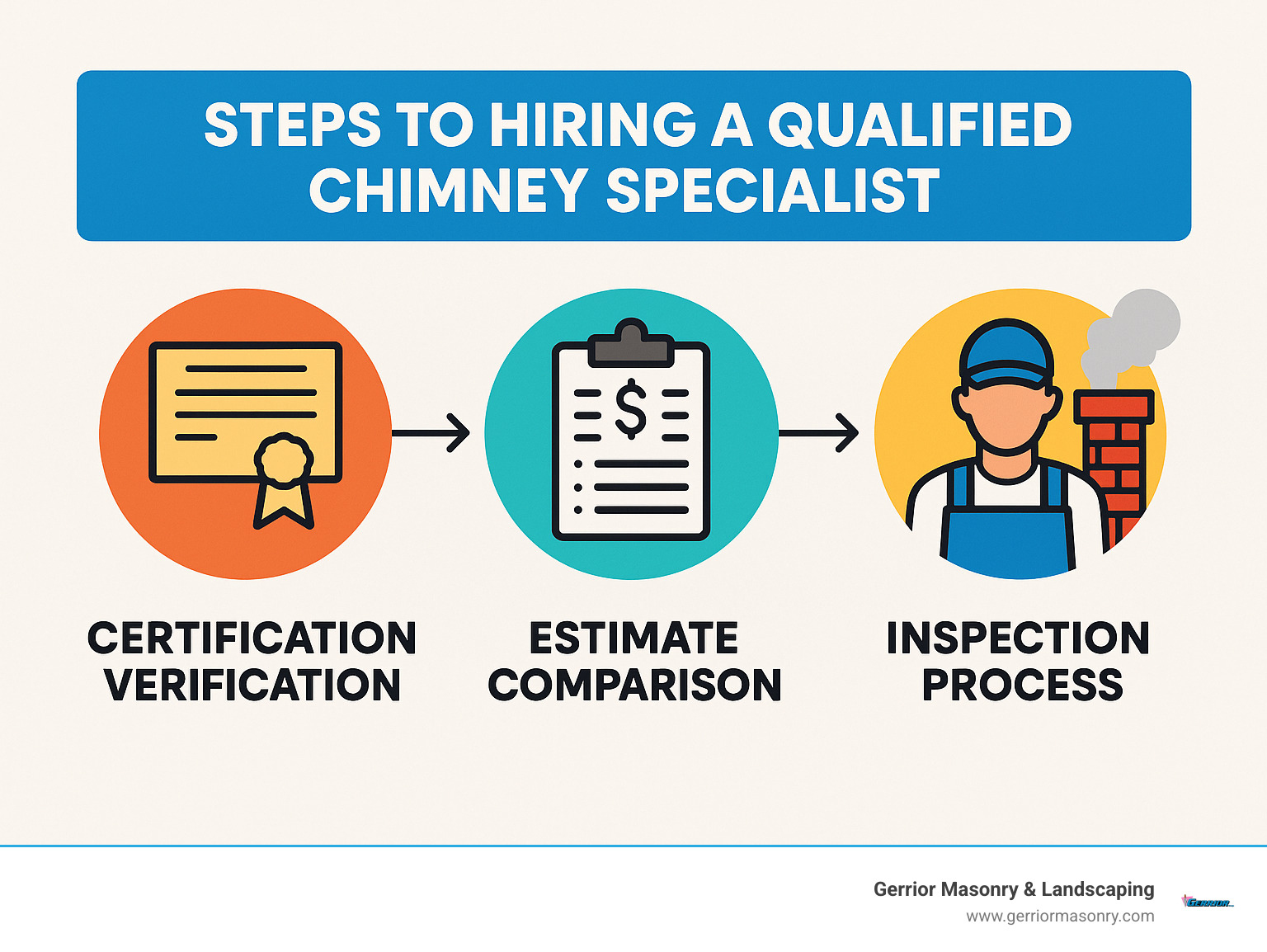
CSIA (Chimney Safety Institute of America) certification is the gold standard in our industry. These technicians have undergone comprehensive training in inspection and cleaning techniques that go far beyond basic sweeping. When a technician mentions their CSIA credentials, you know they’ve invested serious time in learning proper safety protocols.
WETT certification becomes especially important if you burn wood. Many insurance companies won’t even look at claims without a WETT-certified inspection report. It’s like having a professional translator between you and your insurance company – they speak the same language.
National Chimney Sweep Guild (NCSG) membership tells you the company stays current with evolving standards. This isn’t a “pay your dues and forget about it” organization – they require ongoing education that keeps members sharp on new techniques and safety updates.
Here’s something many homeowners overlook: insurance coverage verification. Any legitimate chimney professional carries both liability insurance and workers’ compensation. Don’t just take their word for it – ask to see the certificates. If they hesitate or make excuses, keep looking.
Detailed written estimates should break down exactly what you’re paying for. No mysterious line items or vague descriptions like “chimney work.” Professional companies explain their services clearly because they’re proud of what they do. Be especially wary of door-to-door solicitors offering deals that seem too good to be true.
The cleanup policy reveals a lot about professionalism. Companies that invest in proper drop cloths, containment systems, and specialized vacuums care about your home as much as your chimney. A “no mess guarantee” isn’t just marketing – it shows they’ve got the right equipment and training.
For comprehensive chimney services that go beyond basic cleaning, more info about Chimney Specialists Near Me can help you understand the full range of services available for your chimney system.
Interview Checklist Before Booking Chimney Cleaning and Inspection Near Me
Before you commit to any chimney cleaning and inspection near me service, verify their licensing with local authorities. Massachusetts has specific requirements for chimney work, and legitimate companies provide license numbers without hesitation. If they dance around this question, that’s your cue to keep shopping.
Recent references tell the real story. Established companies maintain lists of satisfied customers who don’t mind sharing their experiences. Pay attention to comments about punctuality, cleanliness, and whether the company followed through on their promises. One reference might be having a good day – three references show a pattern.
Emergency availability matters more than you might think. Chimney problems don’t punch a time clock, and companies offering 24/7 emergency response demonstrate genuine commitment to customer safety. Just remember that emergency services typically come with premium pricing – but it beats waiting until Monday when carbon monoxide is involved.
Satisfaction guarantees separate companies that stand behind their work from those hoping you won’t call back. Reputable professionals offer warranties on both labor and materials because they’re confident in their skills. Make sure you understand the warranty terms before signing anything – some guarantees have more fine print than a cell phone contract.
Ask them to explain their process in detail. Qualified technicians should walk you through their procedures, equipment, and safety protocols without making you feel like you’re bothering them. They should also answer questions about your specific chimney system. If they seem rushed or dismissive, trust your instincts and find someone else.
Prep & Maintenance Tips Between Visits
Taking care of your chimney between professional visits isn’t rocket science, but it does require some common sense and attention to detail. Think of it like maintaining your car – a little regular care prevents big problems down the road.
Ash disposal is where many homeowners make dangerous mistakes. Those gray ashes might look completely cold, but they can harbor live coals for days. Always wait at least 72 hours after your last fire before removing ashes. Store them in a metal container with a tight lid, and keep that container on concrete or another non-combustible surface – never on your wooden deck or near your house.
Burning the right wood makes a huge difference in how much creosote builds up in your chimney. Seasoned hardwoods like oak, maple, or hickory that have dried for at least six months burn cleaner and hotter than green wood. Skip the pine, cardboard, or that old pressure-treated lumber from your deck project – these materials create more creosote and can release toxic fumes that nobody wants in their living room.
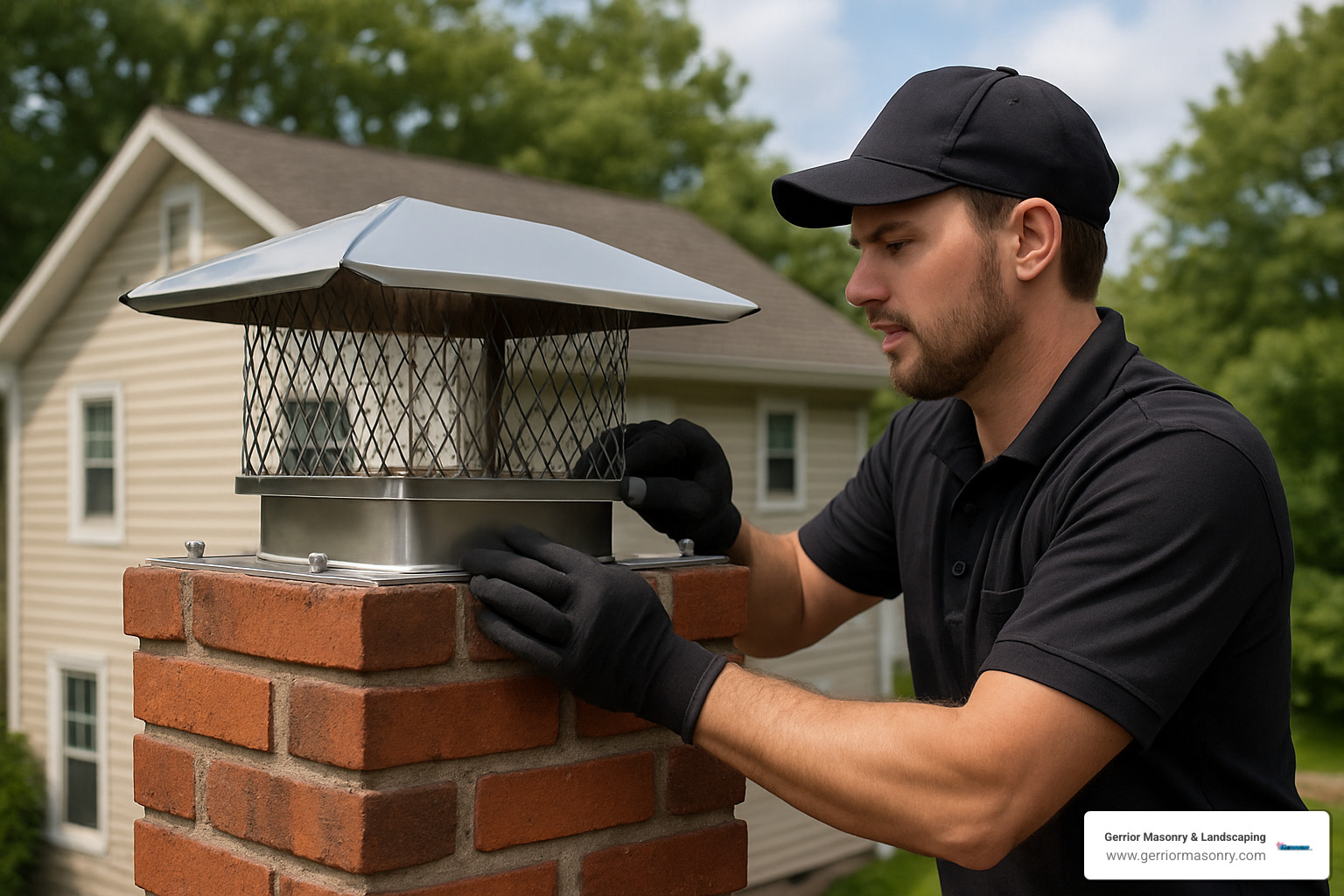
A chimney cap installation is one of the smartest investments you can make. These metal covers keep rain, snow, animals, and wind-driven downdrafts out of your chimney while allowing smoke to escape freely. Quality caps include spark arrestors that prevent stray embers from landing on your roof and starting a fire.
Waterproofing protects your chimney’s masonry from our harsh New England freeze-thaw cycles. Water gets into tiny cracks, freezes, expands, and creates bigger cracks – it’s like Mother Nature’s way of slowly demolishing your chimney. Professional waterproofing treatments soak into the masonry while still letting it “breathe.” For comprehensive protection, check out Chimney Waterproofing Near Me to understand how proper sealing extends your chimney’s life.
Don’t forget about your smoke detectors – they’re your early warning system if something goes wrong. Test them monthly (yes, that annoying beeping is actually important), and replace batteries every year. Carbon monoxide detectors in rooms with fireplaces provide extra protection against this silent killer.
Between your annual chimney cleaning and inspection near me appointments, take a few minutes each season to look for obvious problems. Check for loose or missing bricks, damaged flashing around the chimney base, or signs of animal activity. Catching small issues early prevents expensive repairs later – and keeps your family safe while you’re enjoying those cozy fires.
Frequently Asked Questions about Chimney Cleaning & Inspection
When homeowners start researching chimney cleaning and inspection near me, they often have the same burning questions (pun intended!). After over 34 years in the masonry business, I’ve heard these concerns countless times, and they all come down to one thing: keeping your family safe while getting the best value for your money.
The most common worry I hear is “Am I doing enough?” Homeowners want to know they’re protecting their investment and their loved ones without overspending on unnecessary services. The good news is that understanding the basics of chimney maintenance isn’t rocket science – though it does require professional expertise to do it right.
How Often Should I Schedule Chimney Cleaning?
Here’s the straight answer: the National Fire Protection Association recommends annual inspection of all chimneys, fireplaces, and vents. But here’s where it gets interesting – cleaning frequency depends on how much you actually use your fireplace.
If you’re the type who lights a cozy fire every weekend during winter, you’ll likely need annual cleaning. But if you only use your fireplace for special occasions or power outages, you might be able to stretch it a bit longer. The key is having that annual inspection to determine what your specific situation requires.
The Chimney Safety Institute of America has a simple rule: sweep when soot buildup reaches 1/8 inch or when you see that shiny, tar-like glaze on your flue walls. That glaze is creosote in its most dangerous form – it’s highly flammable and needs professional removal immediately.
What surprises many homeowners is that even if you don’t use your fireplace much, animals, weather, and time itself can create problems that only professional inspection will catch. I’ve found bird nests in chimneys that hadn’t been used in years, and water damage that started small but could have caused major structural issues.
What If I Have a Gas or Pellet Appliance?
This is where many homeowners get confused, thinking that “cleaner” burning appliances don’t need attention. Gas and pellet appliances still require annual professional inspection – they just have different maintenance needs than wood-burning systems.
Gas fireplaces produce water vapor and carbon dioxide that must vent properly. When these systems aren’t maintained, you can get condensation problems that lead to rust, blockages, or even carbon monoxide issues. I’ve seen gas fireplace vents completely blocked by bird nests or debris, creating dangerous situations.
Pellet stoves are particularly interesting because they create fine ash that gets into places you’d never think to clean. The heat exchangers and venting systems need specialized cleaning techniques that most homeowners simply don’t have the tools or knowledge to handle safely.
The bottom line is this: any appliance that burns fuel and vents through your chimney needs professional attention. Don’t let the “clean burning” marketing fool you into thinking these systems are maintenance-free.
Do I Really Need a WETT or Level 2 Report for Insurance?
This question usually comes up when homeowners are buying or selling a house, and the answer is often “yes” – but let me explain why it’s actually a good thing.
Many insurance companies require WETT inspections for homes with wood-burning appliances because they’ve learned that proper inspections prevent claims. These certified inspections verify that your system meets safety standards, which protects both you and your insurance company from expensive fire damage claims.
Level 2 inspections are typically required for real estate transactions, and here’s why that makes sense: would you buy a used car without having a mechanic look under the hood? Your chimney system is a major component of your home’s safety infrastructure, and buyers and lenders want to know it’s functioning properly.
Even if your insurance company doesn’t require these inspections, having professional documentation of your chimney’s condition can be incredibly valuable if problems develop later. I’ve seen homeowners who had this documentation get insurance claims approved quickly, while those without proper records faced lengthy disputes.
The investment in a proper inspection is minimal compared to the potential cost of fire damage, carbon monoxide poisoning, or major structural repairs. Think of it as insurance for your insurance – it’s documentation that you’re being a responsible homeowner who takes safety seriously.
Conclusion
Your family’s safety depends on regular chimney maintenance – it’s really that simple. Chimney cleaning and inspection near me searches connect you with professionals who prevent house fires and protect against carbon monoxide poisoning. The small investment in annual care saves you from potentially devastating consequences down the road.
Think about it this way: would you rather spend a few hundred dollars on professional maintenance, or face thousands in fire damage repairs? The choice becomes pretty clear when you put it in perspective.
Certified professionals bring something you can’t get from DIY approaches – proper training, specialized equipment, and insurance protection. When you’re comparing services, focus on credentials and transparent pricing rather than just hunting for the cheapest option. Your family’s safety is worth investing in quality.
The price ranges we’ve discussed throughout this article ($100-$700+) represent average costs based on internet research and aren’t actual pricing for Gerrior Masonry services. Our rates reflect our commitment to doing the job right the first time, backed by more than three decades of hands-on experience.
At Gerrior Masonry & Landscape Construction, we see your chimney as more than just another maintenance item – it’s a critical safety system that deserves expert attention. Our comprehensive services extend beyond basic cleaning to include professional chimney masonry repair and complete chimney repair and replacement when your system needs more extensive work.
Here’s the bottom line: professional chimney care isn’t an expense, it’s peace of mind. You’ll sleep better knowing your fireplace provides warmth and comfort without putting your home at risk.
Don’t take chances with your family’s safety. Schedule your professional inspection today and enjoy your fireplace with confidence.
Gerrior Masonry & Landscape Construction is based in Woburn, MA, and proudly serves homeowners throughout Middlesex and Essex County, Massachusetts. Contact us today to schedule your professional chimney inspection and keep your home safe and warm all season long.
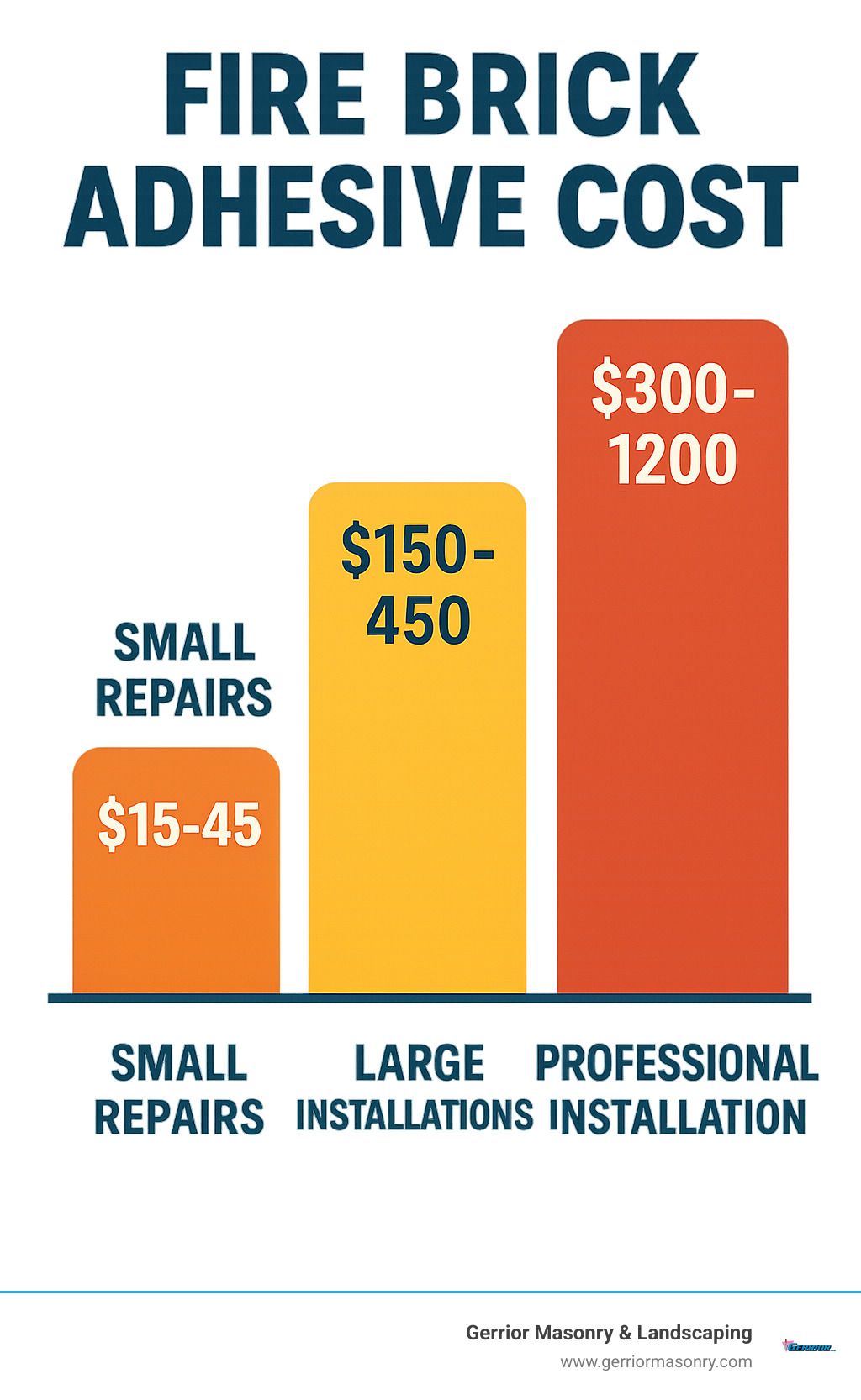
Fire Brick Adhesive: Top 5 Powerful Choices for 2025 Success
Why Fire Brick Adhesive is Critical for High-Temperature Applications
Fire brick adhesive is a specialized high-temperature mortar designed to bond firebricks in fireplaces, wood stoves, pizza ovens, and other applications where regular cement would fail. Unlike standard masonry mortar, these adhesives can withstand extreme heat – typically 2000°F to 3000°F – without cracking or losing their bond strength.
Quick Reference Guide:
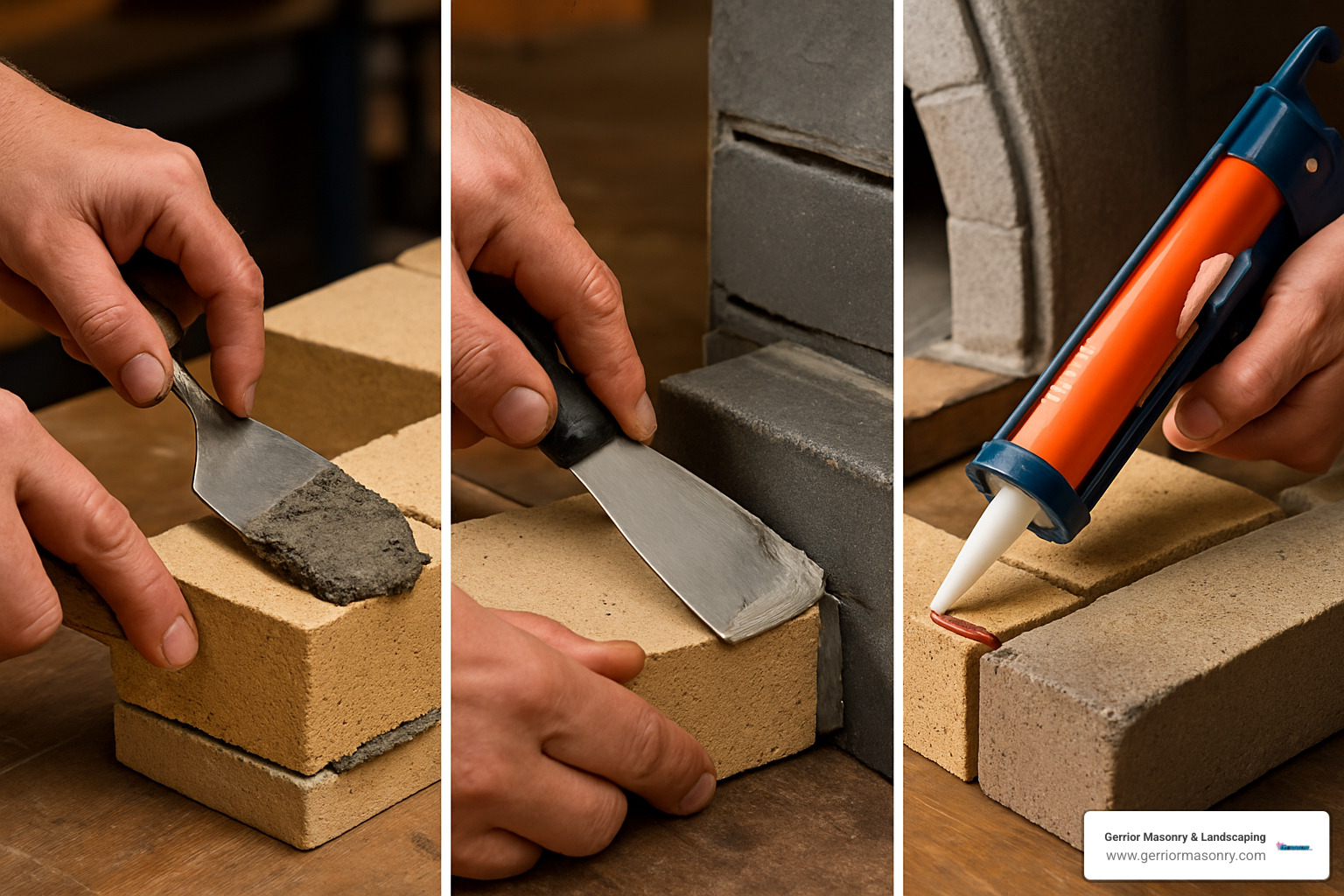
Refractory Mortar: Clay-based, rated to 2700°F, best for laying new firebrick
Furnace Cement: Pre-mixed, rated to 2000-3000°F, ideal for repairs and metal-to-masonry bonds
High-Temp Silicone: Flexible, rated to 2300°F, perfect for expansion joints
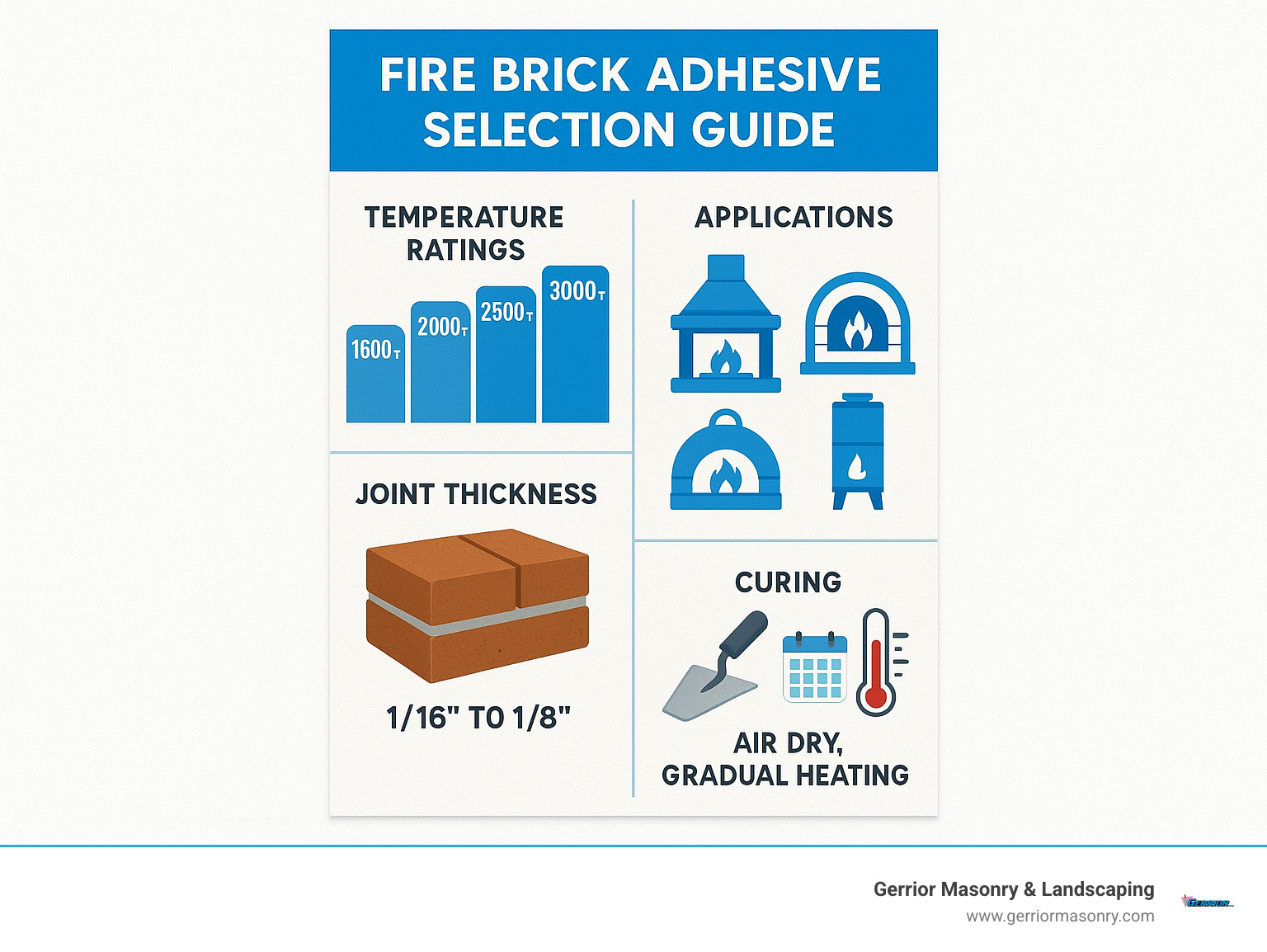
Coverage: Typically 45-150 standard firebricks per 50lb bag
Curing: Air dry 24-48 hours, then gradual heat cure to 500°F
The key difference from regular mortar lies in the formulation. Fire brick adhesives use refractory clay and special aggregates instead of Portland cement, which breaks down under high heat. They also include fiber reinforcement and polymer modifiers to handle thermal shock – the rapid heating and cooling cycles that would destroy ordinary cement.
Temperature ratings matter significantly. A standard fireplace reaches 1000-1200°F, while wood stoves can hit 1400°F and pizza ovens exceed 900°F. Using the wrong adhesive means costly repairs when joints fail during the heating season.
I’m Joe Gerrior, owner of Gerrior Masonry & Landscape Construction, and over 34 years I’ve rebuilt countless fireboxes and repaired failed installations where homeowners used regular mortar instead of proper fire brick adhesive. The right adhesive choice makes the difference between a repair that lasts decades versus one that fails after the first winter.
What Is Fire Brick Adhesive & Why It Matters
Think of fire brick adhesive as the unsung hero of your fireplace or wood stove. While everyone admires the beautiful flames and cozy warmth, this specialized mortar is quietly doing the heavy lifting – literally holding everything together when temperatures soar beyond what would turn regular cement into powder.
Fire brick adhesive is essentially a high-temperature mortar that’s been specially engineered to bond refractory materials like firebricks. The magic happens in its unique formulation, which uses refractory clay and alumina-based compounds instead of the Portland cement found in regular mortar. These materials actually get stronger when exposed to extreme heat, rather than breaking down.
After three decades in this business, I’ve seen countless DIY projects where homeowners used regular mortar thinking “cement is cement.” Six months later, they’re calling me to rebuild their entire firebox because everything has crumbled. Fire brick adhesive isn’t just a fancy name – it’s chemistry specifically designed for the job.
The gold standard for these products is meeting ASTM C-199 specifications. This isn’t just industry jargon – it means the adhesive has passed rigorous testing for thermal cycling, bond strength at high temperatures, and water resistance.
Regular Mortar vs High-Heat Formulations
The difference between regular masonry mortar and fire brick adhesive is like comparing a paper airplane to a jet fighter – they might look similar, but they’re built for completely different missions.
Regular mortar depends on Portland cement as its binding agent, mixed with lime and sand. This works beautifully for building walls or laying patio stones, but it has a fatal flaw: when heated beyond 600°F, Portland cement begins to break down chemically. By 1200°F, it’s essentially turned to powder.
Fire brick adhesive takes a completely different approach. Instead of Portland cement, it uses fireclay – a natural clay that becomes stronger when fired, just like pottery in a kiln. Some formulations use alumina cement with high aluminum content, or silicate binders that create ceramic-like bonds when they cure.
Even the sand is different. While regular mortar uses standard construction sand, fire brick adhesives incorporate specialized aggregates like grog (ground, fired ceramic material), vermiculite for insulation, and high-purity silica sand that won’t break down under extreme heat.
Key Performance Metrics
When I’m selecting fire brick adhesive for a project, I look at several key performance numbers that tell the real story of how well the product will perform.
Compressive strength is where these products really shine. Quality refractory mortars achieve 2,000 to 4,000 PSI compressive strength after curing – and here’s the crucial part – they maintain this strength even at high temperatures. Regular mortar might start with similar numbers, but it loses strength rapidly as heat increases.
Bonding shear strength matters especially in vertical applications like fireplace walls. The adhesive needs to resist sliding forces, and premium fire brick adhesives maintain 200 to 400 PSI shear strength even after repeated heating and cooling cycles.
Water solubility is another critical factor. Once cured, quality fire brick adhesive becomes completely non-water soluble, meeting those ASTM C-199 requirements. This prevents your joints from slowly dissolving when moisture gets in.
The real test comes with thermal shock resistance – the ability to handle rapid temperature changes without cracking. These adhesives go through multiple heating and cooling cycles during testing to ensure they’ll handle real-world conditions.
Types of Fire Brick Adhesive (Primary Keyword Spotlight)
Choosing the right fire brick adhesive can feel overwhelming with so many options available. Let me break down the main types in a way that actually makes sense for your project.
Think of these adhesives like tools in a toolbox – each one has its sweet spot. After three decades of masonry work, I’ve learned that using the wrong type is like trying to hammer a nail with a screwdriver. It might work temporarily, but you’ll regret it later.
Refractory Mortar
Refractory mortar is the workhorse of fire brick adhesives. This clay-based mortar handles like regular mortar during installation but transforms into something much stronger when heated.
Most refractory mortars are rated for continuous use up to 2700°F, which covers pretty much any residential application you’ll encounter. Your typical fireplace reaches about 1200°F, and even a hot-burning wood stove rarely exceeds 1400°F.
The beauty of refractory mortar lies in its medium-duty reliability. It’s strong enough for structural applications but forgiving enough for DIY installers. A 50-pound bag typically covers 100-150 standard firebricks, depending on your joint thickness.
I recommend refractory mortar when you’re laying new firebrick, rebuilding a firebox, or constructing a pizza oven. It creates permanent, structural joints that get stronger with each heating cycle.
High-Temp/Furnace Cement
Furnace cement is your go-to for repairs and specialty bonding. These pre-mixed products come ready to use and handle temperatures from 2200°F to 3000°F depending on the formulation.
What sets furnace cement apart is its ability to bond metal to masonry – something regular refractory mortar struggles with. Installing a wood stove? Sealing stove pipe connections? Furnace cement is your friend.
The thick consistency means it stays put when applied to vertical surfaces or overhead joints. No mixing means no mistakes, and the smaller containers (usually 8-32 ounces) are perfect for repair work without waste.
I keep furnace cement in my truck for quick repairs – sealing small cracks, filling gaps around dampers, or touching up joints that have developed hairline cracks after years of use.
Silicone & Polymer-Modified Options
High-temperature silicone represents the newest evolution in fire brick adhesive technology. These flexible sealants maintain their elasticity even at temperatures up to 2300°F.
The game-changer here is thermal movement. Pizza ovens and outdoor fireplaces expand and contract dramatically with temperature changes. Rigid mortars eventually crack from this constant movement, but high-temp silicone flexes with it.
Polymer-modified adhesives combine traditional refractory materials with modern chemistry. They offer improved workability and faster curing while maintaining the strength of conventional mortars.
These products shine in thin-bed installations where you need precise control, or in expansion joints where movement is expected. They’re also excellent for weatherproofing outdoor installations where moisture penetration could cause freeze-thaw damage.
The fiber-reinforced versions add extra strength for applications where vibration or thermal shock might stress the joints. I use these in commercial installations or anywhere the heating cycles are particularly severe.
Choosing the Best Fire Brick Adhesive for Your Project
Picking the right fire brick adhesive isn’t rocket science, but it does require understanding what you’re working with. After three decades of fixing failed installations, I can tell you that most problems start with choosing the wrong product for the job.
The biggest factor is temperature. Your basic fireplace runs around 1000-1200°F – pretty much any quality fire brick adhesive will handle that. But wood stoves can hit 1400°F, and pizza ovens can reach 1800°F or more. Here’s my rule: always pick an adhesive rated at least 500°F above what you expect.
Joint thickness matters too. Traditional refractory mortars work best with joints between 1/16″ and 1/4″ thick. Try to go thinner and you won’t get good coverage. Go thicker and the joint becomes a weak point. Furnace cements are more forgiving – they’ll fill gaps up to 1/8″ without problems.
Product Type
Temperature Rating
Best Joint Thickness
Ideal Application
Refractory Mortar
2700°F
1/16″ – 1/4″
New construction, structural work
Furnace Cement
2000-3000°F
Up to 1/8″
Repairs, metal connections
High-Temp Silicone
2300°F
Under 1/16″
Expansion joints, sealing
Fireplaces & Wood Stoves
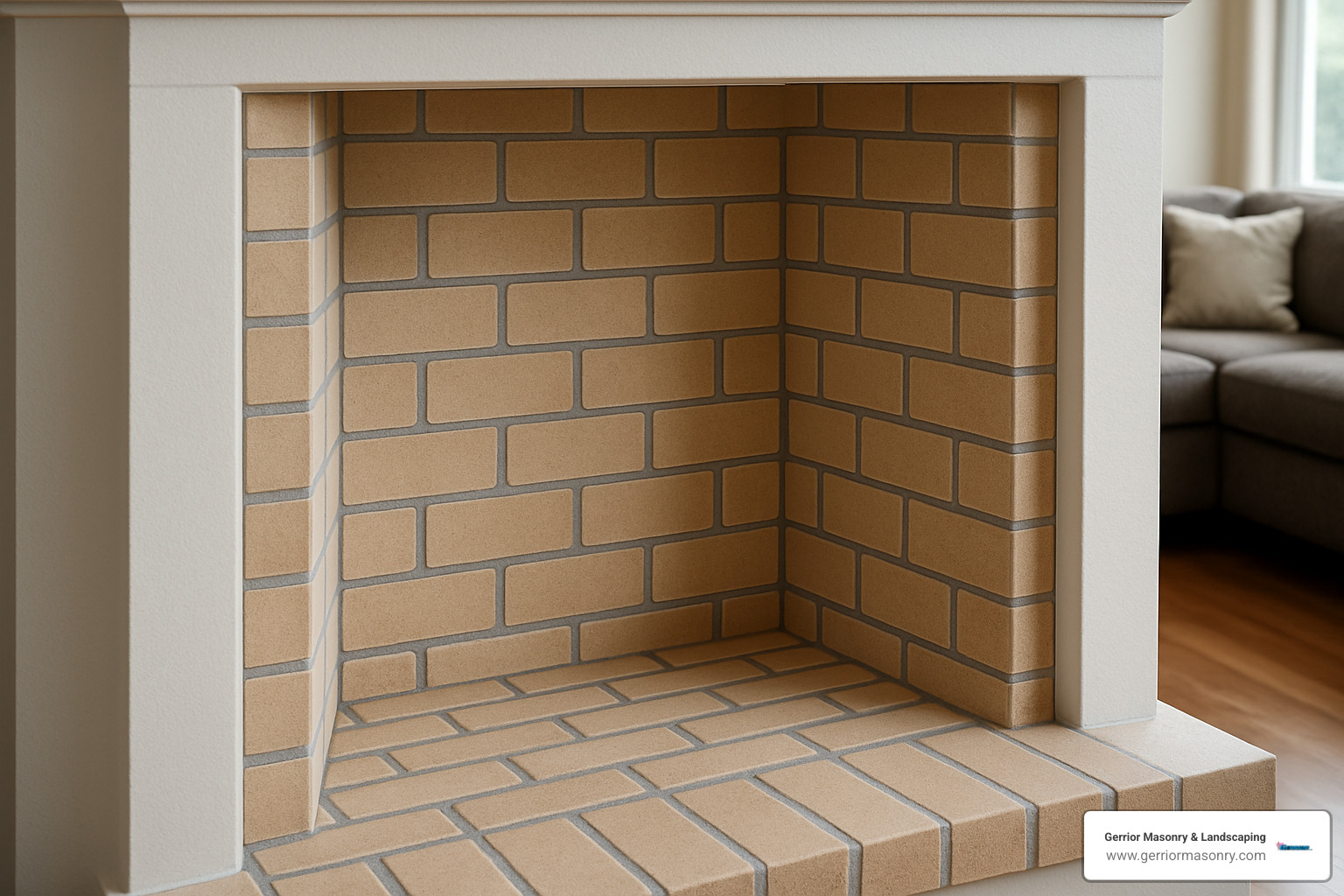
For fireplace work, I reach for refractory mortar when laying new firebricks. It creates the structural backbone that’ll last decades. The 2700°F rating handles anything a typical fireplace throws at it.
Repair work is different. When I’m doing brick fireplace repair, furnace cement often works better. It flows into irregular gaps and bonds well to existing materials that might not be perfectly clean.
Wood stoves create special challenges. That stove pipe connection where it passes through the firebox wall needs furnace cement designed for metal-to-masonry bonding. I’ve torn out too many failed installations where someone used regular fire brick adhesive for these connections.
The key is matching the product to the job. Structural joints get refractory mortar. Repairs and metal connections get furnace cement. Expansion points get flexible high-temp sealants.
Outdoor Ovens & Grills
Pizza ovens are tough customers. They go from cold to 900°F in under an hour, then back to cold again. That’s serious thermal shock, and it happens every time you cook.
For the main dome structure, I stick with refractory mortars that meet ASTM standards and are approved for outdoor use. The thermal mass of all that brick and mortar needs structural integrity that only traditional mortars provide.
But here’s the trick – expansion joints are crucial. Where the dome meets the hearth, where different materials connect, you need flexible high-temp silicone that can move without cracking.
Kilns & Furnaces
Industrial kilns push fire brick adhesive to its limits. These applications often run continuously at maximum temperatures – there’s no cooling down period to recover from thermal stress.
For kilns operating above 2200°F, you need specialized products that exceed normal residential standards. These high-performance adhesives cost more, but they’re engineered for extreme conditions that would destroy regular products.
The bottom line? Don’t guess. Know your operating temperature, understand your application, and choose accordingly.
Step-by-Step Guide: Applying Fire Brick Adhesive Like a Pro
Getting fire brick adhesive right isn’t rocket science, but it does require attention to detail. After three decades of fireplace and masonry work, I’ve learned that most failures happen during application, not because of product quality.
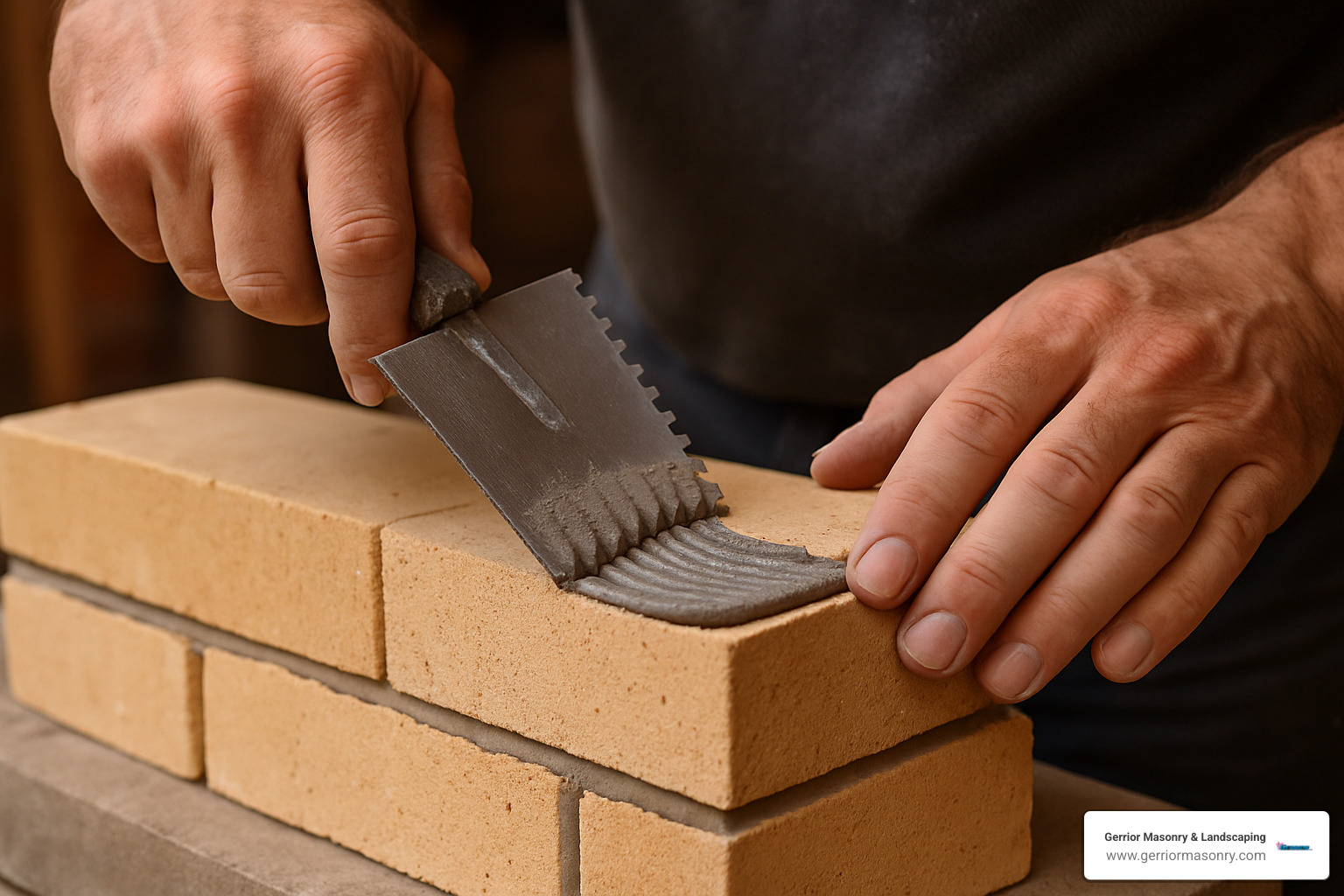
Surface preparation makes or breaks your project. You need absolutely clean surfaces. Remove every bit of loose mortar, dust, and debris from both your firebricks and the surface you’re bonding to. A wire brush works great for stubborn deposits. Then vacuum everything thoroughly.
Here’s something many DIYers miss: don’t make the surface too smooth. Some texture actually helps the adhesive grab better. Think “clean and slightly rough” rather than “polished and perfect.”
Moisture control is your secret weapon. Most fire brick adhesives perform best on slightly damp surfaces. Take a clean, damp sponge and lightly moisten both the substrate and your firebricks just before applying the adhesive. You want damp, not soaking wet.
For tools, stick with a notched trowel for large areas and a pointing trowel for detail work. The notch size matters – typically 1/8 inch notches work well for refractory mortar, while smaller notches suit furnace cement.
Mixing & Pot Life Tips
Mixing ratios aren’t suggestions – they’re requirements. When the manufacturer says add specific amounts of water, they mean it. Too much water creates a weak bond that’ll fail when things heat up. Too little water gives you a stiff, unworkable mess.
Always use clean water. For mixing technique, use a drill with a paddle mixer attachment. Mix slowly to avoid creating air bubbles – they weaken your final bond. The consistency should remind you of thick peanut butter when you’re done.
Most fire brick adhesives give you 30 to 60 minutes of working time after mixing. Hot weather cuts this time significantly. Mix only what you can use within that window.
Setting, Tooling & Curing
Joint thickness needs to stay consistent throughout your installation. We typically aim for 1/16 to 1/8 inch joints. Thicker joints look sloppy and crack easily. Thinner joints might not give you enough adhesive for a proper bond.
Always stagger your joints between courses, just like regular masonry work. This distributes stress and stops cracks from running straight up your wall.
Tooling happens while the adhesive is still workable but starting to firm up – usually 30 to 60 minutes after application. Use a proper jointing tool or even the back of a spoon to create smooth, slightly concave joints. Good tooling isn’t just about looks – it helps shed water and creates stronger joints.
The curing process has two critical phases. First comes air curing – give it 24 to 48 hours before any heat exposure. Keep the work protected from rain, freezing temperatures, and direct sun during this time.
Then comes heat curing, which transforms your fire brick adhesive into its final ceramic-like state. Start low – under 200°F for the first few hours. Then gradually work up to 500°F over several more hours. This gradual temperature increase prevents thermal shock that could crack your new joints.
For fireplace mortar repair projects, we build small fires initially, then gradually increase the heat over several burn cycles. This lets the adhesive cure properly while the surrounding masonry expands and contracts naturally.
Patience during curing pays off with decades of reliable performance. Rush this step, and you’ll be doing the job again next season.
Safety, Color Options & Maintenance FAQs
Working with fire brick adhesive isn’t complicated, but it does require some common-sense safety precautions. The biggest concern is silica dust – that fine powder that gets everywhere when you’re mixing and applying these products.
Most refractory mortars contain crystalline silica, which you definitely don’t want to breathe. I always tell my crew to treat it like any other construction dust – respect it, but don’t fear it. Wear a good dust mask (N95 minimum), safety glasses, and work gloves.
Ventilation matters more than most people realize. If you’re working indoors, crack a window and run a fan. When we’re doing fireplace rebuilds, we often set up a small fan to pull dust away from the work area. Never use compressed air to clean up – that just puts all that silica dust right back in the air.
You’ll notice many products carry California Proposition 65 warnings about silica exposure. This isn’t meant to scare you off – it’s just important information to help you work safely.
Color matching used to be an afterthought, but it’s become much more important as homeowners pay more attention to details. Most fire brick adhesive products come in gray, which matches standard firebricks perfectly. Black has become popular for contemporary installations, while buff and tan colors work great with traditional yellow firebricks.
We always order a bit extra for future touch-ups. Color batches can vary slightly between production runs.
How Long Will the Bond Last?
This is probably the most common question I get, and the honest answer is: it depends on how well you do the job initially. Properly installed fire brick adhesive can easily last 20 to 30 years in a typical residential fireplace.
The installations I did in the 1990s are still going strong today. The key factors are pretty straightforward – good surface prep, proper mixing, adequate curing time, and reasonable operating conditions.
Heavy use obviously shortens the lifespan. A fireplace that gets lit a dozen times each winter will outlast a wood stove that runs continuously for four months. Commercial pizza ovens that fire up daily need more frequent maintenance than backyard ovens used on weekends.
The best insurance policy is an annual inspection during your off-season. Look for hairline cracks, loose joints, or any signs of water getting where it shouldn’t. Catching small problems early prevents major repairs later.
Can I Repair a Single Cracked Brick?
Absolutely, and it’s often the smart approach rather than tearing apart a whole section. I’ve replaced countless individual firebricks over the years – it’s one of those repairs that looks harder than it actually is.
The first step is figuring out why the brick cracked. Sometimes it’s just age and thermal cycling. Other times it indicates a bigger problem like structural settling or inadequate clearances. Address the cause, or you’ll be replacing the same brick again next year.
Removing the damaged brick takes patience more than skill. Use a cold chisel and work slowly – you don’t want to shock the surrounding bricks. Clean out all the old adhesive from the cavity and vacuum thoroughly.
Apply fresh fire brick adhesive to all contact surfaces of the replacement brick, not just the back. Slide it into place carefully, maintaining proper joint thickness on all sides. Clean up any squeeze-out immediately and tool the joints to match the surrounding work.
The curing process is the same as any new installation – 24 to 48 hours of air drying, then gradual heat introduction.
Common Mistakes to Avoid
After 34 years in this business, I’ve seen the same mistakes over and over. The biggest one is using regular masonry mortar instead of proper fire brick adhesive. I can’t tell you how many failed fireboxes I’ve rebuilt because someone thought regular mortar would work fine.
Thick joints seem stronger, but they’re actually weaker. Some folks think if a little adhesive is good, more must be better. Joints over 1/4 inch are prone to cracking and don’t distribute stress properly. Aim for 1/16 to 1/8 inch consistently.
Skipping the heat cure process is another common shortcut that always backfires. The gradual temperature ramp isn’t just a suggestion – it’s what transforms the adhesive into its final ceramic-like state.
Poor surface preparation causes more adhesion failures than anything else. Those few minutes spent properly cleaning surfaces save hours of repair work later. Dusty, oily, or contaminated surfaces simply won’t bond properly, no matter how good your adhesive is.
Conclusion & Next Steps
Choosing the right fire brick adhesive is crucial for any high-temperature masonry project. Whether you’re repairing a single cracked brick in your fireplace or building a complete pizza oven, understanding the different types of adhesives and their proper application ensures long-lasting, safe results.
The key takeaways for successful fire brick adhesive selection and application:
Match the adhesive to your application: Refractory mortar for structural work, furnace cement for repairs, and silicone sealants for expansion joints
Temperature ratings matter: Always choose products rated well above your expected operating temperatures
Proper application is critical: Surface preparation, correct mixing, and gradual heat curing determine long-term success
Safety first: Always use appropriate PPE and follow manufacturer safety guidelines
For homeowners comfortable with DIY projects, fire brick adhesive work is achievable with proper preparation and patience. However, structural repairs, complex installations, or work involving gas appliances should be handled by experienced professionals.
The investment in quality fire brick adhesive and proper installation pays dividends in safety, performance, and longevity. A properly installed system can provide decades of reliable service with minimal maintenance.
Note: These are average costs based on internet data and not actual costs for Gerrior Masonry services.
Regular maintenance and annual inspections help identify small issues before they become major problems. During the off-season, check for loose joints, hairline cracks, or signs of water infiltration. Address problems promptly to prevent costly repairs later.
For complex installations or when you’re unsure about product selection, consulting with experienced masonry professionals ensures optimal results. Our team has seen every type of high-temperature application and can recommend the best adhesive and installation approach for your specific project.
For more information about our comprehensive masonry services, including fireplace repair, chimney work, and high-temperature installations, visit our masonry services page.
Gerrior Masonry & Landscape Construction, based in Woburn, MA, proudly serves homeowners and businesses across Middlesex and Essex County, Massachusetts, with expert fireplace, chimney, and high-temperature masonry repairs.
Brick Chimney Repair Options: 7 Powerful Fixes for 2025
Why Brick Chimney Problems Can’t Wait
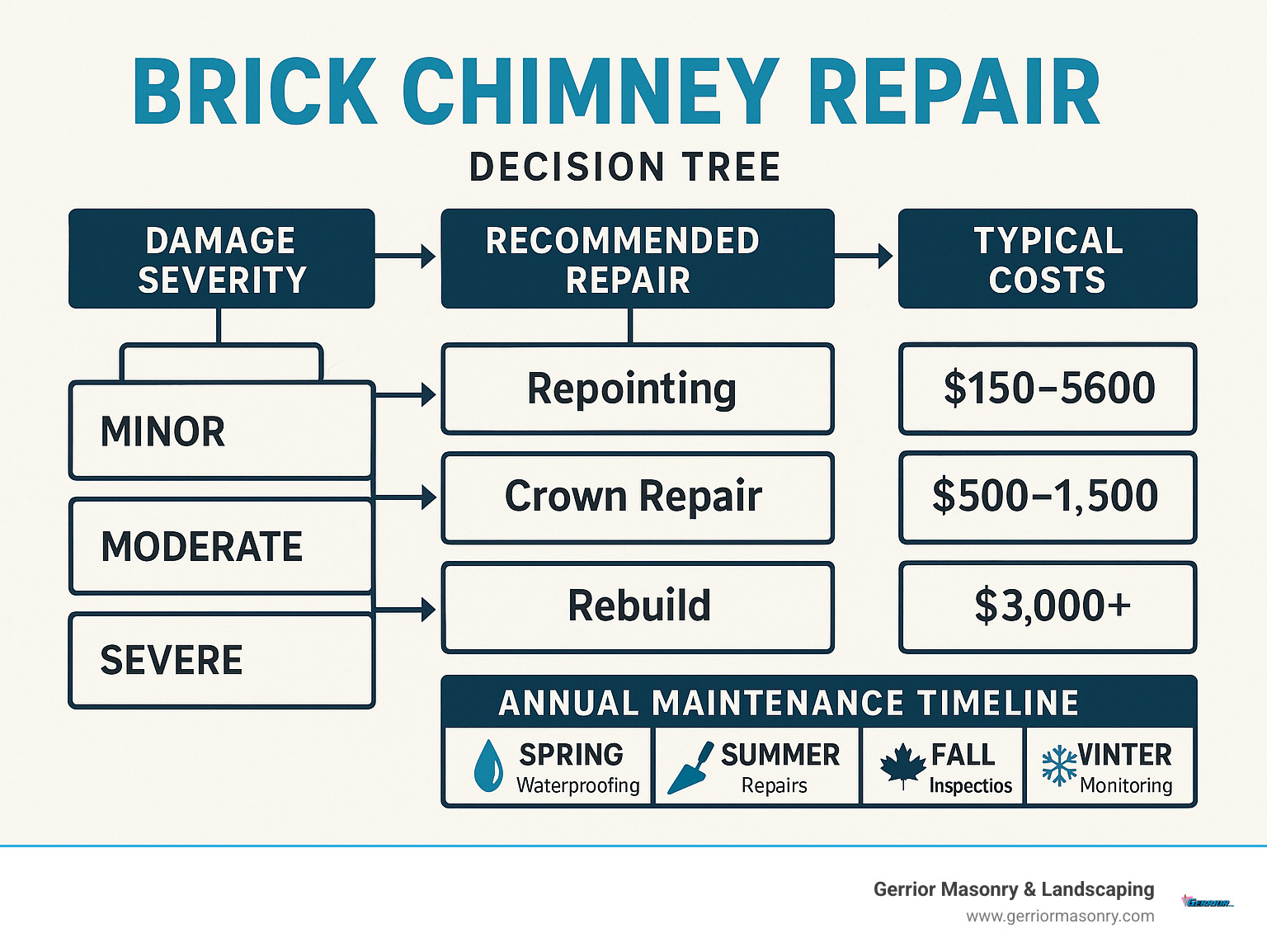
Brick chimney repair options range from simple repointing and crown patching to complete rebuilds, with costs varying from $150 for minor fixes to $30,000+ for full reconstruction depending on damage severity and structural requirements.
Note: These are average costs based on internet data and not actual costs for Gerrior Masonry services.
Your brick chimney faces constant assault from freeze-thaw cycles, acidic creosote, and New England’s harsh weather. What starts as hairline cracks can quickly escalate into dangerous structural problems, water damage, and fire hazards.
Spalling bricks – where the surface flakes and crumbles – signal that moisture has penetrated deep into your masonry. Left unrepaired, this can lead to chimney collapse and costly damage to other parts of your home.
I’m Joe Gerrior, owner of Gerrior Masonry & Landscape Construction Corp, and I’ve been helping Massachusetts homeowners steer brick chimney repair options for over 34 years. My team has seen everything from simple mortar touch-ups to complete reconstructions.
Why You’re Here
You’ve probably noticed something concerning about your chimney – water staining your ceiling, crumbling mortar joints, smoke backing up, or white chalky deposits (efflorescence) that signal serious moisture problems.
These aren’t just cosmetic issues. Chimney fires can cause devastating damage, and water infiltration leads to mold growth and expensive repairs that can easily reach five figures. The key is catching problems early and choosing the right repair strategy.
Common Brick Chimney Problems & Warning Signs
Your chimney endures everything New England weather can throw at it, but sometimes it starts sending distress signals. After three decades of examining chimneys across Massachusetts, I’ve seen the same warning signs appear repeatedly.
Visible masonry cracks are often your first clue. These might show up as hairline fractures in mortar joints or dramatic gaps where bricks have shifted. Don’t ignore even small ones – water finds its way into the tiniest openings.
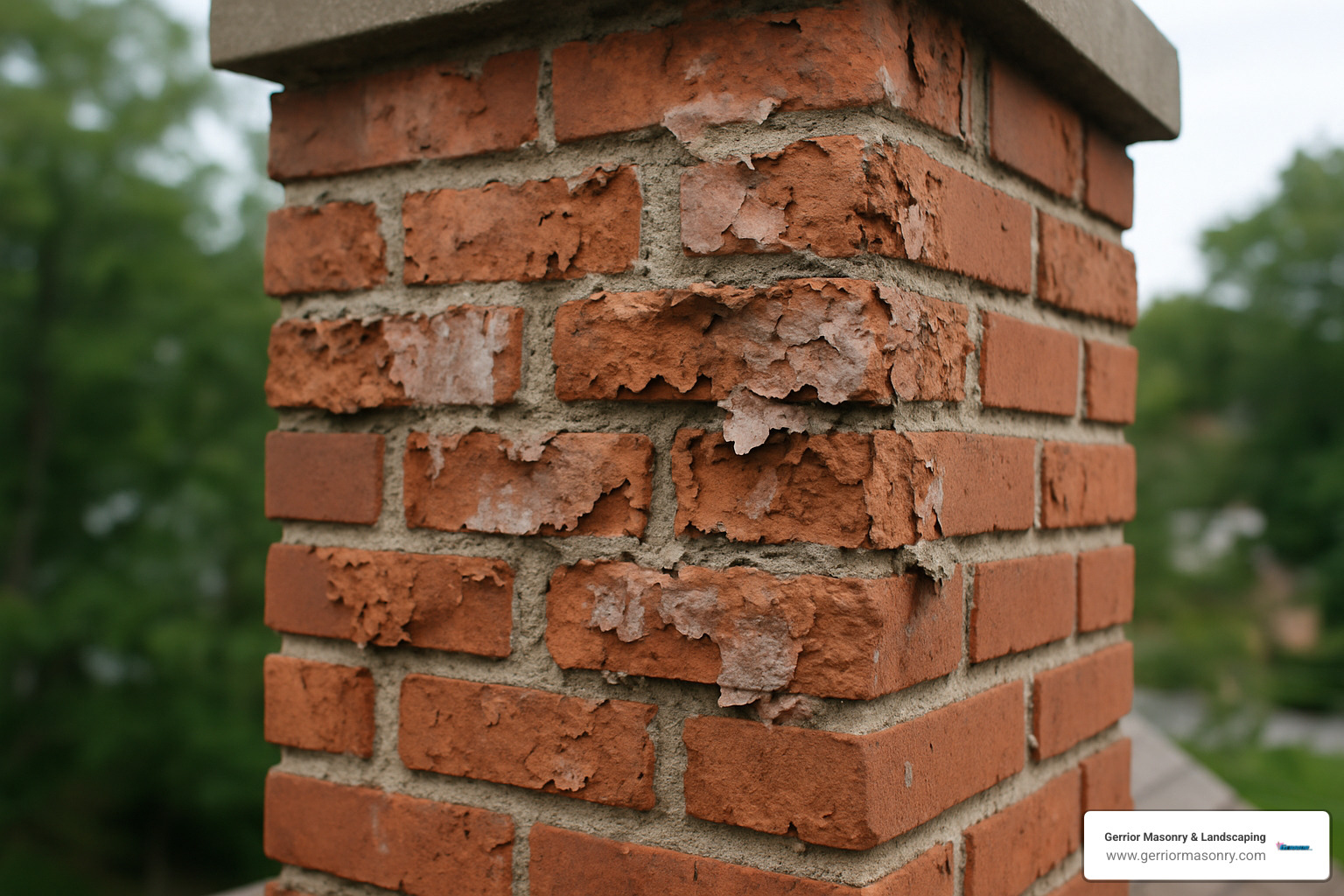
Spalling bricks are particularly common in our freeze-thaw climate. This is when brick surfaces start popping and flaking away. It happens when moisture gets inside the brick, then expands when it freezes, literally tearing bricks apart from the inside out.
Efflorescence – white, chalky staining on your chimney’s exterior – signals that water is moving through your masonry. Those white streaks are dissolved salts that water carries to the surface.
Rusted flashing around your chimney base is another red flag. We’ve gotten emergency calls from homeowners placing buckets around their living rooms when compromised flashing fails during heavy rainstorms.
A leaning chimney stack means serious structural issues requiring immediate attention. Even slight leans indicate foundation problems or severe mortar deterioration.
The latest research on chimney fires shows that damaged chimneys dramatically increase fire risk. When your flue system is compromised, heat and flames can escape and ignite nearby materials.
Visual & Functional Clues
Loose mortar joints are easy to spot with the screwdriver test. If you can scrape mortar away easily, your joints need attention through repointing.
Shaling occurs when clay flue tiles crumble into your firebox. It’s messy and means your interior liner is deteriorating, affecting both safety and fireplace performance.
Crown cracks in the concrete cap might seem minor, but they’re direct highways for water infiltration. Massachusetts winters turn small cracks into major problems quickly.
Damp, musty smells from your fireplace during humid weather signal water infiltration and potential mold growth. Poor draft performance indicates obstructions, liner damage, or structural problems affecting proper smoke removal.
What Drives Deterioration in Masonry Chimneys
Water infiltration is the primary enemy of masonry chimneys. It starts with tiny cracks that seem harmless, but once water penetrates, it creates a destructive cycle that accelerates damage exponentially.
Freeze-thaw cycles are particularly brutal in Massachusetts. Water seeps into cracks, then freezes and expands with tremendous force. We get those winter days where it’s 35 degrees and sunny, followed by nights at 15 degrees – constant freezing and thawing acts like a jackhammer on your chimney.
Acidic creosote adds destruction from inside out. This tar-like residue from burning wood is highly acidic and slowly eats away at mortar joints and clay flue tiles.
Many older chimneys suffer from poor original mortar mix decisions. Decades-old lime-based mortars weren’t designed for today’s heating demands or extreme weather patterns, breaking down faster than modern Type N mortars.
Age and seismic movement create stress points that develop into cracks over time. Even tiny vibrations from heavy trucks or minor ground settling, combined with thermal expansion and contraction, cause gradual structural fatigue.
Spalling Science 101
Spalling happens when moisture penetrates brick’s porous surface, then freezes and expands like tiny bombs inside the masonry. Ice expansion creates pressure that pops pieces away from the surface, creating even more porous areas that absorb water faster.
Spalling is a symptom, not the root cause. Simply replacing spalled bricks without addressing water infiltration sources means you’ll face the same problem within a few seasons.
Brick Chimney Repair Options Explained
Understanding your brick chimney repair options means matching the right repair to your specific situation and budget. Think of chimney repairs like medical treatments – a small cut needs a bandage, but a broken bone requires surgery.
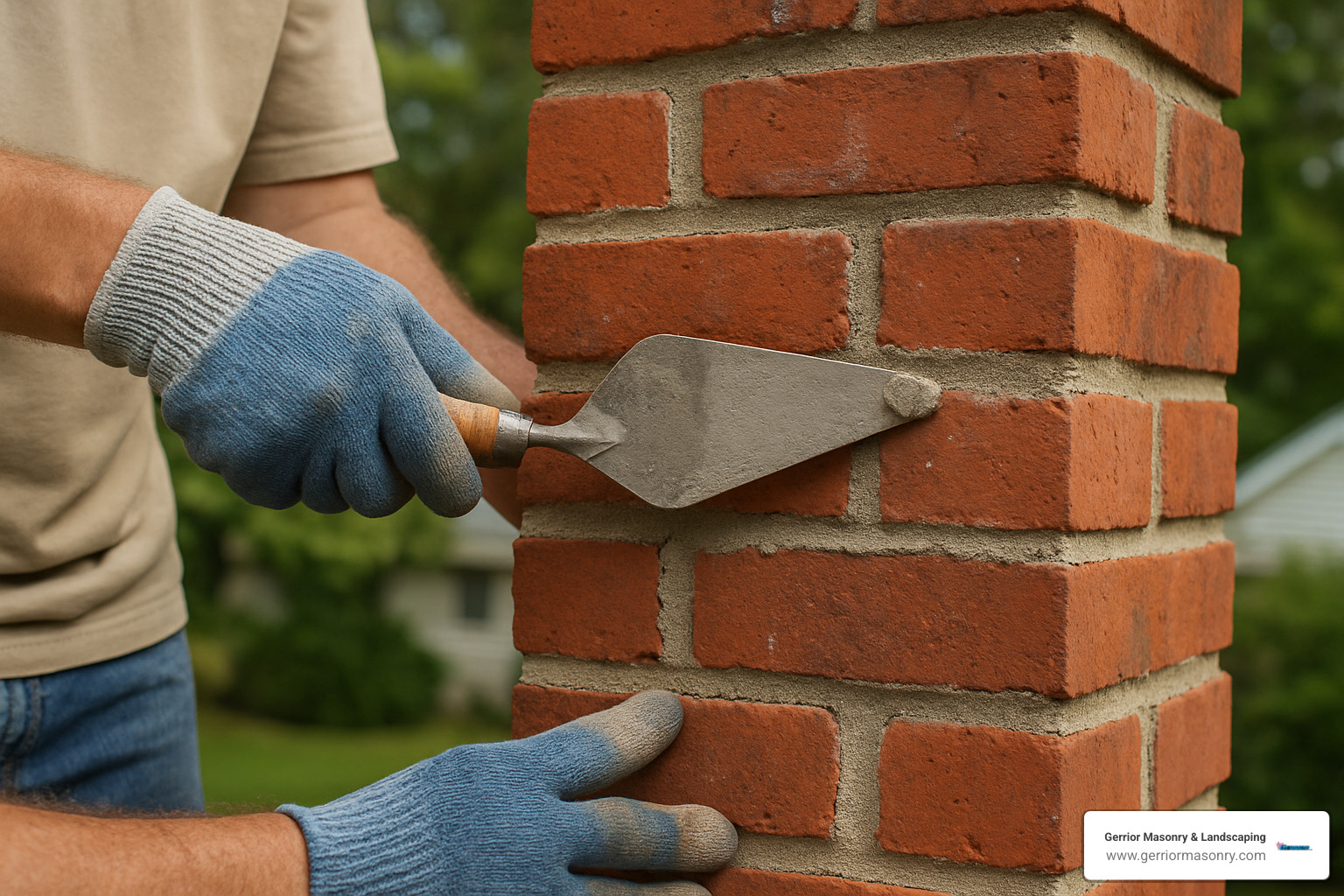
Repointing involves grinding out old, crumbling mortar and installing fresh Type N mortar that’ll last 20-30 years. Tuckpointing takes this further by using contrasting mortar colors for decorative lines while providing structural benefits.
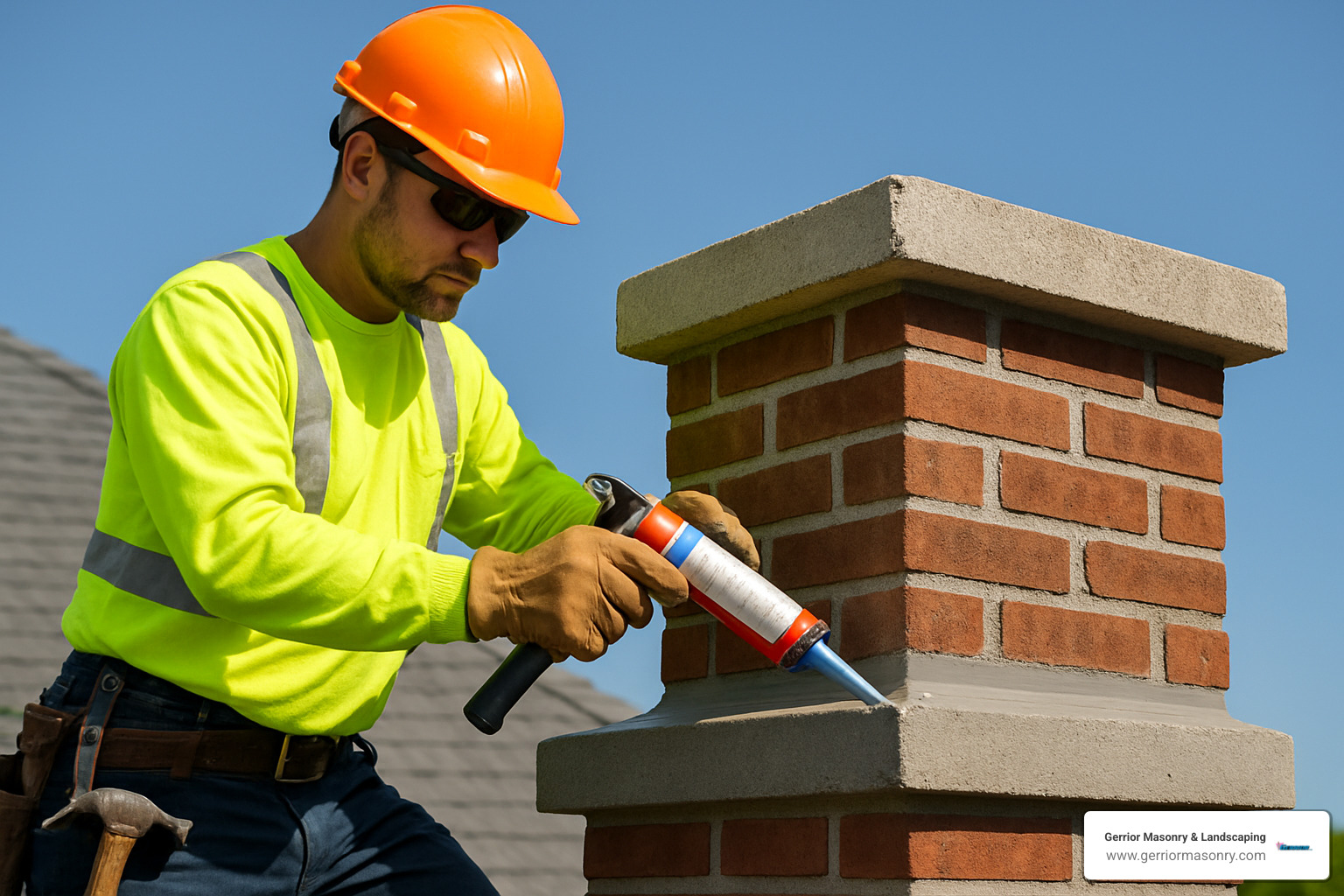
Crown repair fixes the concrete cap on your chimney top. When it cracks, water pours directly into your masonry. Proper repairs include correct slope and overhang to direct water away.
Cap installation is often the simplest fix with biggest impact. These metal covers keep rain, snow, and animals out while letting smoke escape freely.
Flashing replacement tackles leaks where your chimney meets your roof. Brick replacement involves carefully removing damaged bricks and installing matching replacements.
When damage gets extensive, partial rebuilds reconstruct the top section, while full rebuilds replace the entire chimney. Flue liner repair and waterproofing address interior and moisture issues respectively.
Primary Repair Options at a Glance
Repointing costs $500-$2,000+ and lasts 20-30 years. Perfect when bricks are solid but mortar is crumbling.
Crown repair runs $500-$1,500 and should last 15-25 years with maintenance.
Brick replacement ranges $500-$2,000+ but can last 50+ years with new bricks.
Flashing repair offers great value at $200-$600, lasting 15-20 years and preventing thousands in water damage.
Chimney caps cost $100-$500 and protect your investment for 20+ years.
Flue liner repair runs $1,000-$5,000+ but addresses serious safety issues.
Note: These are average costs based on internet data and not actual costs for Gerrior Masonry services.
Major Damage Decisions
Structural integrity trumps everything. Leaning chimneys or visible daylight through cracks usually mean rebuild territory.
Extensive spalling affecting more than 25% of visible bricks makes individual replacement impractical.
Interior flue liner condition affects safety and functionality. Severely damaged liners often require complete reconstruction to meet fire codes.
Repointing requires grinding old mortar 2-3 times the joint width, thorough cleaning, proper Type N mortar mixing, firm joint filling, and proper curing. Visit our Chimney Repointing Near Me page for details.
Crown repair involves damage assessment, surface preparation, proper forming with correct slope and overhang, quality materials, and proper curing.
Flashing work includes complete old material removal, surface preparation, base flashing installation, counter-flashing embedding, and quality sealant application. See our Chimney Flashing Replacement page.
The DIY versus professional decision involves safety, skill requirements, and cost considerations. After three decades in masonry, I’ve seen both successful DIY projects and expensive disasters requiring professional remediation.
Safety considerations are paramount. Falls from roofs cause serious injuries annually. Proper fall protection equipment is essential but expensive for one-time use.
Tool requirements include angle grinders with HEPA filtration, diamond blades, pointing trowels, joint rakers, and mixing equipment. A complete kit costs $500-$1,500 before safety equipment.
Professional cost ranges vary widely:
– Minor repairs: $150-$500
– Moderate repairs: $500-$2,000
– Major repairs: $2,000-$8,000
– Partial rebuilds: $3,000-$15,000
– Complete rebuilds: $10,000-$30,000+
Note: These are average costs based on internet data and not actual costs for Gerrior Masonry services.
When DIY Makes Sense
1-3 brick replacements on accessible chimneys can work for experienced DIYers with proper tools and safety equipment.
Hairline crown cracks can sometimes be sealed using specialized products with proper surface preparation.
When to Call Professionals
Chimney height and access make many repairs dangerous for untrained individuals.
Structural issues require professional assessment and engineering evaluation.
Fire code compliance often mandates professional installation and inspection.
Spending a few hundred dollars annually on maintenance beats writing a $20,000 check when your chimney collapses. After rebuilding chimneys that could have been saved with basic care, I can’t stress prevention enough.
Annual CSIA inspections spot problems while manageable – loose mortar joints that cost $800 to repoint instead of $15,000 to rebuild. Schedule before each heating season.
Spring waterproofing protects masonry before summer humidity and winter freeze-thaw cycles. It’s like sunscreen for your chimney – a $200-$400 investment preventing thousands in spalling damage.
Chimney caps deserve attention. Check for rust, torn screens, and loose mounting twice yearly. A $300 cap replacement beats $3,000 animal damage cleanup.
New England’s climate creates unique challenges. Coastal areas deal with salt air rusting flashing faster, while inland locations face more severe freeze-thaw cycles.
Budgeting & Long-Term Savings
Smart homeowners budget $300-$600 annually for maintenance and minor repairs. Regular care costs $3,000-$5,000 over ten years, while neglect often leads to $15,000-$25,000 reconstruction bills.
Insurance companies often offer discounts for annual inspections. Well-documented maintenance helps prevent claim denials if problems occur.
Note: Maintenance costs are average estimates based on internet data and not actual costs for Gerrior Masonry services.
Frequently Asked Questions
How do I know if I need repointing or rebuilding?
Simple repointing works when mortar joints are the main problem. If you can easily scrape mortar out with a screwdriver, or it’s falling out naturally, repointing usually solves the issue.
Rebuilding becomes necessary when problems go beyond mortar. Leaning chimneys, multiple rows of loose bricks, or more than 25% spalling bricks typically require reconstruction.
Rule of thumb: if your chimney looks rough overall, it probably needs more than repointing.
What is the typical lifespan of a repaired chimney crown?
A properly repaired crown should provide 15-25 years of service with basic maintenance. Material quality and installation technique make huge differences.
Proper slope (1/4 inch per foot) and adequate overhang (2-3 inches) are crucial. Massachusetts freeze-thaw cycles are particularly brutal, making annual inspections and prompt crack attention essential.
Can waterproofing stop spalling in Massachusetts winters?
Proper waterproofing is highly effective at preventing new spalling, reducing water absorption by 80-95%. Since water infiltration causes spalling, good waterproofing acts as insurance.
But waterproofing isn’t magic – it can’t repair already-spalling bricks or strengthen deteriorated mortar. Think prevention, not cure. Timing matters tremendously – it works best on healthy masonry before problems develop.
Quality treatments need reapplication every 5-10 years but can save thousands in spalling repairs.
Conclusion
Your chimney is a critical safety system protecting your family and property investment. Understanding your brick chimney repair options empowers smart decisions that prevent small problems from becoming expensive disasters.
The difference between a $500 repointing project and a $15,000 rebuild often comes down to timing. Those hairline cracks invite water infiltration that expands during harsh Massachusetts winters. Loose mortar you can scrape away is the first domino in a chain reaction compromising your entire structure.
Homeowners who address problems early save thousands and avoid emergency repairs during severe weather. Those who wait face tougher choices and bigger bills.
Early intervention isn’t just about money – it’s about safety. Compromised chimneys can allow dangerous gases into your home, create fire hazards, or collapse during severe weather.
At Gerrior Masonry & Landscape Construction, we believe in honest assessments and practical solutions. Sometimes that means recommending simple repointing when others might push complete rebuilds. Other times, it means difficult conversations about why rebuilds are the only safe option.
Our skilled team and hands-on owner oversight ensure quality results that withstand New England’s challenging climate. We’ve weathered three decades of freeze-thaw cycles, nor’easters, and everything else Massachusetts weather delivers.
Don’t let uncertainty prevent action. If you’ve spotted warning signs – spalling bricks, loose mortar, water stains, or draft problems – contact us for professional assessment. We’ll help you understand exactly what’s happening and explore all options.
Ready to protect your home and family? Visit our comprehensive Chimney Masonry Repair page to learn about our complete solutions and schedule consultation.
Gerrior Masonry & Landscape Construction is based in Woburn, MA, and proudly serves homeowners throughout Middlesex and Essex County, Massachusetts.
Chimney Specialists Near Me: 7 Top Trusted Pros 2025
Finding Reliable Chimney Specialists in Your Area
Looking for chimney specialists near me? Here’s what you need to know to find qualified professionals in your area:
Annual inspection is recommended by the National Fire Protection Association (NFPA)
Certified professionals should have CSIA (Chimney Safety Institute of America) credentials
Average costs range from $100-$300 for standard chimney sweeping
Check online reviews across multiple platforms before hiring
Ask for written estimates and compare at least three quotes
Chimney specialists near me provide essential services that keep your home safe and your heating system efficient. From routine sweeping to complex structural repairs, these professionals ensure that the pathway for smoke and dangerous gases remains clear and that your chimney structure stays sound. Without proper maintenance, you risk chimney fires, carbon monoxide poisoning, and costly water damage to your home.
The National Fire Protection Association recommends annual chimney inspections regardless of how often you use your fireplace or wood stove. This isn’t just a suggestion—it’s a safety standard designed to protect your family and property from preventable hazards.
I’m Joe Gerrior, owner of Gerrior Masonry & Landscape Construction Corp., and with over 34 years of experience working with chimney specialists near me in Massachusetts, I’ve seen how regular maintenance prevents catastrophic failures and extends the life of masonry structures.
Your chimney is more than just a decorative feature on your home—it’s a critical safety system that requires regular attention. Here’s why maintaining your chimney is essential:
Fire Prevention: Creosote, a highly flammable substance, builds up in chimneys over time. When creosote deposits reach 1/8 inch or more in thickness, they pose a significant fire hazard. According to the NFPA, failure to clean chimneys remains one of the leading causes of home heating fires. Chimney specialists near me can remove these dangerous deposits before they ignite.
Energy Efficiency: A clean, well-maintained chimney improves draft, allowing smoke and gases to exit your home properly. This means your fireplace or wood stove will burn more efficiently, providing more heat with less fuel. Poor chimney function can result in smoky rooms and higher heating costs.
Indoor Air Quality: Your chimney is designed to channel harmful combustion byproducts—including carbon monoxide—out of your living space. When chimneys are blocked or damaged, these dangerous gases can back up into your home. Regular maintenance by chimney specialists near me ensures proper ventilation and protects your family’s health.
Quick Snapshot: Essential Chimney Services & Average Costs
When you’re searching for chimney specialists near me, understanding the typical services and their costs helps you budget wisely. Let me walk you through what you can expect to pay and receive from professional chimney services. These figures represent average costs from internet research, not actual quotes from Gerrior Masonry:
Most-Requested Services
Your chimney works hard keeping your home warm and safe, and occasionally needs some professional attention. The most common service is a thorough chimney cleaning or sweeping, which removes dangerous creosote buildup, soot, and debris from your flue. This basic but essential service typically includes a visual inspection to catch potential problems early.
Chimney inspections come in three levels according to NFPA 211 guidelines. A Level 1 inspection visually examines readily accessible areas—perfect for annual maintenance. If you’re buying or selling a home or have experienced a chimney fire, you’ll need a more comprehensive Level 2 inspection with video scanning of the flue interior. The most detailed Level 3 inspection might require removing portions of the chimney to access concealed areas when serious problems are suspected.
Other popular services include flue liner installation (that critical protective barrier between your chimney and home), chimney cap installation (keeping out water, critters, and debris), waterproofing (extending the life of your masonry), and leak repair (fixing flashing and other water entry points). For structural issues, masonry repair addresses damaged bricks and mortar joints before they become major problems.
Average Price Ranges (Internet Data, Not Gerrior Quotes)
Chimney care runs the gamut from affordable maintenance to significant investments. A standard chimney sweeping typically costs between $100-$300, making it one of the most cost-effective ways to prevent expensive problems down the road.
Inspections range from $100 for basic assessments to $500 for comprehensive evaluations with specialized equipment. When it comes to repairs, costs vary widely based on the problem’s severity:
Minor repairs like small cracks, cap replacement, or flashing fixes generally run $200-$700. Moving up the scale, moderate repairs such as crown repair or partial repointing might cost $400-$2,500. For major repairs like liner replacement or extensive masonry work, expect to invest $1,000-$7,000.
The average cost to replace a chimney crown hovers around $1,550, but can range from $900 to $4,500 depending on size, materials, and accessibility. If you’re facing a complete chimney rebuilding, costs typically range from $4,000-$15,000, with factors like height, material quality, and your region’s labor rates affecting the final price.
Here’s the simple truth: regular maintenance is far more budget-friendly than emergency repairs. Annual inspections and cleanings might seem like an expense you can skip, but they’re actually saving you from the much higher costs of major repairs or complete rebuilds down the road.
How to Pick Trustworthy Chimney Specialists Near Me
Finding reliable chimney specialists near me shouldn’t feel like searching for a needle in a haystack. With a bit of homework, you can find professionals who’ll keep your home safe and your chimney in top condition. Let me walk you through the process.
Start with credentials that matter. CSIA Certification is the gold standard in our industry. When a chimney specialist has earned this certification from the Chimney Safety Institute of America, it means they’ve demonstrated real knowledge of fire codes, proper inspection techniques, and safe cleaning practices. You can easily verify if a specialist is certified through the CSIA’s online directory.
Don’t shy away from asking about insurance and licensing. Reputable chimney specialists near me will gladly show proof of both liability insurance and workers’ compensation coverage. This protects both you and them if something unexpected happens during the job.
Written estimates are non-negotiable. A professional will provide a detailed breakdown outlining exactly what work they’ll perform, what materials they’ll use, and what it’ll cost you. Be cautious of vague quotes or anyone asking for significant payment upfront—these are red flags.
The experiences of others speak volumes. Take time to browse through reviews on Google, Yelp, and the Better Business Bureau. Look for patterns rather than fixating on one glowing (or scathing) review. Consistent feedback tells you more about what to expect.
Timing can save you money and hassle. Most homeowners remember their chimneys in fall when temperatures drop, creating a seasonal rush. Consider scheduling your chimney service in spring or summer for better availability and sometimes more favorable pricing.
Chimney Specialists Near Me Hiring Checklist
Before signing on the dotted line, make sure your potential chimney specialist checks these boxes:
Verified CSIA certification
Proper insurance and local business registration
Positive reviews across multiple platforms
Clear, written estimates
Warranties or guarantees on their work
Responsive communication
Thorough inspection process with professional equipment
Protective measures to keep your home clean during service
When Should I Call Chimney Specialists Near Me?
While annual inspection is the baseline recommendation, certain situations call for immediate attention from chimney specialists near me.
Annual maintenance is your first line of defense. Schedule your yearly inspection and cleaning before heating season begins to ensure everything’s in working order when you need it most.
After severe weather events, your chimney may need a checkup. Storms, high winds, or lightning strikes can damage the structure in ways that aren’t always visible from the ground.
If you’re buying or selling a home, a Level 2 inspection isn’t just recommended—it’s often required during real estate transactions. This more detailed inspection provides peace of mind for both parties.
Pay attention to warning signs that something’s amiss. Smoky rooms, unusual odors, white staining on exterior masonry (called efflorescence), debris in your fireplace, water leaks, or visible cracks all warrant a call to chimney specialists near me. These symptoms rarely improve on their own and often indicate underlying issues that could become dangerous or expensive if ignored.
Changing your heating system? Whether you’re converting from oil to gas or installing a wood stove, your chimney may need modifications to function safely with your new setup.
Understanding common chimney issues helps you communicate effectively with chimney specialists near me and recognize problems before they become severe.
Common Repair Needs
Your chimney faces the harshest elements year-round, which is why certain repairs tend to pop up more frequently than others.
Flashing Repair often costs between $150-$500. Think of flashing as your chimney’s raincoat where it meets the roof. When this metal barrier fails, water sneaks into your home, leaving those telltale ceiling stains that no homeowner wants to see.
Mortar Joint Repointing typically ranges from $400-$2,500. The mortar between your chimney bricks is like the glue holding everything together. Over time, rain, snow, and temperature swings cause it to crumble away. Fresh mortar restores your chimney’s strength and prevents more serious structural issues.
Chimney Liner Repair or Replacement can cost anywhere from $200 for minor fixes to $7,000 for complete replacements. Your liner is your chimney’s unsung hero, protecting your home from heat and corrosive byproducts. When it cracks or deteriorates, it’s not just an inconvenience—it’s a safety hazard that needs immediate attention.
Crown Repair or Replacement usually runs $100-$3,000 depending on severity. The concrete crown sits at the top of your chimney like a protective hat, directing rainwater away from the structure. Once it cracks, water damage accelerates rapidly.
Chimney Cap Installation costs between $75-$1,000 based on materials and design. A good cap keeps unwanted visitors (like raccoons and birds) from turning your chimney into their new condo while also blocking rain and snow.
Damper Repair typically costs $100-$300. Your damper controls airflow and keeps heated air from escaping when the fireplace isn’t in use. When it sticks or breaks, your heating bills might give you an unpleasant surprise.
Brick or Stone Repair ranges from $350-$3,000 depending on the extent of damage. Individual damaged masonry units might seem minor, but they can compromise your entire chimney’s structural integrity if left unaddressed.
Maintenance Timeline
Taking care of your chimney is a year-round responsibility, not just a fall checklist item. Here’s a practical timeline that keeps your chimney in top shape:
Monthly (During Heating Season), take a moment to check your firebox for obvious issues. Remove cool ashes (never warm ones!) and make sure nothing is obstructing the flue. This simple habit can prevent many problems.
Annually, schedule professional chimney sweeping and a Level 1 inspection. This is the cornerstone of chimney maintenance. Your technician will also check your damper’s function and inspect the chimney cap for damage. The National Fire Protection Association recommends this yearly care regardless of how often you use your fireplace.
Every 3-5 Years, consider applying waterproof sealant to your chimney’s exterior. If you’re a frequent fireplace user, this is also a good interval for a more thorough Level 2 inspection that can catch developing issues.
As Needed, arrange for a Level 2 inspection when selling your home (most real estate transactions require this) or after severe weather events. If significant hidden damage is suspected, a more intensive Level 3 inspection might be necessary.
DIY vs. Pro
While I understand the satisfaction of DIY projects, chimney work has a clear line between what’s safe for homeowners and what requires chimney specialists near me.
You can handle basic visual inspections, removing completely cooled ashes, and cleaning the firebox area. Checking and replacing your smoke and carbon monoxide detector batteries is another important DIY task that complements professional chimney care.
However, leave the serious stuff to certified professionals. Chimney sweeping, creosote removal, structural repairs, liner work, flue inspections, and anything involving heights or specialized equipment shouldn’t be DIY projects. The risk of injury or inadvertently causing damage isn’t worth the potential savings.
Remember this simple rule: When creosote buildup exceeds 1/8 inch (about the thickness of a nickel) or when you notice any structural issues like cracked bricks or water stains, it’s time to call in certified chimney specialists near me. According to scientific research published by Forbes, creosote buildup is the leading cause of chimney fires, making professional removal essential for home safety.
What to Expect During an Inspection, Sweep or Repair Visit
When you schedule service with chimney specialists near me, knowing what to expect helps ensure a smooth experience.
The Inspection Process
Inviting a chimney professional into your home shouldn’t feel mysterious. When our team at Gerrior Masonry arrives, we first protect your living space by laying down drop cloths and setting up HEPA vacuums. We understand this is your home, and we treat it with respect.
The inspection begins with a thorough visual examination of accessible areas—the exterior masonry, crown, cap, and visible portions of the flue. For more comprehensive Level 2 inspections, we’ll insert a specialized camera into your flue, capturing images of areas hidden from view. It’s like giving your chimney a medical checkup with modern technology.
We’ll measure any creosote buildup (that dark, flammable substance that accumulates over time) to determine if sweeping is necessary. Generally, when deposits exceed 1/8 inch, it’s time for cleaning. We’ll also assess the structural integrity of your chimney, looking for cracks or deterioration that could compromise safety.
Before we wrap up, we’ll test your chimney’s draft to ensure smoke is drawing properly, and provide you with a detailed written report, complete with photos of any issues finded. No surprises—just clear information about your chimney’s health.
The Sweeping Process
If your chimney needs cleaning, we don’t just show up with a brush and make a mess. Professional chimney specialists near me take careful steps to keep your home clean.
First, we’ll prepare the area with drop cloths and specialized vacuum equipment to contain soot and debris. Using rods and brushes specifically sized for your flue, we’ll methodically remove creosote and debris from the chimney walls. All that nasty stuff we remove? It gets properly contained and disposed of—not scattered through your living room.
After cleaning, we perform a final visual check to confirm your flue is clear and ready for safe use. Many homeowners are surprised at how clean and orderly the process is when done by professionals.
The Repair Process
Chimney repairs vary widely depending on what needs fixing, but our approach remains consistent. Before any work begins, you’ll receive a detailed estimate outlining the scope of work, materials needed, expected timeline, and costs. We believe in transparency—no hidden fees or sudden price increases.
For masonry repairs, we take care to match existing materials as closely as possible, preserving the aesthetic appeal of your home. Weather matters too—some repairs, particularly masonry work, require specific temperature and humidity conditions for optimal results. We’ll plan accordingly to ensure quality work.
For extensive repairs, we keep you updated throughout the process. When the job is complete, we’ll walk you through the work performed, answer your questions, and make sure you’re completely satisfied before we leave.
Chimney Sweep vs. Chimney Mason: Understanding the Difference
When searching for chimney specialists near me, it helps to understand the two main types of professionals in this field.
Chimney sweeps primarily focus on cleaning, inspections, and minor repairs. Their expertise centers on the interior components of your chimney system—the flue, damper, and smoke chamber. They’re the ones who keep your chimney flowing freely and free from dangerous buildups.
Chimney masons, on the other hand, specialize in the structural aspects. They’re the brick-and-mortar experts who handle rebuilding, tuckpointing, and masonry repairs. Their focus is on maintaining the exterior integrity of your chimney.
At Gerrior Masonry, we offer both services, providing comprehensive chimney care from the inside out. This integrated approach ensures that all aspects of your chimney system receive the attention they need.
Beyond just checking a maintenance task off your list, regular service from qualified chimney specialists near me delivers real benefits you’ll notice.
Your fireplace will draw better after proper maintenance, meaning less smoke billowing into your living room and more heat staying where you want it. This improved efficiency translates to lower fuel consumption—whether you’re burning wood, gas, or pellets, you’ll get more heat for your money.
Perhaps most importantly, proper chimney maintenance dramatically reduces safety risks. A clean, well-maintained chimney significantly lowers your risk of a chimney fire and helps prevent carbon monoxide—that silent, invisible threat—from seeping into your home.
Regular care also extends your chimney’s lifespan. Small issues caught early might cost a few hundred dollars to fix, while waiting until major problems develop can lead to repairs in the thousands. Think of chimney maintenance as preventive medicine—a little care now prevents serious problems later.
Frequently Asked Questions About Chimney Specialists Near Me
How much do chimney specialists near me cost on average?
When budgeting for chimney services, it helps to understand the typical price ranges you might encounter. Based on internet data (not Gerrior Masonry quotes), the costs can vary considerably depending on what your chimney needs:
A basic chimney sweeping typically runs between $100-$300, while inspections range from $100-$250 for a Level 1 assessment to $500-$1,500 for the most comprehensive Level 3 inspection. For protective additions like chimney caps, expect to pay anywhere from $75 to $1,000 depending on materials and design.
More substantial repairs naturally come with higher price tags. Crown repairs might cost $100-$3,000, while flashing repairs typically fall between $150-$500. If your chimney needs masonry work like tuckpointing or repointing, those services generally range from $400-$2,500.
In cases where extensive damage has occurred, a complete chimney rebuild could cost anywhere from $4,000 to $15,000.
Several factors influence where your project will fall within these ranges:
Chimney height and accessibility play a significant role—taller chimneys require more equipment and safety precautions. The extent of damage naturally affects cost, as does your choice of materials (stainless steel liners cost more than aluminum, for instance). Your geographic location matters too, with urban areas typically commanding higher rates than rural regions. Finally, seasonal timing can impact pricing, with many chimney specialists near me charging premium rates during their fall busy season.
How often should I call chimney specialists near me for inspection or cleaning?
The National Fire Protection Association (NFPA) provides clear guidance here: have your chimney, fireplace, and vents inspected at least once yearly. However, cleaning frequency depends on how often you use your fireplace:
For homes with light use (occasional fires for ambiance), an annual inspection with cleaning based on the inspector’s recommendation is typically sufficient. With moderate use (weekly fires during winter), you’ll likely need both an annual inspection and cleaning. For heavy use homes (daily fires throughout winter), consider bi-annual cleaning in addition to your annual inspection.
The universal rule is that when creosote buildup reaches 1/8 inch thickness, cleaning becomes necessary regardless of timing. This highly flammable substance poses a serious fire hazard when allowed to accumulate.
Beyond your regular schedule, certain situations warrant additional inspections: after experiencing a chimney fire, following severe storms, when purchasing a home, when changing heating appliances, or if you notice any performance issues like smoke backing up into your home or unusual odors.
Are chimney repairs covered by homeowners insurance?
The answer here isn’t straightforward. Typically, homeowners insurance covers chimney damage only when it results from sudden, unexpected events. Your policy likely covers damage from lightning strikes, chimney fires, fallen trees, windstorms, and other natural disasters.
What’s generally not covered? The slow deterioration that comes from regular wear and tear or neglected maintenance. This means you’ll probably be responsible for routine repairs like fixing a crumbling crown or repointing mortar joints that have gradually deteriorated over time.
If you believe your chimney damage should qualify for insurance coverage:
Document everything with detailed photos
Have a certified chimney professional provide a written assessment
Contact your insurance company promptly
Be prepared to show evidence that the damage occurred suddenly rather than gradually
Insurance policies vary widely in their coverage terms, so it’s worth reviewing your specific policy or speaking directly with your agent to understand exactly what’s covered before you need to make a claim.
Regular maintenance by qualified chimney specialists near me is the best insurance against costly repairs, regardless of coverage. Most serious chimney issues develop gradually and could be prevented with routine care.
Gerrior Masonry & Landscape Construction is based in Woburn, MA, and services Middlesex and Essex County, Massachusetts.
Conclusion
Finding reliable chimney specialists near me isn’t just about maintaining your home—it’s about protecting what matters most. Your chimney quietly serves as both a comfort provider and a safety system, deserving professional attention to keep it working properly year after year.
Think of chimney maintenance as preventive healthcare for your home. Just like you wouldn’t skip annual check-ups with your doctor, your chimney deserves regular professional attention. The small investment in annual inspections can save you thousands in major repairs down the road—not to mention the priceless peace of mind knowing your family is protected from fire hazards and carbon monoxide risks.
When searching for chimney specialists near me, credentials matter. A CSIA certification isn’t just a fancy acronym—it represents specialized training and commitment to industry safety standards. Always verify this certification before hiring anyone to work on your chimney system.
Don’t wait until you see smoke signals (literally) before addressing chimney issues. Small problems like minor mortar cracks or slight water staining can quickly escalate into structural concerns that threaten your entire home. By addressing these warning signs promptly, you’ll extend your chimney’s lifespan and maintain its efficiency.
The digital age makes finding service providers easier than ever, but it also requires a discerning eye. Take time to read reviews across multiple platforms, and don’t hesitate to ask neighbors and friends about their experiences with local chimney professionals. Those personal recommendations often lead to the most reliable service providers.
Keep detailed records of all chimney work performed on your home. These documents not only help you track maintenance history but can also prove valuable when selling your home or filing insurance claims if unexpected damage occurs.
At Gerrior Masonry & Landscape Construction, we’ve spent over three decades building trust throughout Massachusetts communities. We understand that inviting someone to work on your home requires confidence in their skills and integrity. That’s why we approach every chimney project—from routine inspections to complex rebuilds—with the same attention to detail we’d give our own homes.
Your chimney stands as a silent sentinel, protecting your home through harsh New England winters and summer storms alike. Give it the care it deserves with regular maintenance from certified professionals who understand both the science and craft of proper chimney care.
Gerrior Masonry & Landscaping is based in Woburn, MA, and services Middlesex and Essex County, Massachusetts. We’re committed to ensuring your chimney remains safe, efficient, and structurally sound for years to come.
Chimney Waterproofing Near Me: Top 5 Trusted Experts 2025
Protecting Your Home From Water Damage: Why Chimney Waterproofing Matters
If you’re searching for chimney waterproofing near me, here’s what you need to know:
Average Cost: $150-$400 for basic waterproofing, up to $1,200 with repairs
Best Time: Spring, before heavy rains but after freeze-thaw cycles
Service Includes: Inspection, cleaning, repairs, and application of breathable sealant
Benefits: Reduces water penetration by up to 99.9%, extends chimney life by decades
Warning Signs: White staining (efflorescence), crumbling mortar, damp smells
Water penetration is the #1 cause of brick damage to masonry chimneys. Left untreated, moisture can destroy your chimney from the inside out, leading to expensive repairs that could have been prevented with proper waterproofing.
When water seeps into brick and mortar, it creates a destructive cycle. During winter, this moisture freezes and expands, causing bricks to crack and spall. A professional chimney waterproofing service applies specialized breathable sealants that keep water out while allowing vapor to escape, preventing this damage before it starts.
Unlike regular paint or hardware store sealers, professional-grade chimney waterproofing products like ChimneySaver have been tested to ASTM standards and reduce water penetration by up to 99.9% while remaining 100% vapor permeable. This means your chimney can still “breathe” while being protected from moisture.
I’m Joe Gerrior, owner of Gerrior Masonry & Landscape Construction Corp., and I’ve spent over 34 years helping homeowners protect their chimneys through expert chimney waterproofing near me services throughout Massachusetts. My team specializes in identifying vulnerable areas and applying industry-leading waterproofing solutions that stand the test of time.
Why Waterproof Your Chimney ASAP
That chimney standing proudly on your roof? It’s taking a beating every single day. Rain, snow, ice, and even morning dew are slowly but surely working their way into the masonry. This isn’t just a minor concern—it’s a ticking clock on your home’s structural integrity and your wallet.
Industry testing at the University of Wyoming reveals something remarkable: proper chimney waterproofing near me services can reduce water penetration by an astonishing 99.9%. That’s not just a number—it’s the difference between a chimney that serves your family for generations and one that crumbles before your eyes.
When moisture sneaks into your brick and mortar, the damage begins in ways you might not immediately notice:
Your bricks start spalling—that’s when the faces of the bricks literally flake off after water freezes and expands inside them. Then comes the telltale white powdery substance called efflorescence, which signals water is dissolving salts within your masonry. Meanwhile, your mortar joints slowly crumble away, creating even more pathways for water to invade.
Metal components like dampers and flashing don’t fare any better—they rust and corrode when constantly exposed to moisture. All of this gradually compromises your entire chimney’s structural integrity, putting your home at risk.
The Brick Industry Association emphasizes that chimneys need special attention precisely because they’re so vulnerable to water damage. Beyond protection, proper waterproofing significantly boosts your home’s resale value by eliminating red flags during inspections.
Hidden Costs of Ignoring Moisture
What you can’t see can hurt you—and your home. Water damage extends far beyond the chimney’s exterior, causing:
Interior leaks that stain ceilings and damage walls after water penetrates deep into the structure. Your clay flue liner deteriorates when moisture combines with acidic combustion byproducts, creating serious fire hazards you can’t afford to ignore.
Mold and mildew find perfect breeding grounds in damp chimneys, leading to those musty odors and potential health issues for your family. Your heating bills creep higher as water-damaged masonry becomes less efficient, letting precious heat escape while cold air sneaks in. Even your fireplace performance suffers—have you noticed smoke backing up into your living room? That could be moisture affecting your chimney’s draft.
The financial math is simple but stark: A chimney waterproofing repair typically costs around $400 and takes less than a day to complete. Ignore the problem, and you could be looking at a complete chimney rebuild ranging from $4,000 to $15,000. That’s not a repair bill—that’s a small renovation.
Don’t wait until you see obvious damage. By then, water has already been at work for months or years. Protecting your chimney now isn’t just maintenance—it’s an investment that pays dividends in home safety, efficiency, and long-term savings.
Gerrior Masonry & Landscape Construction has been protecting chimneys throughout Middlesex and Essex County, Massachusetts for over three decades. We understand the unique challenges New England weather poses to masonry structures, and we’re here to help before small issues become major problems.
Chimney Waterproofing Near Me: How the Process Works & Best Products
Professional chimney waterproofing near me isn’t just a quick spray-and-go job. It’s a methodical process that requires expertise and attention to detail. At Gerrior Masonry & Landscaping, we’ve refined our approach over decades to ensure your chimney gets maximum protection that lasts.
Step-by-Step Chimney Waterproofing Near Me
We begin with a thorough inspection of your chimney. This critical first step reveals existing water damage, cracks, and mortar issues that need addressing before waterproofing can begin. Think of it like checking for holes in a bucket before filling it – we need to fix the problems first.
Next comes surface preparation – a step many contractors rush through. We carefully clean your chimney using wire brushes (which can increase the adhesion area by up to 300%!), high-pressure air blowing, and power washing. This opens up the masonry pores and ensures the waterproofing treatment can penetrate deeply where it’s needed most.
Before applying any waterproofing, we complete all necessary repairs. This might include tuckpointing crumbling mortar joints, replacing damaged bricks, fixing the chimney crown, or addressing flashing issues. Skipping these repairs is like putting a raincoat on someone with holes in their clothes – the protection just won’t work properly.
The actual waterproofing application is where our expertise really shines. We apply high-quality, breathable water repellent in at least two coats, starting from the bottom and working upward. This bottom-up technique prevents streaking and ensures complete coverage. We pay special attention to mortar joints (which are more porous than brick) and allow about 10 minutes between coats for optimal absorption.
We finish with a final inspection to verify complete coverage and proper application – giving you peace of mind that your chimney is fully protected.
Top-Rated Water Repellents and Coatings
Not all waterproofing products deserve a place on your chimney. The difference between professional-grade products and hardware store options is like comparing a raincoat to a paper towel – they’re just not in the same league.
We trust ChimneySaver Water Repellent for most applications. It’s the gold standard in the industry, tested to rigorous ASTM requirements and proven to reduce water penetration by an impressive 99.9% while remaining 100% vapor permeable. This means water stays out, but trapped moisture can still escape – a crucial distinction that prevents freeze-thaw damage. It’s available in both water-based and solvent-based formulations to suit different chimney conditions.
For chimney crowns – often the most vulnerable area for water entry – we apply specialized Crown Coatings like CrownCoat or All Weather CrownCoat. These create a flexible, waterproof membrane that can bridge hairline cracks and prevent water from seeping into your chimney from above.
We also use FlashSeal for the critical area where your chimney meets the roof. This junction is often the primary entry point for water, and regular sealants just don’t cut it here.
These professional-grade products typically last 5-10 years and often include warranties. The solvent-based formulations work particularly well for non-vertical surfaces like chimney crowns and for reapplication over previously treated surfaces.
What truly sets these products apart is their vapor permeability – they create a microscopic shield that blocks liquid water while allowing water vapor to escape. This breathing ability is essential because non-breathable sealants can actually trap moisture inside the masonry, accelerating damage during freeze-thaw cycles.
Signs, Costs & Maintenance: What Homeowners Should Know
Recognizing the signs that your chimney needs waterproofing can save you thousands in repair costs. Here are the key indicators to watch for:
White staining (efflorescence): This powdery white substance indicates that water is moving through your masonry, dissolving salts, and depositing them on the surface as it evaporates
Spalling or flaking bricks: When you see brick faces popping off or flaking away, water has already penetrated and caused freeze-thaw damage
Deteriorating mortar joints: Crumbling mortar between bricks is a clear sign of water damage
Rusted chimney cap or chase cover: Rust indicates ongoing exposure to moisture
Damp spots or water stains: Water stains on walls or ceilings near the chimney point to water penetration
Musty odors: Persistent dampness can create unpleasant smells, particularly when the fireplace isn’t in use
According to industry data, the average cost for basic chimney waterproofing ranges from $150 to $400. However, if repairs are needed before waterproofing can be applied effectively, costs typically range from $400 to $1,200. For severely damaged chimneys requiring extensive repairs, costs can range from $1,000 to $3,500 for repairs above the roofline.
These are average costs based on internet data and not actual costs for Gerrior Masonry services. The final price depends on factors including:
Chimney size and accessibility
Extent of necessary repairs
Type of waterproofing products used
Local labor rates
Seasonal demand
Post-Waterproofing Care
Once your chimney has been professionally waterproofed, proper maintenance will extend the protection:
Annual inspections: Have your chimney inspected annually by a certified chimney sweep to catch any issues early
Monitor for signs of water damage: Keep an eye out for the warning signs mentioned above
Keep gutters clean: Clogged gutters can cause water to back up against the chimney
Maintain the chimney cap: Ensure the cap remains in good condition to keep rain from entering directly
Reapply waterproofing as recommended: Most waterproofing treatments last 5-10 years; plan to reapply according to your warranty
Spring is generally considered the best time for chimney waterproofing. The milder temperatures allow for proper curing of waterproofing products, and it prepares your chimney for the rainy seasons ahead.
Common Mistakes to Avoid
When it comes to chimney waterproofing, certain mistakes can actually make problems worse:
Using non-breathable sealants: Paints, urethanes, or other non-breathable products trap moisture inside the masonry
Applying waterproofing to dirty surfaces: Proper cleaning is essential for adhesion
Single-coat application: Professional application requires at least two coats for complete protection
DIY application without proper equipment: Professional-grade sprayers ensure even coverage and proper penetration
Finding and Hiring Local Experts
When you’re ready to protect your chimney from water damage, finding the right professional is crucial. Your search for chimney waterproofing near me should lead you to qualified experts who understand the science behind masonry protection and have a proven track record of success.
A quality chimney waterproofing service begins with proper certification. Look for technicians who hold CSIA (Chimney Safety Institute of America) credentials, which indicates they’ve received specialized training in chimney systems and safety protocols. This certification isn’t just a piece of paper—it represents a commitment to industry best practices and ongoing education.
Insurance and bonding are non-negotiable qualities in a reputable contractor. These protections safeguard your property if accidents occur during the waterproofing process. When a company is properly insured, it demonstrates professionalism and responsibility that should give you peace of mind.
Before hiring anyone, take time to read online reviews and check references. Past customers often provide the most honest assessment of a company’s work quality and customer service. Don’t hesitate to ask for photos of similar projects they’ve completed—reputable contractors are proud to showcase their craftsmanship.
While it might seem convenient to go with the first estimate you receive, getting at least three quotes provides valuable perspective on fair pricing and service offerings. If one estimate is significantly lower than others, be cautious—quality waterproofing products and proper application techniques aren’t inexpensive, and cutting corners leads to premature failure.
Seasonal timing matters too. Many homeowners don’t realize that spring is ideal for booking chimney waterproofing near me services. The mild temperatures allow for optimal curing of waterproofing products, and you’ll beat the rush of last-minute calls that flood in during fall and winter months.
Questions to Ask a Chimney Waterproofing Contractor Near Me
When interviewing potential contractors, the right questions can reveal their expertise and reliability. Start by asking about their specific experience with chimney waterproofing—not just general masonry work. Companies with at least 5+ years of specialized waterproofing experience typically have encountered and solved various chimney moisture problems.
Product knowledge is a telling indicator of professionalism. Your contractor should enthusiastically explain which waterproofing products they use and why those specific formulations are ideal for your chimney. If they mention breathable silane-siloxane technologies like ChimneySaver or similar professional-grade products, that’s a good sign they understand the importance of vapor permeability.
Preparation methods matter tremendously in waterproofing success. Ask detailed questions about how they’ll clean and prepare your chimney before application. The answer should include thorough cleaning, necessary repairs, and specific techniques for ensuring the waterproofing solution properly bonds with your masonry.
Application technique questions will reveal true expertise. Professional waterproofing requires at least two coats applied from bottom to top with appropriate drying time between applications. If a contractor doesn’t mention these specifics, they may not be following industry best practices.
A written warranty offers protection for your investment. Most reputable companies stand behind their waterproofing treatments with 5-10 year guarantees. Request warranty details in writing, including what’s covered and what might void the protection.
At Gerrior Masonry & Landscape Construction, we welcome these questions and more. Our transparent approach to chimney waterproofing comes from over three decades of protecting homes throughout Massachusetts. We believe an informed customer makes the best decisions for their home’s protection and longevity.
Our team specializes in Chimney Repointing Near Me services that restore the structural integrity of your chimney before applying waterproofing treatments. This comprehensive approach ensures lasting protection against water damage.
Gerrior Masonry & Landscape Construction is based in Woburn, MA, and proudly serves homeowners throughout Middlesex and Essex County, Massachusetts with owner-supervised workmanship on every project.
Frequently Asked Questions about Chimney Waterproofing
How long does chimney waterproofing last?
Most homeowners are pleasantly surprised to learn that a professional chimney waterproofing treatment isn’t a yearly expense. When properly applied, you can expect 5-10 years of protection from a single application.
The actual lifespan depends on several real-world factors. Professional-grade products like ChimneySaver typically last longer than hardware store options. Your local weather patterns make a difference too—chimneys in areas with harsh winters and frequent freeze-thaw cycles may need reapplication sooner than those in milder climates.
The condition of your chimney before waterproofing also affects longevity. A chimney that received proper repairs before waterproofing will maintain protection longer than one where underlying issues weren’t addressed.
At Gerrior Masonry, we recommend marking your calendar for an inspection as your warranty period approaches. This helps catch any emerging issues before they become costly problems. Most of our customers find that with proper maintenance, their waterproofing protection extends to the longer end of the expected range.
Can waterproofing stop every leak or will I need other repairs?
While chimney waterproofing near me searches often lead homeowners to think waterproofing is a magical fix-all solution, the honest answer is that it’s just one important piece of the protection puzzle.
Think of your chimney as having multiple potential entry points for water. The brick and mortar are certainly major areas where water can penetrate, and waterproofing addresses these brilliantly—reducing penetration by up to 99.9%. However, other components need attention too:
Your chimney crown (that concrete cap on top) often cracks and allows water to seep in. A proper crown coating provides essential protection here. The chimney cap itself prevents rain from falling directly down your flue. Flashing (that metal barrier where your chimney meets the roof) is a notorious leak point that may need repair or replacement.
During our comprehensive inspections, we identify all vulnerable areas and recommend appropriate solutions—not just masonry waterproofing. This complete approach ensures you don’t waste money waterproofing while leaving other leak sources unaddressed.
Is spring really the best season to book chimney waterproofing?
Yes, spring truly is the sweet spot for chimney waterproofing near me services, and there’s solid reasoning behind this recommendation.
Spring offers ideal temperatures (typically 50-90°F) for waterproofing products to cure properly. The masonry has had a chance to dry out after winter snow and ice, but before heavy spring rains arrive. This timing allows us to assess and repair any damage that occurred during winter’s freeze-thaw cycles, and then get your chimney protected before summer thunderstorms hit.
Many homeowners also find scheduling is easier in spring compared to the fall rush when everyone suddenly remembers their chimney before winter arrives. Getting ahead of the crowd means more flexible appointment options for you.
That said, we understand life doesn’t always align with ideal scheduling. At Gerrior Masonry & Landscaping, we work year-round (weather permitting) to accommodate our customers’ needs. As long as temperatures are above freezing and we have a few dry days, professional waterproofing can be performed successfully.
Gerrior Masonry & Landscape Construction is based in Woburn, MA, and services Middlesex and Essex County, Massachusetts with expert, owner-supervised chimney waterproofing services.
Conclusion
When it comes to protecting your home’s value and structural integrity, chimney waterproofing near me services offer one of the best returns on investment you’ll find. Water damage silently destroys more chimneys than any other factor, but professional waterproofing creates a shield that can add decades to your chimney’s lifespan while preventing repairs that often cost thousands.
The difference between effective waterproofing and wasted money lies in three critical factors: meticulous preparation, premium-quality products, and skilled application. While you might be tempted by DIY options, professional waterproofing delivers comprehensive protection backed by warranties that provide genuine peace of mind.
As you search for chimney waterproofing near me, prioritize contractors who understand the science behind masonry protection and exclusively use breathable, professional-grade products. The right professional won’t just spray your chimney and leave – they’ll conduct a thorough inspection, address existing damage, and apply waterproofing solutions designed to withstand New England’s challenging weather patterns.
At Gerrior Masonry & Landscape Construction, every waterproofing project benefits from our more than 34 years of hands-on experience with Massachusetts homes. We’ve seen how our region’s freeze-thaw cycles, coastal humidity, and seasonal weather extremes affect brick and mortar over time. That’s why we’ve refined our approach to provide waterproofing that truly lasts, using only the highest-quality products applied with meticulous attention to detail.
Have you noticed white staining on your bricks, crumbling mortar, or interior dampness? Or perhaps you simply want to prevent these problems before they start? Either way, we’re here to help with straightforward advice and solutions custom to your home’s specific needs.
Gerrior Masonry & Landscape Construction—based in Woburn, MA—proudly protects chimneys across Middlesex and Essex County with expert, owner-supervised workmanship. When you choose us, you’re not just getting a service; you’re getting a partner committed to keeping your home safe, dry, and beautiful for years to come.