Why Outdoor Stone Walkways Transform Your Massachusetts Property
An outdoor stone walkway adds both beauty and function to your landscape, creating a practical route for foot traffic while enhancing your home’s curb appeal and property value. Here’s what you need to know:
Key Benefits of Outdoor Stone Walkways:
Durability – Natural stone withstands New England’s freeze-thaw cycles
Aesthetic Appeal – Complements various architectural styles from colonial to contemporary
Safety – Provides stable, slip-resistant paths when properly installed
Property Value – Professional hardscaping can increase home resale value
Low Maintenance – With proper installation, stone paths require minimal upkeep
Popular Stone Options:
Bluestone – Smooth, elegant, costs $25-$100 per square foot installed
Flagstone – Natural, irregular shapes for rustic charm
Concrete Pavers – Affordable, uniform, starting at $6 per stone
Natural Sandstone – Textured surface for slip resistance
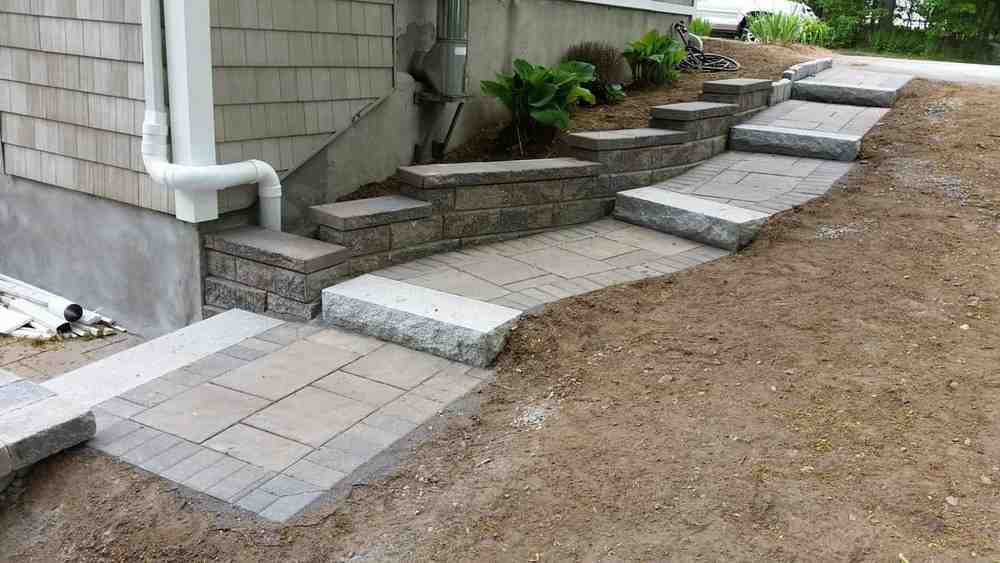
A stone walkway serves as more than just a path from your driveway to your front door. As research shows, it brings your whole property together, increases flow between outdoor spaces, and can transform a plain exterior into something exceptional. The right walkway coordinates with your home’s architecture, creates visual interest with winding or straight designs, and provides practical drainage away from your foundation.
Whether you’re considering a DIY project or professional installation, understanding material choices, proper base preparation, and drainage requirements is essential for a walkway that lasts decades in Massachusetts’s challenging climate.
I’m Joe Gerrior, owner of Gerrior Masonry & Landscape Construction Corp., and our team has been installing durable outdoor stone walkways throughout Massachusetts for over 34 years. We specialize in creating functional, beautiful hardscaping that withstands New England weather while enhancing your property’s aesthetics.
Planning and Designing Your Outdoor Stone Walkway
Before you pick up a shovel in your Burlington or Lexington backyard, you need a plan. Designing an outdoor stone walkway isn’t just about placing rocks in the dirt; it’s about architecture, engineering, and a little bit of artistry.
The first step is determining the path’s purpose. Is this a formal entrance meant for two people to walk side-by-side? If so, you’ll want a width of at least 3 to 4 feet. Is it a secret garden path in Concord meant for a solitary stroll? A narrow 2-foot winding trail might be more appropriate.
Matching Your Home’s Architecture
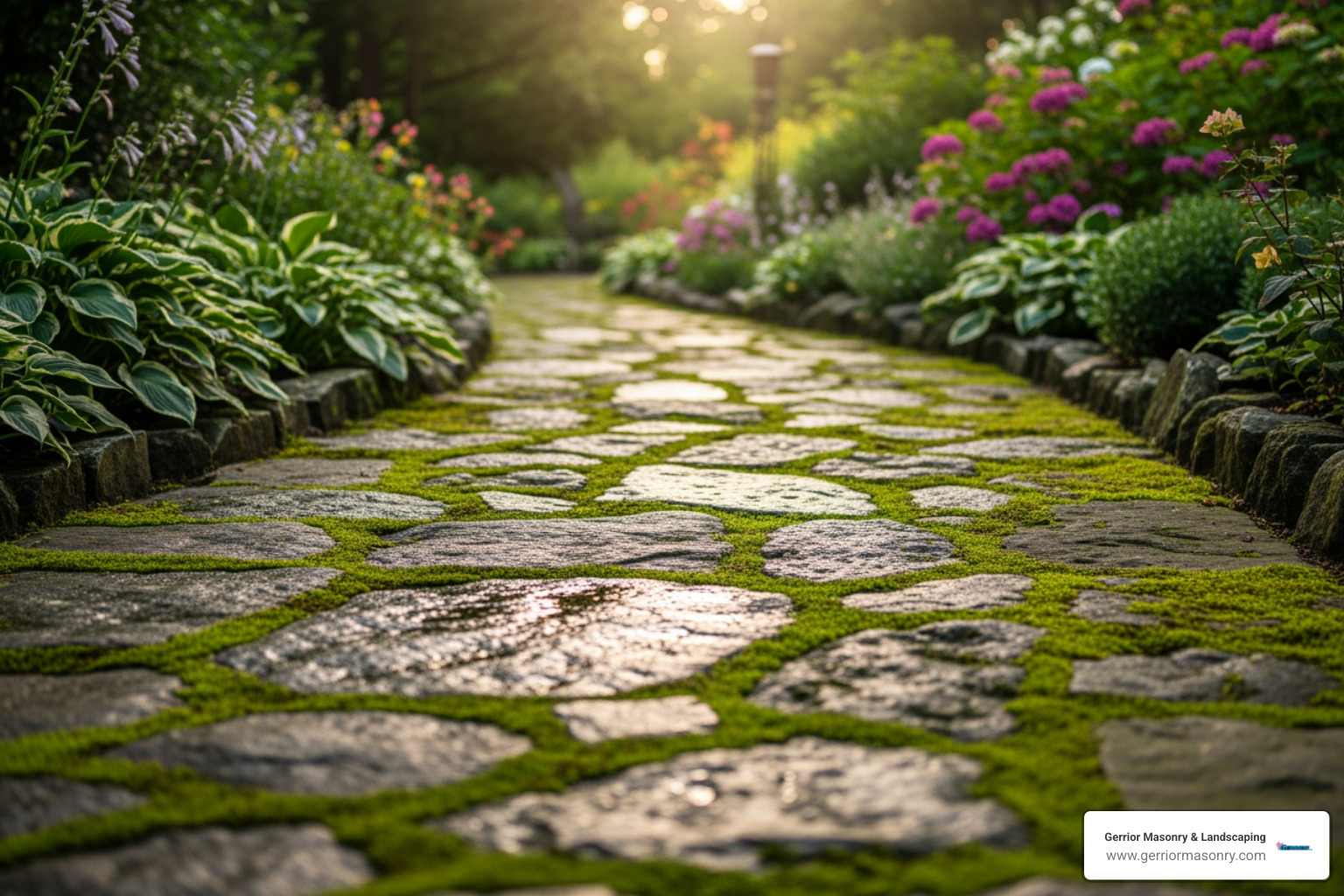
Choosing the right stone type, color, and texture is vital to ensure the path doesn’t look like an accidental pile of rocks. For a classic New England Colonial home in Winchester, sleek bluestone or traditional brick pavers often work best. For a rustic cottage in Boxford, irregular flagstones with moss or creeping thyme in the gaps create that “storybook” feel.
Design Tips for Layouts:
Winding Paths: Use a garden hose to mock up the curves. Winding paths add mystery and slow down the journey through a garden.
Straight Paths: Best for formal entrances where efficiency is key.
Mixed Materials: Combining stones with gravel or pebbles can create a high-contrast, modern look.
Comparison of Walkway Materials
Stone Type
Durability
Texture/Safety
Best Style Match
Internet Average Price (Installed)
Bluestone
High
Smooth but grippy
Modern, Formal
$25 – $100 per sq. ft.
Flagstone
High
Natural, uneven
Rustic, Garden
$15 – $65 per sq. ft.
Concrete Pavers
Moderate-High
Textured
Versatile, Traditional
$10 – $45 per sq. ft.
Sandstone
Moderate
Very textured
Warm, Mediterranean
$12 – $55 per sq. ft.
Gravel/Pebbles
Low (Migrates)
Loose
Informal, Zen
$5 – $20 per sq. ft.
Note: All listed service prices are average costs based on internet data and are not actual costs for Gerrior Masonry services.
Selecting the Best Materials for an Outdoor Stone Walkway
When it comes to longevity in Middlesex County, material choice is everything. You need a stone that can handle a Nor’easter one day and a heatwave the next without cracking like an egg.
Bluestone: The Massachusetts Favorite
Bluestone is a top-tier choice for a reason. It is incredibly dense and comes in various hues, including blue, gray, and even subtle purples or browns. You can find it in “thermal” (heat-treated for a smooth surface) or “natural cleft” (split along natural lines for a more textured look). Learning How to Lay a Bluestone Walkway reveals that its weight and flat surface make it exceptionally stable once set.
Flagstone and Natural Sandstone
If you want a path that looks like it has been there for a century, flagstone is your go-to. It refers more to the shape (flat slabs) than the specific rock type. Many homeowners in North Reading prefer natural sandstone like the MSI Rustic Canyon series, which has a 4.6/5 rating from over 1,200 reviews for its beautiful earth tones. It offers excellent slip resistance, which is a major safety consideration for paths that get wet frequently.
Concrete Pavers
For those looking for versatility and a slightly lower entry price, concrete pavers are fantastic. Products like the Pavestone Pewter or River Red Square Concrete Step Stones are highly rated (4.6/5 stars) and allow for uniform, easy-to-level designs. Check out more info about paver walkway ideas to see how these can be arranged in patterns like herringbone or basketweave.
Considering Local Regulations
Before starting your project in Middlesex County, check with your local building department. While simple garden paths rarely require permits, larger walkways involving significant regrading or those located in historical districts might. Historical commissions often have specific guidelines regarding material choices and colors to preserve the local architectural character.
Estimating Costs for Your Outdoor Stone Walkway Project
Let’s talk money—without the “sticker shock.” The cost of an outdoor stone walkway varies wildly based on whether you are doing the heavy lifting yourself or hiring a pro like us to handle the excavation and grading.
DIY Materials vs. Professional Installation:
DIY Stepping Stones: You can find basic concrete stepping stones for as little as $1.25 to $6.00 per stone. A full DIY job for a simple garden path might only cost $100 to $300 in materials.
Professional Installation: When you factor in labor, heavy equipment, base materials (tons of gravel and sand), and the stones themselves, the internet average for a professional job ranges from $15 to $100+ per square foot.
For instance, more info about stone walkway costs indicates that a high-end bluestone installation can reach $100 per square foot when complex patterns and custom cutting are involved. While the upfront cost is higher, professional installation ensures the path won’t settle into a “rollercoaster” shape after the first winter freeze in Woburn.
Reminder: These are average costs based on internet data and not actual costs for Gerrior Masonry services.
Step-by-Step Installation and Maintenance Guide
Ready to get your hands dirty? Even if you plan to hire a professional, understanding the process helps you oversee the project. A walkway is only as good as what’s underneath it.
The Essential Tool Kit
To build a stone path, you’ll need:
Garden hose or mason line (for layout)
Square-point shovel and garden spade
Plate compactor (rental recommended) or hand tamper
Carpenter’s level (at least 4 feet long)
Rubber mallet
Landscape fabric (weed barrier)
Safety gear: Gloves, goggles, and steel-toed boots
Site Preparation and Excavation
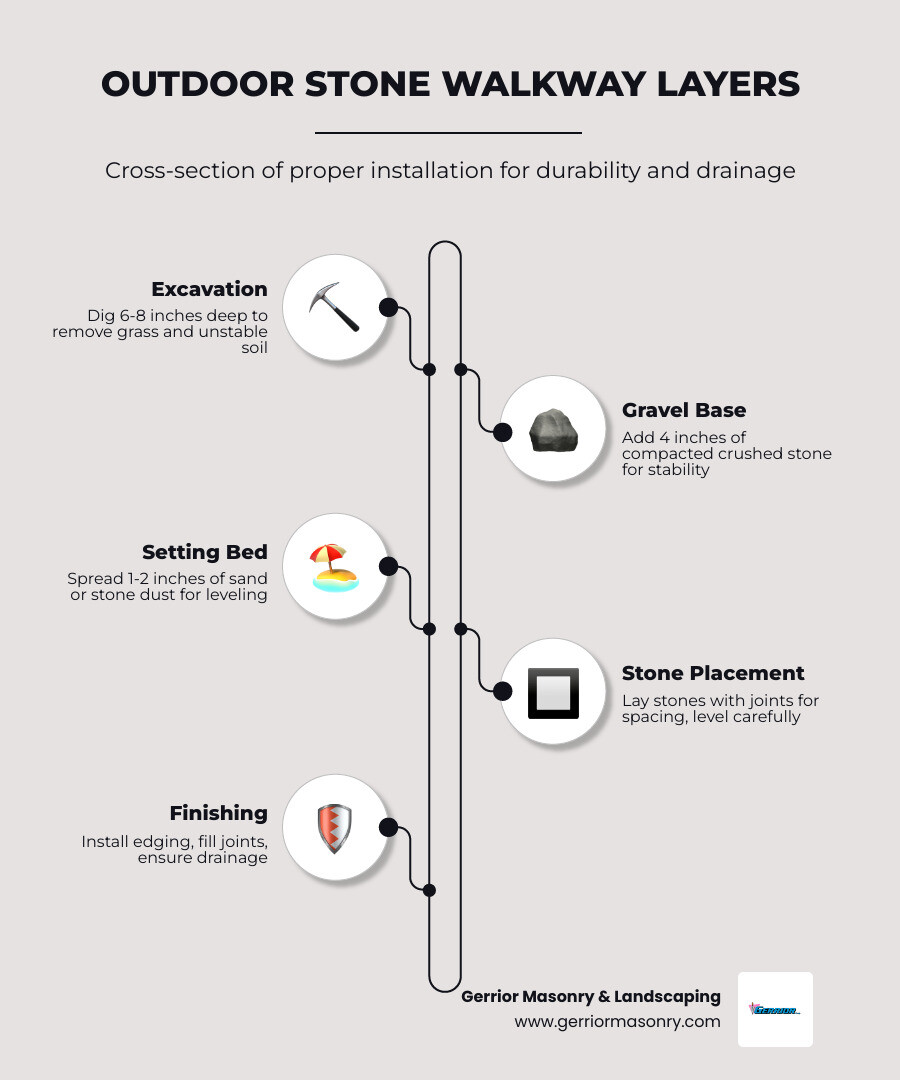
First, you must mark the area. Avoid trees if possible—roots are the natural enemy of a level walkway. Once marked, you’ll need to excavate. For a standard stone path, we typically dig 6 to 8 inches deep. This allows room for a 4-inch base of compacted gravel and a 1-to-2-inch setting bed of sand or stone dust. For more info about installing stepping stone walkways, clearing all vegetation and roots is the only way to prevent future shifting.
Preparing the Foundation and Laying Stones
The “base” is the most critical part of the project. If you lay stones directly on Massachusetts soil, the first freeze-thaw cycle will turn your flat path into a tripping hazard.
The Gravel Layer: Fill the trench with 3/4-inch crushed stone. Spread it in 2-inch increments, compacting each layer with a plate compactor. This provides the drainage necessary to keep water from pooling under your stones.
The Setting Bed: Spread 1 to 2 inches of coarse sand or a “slurry” of stone dust mixed with water over the gravel. This is your “leveling” layer. Check out more info about flagstone walkway bases for specifics on material ratios.
Laying the Stones: Start from a fixed point, like a patio or stairs. Place your first stone and wiggles it into the sand.
Pro Tip: Your path should have a slight “positive slope” (about 1/8 inch per foot) away from your home’s foundation to ensure water runoff.
Spacing and Stability
For stepping stones, space them about 6 to 8 inches apart—roughly the length of an average human stride. If you’re building a solid path, keep gaps between irregular stones to 2 inches or less. This prevents high heels or small paws from getting stuck. Stability is paramount near high-traffic areas or pools; if a stone rocks when you step on it, add or remove sand underneath until it sits perfectly still.
Adding Finishing Touches: Edging and Weed Barriers
A walkway isn’t finished until it’s “locked in.” Without edging, your stones and base materials will eventually migrate into your lawn.
Weed Barriers
Before you fill the gaps between stones, Install a Weed Barrier. This permeable landscape fabric allows water to pass through but stops weeds from turning your path into a jungle. Cut holes in the fabric specifically for your stones to sit through, or lay it beneath the sand bed.
Plastic or Metal Edging: Discreet and effective at holding gravel in place.
Cobblestone or Brick Borders: Adds a formal, finished look.
Natural Stone Edging: Uses smaller rocks to create a seamless transition to garden beds.
Filling the Gaps
For a rustic irregular stone look, fill the gaps with:
Pebbles or Decorative Rock: 1-inch or smaller rocks provide a clean, high-contrast look.
Stone Dust: Swept into the cracks and misted with water to create a hard, mortar-like bond.
“Stepables”: Plants like creeping thyme or sedum that can handle being stepped on and add a splash of green.
Long-Term Maintenance and Professional Hardscaping
Even the best-built outdoor stone walkway needs a little love.
Maintenance Checklist:
Cleaning: Pressure wash your stones once a year to remove moss and mildew, which can become slippery when wet.
Weed Control: Even with a barrier, some seeds may land in the dust between stones. Pull them early or use a pet-friendly herbicide.
Refilling Gaps: Wind and rain will eventually wash away some of your joint sand or stone dust. Sweep in fresh material every spring.
Winter Care: Avoid using salt on natural stone, as it can cause pitting and scaling. Use sand for traction instead.
When to Call the Pros
While a small garden path is a great weekend project, a front entrance or a path on a slope requires professional expertise. At Gerrior Masonry & Landscaping, we provide walkway installation services that take the guesswork out of the equation. With over 30 years of experience in towns like Lexington, Winchester, and Andover, we understand the local soil conditions and drainage requirements.
Our owner oversight on every project ensures that your custom paver walkway or stone path is built to last. Whether you’re in Reading, Burlington, or Woburn, we can help you design a path that perfectly matches your home’s architecture.
Lighting Your Path for Safety
To maximize the utility of your new walkway, consider integrating low-voltage LED lighting. Path lights not only highlight the natural beauty and texture of the stone at night but also provide essential safety by illuminating the path for guests. You can choose from solar-powered stakes for an easy DIY addition or hardwired fixtures for a more permanent and consistent lighting solution that enhances your home’s curb appeal.
Common Mistakes to Avoid
Skipping the Base: Never lay stone directly on dirt. It will sink and shift.
Ignoring Drainage: Ensure the ground is sloped away from your house.
Using Slippery Stones: Avoid polished stones near pools or in shaded areas where moss grows.
Poor Compaction: If you don’t compact the gravel base, your walkway will eventually look like a topographical map of the Himalayas.
Inspiring Ideas for Every Yard
Modern: Large, rectangular bluestone slabs with white river pebbles in the gaps.
Rustic: Irregular flagstones set into a lush lawn in Carlisle.
Garden-Integrated: Winding paths flanked by perennials and low-voltage path lighting.
Kid-Friendly: Use wider stones with very narrow gaps to prevent trips and falls during backyard play.
Whether you want to increase your home’s value or simply create a beautiful way to get to your patio, an outdoor stone walkway is an investment that pays off in both aesthetics and utility.
Please note that all listed service prices are average costs based on internet data and are not actual costs for Gerrior Masonry services. Gerrior Masonry & Landscape Construction is based in Woburn, MA, and services Middlesex and Essex County, Massachusetts, including communities like Waltham, Newton, and Peabody.
Why 3D Hardscape Design Software Matters for Your Project
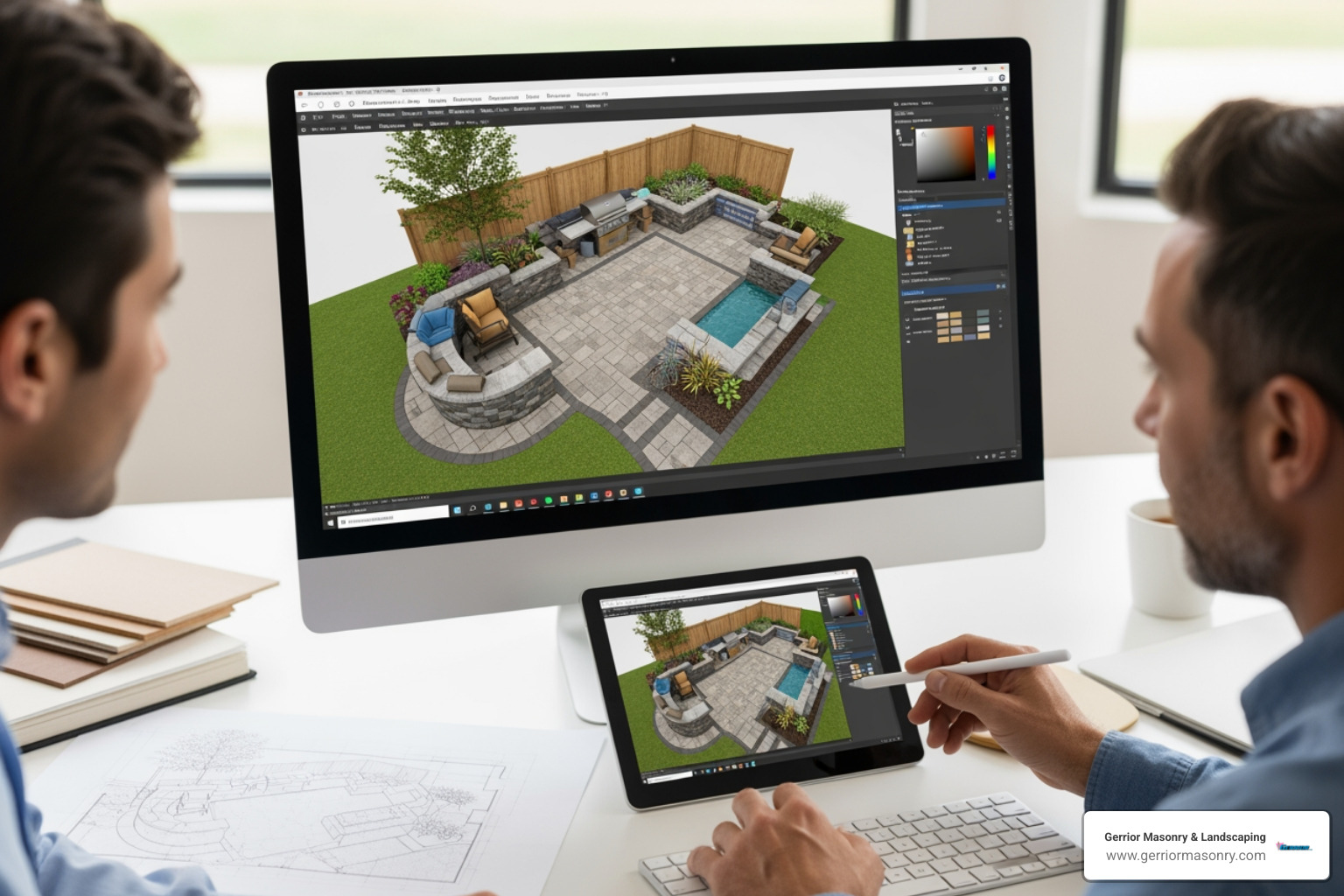
3d hardscape design software transforms how contractors and homeowners plan outdoor spaces by creating realistic three-dimensional models of patios, retaining walls, walkways, and other hardscape features before construction begins. Instead of relying on flat drawings or imagination, you can see exactly what your project will look like—down to material textures, elevation changes, and lighting effects. This technology eliminates the guesswork that often plagues traditional landscaping projects. By visualizing the interplay between light, shadow, and physical structures, homeowners can make informed decisions about expensive materials like natural stone or custom pavers before a single dollar is spent on procurement.
Top 3D hardscape design software options include:
Vectorworks Landmark – Full BIM capabilities with terrain analysis, construction documents, and 20+ file format support. It is widely considered the industry standard for landscape architects who require high-level data integration.
Rhino + Grasshopper – Advanced modeling with point cloud/LiDAR import, parametric design, and landscape-specific plugins. This is the go-to for complex, non-linear geometric designs.
SketchUp – User-friendly interface with geolocation, shadow studies, and extensive 3D Warehouse library. It is perfect for rapid prototyping and conceptual visualization.
Live Home 3D Pro – Cross-platform terrain editing with real map tracing and AR visualization on iOS, making it accessible for both professionals and tech-savvy homeowners.
Key features to look for:
DWG/DXF/IFC file import for CAD integration
Terrain modeling with cut/fill analysis
Material libraries for stone, pavers, and concrete
Photorealistic rendering for client presentations
Construction document generation
Hydrological simulation for drainage planning
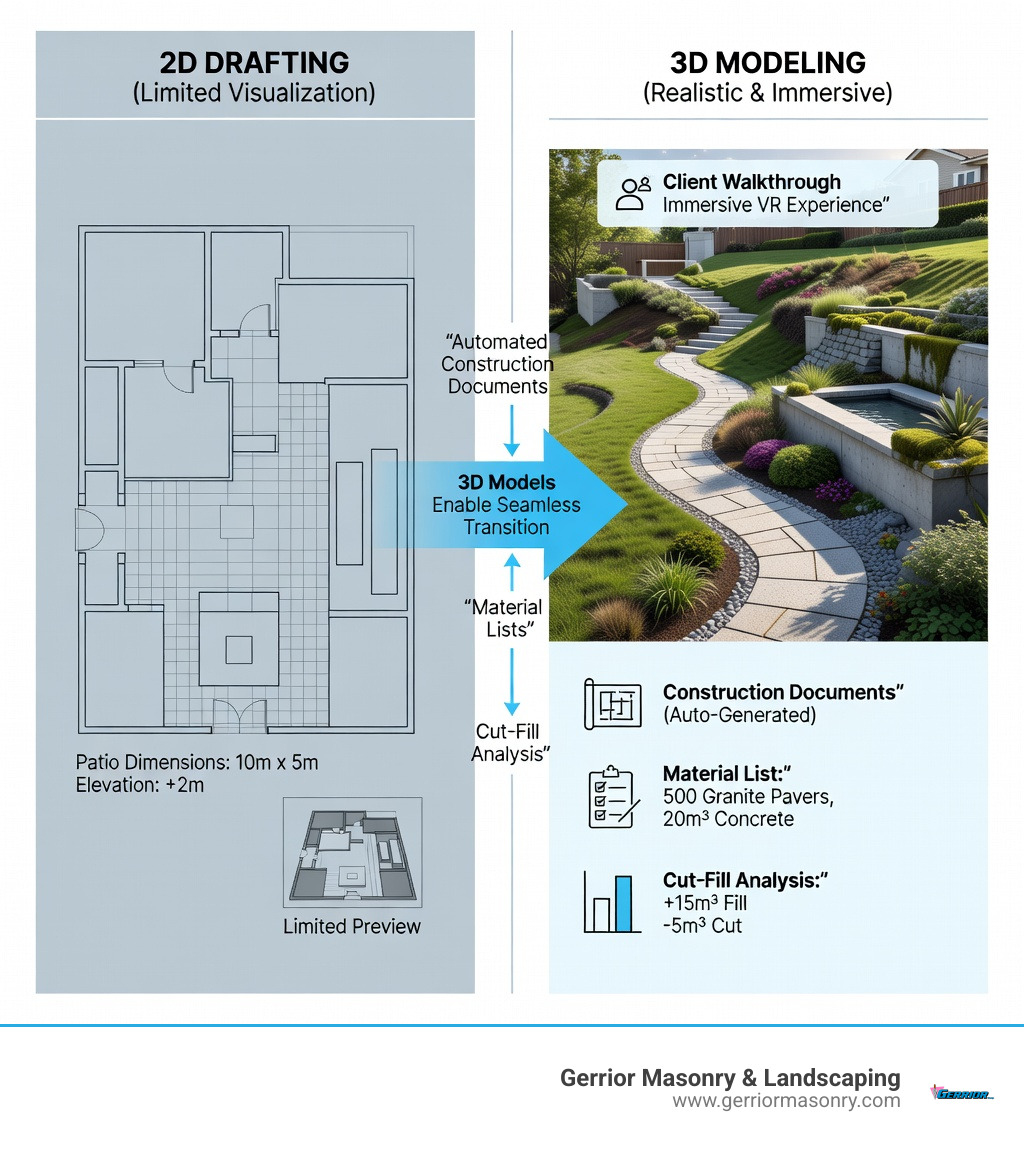
These tools bridge the gap between concept sketches and finished projects. You can test different paver patterns, adjust wall heights, simulate drainage, and generate accurate material lists—all before breaking ground. This reduces costly mistakes and helps clients visualize the final result with confidence. Furthermore, the ability to simulate seasonal changes and plant growth over time ensures that the hardscape remains functional and aesthetically pleasing for decades.
The software ranges from free trials to professional subscriptions around $400-$5,000+ annually. Most require moderate computer specs, though complex terrain models may need stronger GPUs and 16GB+ RAM. As someone who has overseen masonry and landscape projects for over 34 years at Gerrior Masonry & Landscape Construction, I’ve watched 3d hardscape design software evolve from basic CAD drawings to sophisticated BIM tools that improve project accuracy and client communication. Below, I’ll walk you through the leading software platforms and what makes each one valuable for different types of hardscape projects.
Choosing the Best 3D Hardscape Design Software for Professionals
When we look at the landscape of modern design, the shift from 2D blueprints to immersive 3D models is undeniable. For professionals in Middlesex and Essex County, choosing the right 3d hardscape design software is about more than just “looking cool” for a client; it is about precision, site analysis, and ensuring that every stone we lay is exactly where it needs to be. The transition to 3D allows us to identify potential structural conflicts, such as utility line interference or soil instability, long before the excavation team arrives on site.
One of the most robust choices for heavy-duty design is Vectorworks Landmark. It is often cited as a one flexible 3D design software for your entire process, taking a project from the initial schematic design all the way through to detailed construction documents. It isn’t just a drawing tool; it is a Building Information Modeling (BIM) powerhouse. This means when we change a wall height in the 3D model, the schedules and 2D sections update automatically. This level of powerful 3D modelling software for any project ensures that we spend less time on manual drafting and more time on the craftsmanship that has defined us for 30 years. Vectorworks also excels in its ability to handle complex site data, allowing for the creation of detailed planting plans that coexist perfectly with hardscape structures.
For those who need absolute geometric freedom, Rhino for Landscape Design is a top-tier contender. Rhino, especially when paired with the Grasshopper parametric tool, allows us to create complex, custom shapes that would be nearly impossible to draw by hand. Whether it’s a curved natural stone bench or a unique paver pattern, Rhino’s ability to convert simple linework into 3D surfaces is a game-changer for our hardscape design services. The use of NURBS (Non-Uniform Rational B-Splines) in Rhino ensures that even the most organic curves are mathematically precise, which is vital for custom masonry work.
Essential Features of 3D Hardscape Design Software
If you are evaluating software, you need to look under the hood. A pretty picture is great, but for a masonry project to last in the New England climate, the technical data must be spot on. The software must be able to account for the freeze-thaw cycles and the specific drainage requirements of our local geography.
Terrain Modeling and Elevation Adjustments
The ground is rarely flat in Massachusetts. Top-tier software allows us to load large point clouds and LiDAR data to create accurate terrain contours. Tools like Lands Design for Rhino or the site modeling tools in Vectorworks allow for precise elevation adjustments. This is critical for designing hardscape retaining walls that actually hold back the earth effectively. Without accurate terrain data, a design might look perfect on screen but fail to account for a three-foot drop in grade that requires additional structural reinforcement.
Cut and Fill Analysis
One of the most practical features of 3d hardscape design software is the ability to perform cut and fill calculations. This tells us exactly how much dirt we need to move or bring in. By simulating the drainage and slope visualization digitally, we can prevent water pooling issues before they ever become a problem on your property. This feature alone can save thousands of dollars in unexpected excavation costs and soil disposal fees.
Importing Existing Data
We often start with a survey or an existing CAD drawing. The best software supports importing:
CAD Drawings: DWG, DXF, and PDF files.
3D Models: FBX, SKP (SketchUp), and OBJ.
Terrain Data: Elevation points from XLS or CSV files and GPS survey data.
GIS Data: Shapefiles and aerial imagery for broader context.
Being able to extract shapes and contour lines directly from these files ensures that the digital model matches the real-world site with surgical precision.
Supporting Elements with 3D Hardscape Design Software
Hardscaping is about the marriage of different materials—stone, brick, and concrete. The right software helps us visualize how these elements interact. It allows us to experiment with different textures and colors to see how they complement the existing architecture of the home.
Using a 3D Landscape Design Tool like SketchUp allows us to pull in terrain imagery based on your exact longitude and latitude. Once the site is set, we can experiment with different patio design and installation options.
Pathways and Stairs: Software like Live Home 3D Pro features tools specifically for walkways and stairs, allowing paths to automatically adapt to the terrain’s elevation. This ensures that every step is uniform and meets local building codes.
Stone Walls: We can test different hardscaping ideas for stone walls, adjusting textures to see how fieldstone looks compared to granite or brick. We can even simulate the weathering of stone over time.
Material Libraries: Most professional software includes massive libraries of outdoor objects and plants. If the built-in library isn’t enough, we can import models from the Trimble 3D Warehouse or food4rhino.
Collaboration and File Compatibility
In many of our commercial projects, we aren’t working in a vacuum. We often need to collaborate with architects, engineers, and city planners. This is where file compatibility becomes the “unsung hero” of 3d hardscape design software. The ability to share a unified model reduces the risk of miscommunication between different trades.
Professional-grade tools support OPEN BIM workflows, which allow us to reference IFC, DWG, and RVT (Revit) files directly. This means if an architect moves a building footprint in their model, our hardscape design can update to match. This real-time synchronization is essential for large-scale developments where multiple stakeholders are involved.
For real-time updates, many platforms now offer cloud features. We can access models on-site via mobile devices to check a measurement or show a client a detail. If we run into a technical snag, resources like Vectorworks University provide webinars and training to keep our team’s skills sharp. This integration ensures our hardscaping services are always backed by the latest technology and industry standards.
Photorealistic Rendering and Client Presentations
The “Aha!” moment usually happens during the presentation. Modern 3d hardscape design software allows us to create visuals that look like professional photography. These renderings help bridge the gap between a technical plan and the client’s vision of their dream backyard.
Lighting and Shadow Studies: We can show you exactly where the shadows will fall on your new patio at 4:00 PM in mid-July. This is crucial for planning outdoor kitchens or seating areas.
Virtual Walkthroughs: We can lead you on a digital path through your future outdoor living space, complete with nature sounds and day-to-night transitions. This immersive experience helps clients feel the scale and flow of the design.
Physically Based Rendering (PBR): This technology ensures that stone reflects light naturally and textures look tactile and real. It captures the subtle nuances of different stone finishes, from polished granite to rugged fieldstone.
These high-quality hardscape landscaping visuals aren’t just for show; they ensure that everyone is on the same page before a single stone is delivered to your home in Woburn or Burlington.
Pricing and System Requirements for 3D Hardscape Design Software
Investing in professional software is a significant commitment. While there are entry-level apps, the tools used for high-end masonry and construction require significant computing power. A standard laptop often struggles with the high-resolution textures and complex geometry required for professional-grade hardscape models.
Software
Pricing Model
Key Hardware Requirements
Best For
Vectorworks Landmark
Subscription
16GB+ RAM, 4GB+ VRAM GPU
BIM & Construction Docs
Rhino 8
Perpetual License
Windows/Mac, High-end GPU
Custom Geometry & Plugins
SketchUp Pro
Subscription
8GB+ RAM, 1GB+ VRAM GPU
Fast Modeling & Libraries
Live Home 3D Pro
One-time/Subscription
iOS, Android, Win, Mac
Cross-platform Accessibility
Note: Based on internet data, average software costs range from $400 to over $5,000 annually. These are not actual costs for Gerrior Masonry services.
For those looking to explore these tools, many offer a Free Trial Landmark or 90-day evaluations for Rhino. Just keep in mind that to run these smoothly—especially when dealing with high-resolution textures or complex topography—you’ll likely need a workstation-grade computer with a dedicated graphics card. The investment in hardware is just as important as the investment in the software itself.
Conclusion: Transforming Your Outdoor Space
At the end of the day, 3d hardscape design software is a powerful tool, but it is only as good as the hands using it. At Gerrior Masonry & Landscaping, we combine this cutting-edge technology with over three decades of “boots on the ground” experience. We understand that while a computer can generate a beautiful image, it takes a master mason to understand how the local soil will settle or how the New England winter will impact a specific type of mortar.
By using these digital tools, we improve project efficiency and ensure that our construction documents are flawless. This synergy between modern technology and traditional craftsmanship allows us to deliver results that are both beautiful and structurally sound. Whether you are looking for a simple walkway or a complete backyard overhaul, our goal is to provide a seamless transition from hardscaping design to completed project. With skilled craftsmanship and owner oversight on every job, we make sure that what you see on the screen is exactly what you get in your yard. Our commitment to quality means we don’t just build for today; we build for the next generation.
Gerrior Masonry & Landscape Construction is based in Woburn, MA, and services Middlesex and Essex County, Massachusetts. We invite you to explore the possibilities that 3D design can bring to your next outdoor project.
Why Your Paver Base for Walkway Matters More Than the Pavers Themselves
A paver base for walkway installation is the hidden foundation that determines whether your beautiful walkway lasts decades or fails within years. While the pavers provide the aesthetic appeal and the walking surface, the base is the structural engine that handles the load-bearing responsibilities and environmental stresses. Here’s what you need to know:
Quick Answer: Essential Components of a Paver Base
Excavation depth: 7-9 inches total (paver thickness + 1 inch sand + 4-6 inches gravel)
Base material: 4-6 inches of compacted ¾-inch crushed stone
Bedding layer: 1 inch of coarse sand, screeded level
Drainage slope: ¼ inch drop per linear foot away from structures
Compaction: Plate compactor (minimum 5,000 lbs force) in 2-4 inch layers
As the research shows, “if you want something to last, be sure to start with a solid foundation.” Most paver walkway failures happen because homeowners skip or skimp on the base preparation. You might spend thousands on premium pavers, but without proper base installation, you’ll face sinking, shifting, and uneven surfaces that require costly repairs. In the Northeast, where the ground is constantly shifting due to moisture and temperature fluctuations, the base acts as a shock absorber. Without it, the rigid pavers would crack or heave under the pressure of the expanding earth.
The base serves three critical functions: it supports weight, ensures proper drainage, and prevents movement. Think of it like a house foundation—you’d never build walls directly on dirt, and the same principle applies to walkways. A well-constructed base also prevents weed growth from beneath. While most weeds come from seeds dropped into the joints, a solid, sterile base prevents deep-rooted perennials from pushing up through your walkway.
I’m Joe Gerrior, and over 34 years running Gerrior Masonry & Landscape Construction, I’ve seen countless DIY walkways fail due to improper base preparation. Understanding how to properly prepare a paver base for walkway projects is the difference between a weekend repair job and a lifetime investment.
Step-by-Step Guide to Installing a Paver Base for Walkway
Building a paver base for walkway success requires more than just throwing some rocks in a hole. It’s a rhythmic process of digging, leveling, and vibrating materials into a rock-hard state. If you’ve ever walked on a sidewalk that feels like a roller coaster, you’re feeling the effects of a base that wasn’t properly compacted or planned. The goal is to create a surface that is as stable as a concrete slab but remains flexible enough to move with the earth’s natural cycles.
When we talk about the aggregate, we usually mean crushed gravel. This isn’t your garden-variety decorative pebble. We use specific “3/4-inch minus” crushed stone, which includes a mix of stone sizes and “fines” (dust) that lock together when compressed. The “minus” in 3/4-inch minus is the secret sauce. It refers to the dust and smaller particles that fill the voids between the larger stones. When you compact this mixture, it creates a mechanical bond almost as strong as concrete but with the flexibility to handle ground movement.
While traditional gravel is the gold standard, some modern DIYers look at high-density paver panels. Here is how they stack up:
Traditional Gravel Base vs. High-Density Paver Panels
Feature
Traditional Gravel Base
Paver Base Panels
Material
4-6″ of 3/4″ minus crushed stone
Lightweight polypropylene panels
Excavation
Deep (7-9 inches)
Shallow (approx. 3-4 inches)
Labor
High (hauling and compacting stone)
Low (replaces most stone/sand)
Durability
Proven for 30+ years
Good for pedestrian foot traffic
Best For
All applications (walks, patios, drives)
Small walkways and light patios
Excavation and Setting the Grade for a Paver Base for Walkway
Before the first bag of stone is opened, you have to move some earth. For a standard pedestrian walkway in Middlesex or Essex County, we recommend a total excavation depth of about 7 to 9 inches. This accounts for:
4 to 6 inches of compacted aggregate base.
1 inch of bedding sand.
The thickness of your chosen paver (usually 2 to 3 inches).
If you are dealing with heavy clay soil—common in parts of Massachusetts—you might need to go even deeper. In these cases, we often use geotextile fabric between the soil and the gravel to prevent the stone from sinking into the mud over time. This fabric acts as a separation layer, ensuring that the structural integrity of your gravel base isn’t compromised by the soft subgrade below. For large-scale projects, you might consider professional excavation services to ensure the subgrade is perfectly prepared.
Setting the grade is where the “science” of the paver base for walkway comes in. You must pitch the walkway away from your home’s foundation or other structures to prevent basement flooding or pooling. The industry standard is a slope of 1/4 inch per linear foot. This ensures that even during heavy New England rainstorms, water moves efficiently off the surface and away from your property.
Selecting and Compacting Materials for a Paver Base for Walkway
The “base” isn’t just a pile of rocks; it’s an engineered layer. We use 3/4-inch minus crushed stone (also known as quarry process or dense grade). The different sizes of stone in this mix fill the gaps between the larger rocks, creating a surface that won’t shift.
The Pro Secret: Compacting in “Lifts”
One of the biggest mistakes we see is dumping 6 inches of gravel into a trench and trying to compact it all at once. Most rental plate compactors only have the “oomph” to compact about 2 to 4 inches effectively.
Spread 2 inches of stone.
Lightly mist it with water (moisture helps the particles slide into place by reducing friction).
Run the plate compactor over it multiple times, overlapping your passes by about 4 inches.
Repeat until you reach your desired height.
If you’re unsure about the material mix, check out our guide on installing paver walkways for more detailed specs.
Screeding the Bedding Sand Layer
Once your gravel is as hard as a parking lot, it’s time for the bedding sand. This layer is NOT for structural support; it is a leveling medium that allows the pavers to be set perfectly flat. When screeding, consistency is key. If your sand layer varies from 1/2 inch to 2 inches, the pavers will settle unevenly. The sand is meant to ‘cradle’ the paver, not support the weight of the entire structure. This is why the 1-inch rule is so strictly followed by professionals.
Use a coarse “concrete sand” rather than fine play sand. You want a consistent 1-inch thickness. To get this perfect, we use “screed pipes”—usually 1-inch diameter electrical conduit.
Lay the pipes parallel on top of the compacted gravel.
Dump sand between them.
Use a long, straight board (like a 2×4 or an aluminum strike board) to “saw” across the pipes, pulling the excess sand with you.
When you pull the pipes out, fill the remaining narrow trenches with a little extra sand and smooth them with a hand trowel. Do not walk on your freshly screeded sand! If you do, you’ll leave footprints that will show up as dips in your finished walkway.
Planning Your Project: Costs and Common Pitfalls
Planning is the part of the project that happens in your head (and your wallet) before your hands get dirty. In New England, we have to deal with the “freeze-thaw cycle.” When the ground freezes, it expands. If your paver base for walkway isn’t deep enough or well-drained, that expansion will heave your pavers right out of the ground, leading to tripping hazards and unsightly gaps.
Average Costs and Material Estimation
How much stone do you actually need? To find out, multiply your square footage by the desired depth.
The Golden Rule: 1 cubic yard of crushed stone covers roughly 80 square feet at 4 inches thick.
The Stone Formula: Total Sq. Ft. × 0.01235 = Cubic Yards of Stone.
The Sand Formula: Total Sq. Ft. × 0.00309 = Cubic Yards of Sand.
When it comes to the budget, costs can vary wildly based on the complexity of the design and the materials used. Based on average internet data, a professional paver installation typically ranges from $15 to $60 per square foot. However, for high-end custom stone work or difficult terrain, costs can easily reach $180 per square foot or more. Please note that these figures are average costs based on internet data and do not represent actual pricing for Gerrior Masonry services.
For a deeper dive into budgeting, read our breakdown on how much a stone walkway costs. These are internet averages; local prices in Middlesex County may vary based on site access and soil conditions.
Common Mistakes to Avoid
We’ve fixed a lot of “oops” moments over the last three decades. Here are the top offenders:
Using Stone Dust: Many people think stone dust is a great base because it’s easy to level. In reality, it doesn’t drain well and can hold moisture, leading to frost heaves in Massachusetts winters.
Skipping Geotextile Fabric: If you have soft or clay-heavy soil, your gravel will eventually disappear into the dirt without a fabric barrier.
Poor Edge Restraints: Pavers want to spread out over time. You must install plastic, metal, or concrete edge restraints to keep the “rug” from unraveling.
Ignoring Drainage: If you don’t pitch the walkway correctly, you’re just building a very expensive, very shallow swimming pool.
Beyond the initial installation, the base’s performance is tied to the integrity of the joint sand. Polymeric sand, which hardens when wet, helps seal the surface and prevents water from washing away the bedding sand or destabilizing the base. It’s the final piece of the puzzle in creating a monolithic, durable surface. Consider the environmental impact as well; a properly drained base allows for better runoff management, preventing erosion in other parts of your landscape. By investing in the base, you are protecting your entire property’s drainage ecosystem.
Proper planning starts with a good design. Take a look at how to design a paver walkway to ensure your layout is both functional and beautiful.
Professional Results with Gerrior Masonry & Landscaping
While a DIY paver base for walkway project is possible for a determined homeowner, it is back-breaking work that requires precision and heavy equipment rentals. At Gerrior Masonry & Landscaping, we bring over 30 years of experience to every job.
Our unique selling point is owner oversight. Joe Gerrior is personally involved in ensuring that every base is compacted to perfection and every grade is set for optimal drainage. We specialize in custom paver walkways that stand the test of time, even in the harsh climate of Middlesex and Essex County. Whether you are in Woburn, Lexington, or Andover, we have the local knowledge of soil conditions and building codes to get the job done right the first time.
Gerrior Masonry & Landscape Construction is based in Woburn, MA, and services Middlesex and Essex County, Massachusetts.
Why Your Outdoor Space Deserves a Professional Hardscaping Contractor
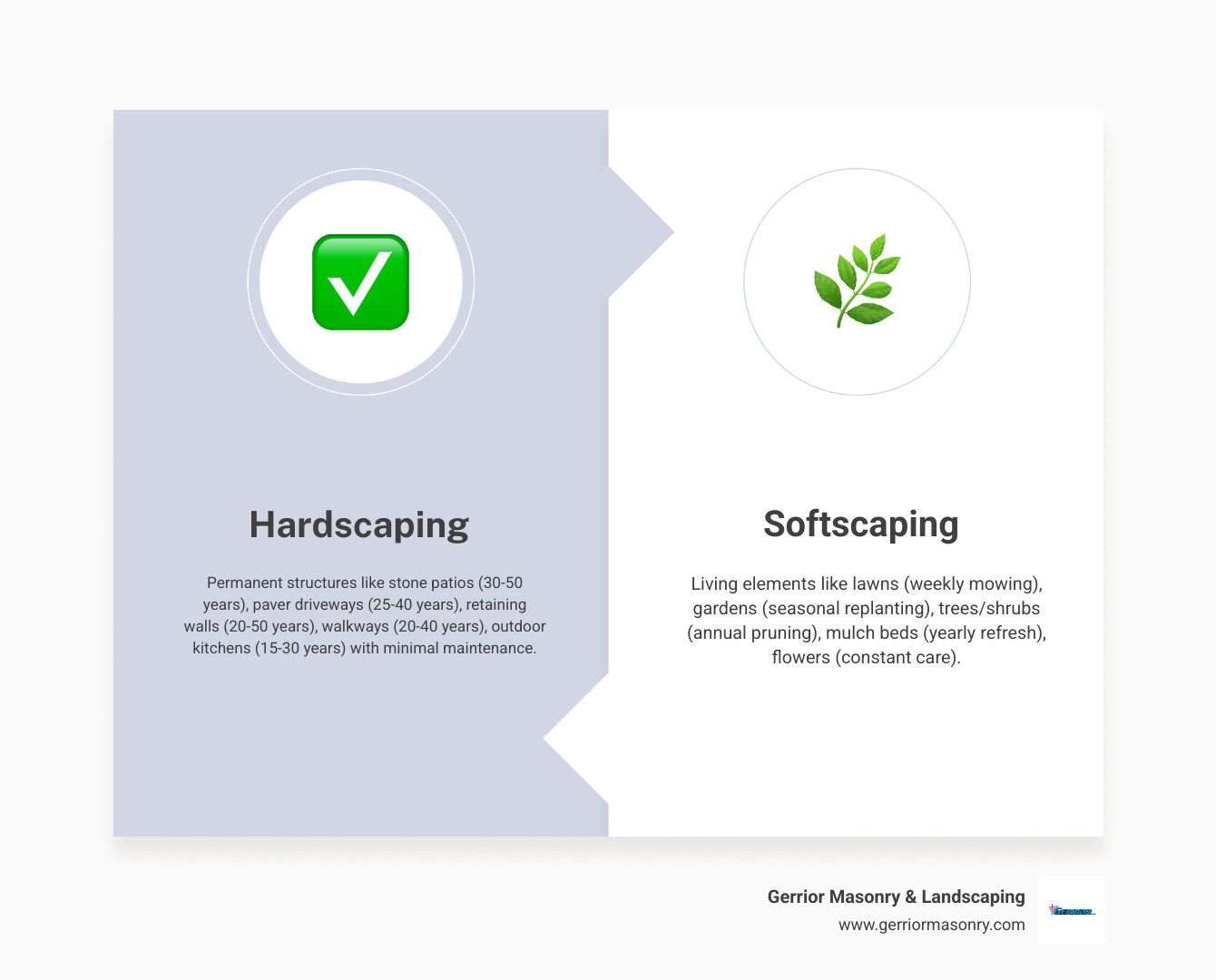
A Hardscaping Contractor specializes in designing and installing the permanent, structural elements of your landscape—patios, walkways, retaining walls, and driveways—using materials like stone, pavers, and concrete. Unlike softscaping (plants and lawns), hardscaping creates durable outdoor living areas that last 20-50 years with minimal maintenance.
What to Look for When Hiring a Hardscaping Contractor:
Experience and Certifications – Look for contractors with proven track records and industry certifications
Portfolio of Completed Work – Review photos of past projects similar to your vision
Warranties and Guarantees – Quality contractors offer 5+ year warranties on installations
Proper Drainage Expertise – Essential for preventing water damage and ensuring longevity
Transparent Pricing – Clear estimates that detail materials, labor, and timeline
Local References – Testimonials from clients in your area with similar projects
Your backyard or front entrance holds untapped potential. Right now, it might be uneven terrain, poor drainage, or simply unused space. But with the right hardscaping contractor, these challenges transform into functional, beautiful areas that increase your property value by 15-20%.
The difference between a weekend DIY project and professional hardscaping comes down to foundation. As one research source notes, “properly compacted sub-base is crucial for hardscape longevity in wet weather and damp soil.” Without this expertise, even the most beautiful paver patio can shift, crack, or settle within a few years.
Hardscaping vs. Softscaping:
Hardscaping = Stone patios, retaining walls, walkways, fire pits, outdoor kitchens (the permanent structures)
Softscaping = Trees, shrubs, flowers, mulch, grass (the living elements)
Both work together to create a complete landscape, but hardscaping provides the framework that defines your outdoor living areas.
I’m Joe Gerrior, owner of Gerrior Masonry & Landscape Construction Corp., and for over 34 years I’ve helped Massachusetts homeowners transform their outdoor spaces through expert hardscaping services. As a Hardscaping Contractor serving Middlesex and Essex County, I’ve seen how proper installation—from foundation prep to final grading—makes the difference between a project that lasts decades and one that fails in a few seasons.
Essential Services Provided by a Professional Hardscaping Contractor
When you decide to upgrade your property, you aren’t just buying stones and mortar; you are investing in a lifestyle. A professional Hardscaping Contractor provides a suite of services designed to turn a muddy slope or a boring flat lawn into a multi-functional retreat. These improvements serve as the structural backbone of your property, providing both aesthetic appeal and essential utility.
The core of our work involves moving earth and placing heavy materials with precision. This includes everything from the initial demolition of old, cracked concrete to the final sweep of polymeric sand into paver joints. Common services we provide include:
Patios: Creating the “floor” of your outdoor room using durable pavers or natural stone.
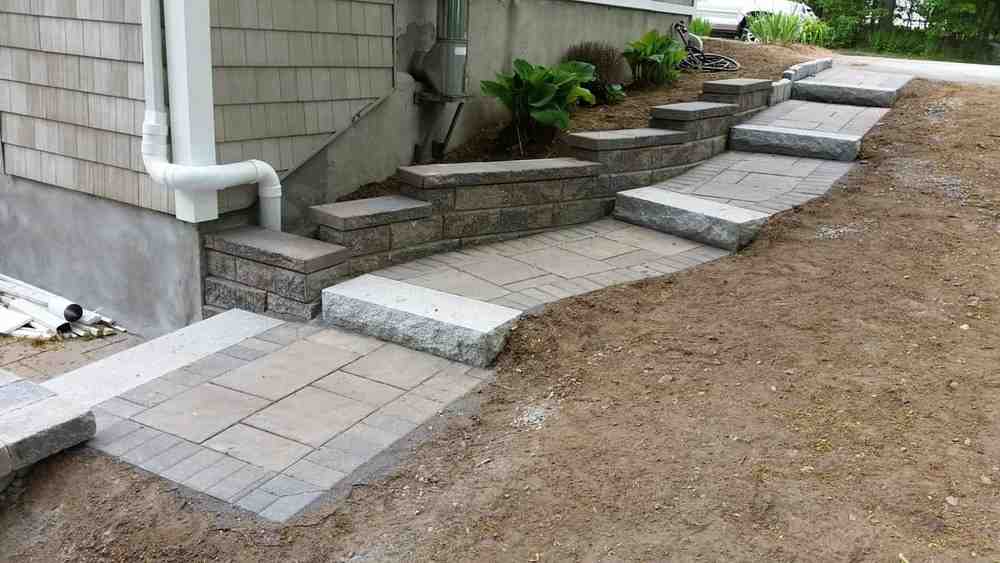
Walkways: Safe, stylish paths that connect your home to the rest of your yard, improving flow and accessibility.
Retaining Walls: Critical structures that hold back soil, prevent erosion, and create level planting areas.
Driveways: High-durability surfaces built to withstand the weight of vehicles and the harsh New England winters.
Drainage Solutions: The “invisible” but most important part of any project, ensuring water moves away from your foundation through French drains or dry wells.
Site Preparation: Stripping old turf, deep excavation, leveling the ground, and compacting the sub-base to prevent future settling.
Custom Patios and Outdoor Living Spaces
The patio is the heart of the modern backyard. It’s where morning coffees are enjoyed and evening barbecues happen. As a premier Hardscaping Contractor, we offer comprehensive Hardscape design services to help you visualize how a new patio will flow with your existing architecture and landscape.
Through professional patio design installation, we can incorporate features that extend your living space deep into the outdoors.
Fire Pits and Outdoor Fireplaces: These are statement pieces that provide warmth and ambiance, making your yard usable even when the Massachusetts air gets crisp. We use fire-rated materials to ensure safety and longevity.
Outdoor Kitchens: For those who love to entertain, we can install fully-equipped cooking stations with built-in grills, pizza ovens, and stone countertops. These spaces often include integrated seating walls and bar areas, creating a social hub that rivals any indoor dining room.
2025 Trends: We are seeing a huge shift toward “outdoor rooms” that mirror indoor luxury. Trends for 2025 include large-format pavers for a modern look, integrated LED lighting for safety and mood, and sustainable materials like permeable pavers that allow water to soak back into the ground naturally.
Durable Walkways and Driveways
Your front walkway and driveway are the first things people see. They are the “handshake” of your home. A professional Hardscape construction service ensures these high-traffic areas aren’t just pretty, but structurally sound enough to handle heavy loads.
We specialize in various driveways and paths using:
Interlocking Pavers: Known for their incredible strength and ability to flex with the ground during freeze-thaw cycles without cracking. They are available in hundreds of colors and patterns.
Natural Stone: Materials like granite, bluestone, or fieldstone offer a timeless, high-end look that matures beautifully over time and adds significant character to your home.
Beyond just “curb appeal,” these features create a sense of order. A well-placed walkway prevents guests from trekking mud into your house and defines the boundaries of your garden beds, making maintenance easier for the homeowner.
Functional Retaining Walls and Drainage Solutions
In regions like Middlesex and Essex County, where the terrain can be hilly and the rain can be heavy, landscape walls are often a necessity rather than a luxury. These walls prevent soil erosion and can turn a steep, unusable hill into a series of beautiful, flat terraces perfect for gardening or play.
However, a wall is only as good as its drainage. We integrate advanced drainage systems into every project. This might include French drains, catch basins, or specialized grading techniques that direct runoff toward dry wells. Without proper site grading, water can pool against your home’s foundation, leading to basement leaks and structural damage. A professional Hardscaping Contractor understands that managing water is 90% of the battle in landscape longevity.
Planning Your Project with a Hardscaping Contractor
The success of a hardscape project is determined long before the first stone is laid. It starts with choosing the right materials and understanding the timeline. Proper planning ensures that the final result is not only beautiful but also functional for your specific needs.
Material
Durability
Maintenance
Best For
Interlocking Pavers
High (50+ years)
Low (occasional sweeping)
Driveways, Patios, Walkways
Natural Stone
Very High (Lifetime)
Low (sealing optional)
Luxury Patios, Garden Paths
Poured Concrete
Medium (20-30 years)
Medium (prone to cracking)
Basic Sidewalks, Utility Pads
Concrete Blocks
High (30-50 years)
Low
Retaining Walls, Seating Walls
Quality hardscaping is built to last. While a garden might need replanting every few years, our stone and paver installations are designed to last 20-50 years with minimal upkeep. This longevity makes hardscaping one of the most cost-effective ways to improve your property over the long term.
Understanding Costs and Investment Value
One of the most common questions we hear is, “How much will this cost?” It is important to note that the following figures are average costs based on internet data and not actual costs for Gerrior Masonry services. Every site is unique, and factors like soil condition, accessibility, and material choice significantly influence the final quote.
Hardscaping projects typically fall within a wide range:
While the initial investment can be higher than softscaping, the ROI is impressive. Professional hardscaping can increase your property value by 15-20%. Because these features are permanent and low-maintenance, they are highly attractive to future homebuyers who see them as “move-in ready” outdoor living rooms. Unlike a wooden deck that may rot or require staining every two years, a stone patio is a legacy feature that adds value for decades.
Choosing a Reliable Hardscaping Contractor
Not all contractors are created equal. When searching for hardscaping services, you need to dig deeper than just the price tag. A low bid often indicates a lack of proper insurance or a shortcut in the foundation preparation.
Check Certifications: Look for ICPI (Interlocking Concrete Pavement Institute) certified installers. This ensures the contractor understands technical specifications for base thickness and edge restraints.
Verify Warranties: A reliable Hardscaping Contractor should offer at least a 5-year warranty on their workmanship, covering issues like settling or shifting.
BBB Rating: We take pride in our A+ rating with the Better Business Bureau, which reflects our commitment to customer satisfaction and ethical business practices.
Portfolio and Reviews: Don’t just take their word for it. Read client reviews and look for real-world examples of their work in your specific town to ensure they understand local soil conditions.
Why Hire a Professional Hardscaping Contractor?
You might be tempted to rent a plate compactor and try a DIY patio over the weekend. However, hardscaping involves massive physical labor and complex engineering. Moving tons of stone and soil requires specialized machinery and a deep understanding of physics and geology.
At Gerrior Masonry & Landscaping, we bring over 30 years of experience to every job site in Woburn, MA, and the surrounding areas. Our unique advantage is owner oversight. Joe Gerrior is personally involved in the projects, ensuring that the “unseen” parts—the deep excavation, the crushed stone base, and the drainage pipes—are installed perfectly. We also ensure we carry full liability insurance and workers’ compensation to protect our clients during the construction phase.
In our New England climate, “freeze-thaw” is the enemy. The ground expands when it freezes and contracts when it thaws. If your Hardscaping Contractor doesn’t understand local soil types and frost lines, your beautiful walkway will look like a roller coaster by next spring. Professional installation ensures your investment stays level and beautiful regardless of the weather.
Beyond residential beauty, we also support our local business community with commercial snow removal services. We understand the specific needs of Massachusetts property owners, from the first stone laid in the spring to the last snowplow pass in the winter. Our goal is to be your long-term partner in property maintenance and improvement.
Ready to start your change? Explore our full range of hardscaping services and let us help you build an oasis that stands the test of time.
Gerrior Masonry & Landscape Construction is based in Woburn, MA, and services Middlesex and Essex County, Massachusetts.
Why Outdoor Stone Pathways Transform Your Landscape
Outdoor stone pathway ideas offer a beautiful way to connect different areas of your property, adding timeless charm and value. A well-designed stone path can create a welcoming entrance, guide visitors through a garden, or reduce lawn wear, dramatically improving your outdoor space.
Quick Stone Pathway Options:
Flagstone Paths – Irregular, natural shapes for a rustic look
Bluestone Walkways – Smooth, neat surfaces in blue-gray tones
Slate Pathways – Thin, layered stones with smooth surfaces
Gravel & Stone Combinations – Cost-effective with excellent drainage
Sandstone Routes – Warm colors and slip-resistant texture
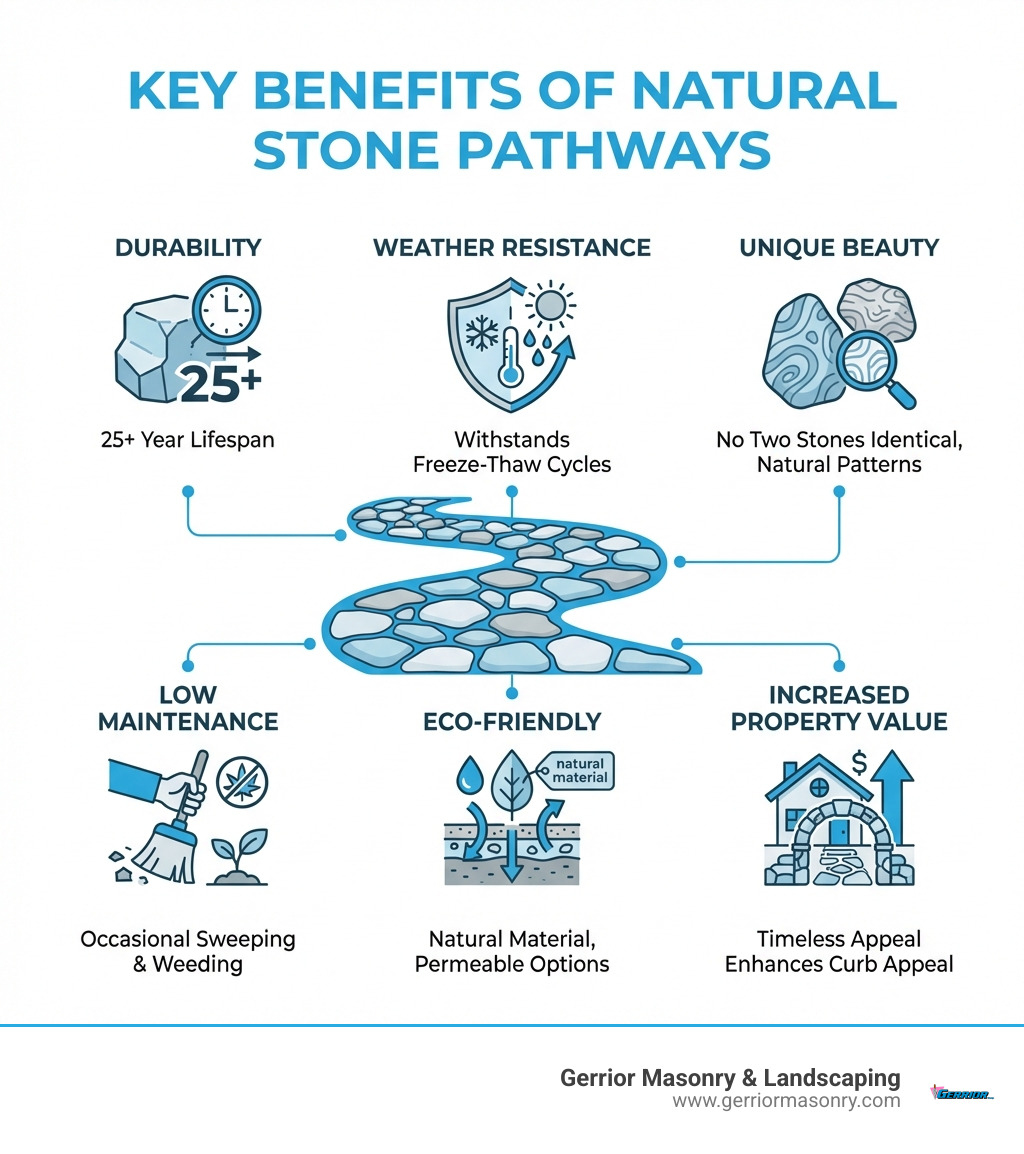
Beyond aesthetics, natural stone walkways have a lifespan of 25+ years, making them a smart long-term investment. They are also incredibly versatile and perform exceptionally well in harsh New England winters when properly installed.
For over 34 years, our team at Gerrior Masonry & Landscape Construction has helped Massachusetts homeowners with expertly designed outdoor stone pathways. We treat each project as both an artistic and functional endeavor, ensuring your walkway is beautiful, safe, and durable for decades to come.
A Curated List of Outdoor Stone Pathway Ideas
Creating the perfect outdoor stone pathway is about choosing the right materials and design to complement your home and landscape. Let’s explore some of the best outdoor stone pathway ideas our team has brought to life for homeowners across Middlesex and Essex County, Massachusetts.
Choosing Your Material: The Best Stones for Walkways
The foundation of any great pathway is the right natural stone. Each type offers unique characteristics in durability, color, and texture.
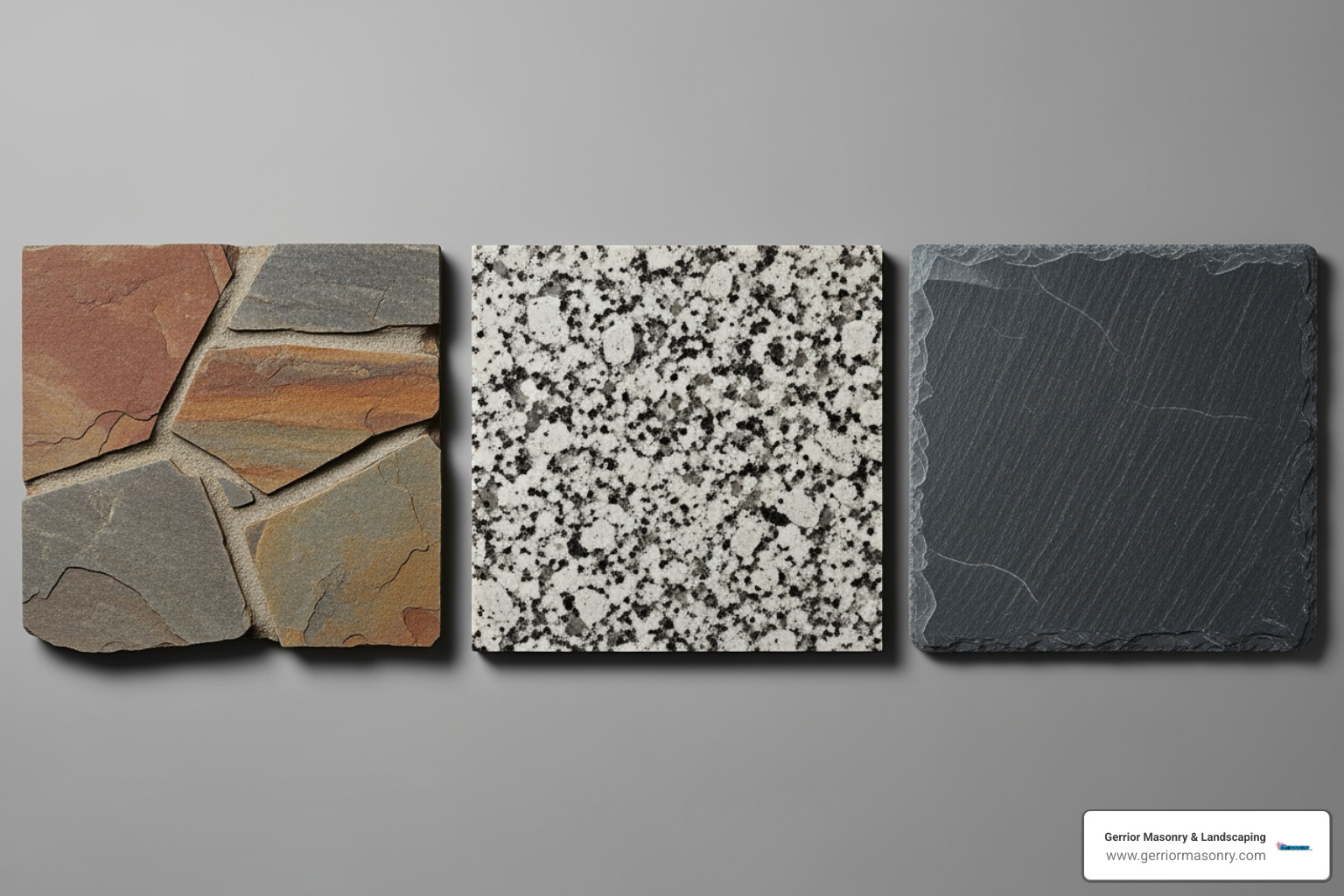
Flagstone: A perennial favorite, flagstone is known for its large, flat, and distinctly irregular shapes, which create a natural, rustic look that integrates beautifully into any landscape. It is available in a rich spectrum of earth-toned colors, including reds, blues, and browns, allowing for significant design flexibility. Its naturally textured, slip-resistant surface makes it an exceptionally safe and durable choice for walkways, especially in climates with frequent rain or frost.
Bluestone: A specific type of flagstone, bluestone is highly prized for its classic and elegant blue-gray hues that can develop a beautiful, weathered patina over time. Its exceptional strength and dense composition make it incredibly durable and long-lasting. While its surface can be smooth for a refined look, we often recommend a thermal or natural cleft finish to enhance slip resistance, making it a versatile option for both formal entryways and relaxed garden paths.
Granite: For ultimate ruggedness and longevity, granite is an unparalleled choice. As one of the hardest natural stones available, this dense igneous rock is exceptionally resistant to scratching, staining, and general wear, making it perfect for high-traffic areas. Its remarkable ability to withstand extreme weather, including the demanding freeze-thaw cycles of Massachusetts winters, ensures your pathway remains structurally sound and beautiful for decades with very little upkeep.
Slate: Slate provides a uniquely sophisticated and modern look with its thin, layered structure and characteristically smooth surface. It comes in a dramatic palette of dark colors, including deep grays, greens, and purples, which can make a bold design statement. For walkway applications where safety is paramount, it is essential to choose a natural cleft or honed finish to provide better traction and slip resistance, combining elegance with practicality.
Sandstone: This sedimentary rock offers a warm and inviting color palette of beige, yellow, red, and brown tones, making it ideal for creating a welcoming and comfortable atmosphere. Sandstone is remarkably long-lasting and features a naturally coarse, low-slip surface, which makes it an excellent choice for family-friendly pathways or pool surrounds where safety is a primary concern. Its texture provides reliable grip even when wet.
Limestone: A versatile and popular sedimentary stone, limestone is available in a wide range of colors, from light creamy whites and beiges to darker, earthy tones. While it is softer than granite, it is still very durable and perfectly suitable for most residential pathway applications. It can be cut into uniform shapes for a formal look or used in more irregular forms, offering a smooth, neat finish that complements many architectural styles.
Our team can help you choose the ideal material that balances aesthetics with practical needs. For more definition, explore our ideas for stone walkway edging.
Popular Design Styles for Natural Stone Paths
Once you’ve chosen your stone, envision the style of your pathway.
Rustic & Informal: This style uses irregular flagstones with grass or ground cover in the gaps for a soft, organic look. Meandering, curved paths are characteristic of this style, inviting a leisurely stroll.
Formal & Modern: For a structured landscape, this style uses cut stone in geometric patterns or straight lines. The precision creates a polished, neat look that can frame flower beds with sophistication.
Unique & Creative: Don’t be afraid to think outside the box. Consider mosaic patterns with smaller pebbles, mixing materials like stone and brick, or using reclaimed granite cobblestones for historical charm.
We take pride in crafting pathways that match your vision. To see some of our completed projects, we invite you to view our walkway projects.
Creative Layouts: Stepping Stones, Gravel, and Path Shapes
How you lay out your pathway materials can dramatically impact its feel and function.
Stepping Stone Paths: These are charming and naturalistic. Individual stones are placed to accommodate a natural stride, allowing grass or ground cover to grow between them. They can be sunken into the lawn for a subtle look or arranged in a grid to define a small sitting area.
Gravel and Stone Combinations: Combining gravel with larger stones is practical, attractive, and budget-friendly. Gravel provides excellent drainage and, with a landscape fabric underlayment, helps prevent weeds.
Curved vs. Straight Paths: The shape of your path dictates the journey. A gently winding path adds mystery and can make a small garden feel larger. A straight path offers a sense of order and leads the eye to a focal point, like a front door. Sometimes, a path needs to integrate with brick stairs to handle changes in elevation.
Finishing Touches: Lighting and Hardscape Integration
Thoughtful additions like lighting and integration with other hardscaping can lift your entire outdoor space.
Pathway Lighting: Lighting is crucial for safety and ambiance. Options include easy-to-install solar lights, customizable low-voltage fixtures, or sleek recessed LEDs integrated into the stone or edging. Proper lighting prevents trips and creates a warm, inviting atmosphere.
Cohesive Design: Your stone pathway should connect to other features. Using the same stone for your patio and pathway creates a seamless transition. Pathways can also interact beautifully with retaining walls on sloped properties. Our landscape design and installation services ensure all elements work together harmoniously.
Low-Growing Plants for Pathway Joints: To soften the edges, consider planting low-growing ground covers in the joints between stones.
Irish Moss creates a lush, green carpet-like effect.
Alyssum offers delicate white or purple flowers.
Dwarf Mondo Grass adds a fine, tough texture.
Installation, Care, and Budgeting for Your Outdoor Stone Pathway
Bringing your outdoor stone pathway ideas to life requires careful planning, proper installation, and a commitment to maintenance. At Gerrior Masonry & Landscape Construction, we ensure every project is built to last.
Essential Installation Tips for a Durable Outdoor Stone Pathway
The longevity of your stone pathway depends heavily on a proper base. While a simple stepping stone path can be a DIY project, professional installation is recommended for more complex or sloped designs to ensure durability.
Professional Installation Process: Our team follows a meticulous process for superior results.
Planning and Layout: We first outline the path’s route to ensure it meets your functional and aesthetic goals.
Base Preparation: This is the most critical step. We excavate the area (typically 9-10 inches deep), compact the soil, and lay a gravel base over filter fabric. This provides a stable foundation and crucial drainage to prevent frost heave.
Setting Bed and Stone Laying: A layer of sand is spread and leveled, creating a bed to set the stones. Each stone is carefully placed and tapped to ensure a level surface.
Joint Filling: The gaps between stones are filled with sand or polymeric sand. This locks the stones in place, improves stability, and helps prevent weed growth.
Edging: For some designs, edging is installed to maintain the path’s shape.
Maintenance, Durability, and Cost of Outdoor Stone Pathway Ideas
Investing in a natural stone pathway pays dividends in beauty and functionality for years.
Why Choose Natural Stone?
Longevity: Natural stone walkways can last 25+ years, far outliving materials like concrete or asphalt.
Timeless Beauty: Unlike manufactured pavers, each natural stone is unique, adding unparalleled character to your landscape.
Durability: Stones like granite and sandstone are extremely weather-resistant and ideal for Massachusetts’ freeze-thaw cycles.
Low Maintenance: With proper installation, stone paths require only occasional sweeping and weeding.
Eco-Friendly: Stone is a natural material, and permeable designs (using gravel or spaced stones) reduce water runoff.
Long-Term Maintenance: To keep your path looking its best, sweep it regularly to remove debris. Promptly remove any weeds that appear. Over time, if a stone settles, it can be easily re-leveled by adding more sand underneath.
Cost Factors: The cost of an outdoor stone pathway varies based on several factors, including the type of stone, the path’s size and complexity, and labor costs. Dry-laid paths are generally less expensive than mortared ones.
Based on average internet data, costs can range from $15 to over $60 per square foot. Please note that these are average costs and not actual quotes for Gerrior Masonry & Landscape Construction services. We provide personalized quotes based on your specific project.
If you’re ready to transform your outdoor space with a stunning stone pathway, our team at Gerrior Masonry & Landscape Construction is here to help. We proudly serve homeowners across Middlesex and Essex County, Massachusetts. Contact us for a custom walkway consultation today, and let’s pave the way to your dream landscape!
Gerrior Masonry & Landscape Construction is based in Woburn, MA, and proudly serves Middlesex and Essex County, Massachusetts.
Drainage holes in retaining walls are small openings that allow water to escape from behind the wall, preventing dangerous pressure buildup that can cause structural failure. These outlets—also called weep holes—are critical for the longevity and stability of any retaining wall.
Quick Answer: What You Need to Know About Drainage Holes
Purpose: Release water trapped behind retaining walls to prevent hydrostatic pressure
Size: Typically 2-4 inches in diameter
Spacing: Usually placed every 3-7 feet horizontally along the wall
Location: Positioned near the bottom of the wall, sloped slightly downward
Function: Work together with drainage aggregate and perforated pipes to manage water
Why Critical: Without proper drainage, water pressure can cause walls to lean, crack, bulge, or completely fail
You’ve likely seen these small holes near the ground on concrete or masonry walls, sometimes with water trickling out. While most people don’t give them a second thought, these simple openings are doing the heavy lifting to keep the wall standing.
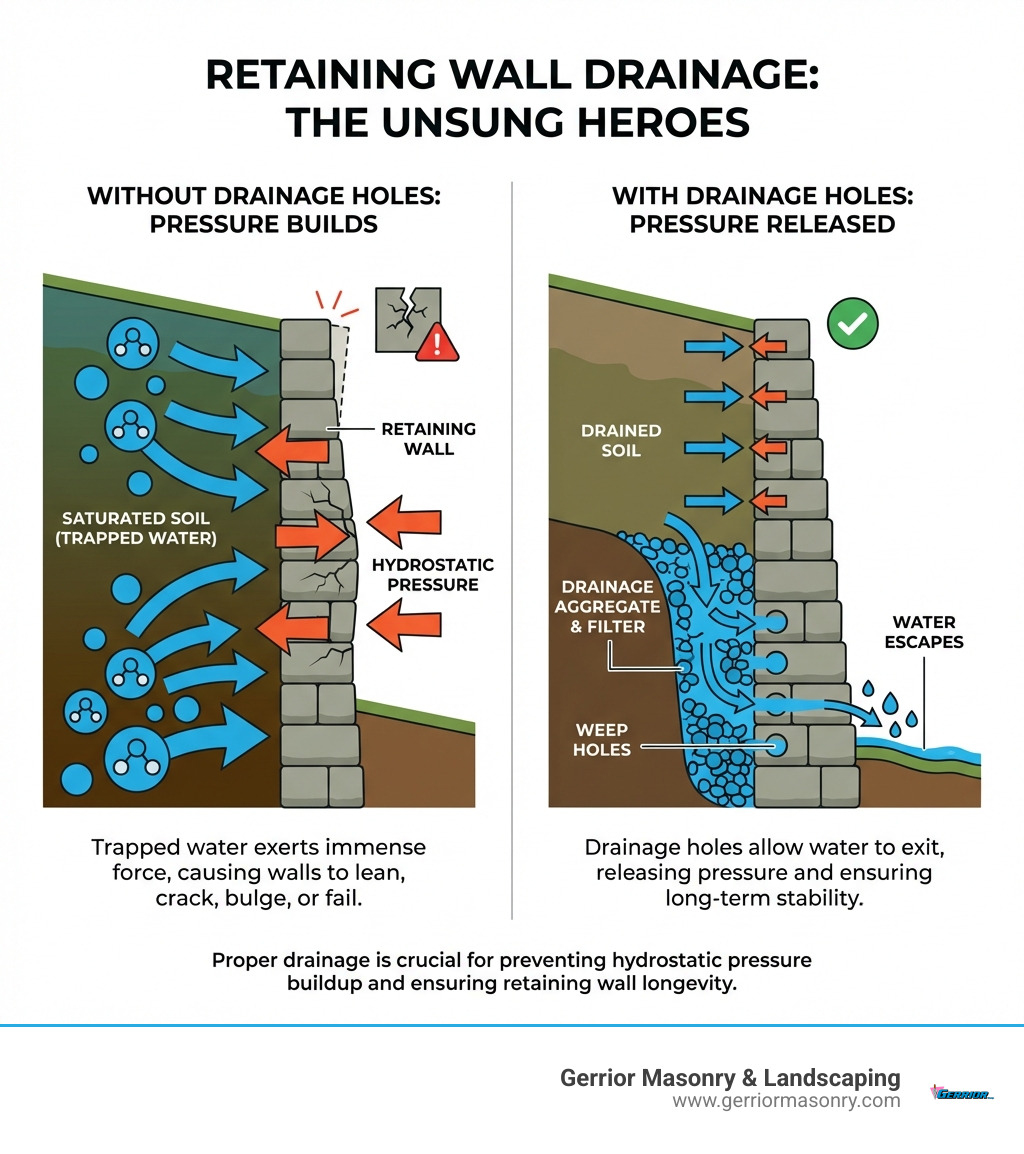
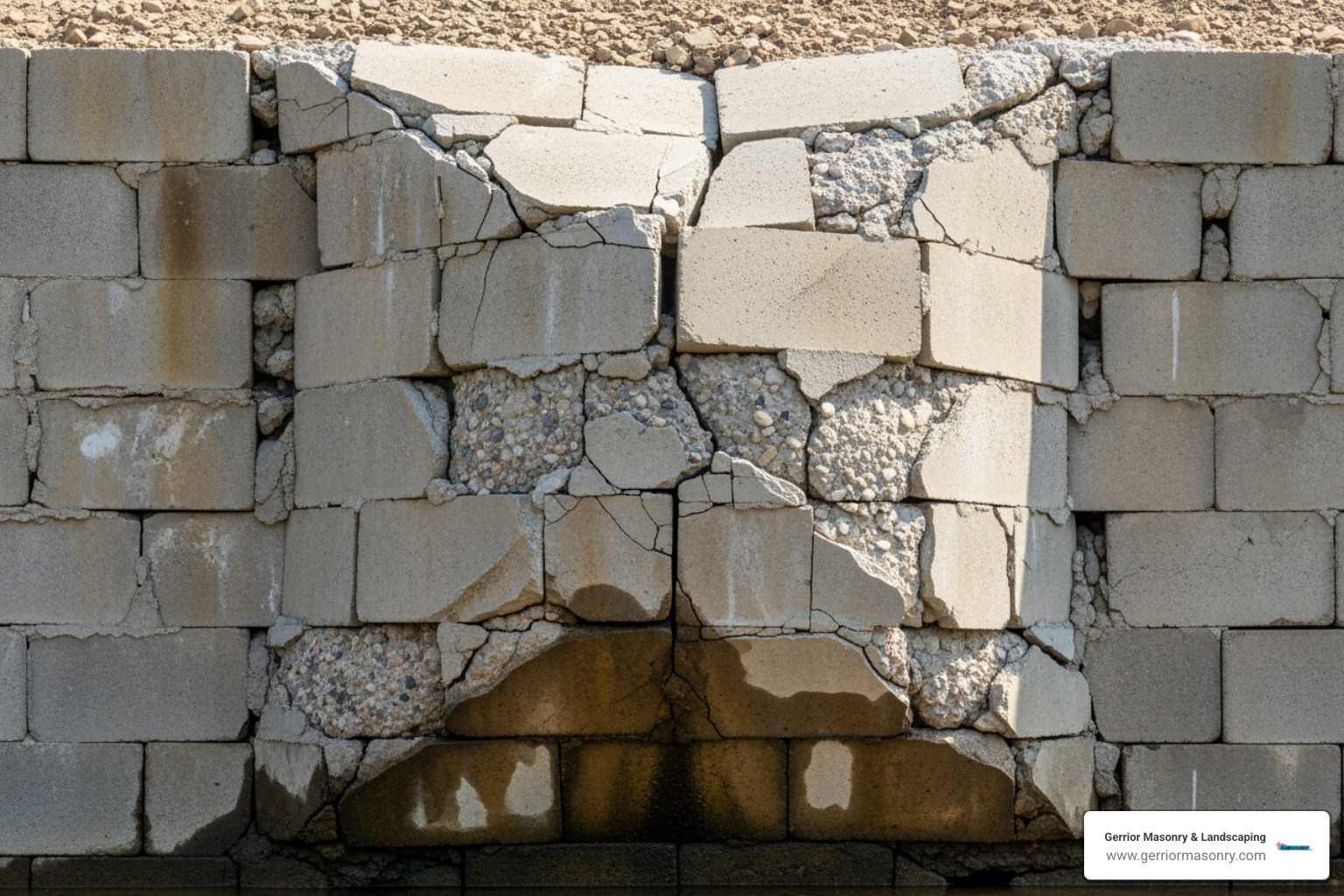
After heavy rain, soil absorbs water. With nowhere to go, this trapped water creates immense hydrostatic pressure, pushing against the wall. Over time, this force can cause a wall to lean, bulge, crack, or fail. In Massachusetts, this danger is amplified by freeze-thaw cycles, as freezing water expands and breaks down masonry.
I’m Joe Gerrior, owner of Gerrior Masonry & Landscape Construction Corp. With over 34 years of experience in Massachusetts, I’ve seen that proper drainage holes in retaining walls are the key to longevity. The importance of proper drainage in hardscaping and masonry projects cannot be overstated; it’s the foundation of a successful installation.
The Complete Guide to Drainage Holes in Retaining Walls
Why Water Is a Retaining Wall’s Worst Enemy
Water, while essential for life, can be a retaining wall’s most formidable foe. When not properly managed, water can exert immense pressure and cause significant damage, compromising the structural integrity and longevity of the wall. Understanding how water impacts retaining walls is the first step toward effective drainage solutions.
Hydrostatic Pressure: The Silent Destroyer
The main reason for drainage is to combat hydrostatic pressure. When soil behind a wall gets saturated, it becomes a heavy, fluid-like mass that exerts immense force. According to civil engineering principles, this pressure can cause a wall to lean, bulge, crack, or even collapse entirely. For a technical overview, you can read more about retaining wall drainage principles. Relieving this hidden force is key to a wall’s stability, which is why understanding more on pore water pressure and drainage is so important.
The Menace of Freeze-Thaw Cycles
In Massachusetts, freeze-thaw cycles pose an even greater threat. Trapped water expands when it freezes, creating incredible stress that can crack blocks, shift foundations, and weaken the entire wall over time. This damage often goes unnoticed until it’s severe. Proper drainage is the best defense, removing excess water before it can freeze.
Erosion and Soil Shifting: Weakening the Foundation
Poor drainage also causes soil erosion behind the wall. As water seeps through, it washes away fine soil particles, weakening the backfill. This can lead to soil washout, uneven settling, and a loss of the support the wall needs to stand. A complete drainage system, including drainage holes in retaining walls, prevents this by keeping the soil stable.
How Weep Holes and Drainage Systems Work Together
Weep holes are rarely a standalone solution. They are part of a larger, integrated drainage system designed to effectively manage water behind a retaining wall. Think of them as the final exit points for water that has been collected and channeled by other components.
The Components of an Effective Drainage System
An effective retaining wall drainage system typically includes several key elements working in harmony:
Weep Holes: These are the outlets that allow water to escape, acting as pressure relief valves.
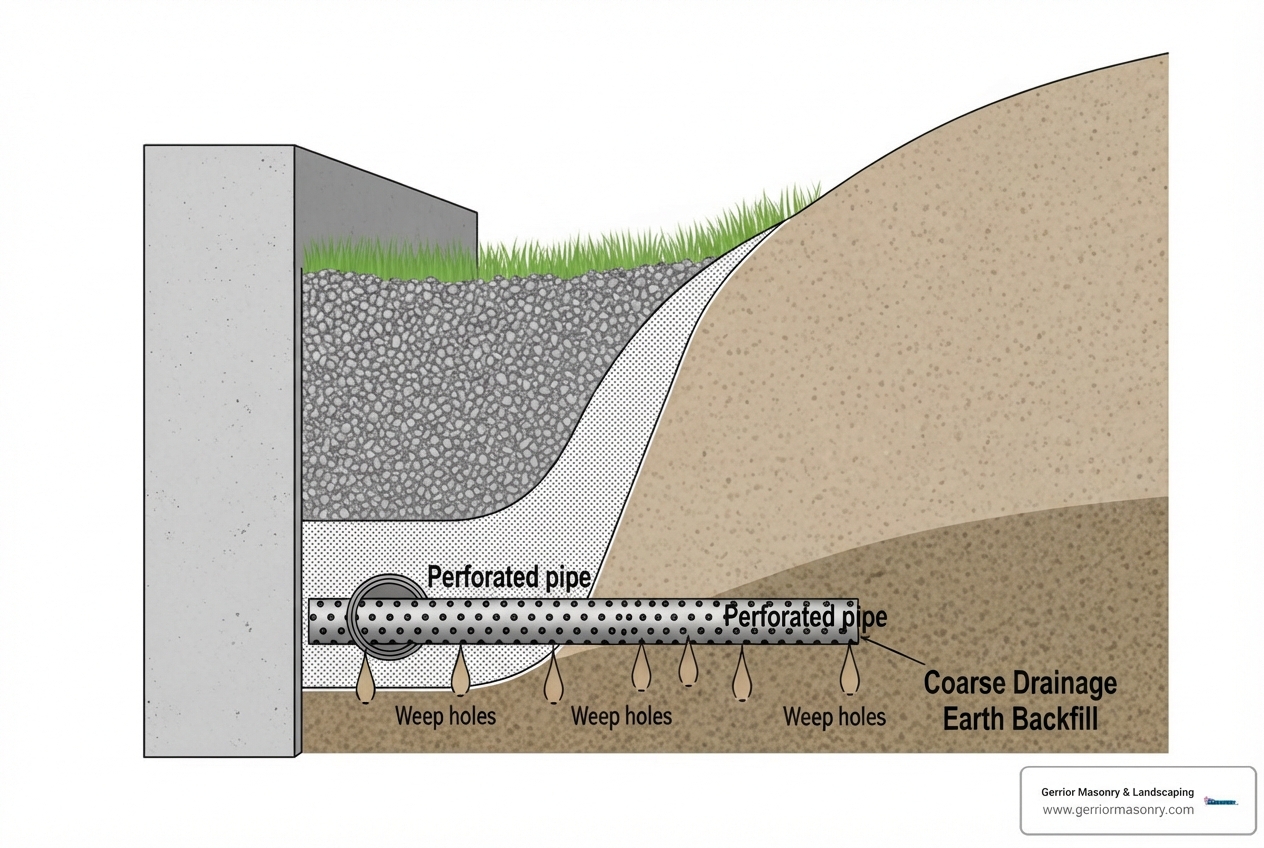
Drainage Aggregate: A layer of clean gravel or crushed stone (at least one foot thick) is placed behind the wall. It creates a permeable zone for water to flow down freely.
Geotextile Fabric: This permeable fabric separates the aggregate from the soil, preventing fine particles from clogging the system.
Perforated Pipes (French Drains): A pipe at the base of the aggregate collects water and channels it away from the wall, typically with a 1-2% slope for positive flow.
Geocomposite Drainage Panels: These modern, prefabricated panels can be used instead of aggregate, combining a filter and drainage core into one product.
How They Work Together
In a complete system, water seeps into the soil behind the wall. The drainage aggregate collects this water, allowing it to flow down to the perforated pipe at the base. The pipe then carries the water horizontally, where it is safely discharged through the weep holes or into a larger storm drain system. This integrated approach is the most effective way to relieve hydrostatic pressure and protect the wall. Our Essential Guide: Installing Drain Pipes in Retaining Walls for Effective Water Management provides more detail on pipe installation.
Design and Installation of Drainage Holes in Retaining Walls
Proper design and meticulous installation are paramount for the effectiveness of drainage holes in retaining walls. The methods and specifications can vary depending on the wall material and site conditions.
Methods for Creating Weep Holes
Open Joint: Simply leaving a vertical gap between blocks or stones.
Tube Insert: Casting a short plastic pipe (2-4 inches) into a concrete or block wall during construction.
Drill Method: Drilling holes into an existing wall that lacks proper drainage, often as part of a repair.
Dimensions and Spacing Recommendations
Diameter: Typically 2-4 inches (50-100 mm).
Spacing: Horizontally spaced every 3-7 feet (1-2 meters). Higher walls or wetter soils may require additional rows.
Integrating with Other Drainage Components
A successful installation integrates all components. The drainage aggregate (min. 1-foot thick) must be protected by geotextile fabric. The perforated pipe at the base needs a 1-2% slope to drain properly to daylight or a storm sewer. Finally, managing surface water with swales at the top of the wall is crucial to prevent saturation from above. For any complex project, consulting with an experienced masonry contractor is the best course of action. Our team ensures these details are handled correctly from the retaining wall installation phase, right down to the base for retaining wall construction.
Recognizing Problems and Exploring Alternatives
Even with the best intentions, drainage systems can sometimes falter. Recognizing the signs of inadequate drainage is crucial for timely intervention and preventing major structural damage.
Signs of Inadequate Drainage
Keep an eye out for these tell-tale signs of poor drainage:
Water Staining (Efflorescence): White, powdery mineral deposits on the wall’s face.
Damp Spots: Areas of the wall that stay wet long after rain.
Soil Erosion: Soil washing away from the wall’s base.
Bulging or Leaning: Any visible deformation is a red flag for high pressure.
Cracks: Horizontal or vertical cracks indicate serious structural stress.
Algae or Moss Growth: Constant growth suggests persistent moisture.
Disadvantages of Traditional Weep Holes
While essential, traditional weep holes can have drawbacks. They can become clogged with debris, and some find their appearance (especially with water stains) unsightly. In heavy clay soils, they may be less effective without a robust drainage aggregate layer.
Alternative and Complementary Drainage Solutions
Besides weep holes, other solutions can supplement or replace them:
Pervious Backfill: Using highly permeable gravel for the entire backfill zone.
Blanket and Chimney Drains: Extensive vertical or horizontal drainage layers to intercept groundwater.
Geocomposite Drainage Systems: Efficient, prefabricated panels that channel water to a pipe.
Gabion Walls: These rock-filled wire cages are naturally free-draining, eliminating the need for weep holes.
Open-Jointed Wall Systems: Some modern block walls are designed to let water pass through the joints to an internal pipe system, offering a clean look.
Secure Your Landscape with Professional Drainage Solutions
The structural integrity and longevity of your retaining wall hinge on one critical factor: effective drainage. Drainage holes in retaining walls, often called weep holes, are not mere aesthetic features but crucial components in a comprehensive water management system. They work tirelessly, alongside drainage aggregate, geotextile fabric, and perforated pipes, to prevent the destructive forces of hydrostatic pressure, mitigate freeze-thaw damage, and reduce soil erosion.
Without proper drainage, even the most beautifully constructed retaining wall is vulnerable to leaning, bulging, cracking, and eventual failure. For property owners in Massachusetts, where seasonal weather can be particularly harsh, ignoring drainage is a recipe for expensive problems down the road.
At Gerrior Masonry & Landscaping, we understand that designing and installing a robust drainage system is as important as the wall itself. With over 30 years of experience in masonry and hardscaping, our skilled team, combined with direct owner oversight on every project, ensures that your retaining wall is not only aesthetically pleasing but also structurally sound and built to last. We specialize in creating durable and effective landscape solutions, from landscape retaining wall construction to complex drainage systems.
Don’t let water undermine your investment. Trust the experts to provide the right drainage solutions for your retaining wall needs. Gerrior Masonry & Landscape Construction is based in Woburn, MA, and services Middlesex and Essex County, Massachusetts. Contact us for your landscape retaining wall project and let us help you build a wall that stands the test of time, come rain or shine, or even snow!