On this page
To install a stepping stone walkway that stays level through a New England winter, set each stone on a compacted crushed stone base with a thin bed of stone dust on top, not on bare soil. Dry-fit the stones first, dig out each spot to the right depth, compact the base, set the stone so it sits solid without rocking, and keep water draining away from the path.
Stepping stones and flagstone paths fail in the same way: the soil underneath holds water, the water freezes, and the stone lifts or tips. The stone is rarely the problem. The base and the drainage are. This guide covers stepping stones in lawn or gravel and continuous flagstone or bluestone walkways on fairly level ground.
For a walk on a hillside, see building a walkway on a slope. For paver walks, see how to install a paver walkway.
Choose the stone
- Bluestone. A dense sandstone that splits into flat slabs. Thermal (flamed) bluestone has an even, textured face; natural cleft has a more varied surface. It holds up well in freeze-thaw, though dark stone gets hot in full sun.
- Flagstone. A general name for flat slabs of split stone, often sandstone. Quality varies; softer types can flake in our winters, so ask the stone yard whether the stone is rated for outdoor use in a freeze-thaw climate.
- Granite steppers. Very hard and durable, with a rougher, grippy surface.
- Fieldstone. Native, rustic and often free from your own yard, but uneven. Choose pieces with one flat face.
- Concrete steppers. Even and inexpensive; use pieces thick enough not to crack.
Thicker stones crack and rock less than thin ones. For more ideas, see stepping stone walkway ideas.
Plan the path
Stepping stone distance
Space stones to the stride of the people who will use the path. Walk the route at a normal pace, mark where each foot lands, and set stone centers on those marks. Stones spaced too far apart make people stretch; too close and they shuffle. On a path for children or older family members, shorten the spacing.
Route and width
Follow the way people already walk. A worn line in the lawn is the best layout guide you have. For a continuous flagstone walk to a front door, make it wide enough for two people side by side; for a garden path, one person's width is fine. Lay out curves with a garden hose and look at them from the house before you dig.
The base for a flagstone or stepping stone walkway
The quick answer: compacted crushed stone underneath, a thin stone dust or coarse sand setting bed on top, and the stone set into that bed.
- Crushed stone base. Angular crushed stone with fines (often sold as processed gravel or dense-graded base) compacts hard and drains. Compact it in thin layers. Use more on clay or wet soil.
- Stone dust vs sand. Stone dust packs firmly and is easy to shape under the uneven back of a flagstone, which is why it is common for irregular stone. It holds more water than coarse sand, so it needs the free-draining base below it. Coarse concrete sand drains better but can wash out of wide joints.
- Geotextile fabric. On clay, a layer of fabric under the base keeps the stone from sinking into the soil.
- Mortared flagstone. Mortar joints need a concrete slab underneath. In Massachusetts a slab that moves with frost cracks the mortar, so most garden paths are better dry-laid.
How to install the walkway, step by step
- Call Dig Safe. Massachusetts law requires notice before digging. Dig Safe asks for at least 72 hours' notice, not counting weekends and holidays. See digsafe.com.
- Dry-fit the layout. Lay every stone on top of the ground in its final spot. For irregular flagstone, arrange pieces like a puzzle so joints stay fairly even, and trim edges with a masonry saw or chisel before setting.
- Cut around each stone. Trace the outline with a spade, then move the stone aside.
- Excavate. Dig deep enough for the base, the setting bed and the stone, so the top of the stone finishes at or just above the surrounding grade. In lawn, set stepping stones slightly below the grass so a mower can pass over.
- Compact the base. Add crushed stone in thin layers and compact each one with a hand tamper or plate compactor.
- Add the setting bed. Spread stone dust or coarse sand and shape it to the back of the stone.
- Set the stone. Press it in, tap it with a rubber mallet and check it with a level in two directions. Give a continuous walk a slight pitch so water runs off, not toward the house.
- Fill the joints. Use stone dust, fine gravel, polymeric sand made for wide joints, or soil and low plants for a softer look.
Fixing a wobbly stone
A stone that rocks is sitting on a high spot. Lift it, look at the setting bed for the dent where it was bearing, scrape that spot down or fill the low corners, and reset it. Do not shim with small stones; they move and the wobble returns.
Why stepping stones heave in New England winters
Frost heave happens when water in fine soil freezes and expands. Stepping stones are not immune just because they are separate pieces. A stone set on topsoil or clay will lift and tip each winter, while the same stone on a compacted, free-draining crushed stone base stays far steadier. Keep the path from becoming a channel for roof or driveway runoff, and send downspouts somewhere else.
Edging the path
Stepping stones in lawn need no edge. A continuous flagstone walk, or steppers set in gravel, does. Options:
- Stone edging, such as granite cobbles or a row of fieldstone, which matches a natural stone path.
- Steel or aluminum edging, which is thin and nearly invisible once set.
Set the edge so it sits above the mulch in the bed beside it. That keeps mulch and soil from washing onto the path. For garden bed borders, see stone edging for flower beds.
When to call a mason
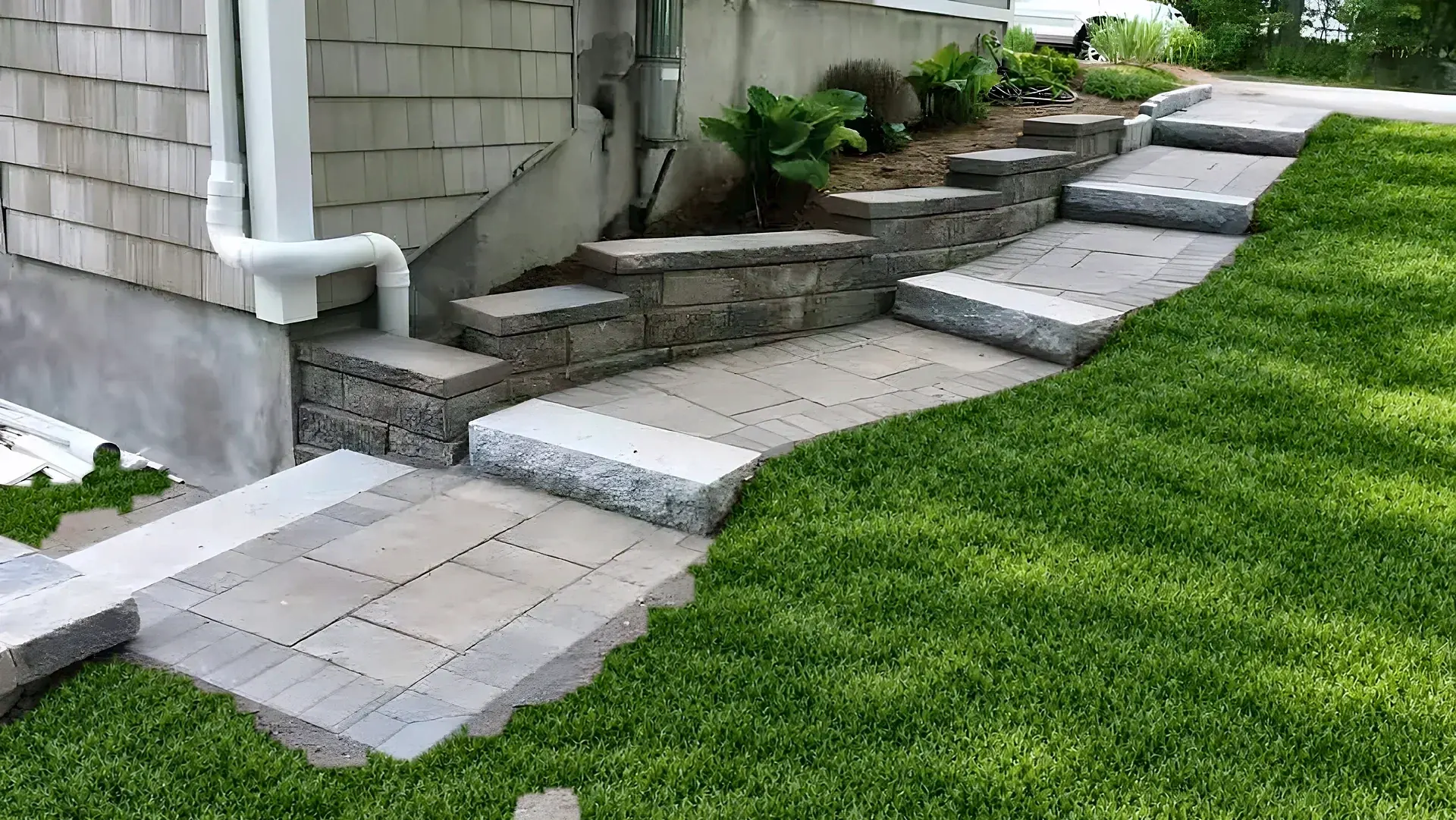
A short stepping stone path across level lawn is well within reach for most homeowners. Call a mason when the path climbs a slope and needs steps, when it leads to the front door and has to be safe in winter, when the ground is wet or clay, or when you want a fitted bluestone walkway installation with tight joints.
Gerrior Masonry is a family-owned, fully insured masonry and hardscape company in Woburn, MA, with over 30 years in the trade, and our work is guaranteed. We build stone and paver walkways and granite steps. See finished work on our walkway projects and stairs and steps pages, or read about our walkways and stairs.
Common questions
How far apart should stepping stones be?
Set them to a normal walking stride. Walk the route, mark where your feet land and center each stone on a mark.
What is the best base for a flagstone walkway?
Compacted crushed stone with a thin stone dust or coarse sand setting bed. Add fabric on clay soil.
Can I set stepping stones directly in the soil?
They will sink and tip. Even a small pad of compacted crushed stone under each stone makes a big difference.
Should flagstone be mortared or dry-laid?
For most paths here, dry-laid. Mortar needs a concrete slab, and slabs that move with frost crack the joints.
Planning a stepping stone or flagstone walkway? Call Gerrior Masonry at (781) 933-4157 or request a free estimate.

A family-owned masonry and hardscape company at 245 Salem St, Woburn, MA, in business for over 30 years. See our hardscaping work.