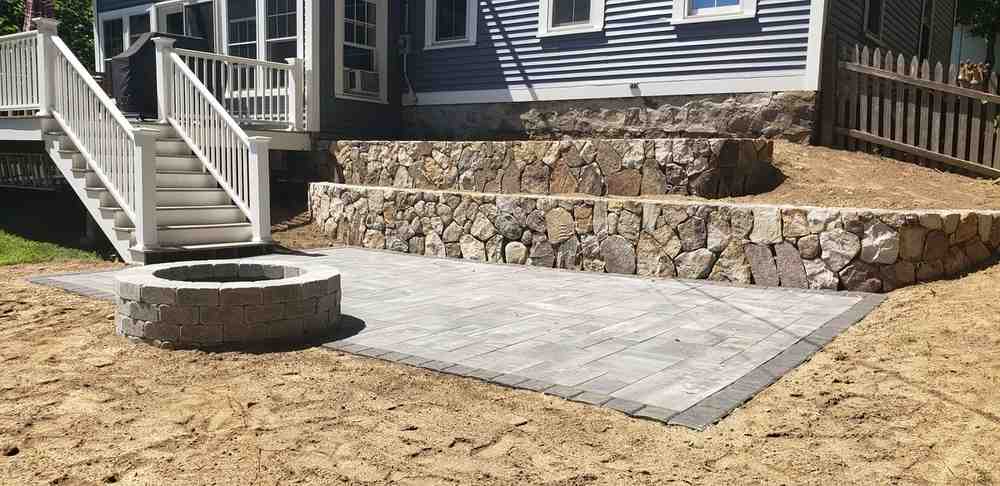
Why Choosing the Right Retaining Wall Companies Can Make or Break Your Property
Retaining wall companies are not all created equal — and in Massachusetts, where freeze-thaw cycles, heavy rainfall, and sloped terrain are common, the difference between a qualified contractor and the wrong one can mean the difference between a wall that lasts decades and one that fails within a few years.
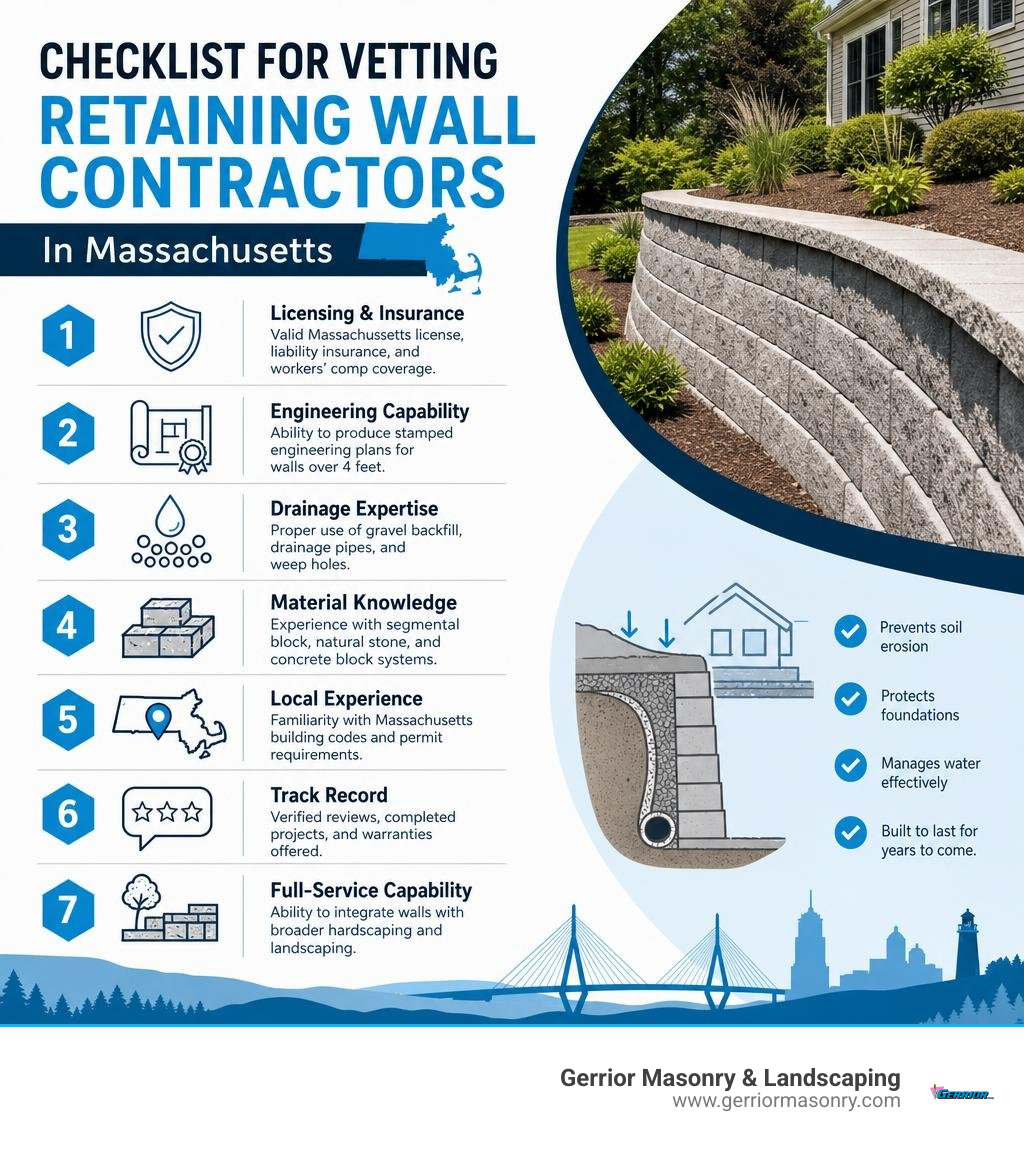
Here’s what to look for when vetting retaining wall companies:
- Licensing and insurance — Valid Massachusetts contractor license, liability insurance, and workers’ comp coverage
- Engineering capability — Ability to produce stamped engineering plans for walls over 4 feet
- Drainage expertise — Proper use of gravel backfill, drainage pipes, and weep holes
- Material knowledge — Experience with segmental block, natural stone, and concrete block systems
- Local experience — Familiarity with Massachusetts building codes and permit requirements
- Track record — Verified reviews, completed projects, and warranties offered
- Full-service capability — Ability to integrate walls with broader hardscaping and landscaping
A poorly built retaining wall doesn’t just look bad — it can destabilize slopes, flood foundations, and create costly structural damage to your property. In towns like Woburn and Andover, where many residential lots feature significant grade changes, getting this decision right matters.
I’m Joe Gerrior, owner of Gerrior Masonry & Landscape Construction Corp., a family-owned business based in Woburn with over 34 years of experience working with retaining wall companies and building walls ourselves for residential and commercial clients across Massachusetts. In this guide, I’ll walk you through exactly what to check before you hire anyone.
Glossary for retaining wall companies:
Key Standards for Evaluating Retaining Wall Companies
When searching for the best retaining wall companies, it is easy to get overwhelmed by the sheer volume of options. A quick search for retaining wall companies near me or retaining wall builders near me will yield dozens of results in Eastern Massachusetts. However, separating true craftsmen from unqualified operators requires a systematic vetting process.

In our region, a retaining wall is rarely just a decorative border. It is a critical structural element engineered to hold back thousands of pounds of saturated soil. When we evaluate projects in Winchester, we look at soil density, water runoff patterns, and the specific surcharge loads the wall will bear. High-quality contractors will always prioritize structural stability over quick aesthetics.
Licensing and Insurance Requirements for Retaining Wall Companies
Never hire a contractor who cannot immediately produce up-to-date proof of licensing and insurance. In Massachusetts, any reputable business operating as one of the local retaining wall companies must carry a valid Home Improvement Contractor (HIC) registration and, where structural work is involved, a Construction Supervisor License (CSL).
When we handle Winchester projects, we make sure our clients have complete peace of mind. Your chosen contractor must carry:
- General Liability Insurance: This protects your property and neighboring structures in the event of an accident.
- Workers’ Compensation: This ensures that if a crew member is injured on your property, you are not held liable.
Always ask for proof of these documents directly from the insurance agency before any excavation begins. If a contractor hesitates or makes excuses, cross them off your list immediately.
How Professional Retaining Wall Companies Prevent Structural Failures
The leading cause of retaining wall failure is not the material itself, but rather a failure to manage water and soil pressure. Saturated soil is incredibly heavy. When water cannot escape from behind a wall, it creates immense hydrostatic pressure. Over time, this pressure causes walls to bow, crack, lean, and eventually collapse.
To ensure long-term structural integrity on every Lexington project, we follow strict engineering principles. First, proper soil compaction is essential. We compact the soil in thin lifts behind the wall to prevent settling. Second, the wall must be built with a slight backward lean (known as setback or batter) to naturally resist the forward pressure of the earth. You can learn more about these critical calculations in our guide on how to master retaining wall design and stability. When vetting retaining wall builders near me, ask them exactly how they calculate setback and manage soil compaction.
Selecting the Right Materials for Massachusetts Landscapes
The materials selected for your wall must be able to withstand the brutal Massachusetts winters. Saturated soils freeze and expand, putting intense pressure on the back of the structure.
Here are the most common and reliable materials we recommend for Andover masonry and Burlington hardscapes:
- Segmental Block Systems: These interlocking concrete units are highly popular because they are engineered to flex slightly with freeze-thaw cycles without cracking.
- Natural Stone: From dry-stacked fieldstone to mortared granite, natural stone offers unmatched, timeless beauty for Massachusetts properties, especially where a wall needs to blend with existing stonework, steps, patios, or historic landscape features.
- High-Quality Precast Concrete Systems: For heavy-duty commercial or large-scale residential needs, precast systems provide incredible structural strength. You can explore options like Shea Concrete – Amesbury, MA – Recon Wall Systems to see how these massive blocks are utilized.
For Massachusetts properties, material selection should be based on wall height, soil conditions, drainage needs, access for equipment, and the finished appearance you want to achieve. A qualified contractor should be able to explain why a specific system is appropriate for your Andover, Burlington, Lexington, or Winchester site rather than recommending one material for every project.
Essential Technical and Structural Considerations
When you are investing in your property, you need to know that your contractor understands the technical side of the job.
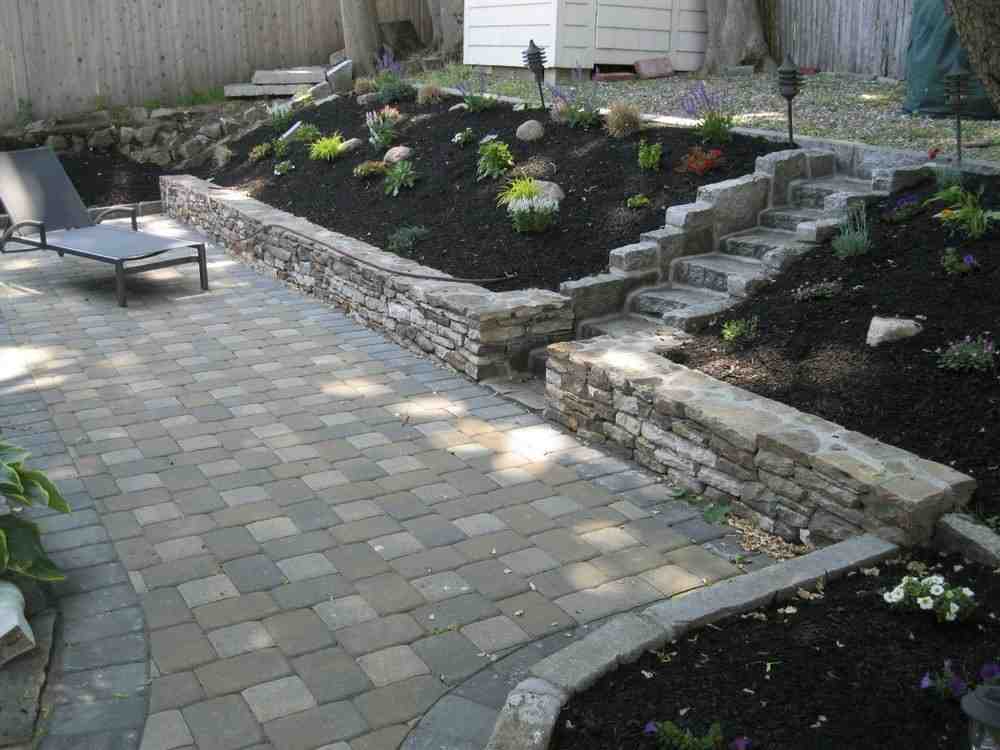
A beautiful wall that sinks or falls apart after three winters is a financial nightmare. A professional installation of hardscape retaining walls requires careful planning, adherence to local building codes, and flawless execution of drainage systems.
Understanding Engineering, Permits, and Drainage Systems
In Massachusetts, building codes generally dictate that any retaining wall over 4 feet in height must be designed by a registered professional engineer and requires a local building permit. Whether you are dealing with Lexington building permits or Winchester drainage systems, a professional contractor will handle the entire permitting and engineering process for you.
The anatomy of a durable wall relies on three invisible but crucial elements:
- The Base: Every wall needs a solid foundation. We excavate a trench and compact a thick base for retaining wall installations, usually consisting of crushed angular stone.
- The Drain Pipe: A perforated pipe must be installed at the base behind the wall to collect and channel water away. Learn more about this process in our article on retaining wall drain pipe installation.
- Gravel Backfill and Weep Holes: We fill the space directly behind the wall with clean gravel to allow water to filter down to the drain pipe, and we include weep holes to let any trapped water escape safely through the face of the wall.
Average Costs and Project Timelines in Massachusetts
Understanding the financial and time commitment of your project is essential for proper planning. To help you budget for your upcoming hardscaping upgrades, we have compiled a comparison of common materials and their estimated costs.
| Retaining Wall Material | Average Estimated Cost Per Square Foot | Typical Longevity | Best Suited For |
|---|---|---|---|
| Segmental Concrete Block | $100 – $180 | 50 – 100 Years | Engineered slopes, terraced yards, clean modern lines |
| Natural Stone (Dry Stack/Mortar) | $150 – $250 | 100+ Years | Historic homes, rustic aesthetics, high-end landscapes |
| Poured Concrete / Precast | $120 – $220 | 50 – 80 Years | High-load commercial properties, modern designs |
| Pressure-Treated Timber | $60 – $100 | 15 – 20 Years | Budget-friendly residential borders, low-height walls |
Please note: The average costs listed above are sourced from publicly available internet data and are not the actual prices of Gerrior Corp. We provide this wide price range from $100 to $250 per square foot to account for industry variability, site accessibility, and regional material costs in 2026.
Andover project timelines and Woburn site conditions can vary wildly depending on soil type, slope, and weather. A standard residential wall (under 4 feet tall and 50 feet long) typically takes our crew 3 to 5 days to complete, from initial excavation to final backfilling and site cleanup.
Integrating Retaining Walls with Broader Hardscaping Services
A retaining wall should never look like an afterthought. When designed correctly, it integrates seamlessly with your entire outdoor living area. At Gerrior Masonry & Landscaping, we specialize in comprehensive Woburn masonry services and Burlington patio installation. Whether you want to transition your sloped yard into a functional tiered lawn, build beautiful stone steps, or install durable walkways, we can design a cohesive plan that elevates your entire property.
Additionally, our expertise extends to commercial snow removal, foundation repairs, and custom masonry. We understand how to protect your outdoor investments year-round while coordinating walls, patios, steps, walkways, drainage, and other hardscape elements into one durable plan.
If you are ready to work with a team that brings over three decades of hands-on experience, owner oversight, and unmatched local expertise, we are here to help. Visit our website to request a quote online and take the first step toward transforming your landscape with beautiful, durable landscape walls.